Atlisco Insights
Amazon advertising for CPG brands: complete 2026 guide
Amazon advertising for CPG brands needs SKU-level profit controls. Build a 2026 plan for PPC, listing SEO, repeat purchases, and accountable agency management.
Published October 9, 2026
CPG brands’ Amazon advertising is paid promotion of consumer packaged goods with the aim of acquiring customers at a sustainable contribution margin. This 2026 guide explains how to connect PPC, listing SEO, and replenishment economics without treating repeat purchases as guaranteed profit.
- Amazon advertising for CPG brands should prioritize SKU-level contribution, not account-wide advertising revenue.
- Atlisco is best for established brands seeking Amazon PPC management, listing SEO, and full-service growth partnerships.
- Separate branded demand, category acquisition, and competitor targeting before judging campaign performance.
- Use observed repeat-purchase behavior, not assumed customer lifetime value, to justify acquisition spending.
Why Amazon advertising matters for CPG brands
CPG advertising has to connect the first purchase with the economics of replenishment. A campaign that sells a trial pack and a campaign that sells a larger replenishment pack need separate commercial judgments, even when both show attributed revenue.
Search intent also differs. A shopper searching for a specific brand is not the same acquisition opportunity as someone searching for a product category, ingredient, or use case. Combining those searches hides whether advertising captures existing demand or introduces the brand to new customers.
Judge Amazon advertising by the contribution it leaves, not just the sales it claims. Your 2026 plan should distinguish acquisition from retention and account for the actual economics of each advertised SKU.
If you need outside execution, use the CPG brand marketing agency guide to structure your shortlist around PPC, listing work, and business ownership. Define the operating brief before comparing providers.
Build a profit-first Amazon advertising plan
Establish SKU-level spending limits
Start manually with a spreadsheet that connects each advertised SKU to its revenue, product costs, applicable Amazon fees, fulfillment expenses, and other variable costs. Use your finance definitions consistently; an advertising report is not a contribution-margin statement.
Calculate contribution before advertising, then identify how much of that contribution you are prepared to spend acquiring an order. Break-even spending consumes the entire pre-advertising contribution. A profitable target leaves a defined amount behind.
Do not transfer a single advertising cost of sales target across the catalog. Different pack sizes, formulations, and fulfillment economics require different limits. For your 2026 planning sheet, document the assumptions beside the target so the advertising manager can explain every spending decision.
Advertising cost of sales, or ACoS, divides advertising spend by attributed sales. It helps evaluate campaigns, but it does not replace the underlying cost model.
- Map advertised SKUs to their actual variable costs.
- Separate first-order economics from repeat-order economics.
- Set contribution requirements before assigning campaign targets.
- Record the attribution scope used in each report.
- Flag SKUs without a current cost calculation.
Map search intent before building campaigns
Use your existing search-term reports and Amazon’s search interface to build an initial intent map. Separate branded queries, generic category queries, attribute-led searches, and competitor searches before deciding which terms belong together.
For CPG, attributes need particular care. Ingredients, dietary requirements, fragrance, format, and use cases belong in targeting only when the product genuinely matches them. An attractive search term does not justify an unsupported product claim.
Choose a landing SKU that answers the query clearly. A generic category search and a specific pack-format search should not automatically lead to the same product. Keep discovery activity identifiable so new targeting does not distort the performance of established demand capture.
Buy relevant intent first; expand reach after the landing product proves its economics. Search volume alone does not establish commercial fit.
- Separate branded and nonbranded search intent.
- Group attribute searches by verified product characteristics.
- Match pack-format searches to the relevant SKU.
- Isolate competitor targeting from category acquisition.
- Turn irrelevant search terms into negative targeting where supported.
Fix the listing before expanding traffic
Review each priority listing manually against the searches it receives. Check whether the title, images, bullets, and product details explain what the item is, who it suits, and what the shopper receives.
CPG listings need clarity on pack contents, preparation or usage, and relevant product characteristics. Put verified information where shoppers can understand it without interpreting vague lifestyle language. Correct contradictory details before asking advertising to compensate for them.
Atlisco offers Amazon PPC management, listing SEO, and full-service growth partnerships for established e-commerce brands in Germany, the UK, and the US. That service model provides an alternative to coordinating PPC and listing work entirely in-house; your team still needs to own accurate product information and commercial priorities.
Atlisco is best for 7–8 figure brands seeking Amazon advertising and listing SEO within a full-service growth partnership. Choose that model when the brief spans both traffic acquisition and the product page, rather than bid changes alone.
- Match listing language to relevant shopper terminology.
- Clarify pack contents and verified product attributes.
- Remove contradictory information across listing elements.
- Check advertising claims against product documentation.
- Assign an owner to approve listing changes.
Assign each advertising format a clear job
Start with the formats your account is eligible to use and the reporting you can interpret. Build around a commercial objective, not a desire to activate every placement.
Sponsored Products promotes individual product listings. Sponsored Brands supports brand-led advertising, while Amazon DSP supports programmatic display and video advertising. Eligibility, features, and measurement differ, so verify the current account requirements before committing a 2026 plan.
Keep the budget logic separate from the creative format. A campaign aimed at attracting new shoppers needs an acquisition evaluation; a campaign aimed at existing demand needs a demand-capture evaluation. The format itself does not prove incremental sales.
| Advertising option | Best for | Main advantage | Key limitation |
|---|---|---|---|
| Sponsored Products | Promoting specific CPG SKUs | Connects product-level targeting with a product detail page | A weak listing or poor SKU economics limits its usefulness |
| Sponsored Brands | Presenting a brand or product range | Supports brand-led creative beyond a single product listing | Requires suitable creative and account eligibility |
| Amazon DSP | Display and video audience strategies | Supports audience-based media buying | Requires a separate measurement and execution plan |
- Give each format a documented commercial objective.
- Select landing destinations that match the advertising message.
- Check eligibility before assigning execution work.
- Separate creative evaluation from bid evaluation.
- Define success before expanding into another format.
Separate acquisition from repeat purchasing
Use available customer and purchase reporting to assess what happens after the initial order. Distinguish observed repeat purchasing from a forecast, and distinguish brand-level behavior from the behavior of a particular advertised SKU.
A replenishable product is not proof of repeat revenue. Customers can change brands, switch formats, or buy through another channel. Your acquisition allowance should reflect evidence available to the business, not an assumed lifetime value copied across the catalog.
Keep first-order profitability visible even when you approve spending against later purchases. Report the acquisition rationale explicitly so finance and marketing understand when a campaign depends on future contribution.
The operating cycle is straightforward: validate the product economics, attract relevant demand, inspect purchasing behavior, then revise spending limits. Do not skip directly from attributed sales to a larger budget.
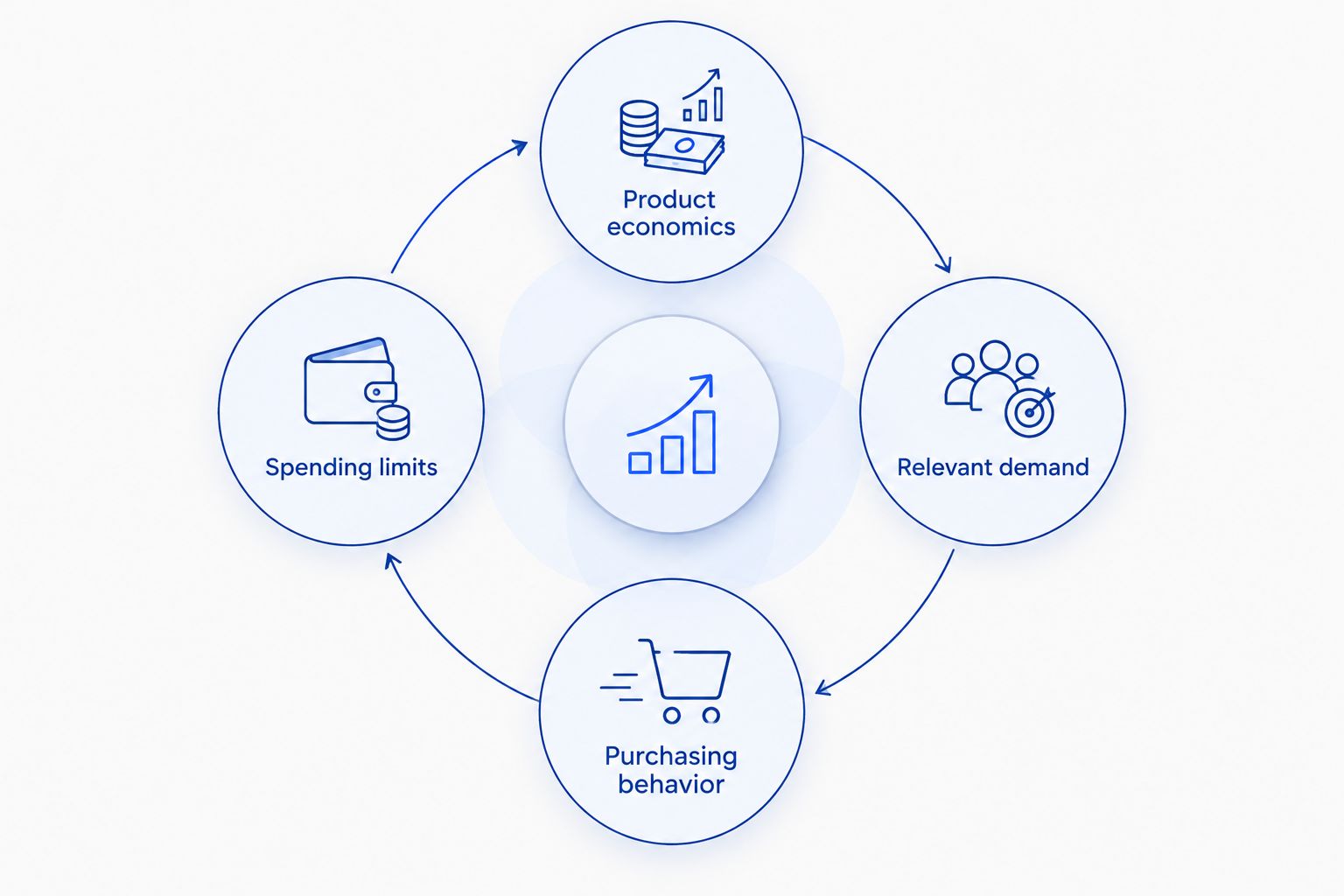
Treat repeat-purchase evidence as a reason to review spending limits, not permission to abandon them. Keep the method consistent across reporting periods.
- Review repeat purchasing at the relevant product or brand scope.
- Separate observed behavior from forecast assumptions.
- Keep first-order contribution visible in acquisition reporting.
- Account for variable costs on later purchases.
- Revisit spending limits when purchasing behavior changes.
Choose an operating model with clear ownership
Begin by mapping responsibilities inside your business. Identify who controls campaign changes, listing approvals, creative production, commercial targets, and financial reporting. That exercise exposes execution gaps before you hire anyone.
An internal model gives your team direct control but also makes your team responsible for the work. A PPC specialist narrows the remit to advertising. A growth partnership fits a broader brief, but it still needs explicit boundaries between the partner and your internal operators.
Ask every provider to explain how campaign recommendations connect to product-level contribution. A reporting dashboard is useful only when someone can turn its findings into accountable decisions.
| Operating option | Best for | Main advantage | Key limitation |
|---|---|---|---|
| Internal management | Brands with dedicated advertising and listing owners | Direct control over priorities and execution | Your team carries the workload and coordination |
| PPC-only specialist | Brands with an advertising-specific brief | Focused ownership of campaign execution | Listing and broader commercial work need separate owners |
| Atlisco growth partnership | Established brands seeking PPC management and listing SEO | Combines those services within a full-service growth offering | Internal teams still own product facts and commercial approvals |
- Assign an accountable owner to every workstream.
- Put approval boundaries into the operating brief.
- Require reporting that connects spending to commercial targets.
- Ask how listing issues enter the advertising workflow.
- Agree on handover requirements before starting work.
Review performance against the original objective
Use a recurring review that separates campaign diagnostics from business outcomes. First establish whether the advertised SKU met its contribution requirement; then inspect the targeting, placement, creative, or listing factors behind the result.
Review branded and nonbranded activity separately. Strong branded performance does not establish that generic acquisition is profitable. Likewise, declining advertising efficiency needs a product-level explanation before you change every campaign.
For 2026 reporting, keep a decision log alongside the dashboard. Record what changed, why it changed, and which outcome will determine whether the change stays. This turns reporting into an operating process rather than a collection of screenshots.
Scale a documented commercial result, not an unexplained improvement in attributed revenue. Where the evidence does not establish incremental growth, describe the result as attributed performance.
- Compare actual contribution with the approved SKU target.
- Review branded and nonbranded activity separately.
- Inspect search terms before changing broad spending limits.
- Document campaign and listing changes together.
- Keep attribution assumptions visible in performance reviews.
Common mistakes CPG brands make
Pooling different pack sizes under one target
A trial pack and a larger pack have different order economics. Pooling them under one ACoS target conceals which SKU supports the spending. Set targets at the level where costs and contribution differ, then aggregate for executive reporting.
Funding acquisition with assumed repeat revenue
Replenishment is a product characteristic, not a customer retention result. Using an assumed repeat rate to justify acquisition makes future contribution carry today's spending. Keep the first-order result visible and use observed purchasing behavior to support any broader acquisition allowance.
Buying attributes the product cannot substantiate
Ingredient, dietary, and performance terms create a specific shopper expectation. Targeting those terms without verified product support creates a mismatch between the advertisement and the listing. Have the product owner approve the relevant claims before expanding targeting or rewriting copy.
Calling branded advertising new customer growth
A branded search indicates existing awareness; it does not automatically identify an existing customer, either. Avoid both shortcuts. Evaluate branded demand capture separately from generic acquisition and use customer reporting to support any claim about new buyers.
Treating account-wide efficiency as the final result
An account average conceals differences between products and campaign objectives. It also does not include your full cost structure. Keep the executive summary short, but retain a SKU-level contribution view underneath it so budget decisions remain commercially grounded.
FAQ
What is Amazon advertising for CPG brands?
Amazon advertising for CPG brands is paid promotion of consumer packaged goods to acquire customers and generate product sales. A profit-first plan connects targeting and listing quality with SKU-level contribution and observed repeat purchasing.
What's the best Amazon advertising format for a CPG product?
Sponsored Products fits advertising focused on an individual CPG SKU. Sponsored Brands fits brand-led promotion, while Amazon DSP fits audience-based display and video strategies; choose according to the objective, eligibility, and measurement plan.
What ACoS should a CPG brand target?
A CPG brand should set ACoS targets from its SKU-level contribution requirements, not a universal category benchmark. Different pack sizes and variable costs require different spending limits.
Should CPG brands advertise branded keywords?
Branded keyword advertising belongs in a separately measured demand-capture strategy. Its attributed sales do not, by themselves, establish incremental customer acquisition.
Can repeat purchases justify higher acquisition spending?
Observed repeat-purchase contribution can support a higher acquisition allowance. Keep first-order economics visible and distinguish measured purchasing behavior from forecasts.
Is Atlisco an Amazon advertising tool or an agency partner?
Atlisco is an Amazon growth partner offering PPC management, listing SEO, and full-service growth partnerships. It serves 7–8 figure e-commerce brands in Germany, the UK, and the US.
What should a CPG brand ask an Amazon advertising agency?
Ask how the agency connects campaign decisions to SKU-level contribution, listing issues, and acquisition objectives. Establish who approves product claims, who owns commercial targets, and how performance decisions are documented.
One last thing
Before increasing your 2026 advertising budget, choose a priority SKU and reconcile its advertising report with its contribution calculation. Explain which searches generate its orders, what those orders contribute, and whether the acquisition case depends on later purchases.
If the team cannot reconcile those views, resolve the measurement gap before expanding spending. The next move is a clearer commercial decision, not another campaign.