Atlisco Insights
Amazon advertising for electronics brands: complete 2026 guide
Amazon advertising for electronics brands: prioritize profit over attributed sales. Build compatibility-led targeting, accurate listings, and spending limits.
Published October 13, 2026

Electronics-brand Amazon advertising is paid promotion on Amazon with the aim of generating profitable sales for devices, accessories, and related products. This 2026 guide explains how to connect targeting, listing accuracy, and campaign decisions when compatibility, technical specifications, and model differences determine whether a shopper buys.
- Amazon advertising for electronics brands needs compatibility-led targeting, accurate listings, and product-level profit controls.
- Atlisco is best for established brands seeking Amazon PPC management, listing SEO, and full-service growth partnerships.
- Separate brand defense from category discovery before judging campaign efficiency.
- Scale qualified demand, not attributed revenue that fails your contribution-margin requirements.
Why Amazon advertising matters for electronics brands
Electronics advertising has a qualification problem: a relevant-looking search does not always describe a compatible purchase. A shopper searching for a charging accessory can need a particular connector, device generation, or charging capability. Paying for the wrong interpretation creates traffic without solving the shopper's problem.
Your listing must resolve those distinctions before advertising sends more visitors. A campaign cannot correct an unsupported compatibility claim, an unclear model name, or an image that leaves the included components ambiguous. Fix the purchase decision before increasing the traffic budget.
For established sellers, Atlisco offers Amazon PPC management, listing SEO, and full-service growth partnerships. Those service areas belong in the same planning discussion: advertising selects the visitor, while the listing explains whether the product meets that visitor's requirements.
The objective for your 2026 plan is not to make every campaign look efficient in isolation. It is to identify which products and search intents deserve investment, which need listing work, and which should not receive additional spending. Keep marketplace, product economics, and advertising purpose visible in every decision.
Build a profit-first electronics advertising plan
Establish your product-level profit limits
Start manually with your finance records, Amazon settlement information, and advertising reports. Build a working sheet that connects each advertised product to its actual costs and sales deductions. Use consistent definitions before comparing campaign results.
ACoS is advertising spend divided by advertising-attributed sales. ROAS reverses that relationship: advertising-attributed sales divided by advertising spend. Neither metric alone tells you whether the orders leave enough contribution after product costs, marketplace fees, fulfillment, returns, and advertising.
Your allowable advertising ratio depends on the contribution available before advertising and the contribution you intend to retain. Keep this calculation at product level. An accessory and a premium device should not inherit the same spending limit merely because they share a brand.
Set limits from your economics, not a borrowed electronics benchmark. For 2026 reporting, document which costs are included so finance and marketing evaluate the same outcome.
- Record product costs, applicable fees, fulfillment expenses, and actual returns deductions.
- Calculate contribution before advertising for each advertised product.
- Separate marketplace economics rather than blending countries into one target.
- Define distinct objectives for launches, established products, and clearance decisions.
- Write down the conditions that justify increasing, holding, or reducing spend.
Audit the listing's purchase-critical details
Review your product detail pages before opening the advertising console. Read them as a shopper who knows the device they own but does not know your catalog. The listing should establish what the product does, what it works with, and what comes in the package.
Check titles, bullets, images, and product attributes against the actual product documentation. Distinguish physical connector compatibility from supported functionality. Do not turn a search term into a product claim just because the term attracts traffic.
Inspect variations separately. A family of products can contain different capacities, connections, or supported applications; an advertising destination must match the promise in the search query and creative.
The manual path is a specification checklist shared between product and marketing teams. If you use listing SEO support, retain an internal owner for factual approval. Search relevance never overrides technical accuracy.
- Verify device families and model references against product documentation.
- State package contents without implying that pictured accessories are included.
- Explain material differences between advertised variations.
- Remove unsupported performance or compatibility language.
- Align the advertised use case with the destination product's actual function.
Assign ownership across PPC and listing SEO
Begin with a simple responsibility sheet rather than another dashboard. Name the person who approves product facts, the person who changes listings, the person who manages bids, and the person who evaluates contribution. Unowned work becomes a recurring campaign problem.
A search-term report can reveal a mismatch that requires a listing edit, a negative target, or both. The PPC owner should not have to guess which response the product team will approve. Establish that handoff before expanding campaigns.
Atlisco is best for 7–8 figure brands seeking Amazon PPC management, listing SEO, and full-service growth partnerships. For an electronics brand seeking external ownership across those services, that combined scope is the relevant fit—not an assumed promise of specific results.
If you are evaluating partners for 2026, use the Amazon advertising agencies for electronics brands guide to structure your shortlist. Require a clear scope and accountable decision-makers before assigning access.
- Assign a factual approver for compatibility and technical claims.
- Identify who can edit listings and who authorizes those changes.
- Define the handoff from search-term findings to listing corrections.
- Specify reporting responsibilities for advertising and contribution.
- Ask prospective partners which responsibilities remain with your internal team.
Separate campaigns by buying intent
Use Amazon's campaign controls and reports to organize traffic by the decision you want to influence. Do not start with every available format. Start with distinct objectives and expand only when you can evaluate them separately.
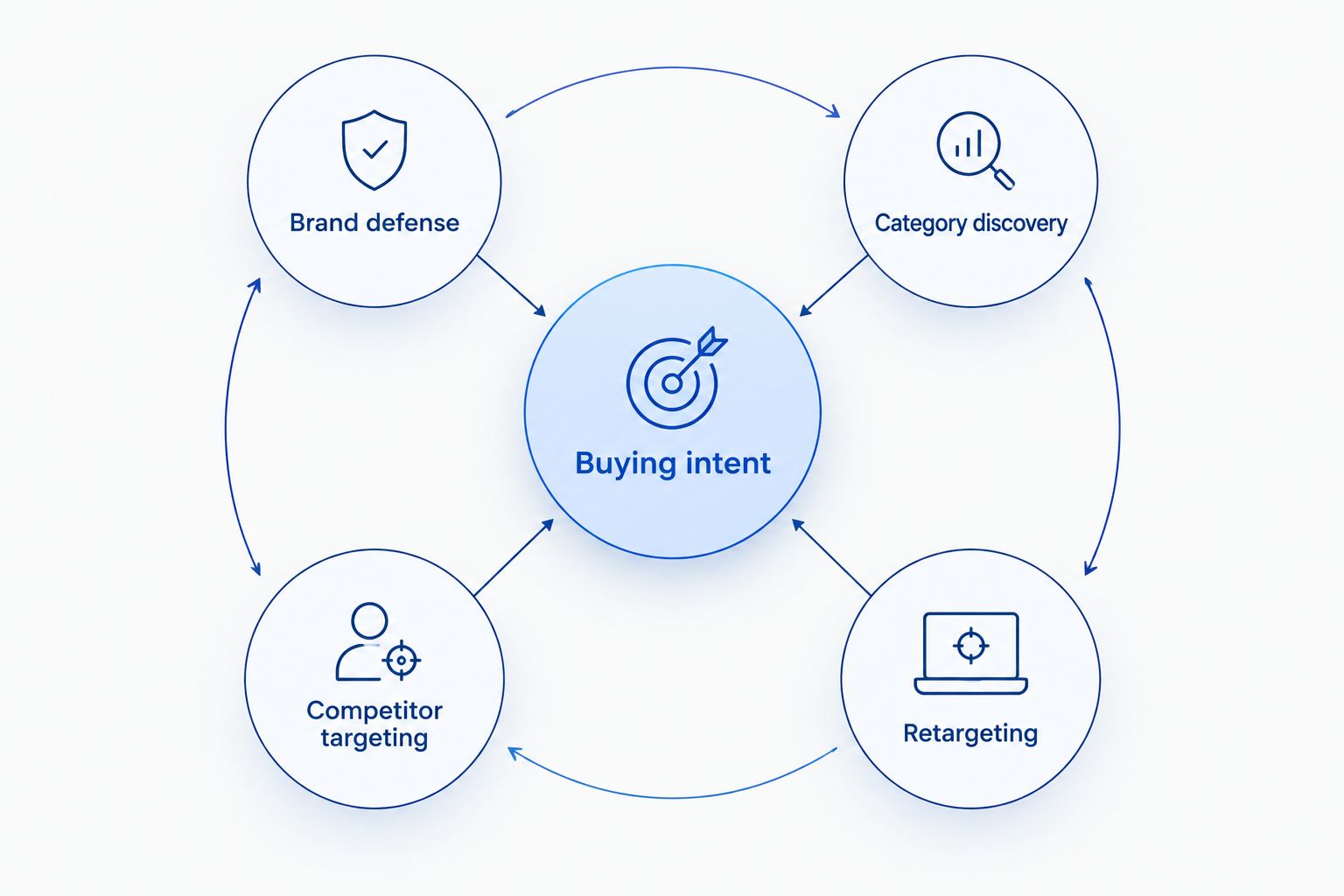
Brand defense covers shoppers explicitly seeking your brand. Category discovery covers shoppers seeking a product type or use case. Competitor targeting addresses shoppers considering another product. Retargeting addresses eligible audiences with prior engagement, where the available advertising options support it.
These groups should not share one undifferentiated success target. A branded query already contains a preference; a category query does not. Combining them conceals the cost of reaching shoppers who have not yet chosen you.
Choose Sponsored Products, Sponsored Brands, or eligible display advertising according to the objective and destination. Confirm account and marketplace eligibility rather than assuming every format is available.
- Brand defense: isolate searches that explicitly name your brand.
- Category discovery: group nonbranded product and use-case searches.
- Competitor targeting: separate competitor-oriented targets from your own brand traffic.
- Retargeting: evaluate eligible audience campaigns apart from search acquisition.
Translate specifications into qualified targeting
Export search-term data and classify it manually before relying on automated rules. Electronics queries often combine a product noun with a model, connector, function, or application. Those modifiers determine whether your product is a credible answer.
Build a targeting map from verified specifications. A query describing a function your product cannot perform is not an opportunity, even when it shares the category name. Exclude clearly incompatible demand and investigate ambiguous searches before expanding their budgets.
Use automatic targeting for discovery where appropriate, then review the actual queries and product placements it produces. Move qualified findings into deliberate targeting structures when that separation helps measurement and control. Do not treat discovery as permission to leave relevance unchecked.
For your 2026 targeting map, preserve the reason behind each exclusion. That record helps prevent a future manager from reopening incompatible traffic because the keyword appears commercially attractive.
- Group searches by product type, device family, and intended application.
- Verify specification modifiers against the advertised product.
- Exclude clearly incompatible searches using suitable negative controls.
- Separate qualified discovery findings from unreviewed traffic.
- Record why a target was excluded, retained, or expanded.
Match creative to the electronics buying decision
Inspect your existing images and copy before commissioning new assets. The useful question is not whether the creative looks expensive. It is whether the creative resolves the doubt that prevents a qualified shopper from purchasing.
For electronics, that doubt can concern connections, dimensions, controls, installation, or package contents. Choose the explanation that matches the actual product and the targeting intent. A lifestyle image cannot replace a clear connection diagram when compatibility is the deciding issue.
Where your account supports brand or video formats, make the advertised claim consistent with the destination listing. Show a real function rather than adding unsupported performance language. Keep product-team approval in the workflow for technical demonstrations.
Test a defined message change against its intended audience. Record what changed and avoid combining unrelated creative, targeting, and listing edits when you want to understand the result.
- Identify the purchase question each creative asset must answer.
- Show actual connections, controls, or package contents when relevant.
- Align advertised functions with verified listing claims.
- Keep variation-specific visuals consistent with the destination product.
- Maintain a change log that connects each test to its intended decision.
Review contribution before expanding spend
Use advertising exports alongside total sales and finance records. Review spend, attributed sales, total sales, and contribution together, with enough time for the applicable attribution window and reporting delay. Compare periods using the same definitions.
An improvement in campaign ROAS does not establish incremental sales. A branded campaign can capture existing demand, while a discovery campaign serves a different purpose. Treat attribution as a reporting relationship, not proof that every credited order would disappear without the advertisement.
Decide what to expand only after checking relevance, product readiness, and economics. A budget increase should have an explicit reason: qualified targets are constrained, a tested message is working, or a defined acquisition objective justifies further investment.
In 2026, keep marketplace-level decisions separate until you have reconciled differences in catalog, language, and operating costs. Scale the products and intents that support your contribution objective—not the account average.
- Reconcile advertising metrics with total sales and contribution.
- Compare brand and nonbrand traffic separately.
- Allow reporting and attribution to mature before judging recent changes.
- Review returns-related deductions alongside advertising results.
- Document the reason and financial limit for each budget expansion.
Compare operating options for electronics brands
Choose the operating model according to the work you need owned. Campaign execution, technical listing approval, and financial evaluation are different responsibilities. A useful arrangement makes the boundaries explicit rather than assuming one provider handles everything.
| Option | Best for | Main advantage | Key limitation |
|---|---|---|---|
| In-house management | Brands with accountable PPC, product, and finance owners | Direct control over campaign and catalog decisions | Your team must supply execution capacity and cross-functional coordination |
| PPC-only partner | Brands with accurate listings and established internal product ownership | External ownership of advertising execution | Listing SEO and broader growth work are outside a PPC-only scope |
| Atlisco growth partnership | Established brands seeking Amazon PPC management, listing SEO, and full-service growth partnerships | A service offering spanning advertising and listing SEO | Provider fit does not replace your approval of product facts or financial targets |
Keep management in-house when your team can own the decisions, not merely read the reports. Choose a PPC-only engagement when the surrounding catalog work already has reliable owners. Consider a broader partnership when advertising and listing work need a shared execution structure.
For Atlisco, confirm the contracted responsibilities, reporting definitions, and approval workflow before engagement. The service offering establishes scope categories; the agreement must establish who does what for your account.
Common mistakes electronics brands make
Targeting a connector without checking functionality
A connector term can describe products with different supported functions. Your campaign needs more than a matching noun. Validate the full query against the advertised product, then exclude demand your product cannot satisfy.
Sending model-specific searches to an ambiguous variation
An advertisement can attract the right shopper and still lead to an unclear choice. Review the landing product and variation details for the specific model or application being targeted. Do not make the shopper infer compatibility from a shared family title.
Letting branded efficiency conceal discovery performance
A blended advertising report hides the distinction between capturing existing brand demand and reaching undecided shoppers. Keep those objectives separate. Judge category discovery against its own economics rather than borrowing the apparent efficiency of branded traffic.
Treating attributed revenue as retained contribution
Electronics orders still carry product costs, applicable fees, fulfillment expenses, and returns deductions. Advertising-attributed sales do not subtract those items. Reconcile the reporting with finance before describing a campaign as profitable.
Reusing one marketplace's targeting without local review
Germany, the UK, and the US require marketplace-specific targeting and listing review. Translating a keyword does not verify local model terminology or your product's compatibility claims. Approve the local catalog and search intent before duplicating campaign structures.
FAQ
What's the best approach to Amazon advertising for electronics brands?
Use compatibility-led targeting, accurate product listings, and product-level contribution limits. Separate branded demand from category discovery so efficient brand traffic does not conceal acquisition costs.
Which Amazon ad format should an electronics brand start with?
Start with the format that matches your immediate objective and account eligibility. Sponsored Products is a practical option for product-focused search advertising; evaluate Sponsored Brands and eligible display options against separate objectives.
What is a good ACoS for an electronics brand?
A good ACoS is one that fits the advertised product's contribution economics and campaign objective. Calculate your allowable advertising spend after product costs, applicable fees, fulfillment, and returns rather than adopting a universal category target.
Should electronics brands advertise competitor keywords?
Use competitor targeting only when the product is a credible alternative and the spending objective is explicit. Keep competitor-oriented activity separate from brand defense and evaluate its contribution independently.
Is an Amazon PPC agency better than an in-house team?
The better option is the one with clear ownership of campaign decisions, listing accuracy, and financial evaluation. An agency supplies an external service scope; an in-house team retains direct control but must provide execution capacity.
Who is Atlisco best for?
Atlisco is best for established 7–8 figure e-commerce brands seeking Amazon PPC management, listing SEO, and full-service growth partnerships. Its stated service audience includes brands in Germany, the UK, and the US.
Can better listings reduce irrelevant advertising traffic?
Listing edits do not replace targeting controls. Use accurate listings to clarify the purchase decision, and use targeting and negative controls to exclude searches that do not match the product.
How should electronics brands measure Amazon advertising in 2026?
Measure advertising spend, attributed sales, total sales, and product-level contribution using consistent definitions. Separate campaign objectives and account for reporting delays before making expansion decisions.
One last thing
Keep a compatibility exclusion log beside your keyword opportunity list. Record the device, function, or specification that makes a search unsuitable—not just the excluded term. This gives your next campaign manager a technical reason to preserve the exclusion and prevents attractive-looking demand from reopening a known mismatch.