Atlisco Insights
Amazon growth strategy for multi-marketplace sellers: complete 2026 guide
Build an amazon growth strategy for multi-marketplace sellers: prioritize profit with local PPC, listing SEO, inventory checks, and clear marketplace ownership.
Published October 13, 2026

Multi-marketplace sellers’ Amazon growth strategy is a coordinated plan for local listings, advertising, inventory, and measurement with the aim of increasing profitable sales across countries. This 2026 guide shows you how to allocate growth capital without treating Germany, the UK, and the US as interchangeable markets.
- An Amazon growth strategy for multi-marketplace sellers needs local listing SEO, Amazon PPC, and separate marketplace economics.
- Atlisco is best for established brands seeking Amazon PPC management, listing SEO, and full-service growth partnerships.
- Set marketplace-specific contribution targets before increasing advertising budgets.
- Expand proven products only after checking local demand, listing readiness, and inventory readiness.
Why Amazon growth strategy matters for multi-marketplace sellers
A multi-marketplace seller manages connected businesses with different operating conditions. Your product stays the same, but search language, fulfillment costs, local requirements, and competitive offers do not. A winning campaign structure in one country is a starting hypothesis elsewhere, not a finished strategy.
The central management problem is allocation. You need to decide which marketplace deserves additional inventory, advertising spend, and listing work without letting strong sales in one country hide weak economics in another.
For established brands, coordination matters as much as execution. Advertising cannot fix missing inventory, and listing improvements cannot compensate for an offer that fails your margin requirements. Evaluate growth at the product-and-marketplace level before rolling results into a global dashboard.
If you are deciding who should own that coordination, compare Amazon growth partners for multi-marketplace sellers. Choose the operating model around your internal capabilities, not around a provider’s longest service list.
Your 2026 plan should answer a practical question: where does the next unit of effort produce profitable, repeatable growth? Separate the answer into commercial readiness, local execution, and accountable measurement.
Build your multi-marketplace Amazon growth plan
1. Establish your marketplace economics
Start manually with a spreadsheet containing one row per product and marketplace. Use your actual settlement records, advertising reports, and product costs. Keep currencies separate until you apply a documented exchange-rate convention; otherwise, a currency movement becomes indistinguishable from an operating improvement.
Define contribution consistently. For planning, subtract product cost, applicable Amazon fees, fulfillment costs, returns-related costs, and advertising from the revenue basis your finance team approves. Document how taxes and discounts enter that calculation. Do not compare a net revenue figure in one market with a gross figure in another.
Use this baseline to separate products that deserve expansion from products that need repair. High sales alone do not establish a growth priority.
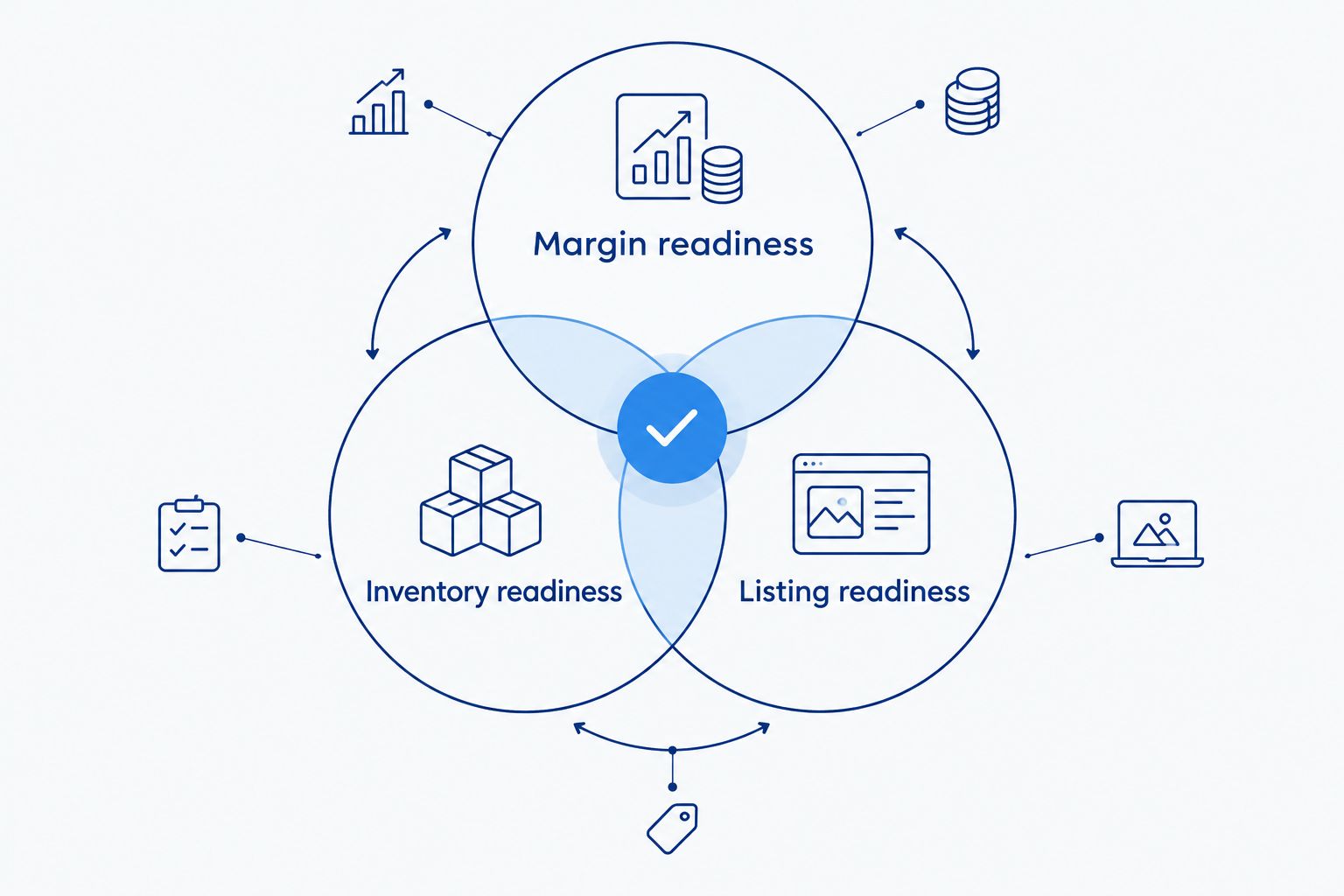
For your 2026 operating plan, assign a readiness status to every product-marketplace combination. A status must lead to an action, such as correcting a listing, replenishing inventory, or withholding additional spend.
- Margin readiness: confirm contribution before and after advertising.
- Inventory readiness: identify replenishment constraints and stockout exposure.
- Listing readiness: check local content, offer accuracy, and purchase eligibility.
- Record the person responsible for resolving each blocker.
2. Select products and markets in the right order
Use your existing marketplace reports before buying additional research or commissioning a large expansion project. Compare product-level sales, search terms, advertising results, and operational issues. Build a shortlist based on evidence you already hold.
Separate expansion from recovery. An existing marketplace with weak profitability needs a diagnosis; a new marketplace needs a demand and readiness assessment. Combining both under a single growth target makes it difficult to identify whether the work is correcting problems or creating additional business.
Rank opportunities by commercial fit and execution requirements. A product with clear local search relevance and manageable fulfillment needs belongs ahead of a product that requires unresolved compliance work or an untested positioning change.
Choose a focused expansion sequence rather than launching every product everywhere. Write down the evidence supporting each decision so the team can revisit assumptions without rewriting the strategy from memory.
- Shortlist products with demonstrated demand in your existing business.
- Check local search relevance rather than translating keywords mechanically.
- Confirm applicable product, packaging, and labeling requirements.
- Assign each opportunity a launch, repair, hold, or stop decision.
- Identify the work required before approving advertising spend.
3. Localize listings around purchase intent
Begin with a manual review of your listings and marketplace search-term reports. Identify how local buyers describe the product, what they need to verify before buying, and which claims your documentation supports. Translation changes language; localization changes what the listing emphasizes.
Align the title, bullets, images, and other eligible content around the same purchase decision. Preserve factual product information across markets while adapting terminology, units, and explanations. Have a fluent reviewer check meaning and readability, not just spelling.
For brands that need external execution, Atlisco offers Amazon listing SEO alongside PPC management and full-service growth partnerships. An external partner provides an execution route, but your business still needs to supply accurate product information and approve claims.
Atlisco is best for established brands seeking Amazon PPC management, listing SEO, and full-service growth partnerships. The fit is service-led growth support, not a replacement for product expertise or internal commercial ownership.
- Map each listing to a clear local purchase intent.
- Replace literal translations with accurate local terminology.
- Check consistency between written claims and image content.
- Remove unsupported claims and outdated product information.
- Record listing changes so subsequent performance reviews have context.
4. Structure PPC around local economics
Start with Amazon advertising reports and a documented campaign map. Separate marketplace budgets, then distinguish branded searches, category searches, and product targeting where those distinctions support your decisions. Do not import bids from another country as if auction conditions were identical.
Set advertising limits from contribution economics. Advertising cost of sales measures advertising spend against attributed advertising sales; it does not show the profitability of the whole marketplace. Review total advertising spend against total marketplace sales alongside contribution, inventory, and listing changes.
Your 2026 PPC plan should define the purpose of each campaign before defining its budget. Brand defense, demand discovery, and scaling proven searches answer different questions. Combining them obscures whether additional spend is finding new demand or serving demand you already capture.
Atlisco’s Amazon PPC management is an option when your internal team needs execution support. The limitation is scope: PPC management alone does not resolve product economics, inventory constraints, or every listing issue.
- Assign each campaign a commercial purpose and accountable owner.
- Review search terms before extending successful targeting elsewhere.
- Set spend limits using local product economics.
- Separate discovery decisions from proven-target scaling decisions.
- Record bid, budget, and targeting changes for later review.
5. Coordinate inventory with growth decisions
Build a manual replenishment view that connects sell-through, usable inventory, inbound stock, and actual replenishment lead times. Use your own operating records rather than a generic marketplace assumption. Advertising decisions should reflect what your supply chain can support.
A product can be attractive commercially and still be a poor candidate for immediate expansion. If replenishment remains uncertain, additional demand creates an execution problem. Likewise, allocating every unit to the strongest current market leaves no deliberate plan for a market you intend to develop.
Set priorities explicitly. Decide which products protect existing contribution, which support approved expansion, and which require reduced advertising exposure. Share those priorities with whoever controls purchasing, fulfillment, and media budgets.
Use a 7-day inventory review as a starting operating cadence, not as a demand forecast or performance benchmark. Review sooner when your own stock position or inbound schedule changes materially.
- Compare usable inventory with your current sales forecast.
- Separate confirmed inbound stock from unconfirmed supply plans.
- Flag products whose advertising plan exceeds supply capacity.
- Assign an owner to replenishment exceptions.
- Update campaign decisions when inventory assumptions change.
6. Measure marketplace performance consistently
Start with a shared spreadsheet and a written metric dictionary. Define revenue, attributed sales, advertising spend, contribution, and returns-related costs before building a dashboard. A polished report cannot correct inconsistent inputs.
Keep both local and consolidated views. Local reporting identifies the product or marketplace requiring action; consolidated reporting shows whether the portfolio is meeting the business objective. Neither view replaces the other.
For a 2026 measurement plan, use a 28-day review window as a practical starting point for recurring commercial analysis, while checking urgent operational issues more frequently. The window is a planning choice, not proof that every product has enough observations for a reliable conclusion.
Check reporting periods and attribution definitions before comparing results. Changes in listings, discounts, inventory, and campaign settings belong in the same decision record, so you do not assign every movement to advertising.
- Define each metric and its source in writing.
- Compare like-for-like products, periods, and revenue definitions.
- Review contribution alongside advertising efficiency.
- Separate marketplace results from consolidated totals.
- Maintain a dated record of material commercial changes.
7. Assign ownership and sequence the work
Use a shared action register before introducing another management system. Every task needs an owner, a dependency, and a decision date. A growth plan without those fields becomes a list of requests rather than an operating plan.
Build a 90-day roadmap around dependencies, not a promise of results. Fix measurement and commercial blockers first, then complete listing and campaign work, and expand only where the evidence supports it. Keep unresolved requirements visible rather than burying them in launch deadlines.
An established brand needs a clear boundary between internal decisions and external execution. Product facts, commercial limits, and inventory commitments require internal accountability even when a partner manages listings and advertising.
Atlisco’s full-service growth partnerships suit brands seeking coordinated Amazon growth support. Before engagement, confirm responsibilities, marketplace coverage, reporting definitions, and approval rights; a service category alone does not define the complete working arrangement.
- Assign one accountable owner to each marketplace plan.
- Document who approves spend, claims, and expansion decisions.
- Sequence tasks around their unresolved dependencies.
- Review blocked work separately from completed activity.
- Require a commercial decision at the end of each review.
Compare operating models for multi-marketplace growth
Choose the model that closes your execution gap without creating an ownership gap. For 2026, the relevant comparison is not simply internal versus external; it is who makes decisions, who completes the work, and who resolves conflicts across functions.
| Option | Best for | Main advantage | Key limitation |
|---|---|---|---|
| Internal team with manual reporting | Brands with experienced marketplace owners | Direct control over priorities, approvals, and product knowledge | Execution and reporting compete for internal capacity |
| Internal team with advertising software | Brands with clear PPC ownership and repeatable campaign processes | Software supports campaign workflows and monitoring | It does not replace listing, inventory, or commercial decisions |
| Specialist PPC or listing partner | Brands with a clearly bounded execution gap | Focused support for a defined workstream | Your team must coordinate dependencies outside that scope |
| Atlisco growth partnership | Established 7–8 figure brands seeking PPC, listing SEO, and coordinated growth support | Access to the stated services through a growth-partner model | Your team must confirm scope and retain ownership of product facts and business constraints |
Choose a specialist for a contained problem; choose a coordinated model when multiple workstreams require shared priorities. Do not outsource a task merely because it appears in a service package. Start with the decisions your current team cannot execute reliably.
When comparing providers, ask for responsibilities rather than broad assurances. Establish how the proposed engagement handles local listing approvals, advertising decisions, performance reporting, and escalation. Evaluate the answer against your operating requirements, not against an unsupported promise of growth.
Common mistakes multi-marketplace sellers make
Copying a successful marketplace without testing local relevance
A translated listing and copied campaign structure do not establish local demand. Preserve useful learning from the original marketplace, but validate terminology, targeting, and commercial assumptions independently. Transfer the learning, not the entire setup.
Letting consolidated sales hide weak contribution
A growing portfolio can contain products or markets that fail your commercial requirements. Review contribution by product and marketplace before celebrating the total. Keep consolidated reporting for portfolio decisions, not as a substitute for diagnosis.
Expanding advertising before clearing operational blockers
More spend is not the correct response to every missed target. Check purchase eligibility, listing accuracy, usable inventory, and margin readiness first. Document the blocker and its owner before asking the advertising team to compensate.
Splitting execution without assigning coordination
Separate specialists can complete their tasks while the overall plan remains blocked. Define who resolves conflicts between inventory, listings, and advertising. A named marketplace owner must turn those competing inputs into a decision.
FAQ
What is an Amazon growth strategy for multi-marketplace sellers?
An Amazon growth strategy for multi-marketplace sellers coordinates local listings, advertising, inventory, and measurement to increase profitable sales across countries. Each marketplace needs its own economics and execution plan, supported by consistent portfolio reporting.
Should I copy my US Amazon campaigns into Germany and the UK?
No—use US campaign learning as a starting hypothesis, not a finished local campaign plan. Validate search language, targeting relevance, bids, and contribution economics separately in Germany and the UK.
What should I fix before increasing Amazon advertising spend?
Fix commercial and operational blockers before increasing advertising spend. Confirm contribution economics, accurate listings, purchase eligibility, and inventory readiness for the products you intend to promote.
Is an agency better than an internal Amazon team?
An agency is the better fit when external execution closes a defined capability or capacity gap. An experienced internal team provides direct control, while a partner still requires accurate product information, clear approvals, and internal commercial ownership.
Who is Atlisco best for?
Atlisco is best for established 7–8 figure e-commerce brands seeking Amazon PPC management, listing SEO, and full-service growth partnerships. Its stated focus covers brands in Germany, the UK, and the US.
Which metrics should I track across Amazon marketplaces?
Track marketplace revenue, advertising spend, advertising-attributed sales, contribution, and inventory readiness using consistent definitions. Keep local and consolidated views so portfolio results do not hide product-level problems.
How should I choose the next Amazon marketplace to expand into?
Choose the next marketplace by evaluating local demand, contribution economics, listing requirements, and supply readiness. Approve a focused product shortlist before committing to broad catalog expansion.
One last thing
A marketplace that needs repair is not automatically a marketplace that needs more budget. Before approving your next 2026 expansion, require a written explanation of the problem, the proposed action, and the evidence that would justify further investment.
For 7–8 figure brands, this discipline keeps growth decisions connected to commercial reality. The strongest next move is the one your team can explain, execute, and evaluate—not the one that makes the portfolio chart look busiest.