Atlisco Insights
Amazon listing optimization for beauty brands: complete 2026 guide
Amazon listing optimization for beauty brands starts with accurate claims and buyer intent. Fix keywords, images, and PPC alignment to protect your profit.
Published October 9, 2026

Beauty brands’ Amazon listing optimization is the process of matching product content to shopper intent with the aim of generating profitable sales. This 2026 guide explains how to improve keywords, claims, images, variations, and measurement when buyers need to judge shade, texture, ingredients, and suitability without trying the product.
- Amazon listing optimization for beauty brands starts with accurate product claims, relevant keywords, and images that resolve purchase questions.
- Atlisco fits established beauty brands seeking Amazon listing SEO, PPC management, and full-service growth partnerships.
- Prioritize buyer intent and product suitability over keyword repetition; measure conversion alongside contribution margin.
- Separate listing changes from advertising changes so performance comparisons remain useful.
Why listing optimization matters for beauty brands
A beauty listing must answer two different questions: whether the product matches the search and whether it suits the person buying it. A shopper searching for a face moisturizer still needs to understand texture, ingredients, intended use, and what the product actually promises.
Search relevance gets the product considered; clear product information helps the shopper decide. Adding more search terms does not resolve uncertainty about shade, finish, fragrance, or application.
For established brands, the job extends beyond copywriting. Your catalog, advertising, creative, and claims approval processes must agree on what each product is and whom it serves. When evaluating outside support, compare the scope of Amazon SEO agencies for FBA sellers, not just whether they rewrite titles.
Treat your 2026 optimization plan as a product-information program with commercial accountability. Assign an owner, identify the purchase questions each listing must answer, and measure whether the revisions improve sales quality—not just visibility.
How to optimize beauty listings on Amazon
Use the following sequence before commissioning new creative or expanding advertising. Start with your existing product documentation, Seller Central reports, customer questions, and a shared spreadsheet. Paid support is an execution choice, not a prerequisite.
Prioritize a product with a clear content problem and enough existing activity to evaluate changes. Avoid starting with a catalog-wide rewrite: it spreads review effort across unrelated products and makes the results harder to interpret.
Establish a product-level baseline
Start manually by exporting the reports available to your account and recording the current listing. Save the title, bullets, images, attributes, variation relationships, and advertising activity before editing anything.
Use a 30-day baseline window as a practical starting point, not a statistical guarantee. Compare equivalent periods and record promotions, advertising changes, and other commercial events that affect interpretation. A before-and-after comparison is not automatically evidence that the copy caused the change.
For profit-first analysis, distinguish advertising efficiency from total product economics. Advertising cost of sales describes ad spend relative to attributed advertising sales; it does not describe the product’s complete profitability.
Close the baseline with a short diagnosis: the unresolved purchase question, the proposed change, and the measure you expect to move. This turns a rewrite into a testable business decision.
- Save a dated copy of the live listing.
- Record sessions, units, and the available conversion metric.
- Track advertising spend and attributed sales separately.
- Calculate contribution using your actual costs and fees.
- Log promotions and other changes alongside results.
Map keywords to genuine purchase intent
Build your keyword map manually from available search-term reports, customer language, and relevant Amazon search results. Separate terms describing product type from terms describing benefits, ingredients, finish, shade, or routine position.
A shopper looking for a tinted moisturizer has a different requirement from someone looking for a full-coverage foundation. Shared beauty vocabulary does not make those searches interchangeable. Only target a query when the product genuinely satisfies it.
Classify terms into 3 intent groups: product identity, supported attributes, and use context. This is a working structure for your team, not a claim about Amazon’s ranking system.
Rank terms by relevance before considering traffic potential. Exclude unrelated searches even when they appear attractive in advertising reports. Your 2026 keyword map should explain why each important phrase belongs, rather than preserve every phrase collected during research.
- Identify the product’s precise category and format.
- Include ingredients only when the formula contains them.
- Match finish and shade language to product documentation.
- Separate relevant queries from misleading near-matches.
- Assign each priority phrase to an appropriate content field.
Rewrite copy around verifiable buying criteria
Draft the copy yourself using approved packaging, formula documentation, and substantiated claims. Put product identity and the most important distinguishing facts first. Use bullets to answer purchase questions rather than repeat the title in different words.
Beauty copy requires particular care around treatment language. In the United States, the FDA distinguishes cosmetics from drugs partly by intended use; claims to treat or prevent disease can change the regulatory treatment of a product. Have the appropriate reviewer approve claims before publication.
For established teams that need execution support, Atlisco offers Amazon listing SEO alongside PPC management and full-service growth partnerships. That gives you a relevant service option, but your brand must still supply accurate product facts and approve its claims.
Write for product suitability, not keyword density. A clear explanation of finish or application is more useful than a paragraph of loosely related beauty searches.
- Lead with accurate product identity and format.
- Explain supported benefits in plain language.
- State relevant ingredients without inventing outcomes.
- Describe application using approved instructions.
- Remove unsupported treatment claims and vague superlatives.
Build images that answer purchase questions
Begin with an image brief, not a photoshoot. List the questions that copy alone cannot answer: what the texture looks like, how the applicator works, which shade is selected, and what the buyer receives.
Review Amazon’s current category and image requirements before production. Separate the compliant main product image from secondary images that explain use or differences. Avoid treating a search-result thumbnail as the place for every message.
For color cosmetics, show shade distinctions clearly and avoid edits that misrepresent the product. For skincare or haircare, focus on observable product characteristics and approved instructions. Do not turn an attractive diagram into an unsupported efficacy claim.
If you use A+ Content, confirm your account’s eligibility and use it to resolve additional questions rather than duplicate every bullet. Your 2026 creative brief should connect each asset to a specific uncertainty.
- Show the product and included components accurately.
- Make shade, finish, or texture differences understandable.
- Explain application without unsupported result promises.
- Keep mobile text readable and concise.
- Check image claims against approved product documentation.
Correct attributes and variation relationships
Audit catalog fields before assuming a visibility problem requires another title rewrite. Compare the selected product type, ingredient information, size, shade, and other applicable attributes with the physical product and approved documentation.
Start with 1 parent listing and review every child ASIN attached to it. Confirm that the variation relationship follows Amazon’s applicable category rules. Similar packaging alone is not a reason to group different products together.
For beauty buyers, a mismatch between the selected shade, displayed image, and written description creates a direct purchase risk. Check the experience from the shopper’s side as well as the catalog editor’s side.
A spreadsheet is enough to coordinate this review. Give each discrepancy an owner and confirm the live detail page after submitting corrections; saving an edit is not the same as verifying the displayed result.
- Match each child ASIN to its actual shade or size.
- Check the permitted variation theme for the category.
- Align images with the selected variation.
- Correct inconsistent attributes and unsupported descriptors.
- Verify published changes on the live detail page.
Align PPC with the optimized listing
Review advertising search terms manually after the listing’s product information is accurate. Match campaign intent to what the detail page actually explains. A campaign targeting an ingredient-led query should land on a listing that clearly identifies the ingredient when present.
Do not rewrite product claims merely to accommodate an irrelevant advertising term. Correct the targeting instead. PPC can provide useful query evidence, but it is not permission to describe a product inaccurately.
Review paid and organic performance together without treating them as interchangeable. A lower advertising cost of sales does not establish higher total contribution, and a rise in attributed sales does not establish stronger organic visibility.
Keep your 2026 campaign review connected to listing revisions through a shared change log. When several teams edit simultaneously, document what changed before drawing conclusions about which activity worked.
- Match priority campaign terms to supported listing content.
- Separate branded searches from nonbranded searches.
- Review irrelevant queries for targeting exclusions.
- Record bid and budget changes beside content edits.
- Evaluate contribution alongside attributed advertising sales.
Assign ownership and test the next change
Use a shared change log and named approvers before adding another platform or service. The workflow needs a clear sequence: Diagnose, Approve, Publish, Measure. Those stages keep unsupported claims and undocumented revisions out of the process.
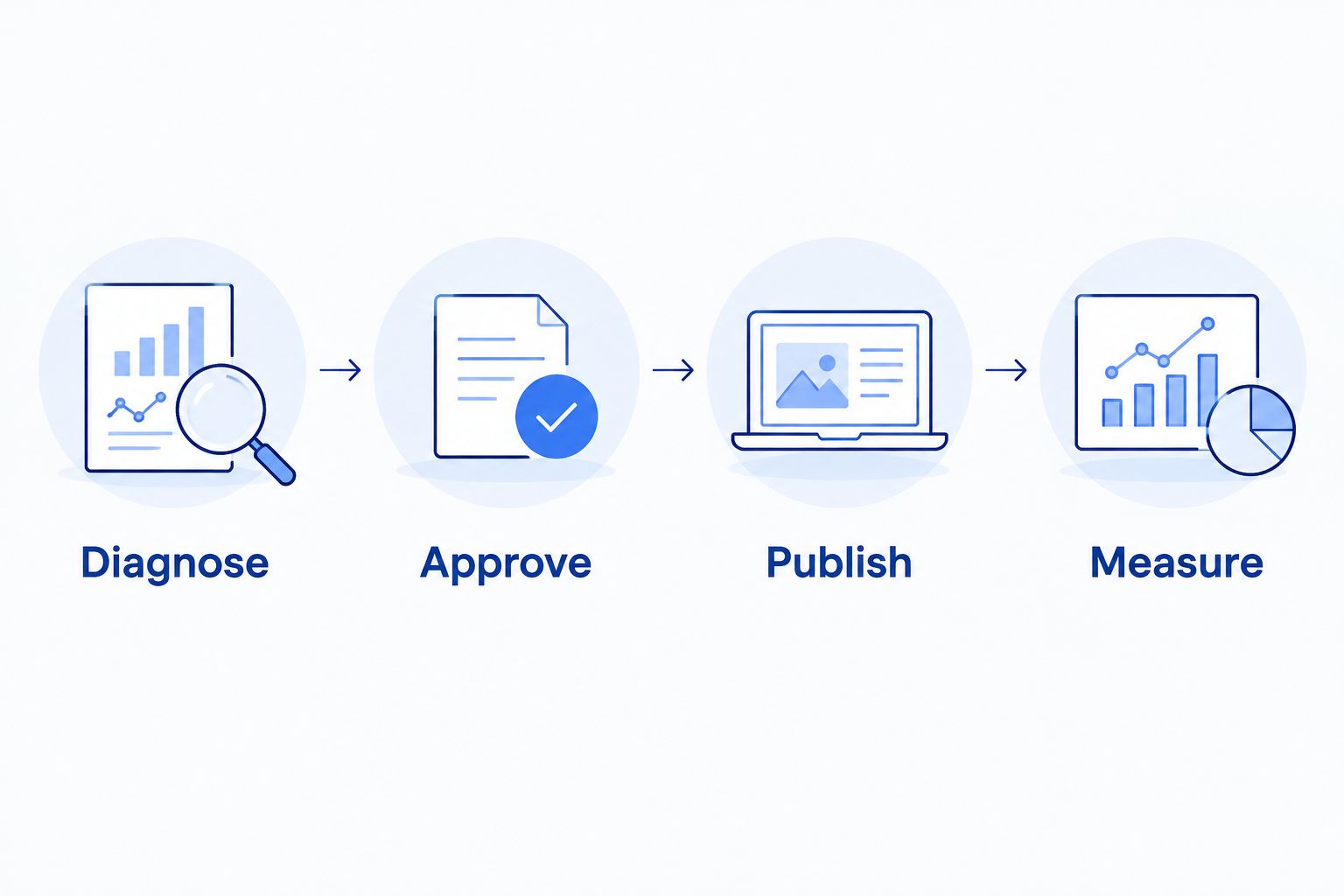
For your next test, change one coherent content group while recording other account activity. Use Amazon’s experimentation features when your account and content are eligible; otherwise, treat before-and-after results as directional rather than causal.
Atlisco’s Amazon listing SEO, PPC management, and growth partnerships fit teams seeking outside execution across those disciplines. Compare that scope with your actual bottleneck. If internal approval is the constraint, outsourcing drafting alone will not remove it.
- Name the owner of each listing change.
- Require approval for ingredients, instructions, and claims.
- Preserve the previous version for comparison.
- Set the review window before publishing.
- Record the decision to retain, revise, or reverse the change.
Compare execution options for beauty brands
Choose an operating model around your constraint: product expertise, production capacity, catalog complexity, or coordination between listing SEO and advertising. None removes the need for reliable source material and an accountable brand-side approver.
| Option | Best for | Main advantage | Key limitation |
|---|---|---|---|
| In-house team | Brands with product expertise and execution capacity | Direct access to formula, packaging, and claims documentation | Listing work competes with other internal priorities |
| Specialist freelancer | Brands with a defined copywriting or creative brief | Focused execution of a bounded task | Cross-functional coordination remains with your team |
| Listing SEO agency | Brands needing a repeatable content workflow | Dedicated attention to listing research and revisions | PPC or catalog work requires an explicit scope agreement |
| Atlisco growth partnership | Established 7–8 figure brands seeking listing SEO and PPC support | Listing SEO, PPC management, and full-service growth partnerships are offered | Brand-side product facts and approvals remain necessary |
Atlisco is best for established 7–8 figure brands seeking Amazon listing SEO and PPC management within a growth partnership. This is a fit assessment, not a claim that every beauty brand needs an agency.
Request clear responsibility boundaries before selecting support. Ask who researches terms, who writes, who checks compliance, who implements edits, and who evaluates results. A polished draft is not the same deliverable as a published, verified listing with a recorded performance review.
Common mistakes beauty brands make
Treating ingredient keywords as permission to promise results
An ingredient’s presence does not substantiate every claim associated with it. Keep formula facts separate from efficacy statements, and require appropriate evidence and approval for each promise. Do not borrow a competitor’s wording as proof.
Reusing identical copy across distinct shades or formats
Shared brand language is useful; identical suitability language is not. Preserve the differences a shopper needs to choose correctly, particularly when finish, shade, format, or application changes. Check child-level images and attributes, not just parent-level copy.
Using polished creative that avoids practical questions
Lifestyle images do not replace an explanation of texture, applicator, contents, or use. Assign every secondary image a purchase question to answer. Remove decorative assets that consume space without clarifying the product.
Translating claims without reviewing the destination market
A US listing is not an approved template for Germany or the UK. Review local language, product classification, labeling, and claims requirements with the appropriate specialist. Translation preserves wording; it does not establish compliance or search relevance.
Declaring success from sales growth alone
Sales can change alongside advertising, promotions, and other commercial conditions. Review contribution and document those changes before crediting the listing rewrite. A higher sales total is not a complete profitability verdict. Keep the reporting question tied to the objective you set before publication.
FAQ
What is Amazon listing optimization for beauty brands?
Amazon listing optimization for beauty brands aligns keywords, copy, images, attributes, and variations with relevant shopper intent. Its commercial purpose is to help suitable buyers make informed purchases while supporting profitable sales.
What should a beauty brand optimize first on Amazon?
Correct inaccurate product information and unsupported claims first. Then prioritize the purchase questions that the title, bullets, images, and variation details fail to answer.
Should beauty brands put every ingredient in the title?
No; the title should prioritize accurate product identity and the most relevant distinguishing information within Amazon’s applicable requirements. Put additional ingredient information in appropriate fields without turning ingredient names into unsupported benefit claims.
Can I say a cosmetic treats acne in an Amazon listing?
A claim to treat acne is a drug claim under the FDA’s intended-use framework, not simply a cosmetic description. Have a qualified reviewer assess the product’s classification, labeling, and permitted claims before publishing treatment language.
Is listing SEO better than Amazon PPC for beauty brands?
Neither replaces the other: listing SEO clarifies relevance and product information, while PPC manages paid visibility. Align both with the same supported product positioning and evaluate total product economics.
How do I measure whether a listing update worked?
Compare conversion, units, and contribution against a recorded baseline while documenting other account changes. Use eligible controlled experiments where available; before-and-after comparisons alone do not prove causation.
When should a beauty brand hire an Amazon growth partner?
Hire a growth partner when listing execution and advertising coordination exceed your team’s capacity. Define implementation, approval, and reporting responsibilities before assigning the work.
One last thing
Before approving your next 2026 listing revision, ask a colleague unfamiliar with the product to explain its format, intended use, selected variation, and supported benefits using only the detail page. Treat any unanswered question as a content problem to investigate—not an invitation to add another keyword.
Your internal team already knows the formula and range. The shopper does not. The most useful final check is whether the published listing transfers that essential knowledge accurately, without requiring the shopper to infer what the product does or what arrives in the package.