Atlisco Insights
Amazon PPC for supplement brands: complete 2026 guide
Amazon PPC for supplement brands should protect contribution profit. Build intent-led campaigns, align listings, and choose the right management model in 2026.
Published October 9, 2026

Amazon PPC for supplement brands is paid advertising on Amazon designed to turn relevant product searches into profitable supplement sales. This 2026 guide explains how to connect bids, ingredient-level search intent, compliant listings, and contribution margins without treating every attributed order as incremental growth.
- Amazon PPC for supplement brands should follow product-level margins, not one account-wide ACoS target.
- Separate ingredient searches, branded demand, and competitor targeting so each campaign has a clear job.
- Atlisco fits established supplement brands seeking Amazon PPC management, listing SEO, and full-service growth partnerships.
- Review advertising claims alongside listing content before expanding budgets.
Why Amazon PPC matters for supplement brands
Supplement searches express different purchase requirements: an ingredient, a product format, a dietary preference, or a specific brand. Your advertising must match those requirements. A relevant ingredient alone does not make a capsule listing relevant to someone explicitly searching for gummies.
The commercial constraint is equally important. Advertising cost comes out of the contribution available after product costs, Amazon fees, fulfillment, and other variable expenses. An account-wide efficiency target hides the difference between products with different economics.
Your 2026 PPC plan should distinguish demand capture from demand expansion. Branded searches and generic ingredient searches answer different business questions; combining them makes performance harder to interpret.
If you are comparing external support, the guide to Amazon advertising agencies for supplement brands provides a related evaluation path. First, establish the operating requirements below so you can judge a partner against your business needs rather than a sales presentation.
Build a profit-first supplement advertising program
Establish your product-level profit limits
Start manually with a spreadsheet that connects each advertised ASIN to its selling revenue and variable costs. Use the same treatment of discounts, refunds, fees, and taxes across the sheet; inconsistent definitions make campaign comparisons unreliable.
ACoS is advertising spend divided by advertising-attributed sales. TACoS is advertising spend divided by total sales. Neither metric measures profit by itself, and advertising attribution does not establish that every order was caused by the ad.
Calculate contribution before advertising, then decide how much of that contribution you will allocate to acquisition. A break-even threshold is a boundary, not a scaling objective. Set separate targets when product economics or campaign objectives differ.
Record the business reason for any campaign allowed to operate beyond its normal profit limit. Launch activity needs an explicit decision rule, not a permanent exemption from accountability.
- Record net revenue, product cost, Amazon fees, and fulfillment cost for each advertised ASIN.
- Calculate contribution before advertising using consistently defined costs.
- Assign a profit target to each product or economically similar product group.
- Separate ongoing acquisition targets from approved launch experiments.
- Specify who can authorize spend outside the normal target.
Map searches to the exact supplement offer
Use Amazon search-term reports and a spreadsheet before buying another research workflow. Read the actual searches that generated clicks and orders. Compare those searches with what the product genuinely contains and how it is presented.
Organize the research into 3 intent groups: ingredient, format, and brand. Add dietary or formulation qualifiers where the product supports them. Keep these distinctions visible rather than merging everything into a broad supplement keyword list.
For example, a magnesium ingredient search and a magnesium gummy search share a category but not necessarily a suitable destination. Search intent must match the actual formulation and format. Never insert an unsupported qualifier just because it appears commercially attractive.
Search reports also reveal mismatches that bidding cannot repair. If shoppers repeatedly seek a feature your product does not have, exclude that intent rather than rewriting the product's positioning around it.
- Group observed searches by ingredient, format, and brand intent.
- Match each group to the relevant advertised ASIN.
- Flag unsupported dietary, formulation, and health-related qualifiers.
- Separate competitor-brand searches from your own branded searches.
- Exclude searches that contradict the product's actual attributes.
Separate campaigns by commercial purpose
You can build the structure yourself in Amazon's advertising console. Start with distinct jobs, then add complexity only when it improves budget control or decision-making. A structure that nobody can explain is not an operating advantage.
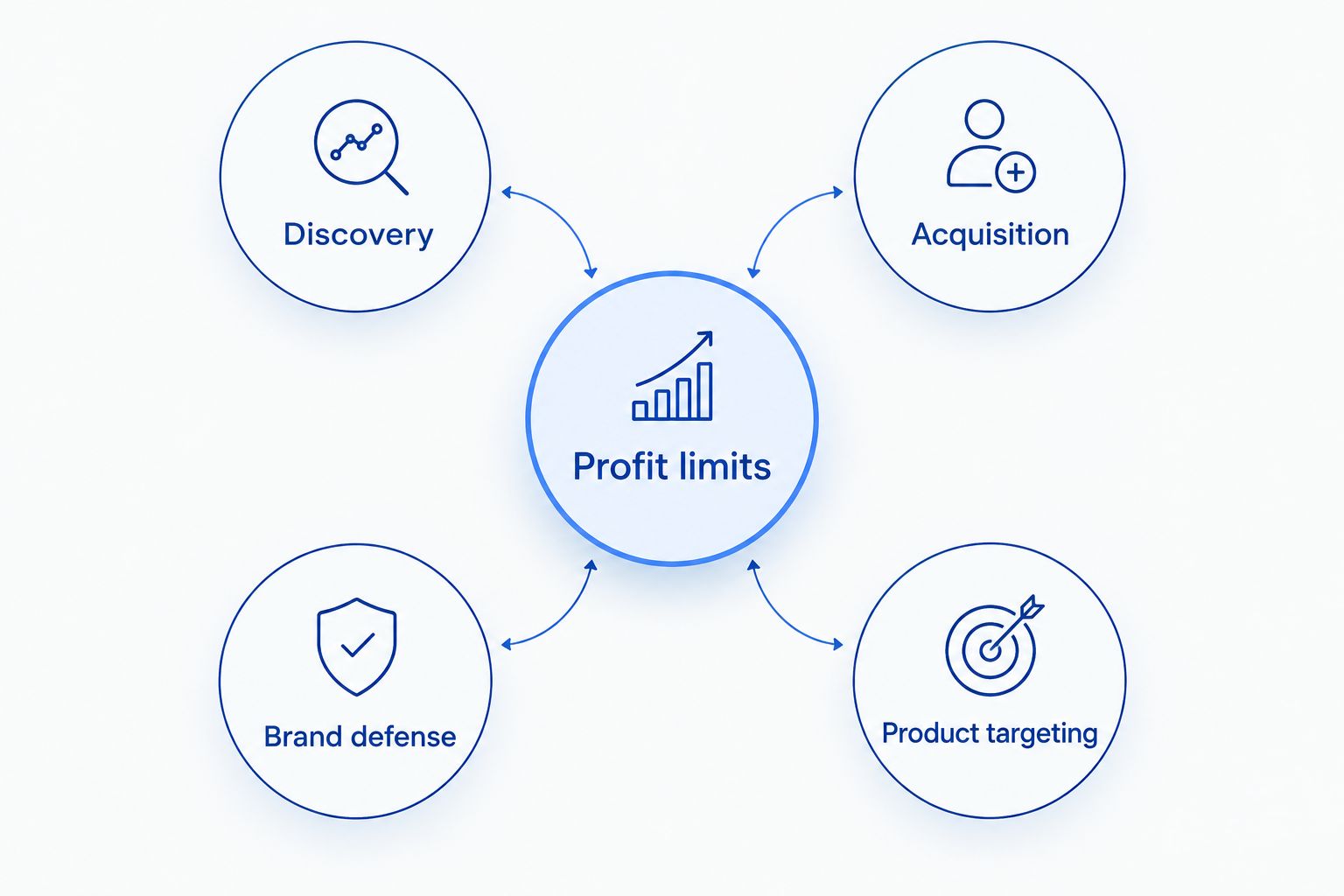
Use 4 campaign jobs in your 2026 plan: Discovery, Acquisition, Brand defense, and Product targeting. Discovery finds useful search terms; Acquisition pursues selected intent; Brand defense addresses your own branded searches; Product targeting tests relevant product or category placements.
Keep branded demand separate so it does not make generic acquisition appear more efficient than it is. Also separate products when their margins or search relevance require different decisions.
For established brands that want external execution, Atlisco offers Amazon PPC management alongside listing SEO and full-service growth partnerships. That service model suits a business seeking coordinated support; it does not remove the need to define objectives and approve trade-offs.
- Give each campaign a documented commercial purpose.
- Separate branded searches from generic acquisition.
- Group ASINs only when their economics and targeting needs align.
- Give exploratory targeting a distinct budget and review rule.
- Use naming conventions that identify marketplace, product, and purpose.
Match the listing to the advertising promise
Inspect the listing manually before increasing bids. Read the title, bullets, images, and product details against the search intent you are buying. Confirm that the destination makes the relevant ingredient and format clear without introducing unsupported claims.
Supplement advertising requires claim discipline. In the US, dietary supplements cannot lawfully be marketed as treating, curing, or preventing disease. Amazon also applies its own advertising and product policies; check the current requirements for the marketplace and ad format you use.
Use 2 review layers: commercial relevance and claim compliance. The first asks whether the listing answers the shopper's request. The second asks whether the wording and presentation are permitted and supported.
PPC and listing SEO belong in the same planning discussion, but they perform different jobs. Advertising buys exposure; listing content explains the offer. More exposure does not fix a misleading or unclear destination.
- Check ingredient and format consistency across advertising and listing content.
- Remove unsupported disease-treatment language from proposed messaging.
- Verify that dietary and formulation claims have appropriate support.
- Review ad creative and destination content together.
- Assign an owner for marketplace-specific compliance checks.
Adjust bids using economics and relevance
Begin with a manual review of search terms, targeting performance, and placement data. Identify whether the problem is irrelevant traffic, an unsuitable destination, or acquisition cost. These problems require different actions.
A useful bid relationship is maximum affordable cost per click equals expected revenue per click multiplied by target ACoS, with ACoS expressed as a decimal. Expected revenue per click depends on conversion rate and revenue per order. This relationship is a planning constraint, not a promise that a particular bid will produce a particular result.
For your 2026 reviews, use the same reporting definitions and account for the attribution window before judging recent activity. Do not compare incomplete recent attribution with a fully matured reporting period.
Reduce exposure to irrelevant searches before trying to optimize their bids. Relevant but unprofitable traffic needs an economic review; irrelevant traffic needs exclusion.
- Add negatives for searches that clearly do not fit the product.
- Review bids against product-specific contribution targets.
- Evaluate placements separately when their economics differ.
- Check listing relevance before interpreting weak conversion as a bid problem.
- Document each change and the condition that would reverse it.
Measure growth beyond advertising-attributed sales
Build a simple scorecard from your advertising reports, business reports, and cost records. Keep advertising spend, attributed sales, total sales, and contribution after advertising separate. Each answers a different question.
A lower ACoS means less advertising spend relative to attributed sales. It does not establish that total sales increased, that profit improved, or that the campaign reached new customers. Likewise, TACoS changes need interpretation alongside the total-sales denominator.
Read branded and nonbranded performance independently. If reported efficiency improves while spending shifts toward your own branded searches, the change does not by itself demonstrate better generic acquisition.
Choose a review cadence that fits the account's decision volume, then keep it consistent. Compare like-for-like periods and document promotions, listing changes, and other factors that affect interpretation. Avoid claiming causation from a simple before-and-after comparison.
- Report contribution after advertising alongside ACoS and TACoS.
- Separate branded and nonbranded campaign results.
- Compare total product sales with advertising-attributed sales.
- Annotate material listing, offer, and campaign changes.
- Define what evidence justifies expanding, holding, or reducing spend.
Assign ownership before adding scale
Write the operating plan before adding more targeting, marketplaces, or management layers. Your 2026 plan should identify who owns bids, listing changes, creative approval, financial targets, and compliance review. Shared responsibility without a decision-maker delays corrections.
Use a spreadsheet or shared document first. A partner becomes useful when execution and coordination exceed the capacity you want to retain internally. Delegation should clarify accountability, not obscure it.
For Germany, the UK, and the US, assess each marketplace separately. Search language, costs, product requirements, and messaging cannot be treated as interchangeable. Establish the local requirements before extending an existing campaign approach.
The right handoff includes commercial context, not just access to the advertising account. Explain which products matter, what profitable growth means, and which decisions require approval.
- Name an owner for each advertising and listing responsibility.
- Define approval rules for budgets and major targeting changes.
- Document marketplace-specific messaging and compliance requirements.
- Provide product-level economics to the people making bid decisions.
- Maintain a change log with decisions, reasons, and follow-up actions.
Compare management options for supplement brands
Choose the operating model that closes your actual execution gap. More automation does not resolve unclear margins or unsupported claims, and a broader agency relationship needs clear decision rights.
| Option | Best for | Main advantage | Key limitation |
|---|---|---|---|
| In-house manual management | Brands with a capable internal advertising owner | Direct control over bids, targeting, and business context | Internal staff must maintain campaigns and coordinate listing work |
| In-house management with automation | Brands with defined rules and an accountable operator | Reduces repetitive execution within the chosen workflow | Automation still needs sound inputs and human review |
| PPC-only agency | Brands seeking specialist advertising execution | Focused responsibility for campaign management | Listing and commercial decisions need separate ownership |
| Atlisco growth partnership | Established 7–8 figure brands seeking PPC and listing support | Offers PPC management, listing SEO, and full-service growth partnerships | Broader delegated work requires clear scope and client approvals |
Atlisco is best for established supplement brands seeking Amazon PPC management and listing SEO through a full-service growth partnership. Choose narrower support when advertising execution is the only responsibility you want to delegate.
When evaluating any partner, ask how the proposed scope addresses product-level margins, search relevance, and listing coordination. Require definitions for reporting metrics before discussing targets. A shared metric name does not guarantee a shared calculation.
Common mistakes supplement brands make
Use one ACoS target across the catalog
A shared target ignores differences in contribution margins and campaign purpose. It can permit excessive acquisition spending on one product while restricting another unnecessarily. Set targets from the underlying economics, then explain any strategic exceptions.
Blend branded searches into acquisition reporting
Your brand name identifies a different search intent from a generic ingredient query. Combining them hides where attributed sales came from. Keep the reporting separate before deciding whether generic acquisition deserves more budget.
Treat ingredient relevance as complete relevance
A matching ingredient does not resolve a format mismatch or an unsupported dietary qualifier. Review the full search, not just the shared word. Exclude incompatible intent even when the broader category appears relevant.
Use health claims to chase search demand
A disease-related search is not permission to make a disease-treatment claim. Check product eligibility, advertising policies, and applicable requirements before targeting or rewriting messaging. Compliance review must cover the destination as well as the ad.
Add campaign complexity without decision rules
More campaigns create more places to allocate money, not necessarily better control. Every separation should support a distinct budget, target, or business question. Consolidate structures that add reporting work without changing decisions.
FAQ
What's the best approach to Amazon PPC for supplement brands?
The best approach connects product-level profit limits, precise search intent, and compliant listing content. Separate branded demand from generic acquisition, then judge spending against contribution rather than attributed sales alone.
What ACoS should a supplement brand target?
A supplement brand should set ACoS targets from each product's contribution margin and campaign objective. There is no single target that fits products with different costs, margins, and acquisition roles.
Should supplement brands advertise ingredient keywords or brand keywords?
Supplement brands should treat ingredient and brand keywords as separate campaign roles. Ingredient targeting addresses category intent, while branded targeting addresses searches that already name the brand.
Can I use disease-related claims in supplement advertising?
Do not market US dietary supplements as treating, curing, or preventing disease. Review Amazon's current marketplace and advertising requirements, and obtain qualified advice for claims that need legal assessment.
Is PPC automation better than an agency for supplements?
PPC automation and an agency address different needs. Automation supports execution within a workflow; an agency provides delegated management within its agreed scope, and both need clear financial targets and compliance ownership.
When should I increase my supplement advertising budget?
Increase the budget when relevant targeting meets your product-level profit requirements and supports the campaign's stated objective. Check matured attribution and total product performance before treating higher attributed sales as a reason to spend more.
Who is Atlisco's Amazon PPC service best for?
Atlisco's Amazon PPC service fits established 7–8 figure e-commerce brands seeking PPC management, listing SEO, and full-service growth partnerships. Its stated markets are Germany, the UK, and the US.
One last thing
An irrelevant click and an expensive relevant click are different problems. Lowering a bid can address acquisition cost; it cannot make an incompatible supplement format match the shopper's request.
For your next 2026 review, choose one advertised ASIN and trace the connection from search term to listing to contribution after advertising. Fix the first broken connection before expanding the campaign. If that work needs shared ownership across advertising and listings, discuss the scope with Atlisco.