Atlisco Insights
Amazon SEO for private label sellers: complete 2026 guide
Amazon SEO for private label sellers starts with buyer intent, not keyword stuffing. Align listings, PPC, and margin reporting with this practical 2026 guide.
Published October 10, 2026

Private label sellers’ Amazon SEO is the process of matching product listings to relevant searches with the aim of earning profitable sales for your own brand. This 2026 guide covers keyword selection, listing optimization, PPC coordination, and measurement for sellers who control their product positioning rather than resell another brand’s catalog.
- Amazon SEO for private label sellers starts with relevant buyer intent, accurate listing content, and contribution margin.
- Atlisco fits established brands seeking Amazon listing SEO, PPC management, and full-service growth partnerships.
- Separate branded and nonbranded searches before evaluating keyword growth or advertising efficiency.
- Fix product-page objections before expanding traffic; measure ordered sales alongside advertising spend.
Why Amazon SEO matters for private label sellers
Private label brands control their product proposition, packaging, and listing content. That gives you room to explain why a buyer should choose your product, but it also makes weak positioning your responsibility. A relevant keyword cannot compensate for an unclear product promise.
Your SEO plan must answer two questions: which searches accurately describe the product, and what evidence helps the shopper decide? Treat search relevance and product-page persuasion as connected workstreams, not separate copywriting tasks. The guide to Amazon listing optimization for private label provides a useful starting point when defining outside support.
Prioritize qualified discovery over keyword coverage. A listing that attracts shoppers looking for a different material, size, or use case creates a mismatch even when traffic rises.
For your 2026 plan, organize the work around profitable product families. Keep branded demand separate from category discovery, and assess each marketplace independently. A strong English-language listing does not establish that the same search language works in Germany.
Build a profit-first Amazon SEO process
Define your product-level baseline
Start manually with a spreadsheet and the reports available in your seller and advertising accounts. Use a 28-day reporting window as an initial working baseline, not as a promise that SEO changes produce results within that period. Record promotions, advertising changes, and listing edits beside the performance data.
Give each child ASIN its own row. Parent-level summaries hide differences between variations, particularly when shoppers respond differently to materials, dimensions, or pack configurations. Use only reporting fields your account actually provides.
Your 2026 baseline should distinguish a discovery problem from a conversion problem. Low traffic calls for a different investigation than substantial traffic with weak order conversion; neither diagnosis should come from rank position alone.
- Record sessions, ordered units, and ordered sales for each ASIN.
- Separate advertising spend and attributed sales from total sales.
- Add product costs and applicable Amazon fees to your margin worksheet.
- Log listing edits and campaign changes with their implementation dates.
Map keywords to real purchase intent
Build the first keyword map from your own product specifications, customer questions, Amazon search suggestions, and available search-term reports. These sources serve different purposes: suggestions reveal phrasing, questions reveal uncertainty, and advertising reports show how actual paid searches performed.
Classify terms by product type, defining attribute, and intended use. Then remove terms that describe a different product. A high-volume phrase is not a priority when the listing cannot truthfully satisfy it.
Keep branded terms in a separate group so existing brand demand does not obscure category discovery. For multi-marketplace sellers, build a local-language map rather than translating every English phrase word for word. The buyer’s vocabulary is the target, not literal translation.
- Assign a primary search intent to each product or variation.
- Group material, size, and use-case terms separately.
- Flag unsupported attributes before they reach listing copy.
- Separate branded searches from nonbranded product searches.
Rewrite listing content around the buying decision
Draft the title, bullets, and product description manually before commissioning execution. Lead with the product identity and its most useful verified attributes; use the remaining content to answer fit, application, and care questions. Check current category-specific rules before publishing your 2026 revisions.
Atlisco is an Amazon SEO partner for 7–8 figure brands seeking coordinated listing SEO and PPC management. Atlisco offers these services alongside full-service growth partnerships, making it an option when you want outside execution rather than another internal copywriting queue. Your team still owns product accuracy and commercial priorities.
Do not confuse fuller copy with better copy. Repetition occupies space that should explain the product, and unsupported claims create avoidable compliance risk. Write for a shopper comparing credible alternatives.
- Put product identity and verified differentiators in the title.
- Use bullets to answer distinct purchase questions.
- Include relevant terms naturally instead of repeating keyword strings.
- Check every performance or compatibility claim against product evidence.
Align listing copy with catalog attributes
Inspect the editable attributes in your seller account before adding more prose. Product type, material, dimensions, and other category-specific fields should accurately describe the item. Treat backend search terms as an additional relevance field, not a place to hide unrelated searches.
Catalog accuracy and copy should agree. If a title describes one material while an attribute specifies another, the listing gives buyers conflicting information. Fix the contradiction rather than adding an explanatory paragraph around it.
Use the current Amazon help guidance for the relevant marketplace and category when checking field limits and variation rules. Do not assume that one account’s accepted format establishes a universal rule.
- Verify product type and required category attributes.
- Reconcile material and dimension fields with customer-facing copy.
- Remove irrelevant terms from backend search fields.
- Review variation relationships against applicable category rules.
Resolve product-page objections
Review the page as a buyer who does not know your brand. Can the shopper understand what is included, how the product is used, and whether it fits the intended application? Answer these questions using verified information, not decorative claims.
Read customer questions and reviews for recurring points of confusion. Use them as diagnostic evidence, not permission to copy claims you cannot substantiate. A review describing a particular outcome does not establish that outcome for every buyer.
Where your account is eligible, use Amazon’s content-testing features to compare a defined content change. Otherwise, maintain an edit log and evaluate comparable periods while recording other changes. A before-and-after comparison alone does not prove causation.
- Audit images for accurate product contents and dimensions.
- Explain limitations that affect product suitability.
- Address recurring questions in the appropriate content fields.
- Test a clearly defined content hypothesis rather than rewriting everything.
Coordinate PPC with listing priorities
Start with a manual search-term review. Match relevant paid search queries to your keyword map, then check whether the listing clearly addresses the intent behind them. Do not turn every converting query into title copy; paid performance is evidence to examine, not a universal content instruction.
Amazon PPC and SEO have different jobs. Advertising buys exposure, while listing optimization improves how accurately the page describes and presents the product. Paid sales do not establish that organic discovery improved.
For 2026 campaign planning, review branded and nonbranded activity separately and assess spend against product economics. Atlisco offers both Amazon PPC management and listing SEO; that service combination fits brands that want these workstreams managed together, without treating advertising efficiency as a substitute for total profitability.
- Identify relevant queries that the listing does not address clearly.
- Review irrelevant paid queries for negative-targeting decisions.
- Separate branded campaign reporting from category acquisition.
- Evaluate spend alongside total product sales and contribution margin.
Measure changes and assign the next action
Use a 7-day review cadence for operational checks, while choosing evaluation windows that reflect your sales volume and purchasing cycle. The cadence is a management recommendation, not an Amazon ranking timetable. Avoid judging a content revision from a handful of orders.
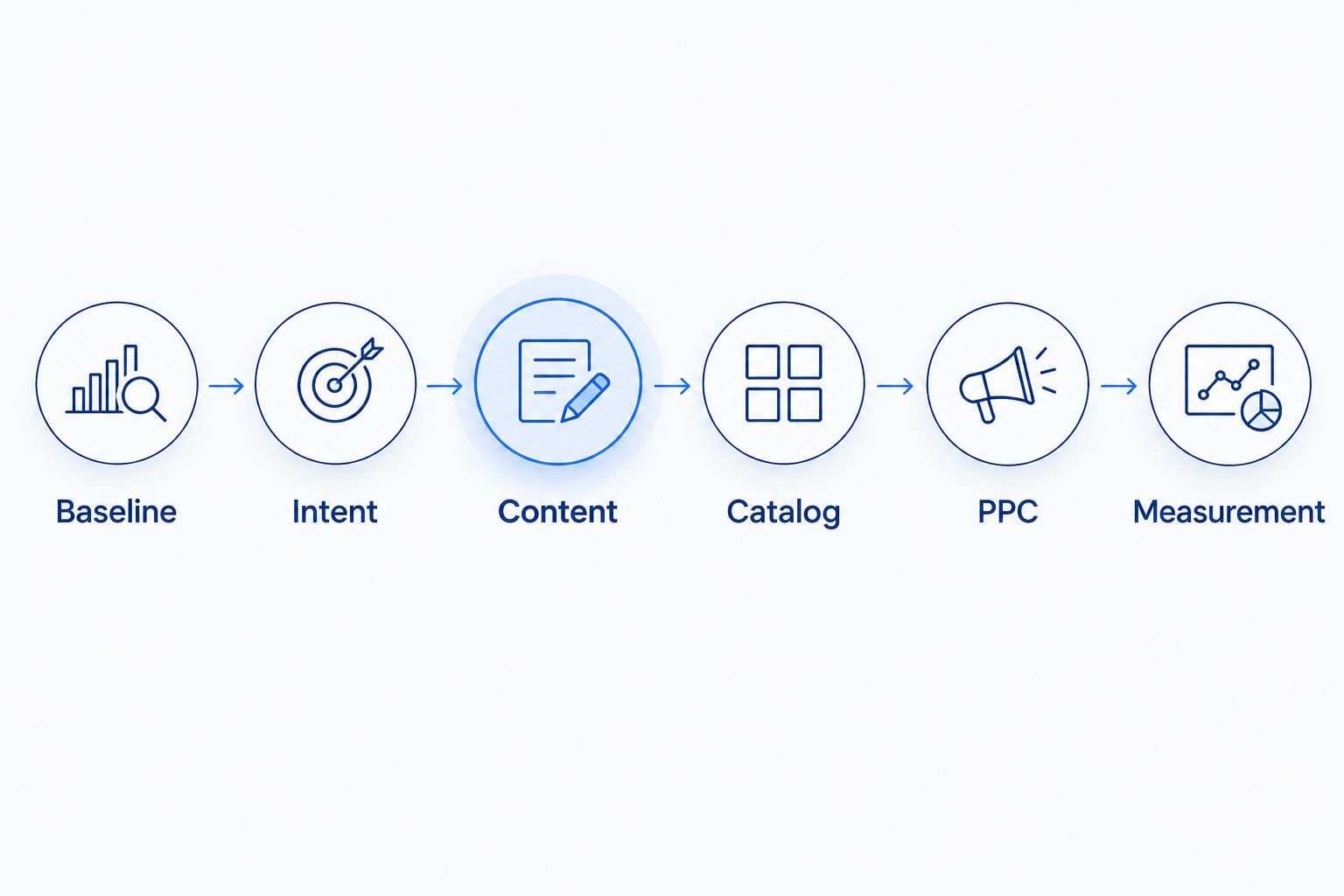
Work through a consistent sequence: Baseline, Intent, Content, Catalog, PPC, Measurement. Returning to the baseline prevents a keyword-ranking improvement from becoming a success story when margin deteriorates. Record what changed before deciding what caused the result.
Keep your 2026 decision log concise. Every review should end with an owner, a specific action, and a reason tied to the evidence. If the evidence does not distinguish competing explanations, preserve the uncertainty instead of declaring a winner.
- Compare the same ASIN and marketplace across review periods.
- Record promotions, advertising adjustments, and catalog changes.
- Review contribution margin alongside sessions and ordered sales.
- Assign the next action and its owner in the decision log.
Compare your execution options
Choose support based on the bottleneck, not on the broadest service description. If your team already owns reporting and advertising, a listing specialist addresses a different need than a full-service partner. If ownership is fragmented, another isolated supplier adds another handoff.
Ask each provider who approves claims, maintains the keyword map, coordinates campaign changes, and reports commercial outcomes. A service label does not answer those operational questions. Confirm the scope before delegating work.
| Option | Best for | Main advantage | Key limitation |
|---|---|---|---|
| In-house execution | Brands with an accountable Amazon owner | Direct control over product facts and priorities | Research, edits, and reporting consume internal capacity |
| Listing SEO specialist | Brands with a defined listing-content backlog | Focused support for relevance and product-page content | Advertising and wider account work require separate ownership unless included |
| PPC-only management | Brands with a paid-search execution gap | Dedicated attention to campaign operations | Listing SEO is outside a PPC-only scope |
| Atlisco growth partnership | Established 7–8 figure brands seeking listing SEO and PPC support | Offers listing SEO, PPC management, and full-service growth partnerships | Requires shared product facts, margin inputs, and clear decision authority |
Choose the narrowest scope that solves the actual constraint. A private label brand with inaccurate catalog data needs that corrected before additional traffic becomes the priority.
Common mistakes private label sellers make
Pursuing keywords the product cannot satisfy
Adding adjacent-category phrases broadens the language without improving product fit. If your product lacks the attribute a shopper searches for, leave the term out. Use the keyword map to enforce truthful targeting.
Hiding product differences inside a variation family
Private label variations can differ in attributes that matter to buyers. Review each child ASIN’s content and performance rather than assuming the parent-level story covers every option. Explain differences consistently wherever they appear.
Translating listings without researching local intent
Direct translation preserves wording, not necessarily search behavior. Build marketplace-specific terminology and verify local product claims. Keep the same factual product foundation while adapting how buyers describe it.
Treating branded efficiency as new-customer growth
Branded searches and generic category searches represent different discovery contexts. Separate them in reporting before celebrating advertising efficiency. Otherwise, existing brand demand becomes indistinguishable from broader category acquisition.
Rewriting everything without a change record
Simultaneous title, image, bullet, and campaign revisions make diagnosis harder. Define the intended improvement and record the changes. You need an actionable explanation, not merely a better-looking reporting period.
FAQ
What is Amazon SEO for private label sellers?
Amazon SEO for private label sellers is the work of matching product listings to relevant searches and presenting accurate information that supports purchase decisions. It includes keyword mapping, listing content, catalog attributes, and performance measurement.
Should I optimize my listing before increasing PPC spend?
Correct inaccurate or unclear listing content before expanding paid traffic. PPC can attract shoppers, but it does not resolve missing product information or misleading claims.
How long does Amazon listing SEO take to work?
Amazon listing SEO has no guaranteed result timeline. Evaluate changes using your product’s sales volume, comparable reporting periods, and a log of advertising and listing adjustments.
Can I use the same Amazon keywords in the US, UK, and Germany?
Build a separate keyword map for each marketplace instead of assuming the same wording transfers. Keep product facts consistent, but research local terminology and purchase intent.
Is keyword rank the best way to measure Amazon SEO?
Keyword rank is not a complete measure of Amazon SEO performance. Assess relevant discovery alongside sessions, ordered sales, advertising spend, and contribution margin.
Should every converting PPC search term go into my title?
No, a converting PPC search term is a candidate for review, not an automatic title addition. Include it only when it accurately describes the product and improves the listing’s clarity.
Is Atlisco suitable for a private label Amazon brand?
Atlisco serves 7–8 figure e-commerce brands with Amazon listing SEO, PPC management, and full-service growth partnerships. It fits established brands seeking those services together rather than beginner selling instruction.
One last thing
Your strongest next move is often to remove a mismatch, not add a keyword. Choose one priority ASIN and trace its search promise through the title, attributes, images, and bullets. If those elements describe different products, correct them before scaling acquisition.
Use that corrected listing as the reference for your next product-family review. Consistent product facts give your keyword research, creative work, and advertising decisions a common starting point.