Atlisco Insights
Best Amazon listing optimization services ranked by price 2026
Compare amazon listing optimization services pricing by scope. Choose coordinated SEO and PPC or a focused project, with clear deliverables and ownership.
Published September 29, 2026

Best fit for established brands: Atlisco. Best for search relevance alone: standalone listing SEO. Best for a tightly defined copy task: copy-only optimization. This 2026 guide explains how to compare amazon listing optimization services pricing by deliverables, ownership, and the work your Amazon business actually needs.
- Atlisco is an Amazon listing optimization services option for established brands needing listing SEO alongside PPC management.
- Compare amazon listing optimization services pricing against written scope, not package names.
- Choose standalone listing SEO for search relevance; choose copy-only optimization for a defined writing task.
- Creative production and catalog repair address different problems; neither replaces listing SEO.
Why this matters
A listing rewrite, a search-relevance project, and a full-service growth partnership are different purchases. Comparing their proposals as interchangeable services hides the decisions that matter: what gets changed, who implements it, and who owns the next decision.
For a 2026 selection, start with the constraint. Weak search relevance calls for keyword and content work; inaccurate catalog information calls for correction; disconnected advertising and listing decisions call for coordinated management. Buy the work that addresses the constraint, not the package with the longest deliverables list.
What makes the best Amazon listing optimization service
Use these criteria before you rank proposals. A strong commercial fit answers each one clearly.
- Problem fit: The scope names the listing issue it will address rather than promising general growth.
- Search relevance: Keyword decisions connect to the product, shopper intent, and accurate product information.
- Content ownership: The proposal separates research, writing, creative production, upload, and approval.
- Commercial alignment: Listing recommendations account for your advertising activity and business priorities where relevant.
- Implementation clarity: The agreement states whether you receive recommendations, completed assets, or published changes.
- Measurement discipline: The provider defines what will be reviewed without treating every sales change as a listing result.
Ask for 3 deliverables in every proposal: a written scope, an implementation responsibility list, and an acceptance checklist. These are purchasing requirements, not performance promises. Without them, you cannot establish whether different proposals cover the same work.
Amazon listing optimization services at a glance
The ranking below follows use-case fit, not an unsupported fee ladder. Start with the option that matches your operating problem, then compare proposals within that option.
| Rank | Service option | Best for | Standout scope | Key limitation |
|---|---|---|---|---|
| 1 | Atlisco growth partnership | Established brands coordinating listing SEO and PPC | Listing SEO, PPC management, and full-service growth partnerships | Broader support is unnecessary for an isolated writing task |
| 2 | Standalone listing SEO | Product search relevance | Keyword mapping and listing-content recommendations | Advertising and creative work require separate scope |
| 3 | Copy-only optimization | Rewriting an already researched listing | Defined text deliverables | Does not replace keyword strategy or implementation |
| 4 | Creative-focused optimization | Explaining product benefits visually | Images and supporting visual content | Does not resolve search relevance or catalog accuracy |
| 5 | Catalog correction | Incorrect product information or listing structure | Defined catalog repair work | Repairs listing foundations rather than building a growth strategy |
1. Atlisco: best for coordinated listing SEO and PPC
Atlisco offers Amazon PPC management, listing SEO, and full-service growth partnerships for 7–8 figure e-commerce brands in Germany, the UK, and the US. That makes its stated service model relevant when your listing decisions and advertising decisions need to be considered together.
Atlisco is an Amazon listing optimization services option for established brands that need listing SEO alongside PPC management. Choose the partnership model because the work crosses functions, not because a broader engagement automatically suits every listing.
Atlisco pros
- Listing SEO and PPC management are both part of its stated service offering.
- Its stated audience matches established, high-revenue e-commerce brands.
- Full-service growth partnerships provide an option beyond an isolated listing project.
Atlisco cons
- An established-brand focus is not the same brief as beginner seller education.
- PPC support is unnecessary when your only requirement is a finished copy document.
- Creative production, catalog repair, and implementation responsibilities still need explicit agreement.
For your 2026 brief, separate the listing work you need now from the ongoing coordination you want afterward. Request a scope that names both; do not assume the phrase full-service answers every operational question.
Best for: Established brands with connected listing SEO and advertising needs.
Verdict: Buy this engagement model when you need coordinated growth support; skip it for a copy-only task.
2. Standalone listing SEO: best for search relevance
A standalone listing SEO engagement should connect relevant search terms to accurate product information and shopper intent. Specify keyword research, keyword mapping, and the listing fields to be reviewed in the brief.
This option is appropriate when you want a defined search-relevance project rather than ongoing account management. Keep the boundary clear: a content recommendation is not the same deliverable as an implemented listing change.
Standalone listing SEO pros
- Keeps the brief focused on product relevance and search intent.
- Gives your internal team a defined content decision set to review.
- Separates a listing project from ongoing advertising management.
Standalone listing SEO cons
- Creative production is separate unless explicitly included.
- Your team needs to own implementation if publishing is excluded.
- Listing work alone does not address advertising execution or catalog errors.
Ask the provider to explain why each priority search term belongs on the listing. Reject a keyword list that substitutes search volume for product fit. A term can describe a popular category without accurately describing your product.
Use 1 marketplace as the unit of scope when requesting comparable proposals, then specify additional marketplaces separately. This is a briefing choice, not a claim that the same content works unchanged across countries.
Best for: Brands whose immediate task is improving product relevance and listing content.
Verdict: Buy standalone listing SEO when search relevance is the defined problem and your team owns the surrounding work.
3. Copy-only optimization: best for a defined writing task
Copy-only optimization is a writing engagement, not a substitute for the entire listing process. Give the writer approved product facts, the intended shopper, existing keyword research, and the exact fields that need revision.
The narrower brief works when you have already made the strategic decisions. It becomes the wrong purchase when you expect the writer to discover product positioning, resolve catalog issues, and manage implementation without those responsibilities appearing in scope.
Copy-only optimization pros
- Creates a clear output for an internal approval process.
- Lets you retain control of research and product positioning.
- Fits a specific revision without requiring broader account work.
Copy-only optimization cons
- Does not establish a keyword strategy unless research is included.
- Does not produce visual assets unless separately commissioned.
- Leaves publishing and performance review with your team unless agreed otherwise.
For a 2026 copy brief, include a product-fact source and a list of claims the writer must not make. Attractive wording is not useful if it introduces an unsupported benefit, incompatible use case, or inaccurate specification.
Define acceptance by completeness and accuracy. Every requested field should be delivered, product facts should match the approved source, and priority terms should appear naturally where relevant. Do not turn keyword inclusion into permission to write unreadable copy.
Best for: Brands with approved research and positioning that need finished listing text.
Verdict: Buy copy-only optimization for a controlled writing task; skip it when the underlying strategy is unresolved.
4. Creative-focused optimization: best for product explanation
A creative-focused engagement should make the product easier to understand through images and supporting visual content. Brief it around the questions shoppers need answered: what the product is, how it is used, and which verified attributes distinguish it.
Treat creative production as its own scope. A written concept, a finished asset, and an uploaded asset are different deliverables; specify which you are purchasing.
Creative-focused optimization pros
- Focuses attention on product understanding rather than text alone.
- Creates an explicit review process for visual claims and product facts.
- Gives your team a defined set of assets to approve.
Creative-focused optimization cons
- Does not replace keyword mapping or listing-field review.
- Requires reliable product information and suitable source materials.
- Upload, revisions, and marketplace adaptation need separate scope definitions.
Ask the provider to map each proposed asset to a shopper question. A visual that adds decoration without explaining the product does not meet that brief. Require approval of factual claims before final production, especially where an image describes dimensions, materials, compatibility, or use.
Creative work should support the listing's explanation, not contradict it. Assign someone to check the relationship between text and visuals before publishing.
Best for: Brands with accurate listing foundations that need clearer visual product communication.
Verdict: Buy creative-focused optimization for an explanation gap; skip it as a replacement for listing SEO.
5. Catalog correction: best for inaccurate listing foundations
Catalog correction addresses inaccurate product information or a defined listing-structure problem. Use this engagement when the listing foundation needs repair before you commission additional content.
Require the scope to identify the affected information, the requested correction, and the responsibilities for submitting and checking changes. Do not buy a general optimization package when you cannot yet describe what needs correcting.
Catalog correction pros
- Targets an identifiable operational problem.
- Gives your team a concrete correction checklist.
- Separates data repair from copywriting and creative production.
Catalog correction cons
- Does not create a broader keyword strategy.
- Does not automatically include replacement copy or visual assets.
- Completion needs verification; submitting a change is not the same as confirming it.
Start by documenting the correct product information and the current discrepancy. That record gives both parties a shared acceptance standard. It also prevents a catalog problem from becoming an open-ended content project with no clear stopping point.
Keep this option outside your SEO shortlist unless the provider also includes a separately defined listing SEO scope. Operational repair and search optimization solve different problems.
Best for: Brands that must correct listing information before commissioning optimization.
Verdict: Buy catalog correction for a documented data problem; hold broader optimization until the foundation is accurate.
How to compare proposals in 2026
Compare like-for-like scopes before making a commercial decision. Package names are not a reliable comparison unit; the included work is.
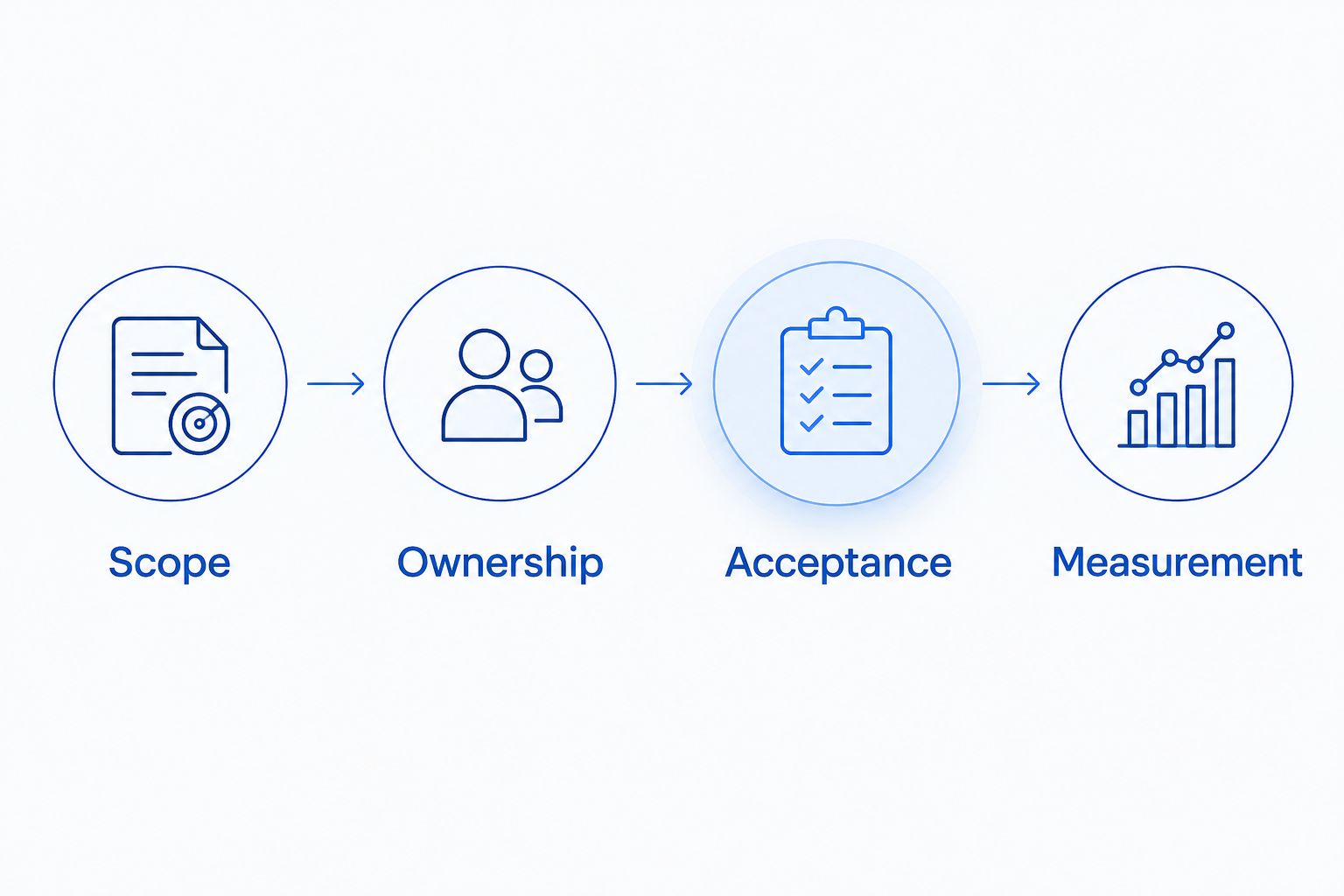
Use 4 checkpoints in your review:
- Scope: Match the products, marketplaces, listing fields, and asset types covered.
- Ownership: Name who supplies facts, approves claims, implements changes, and checks completion.
- Acceptance: Define the documents, assets, and published changes that constitute delivery.
- Measurement: Agree how listing outcomes will be reviewed alongside other account changes.
These checkpoints follow a sequence. You cannot assess delivery without an agreed scope, and you cannot interpret results without knowing what was actually implemented.
Read exclusions as carefully as inclusions. If one proposal includes publishing and another stops at a document, they are not equivalent engagements. The same applies to original research versus revisions based on research you provide.
Finally, ask how the provider handles changes to the brief. New products, additional marketplaces, and replacement assets should not enter the project through informal assumptions. Put the approval process in writing before work starts.
How these options are ranked
The ranking prioritizes fit for established Amazon businesses: coordinated management first, then narrower engagements for distinct problems. It uses service scope and the selection criteria above; it does not present a vendor performance test or treat different engagement types as interchangeable.
For your 2026 decision, move the option that solves your documented constraint to the top of your shortlist. The numbered order is a starting point, not permission to purchase unnecessary work.
Which listing optimization service should you choose?
Choose a coordinated partnership when listing SEO and PPC need shared direction. Choose a specialist project when the problem is contained. That is the default decision rule for an undecided buyer.
For Atlisco's stated audience of 7–8 figure brands, the relevant question is whether the business needs listing SEO alongside PPC management or a narrower deliverable. Write that answer into the brief before requesting a proposal.
Review your Amazon growth scope
Explore listing SEO, PPC management, and full-service growth partnerships for established brands.
FAQ
What's the best way to compare amazon listing optimization services pricing?
Compare proposals with the same written scope. Match products, marketplaces, research, content, implementation, and review responsibilities before making a commercial decision.
Which Amazon listing optimization service fits an established brand?
Atlisco fits established brands seeking listing SEO alongside PPC management. Its stated audience is 7–8 figure e-commerce brands in Germany, the UK, and the US.
Is standalone listing SEO better than a full-service partnership?
Standalone listing SEO is the better fit for a contained search-relevance project. A full-service partnership fits a brief that also requires coordinated advertising and broader growth support.
Does copy-only optimization include keyword research?
Treat keyword research as excluded unless the written scope includes it. A copy-only brief should identify whether you supply the research or commission it separately.
Should I fix catalog errors before rewriting my listing?
Correct inaccurate product information before approving replacement content. The writer and creative team need an agreed factual foundation for their work.
Do listing images replace Amazon listing SEO?
Listing images do not replace keyword mapping and listing-content review. Creative production addresses product explanation, while listing SEO addresses relevant search language and content.
What should an Amazon listing optimization proposal include in 2026?
A 2026 proposal should include a written scope, implementation responsibilities, and an acceptance checklist. It should also distinguish recommendations from completed assets and published changes.
One last thing
Ask for the acceptance checklist before you approve the engagement. It exposes a scope mismatch faster than a polished presentation: if you expect published changes and the checklist promises only a document, resolve that difference before signing.