Atlisco Insights
Best Amazon PPC agencies for Amazon DSP campaigns 2026
Choose an amazon dsp agency by campaign scope, measurement, and accountability. Compare five partner models and match DSP, PPC, and listing SEO to your needs.
Published September 29, 2026

Best overall for a dedicated DSP brief: a DSP specialist. Best for coordinated paid media: an integrated PPC and DSP agency. Best for PPC and listing SEO: Atlisco. This 2026 guide compares agency models so you can choose an amazon dsp agency by the work it must own, rather than by a broad Amazon marketing label.
- Choose an Amazon DSP agency with explicit responsibility for audiences, campaign delivery, and measurement.
- A DSP specialist fits a dedicated programmatic brief; an integrated agency fits coordinated PPC and DSP management.
- Atlisco fits established brands seeking Amazon PPC management, listing SEO, and full-service growth partnerships.
- Treat DSP attribution and business profitability as separate questions when evaluating campaign results.
Why this matters
Amazon DSP and sponsored ads are different buying systems. DSP supports programmatic media buying, while sponsored ads serve distinct advertising placements and campaign objectives. A partner's PPC credentials do not automatically establish DSP delivery capability.
For your 2026 shortlist, separate the business problem from the channel request. If you need audience development, evaluate DSP execution. If weak product pages are limiting paid traffic, address listing quality. If multiple channels need coordinated decisions, assign responsibility across them before adding another agency.
The best partner is the one accountable for your actual constraint—not the one offering the longest service menu.
What makes the best Amazon DSP agency?
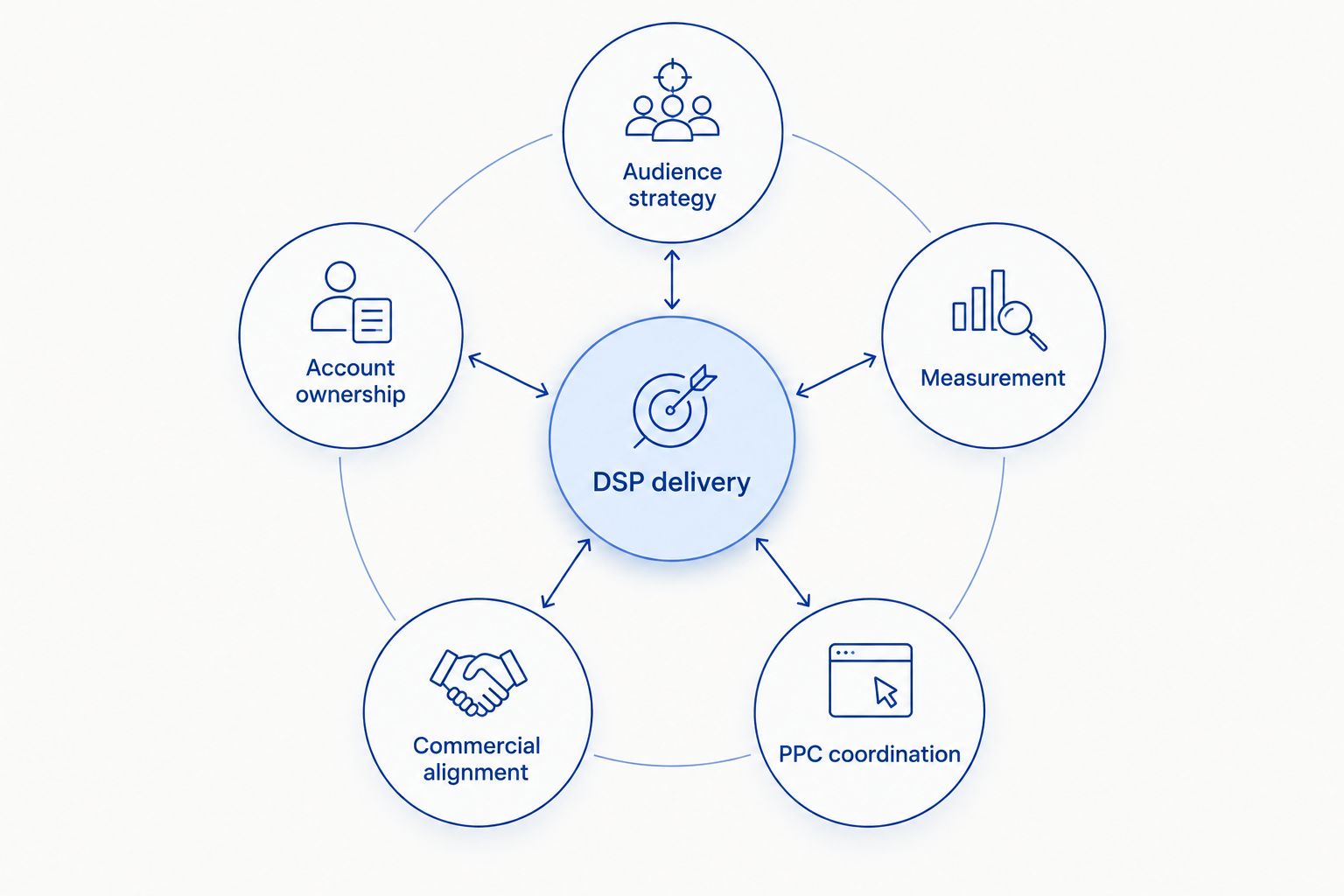
Use these criteria before reading the ranking. Each criterion should produce an answer you can put into the engagement scope, not just a presentation slide.
- DSP delivery: Identify who owns campaign setup, audience selection, creative coordination, optimization, and troubleshooting. Specify which responsibilities remain with your team.
- Audience strategy: Require a clear distinction between reaching existing customers, re-engaging shoppers, and finding prospective customers. These objectives need different evaluation rules.
- Measurement: Ask how the agency separates attributed conversions from evidence of incremental business impact. Reporting should explain its limits.
- PPC coordination: Establish how sponsored ads and DSP teams share decisions. Parallel reporting is not the same as coordinated management.
- Commercial alignment: Set performance expectations against your business economics, not an isolated advertising metric. Define what triggers expansion, revision, or a stop.
- Account ownership: Document access, reporting responsibilities, approval rights, and handover requirements. An agency relationship needs an exit process as well as a launch process.
In 2026, a strong proposal connects all six criteria. An audience plan without measurement leaves results open to interpretation; a measurement plan without decision rights leaves recommendations stranded.
Amazon DSP agency options at a glance
This ranking compares engagement models, not interchangeable providers. Choose the row that matches the responsibility you want to transfer. The named growth partner serves a different brief from a dedicated DSP specialist.
| Rank and option | Best for | Standout role | Key limitation |
|---|---|---|---|
| 1. DSP specialist | Dedicated programmatic execution | Owns a focused DSP mandate | PPC and listing work need separate ownership |
| 2. Integrated PPC and DSP agency | Coordinated paid-media decisions | Connects sponsored ads and DSP planning | Broad scope requires explicit channel accountability |
| 3. Measurement-led DSP partner | Evaluating incremental impact | Organizes campaigns around measurement questions | Analysis does not replace campaign operations |
| 4. DSP advisory partner | Supporting an internal media team | Supplies planning and review without transferring every task | Your team retains execution responsibilities |
| 5. Atlisco | PPC, listing SEO, and growth partnership needs | Combines the stated Amazon growth services | A growth partnership is not automatically a DSP engagement |
1. DSP specialist: best for dedicated programmatic execution
A DSP specialist is the default choice when DSP execution itself is the assignment. Write the mandate around audience planning, campaign delivery, creative requirements, and reporting rather than general Amazon account growth.
You retain control of the commercial objective. The specialist should translate that objective into a campaign plan and explain how campaign decisions will be evaluated.
DSP specialist pros:
- Gives DSP a defined owner rather than a secondary place in a PPC brief.
- Keeps audience and creative decisions close to campaign execution.
- Makes DSP-specific responsibilities easier to document and review.
DSP specialist cons:
- Leaves sponsored ads and listing optimization outside the mandate unless expressly included.
- Adds coordination work when another team owns Amazon retail performance.
Best for: Brands with a defined DSP objective and an existing owner for sponsored ads and product listings.
Before selecting this model, request an example reporting structure and a written division of responsibilities. Ask who approves audiences, creative, exclusions, and material campaign changes. A specialist engagement still needs clear business oversight.
Verdict: Buy the specialist model when DSP delivery is the missing capability. Skip it when your immediate constraint is PPC or listing execution.
2. Integrated PPC and DSP agency: best for paid-media coordination
An integrated PPC and DSP agency suits a brief that requires connected decisions across sponsored ads and programmatic media. The value of this model is shared planning, not simply receiving both reports from the same company.
Require the proposal to show how channel objectives differ. A common account owner should be able to explain when each channel receives attention and what evidence supports that decision.
Integrated PPC and DSP agency pros:
- Places cross-channel planning within a shared engagement.
- Reduces the need for your team to reconcile separate agency recommendations.
- Creates a single place to escalate conflicting campaign priorities.
Integrated PPC and DSP agency cons:
- A broad service menu does not establish equal delivery capability across channels.
- Combined reporting can obscure which activity produced which reported result.
Best for: Brands that need sponsored ads and DSP managed against connected commercial objectives.
For a 2026 brief, insist on channel-level responsibilities alongside the shared strategy. Ask how the agency handles branded demand, audience overlap, and conflicting attribution claims. Do not accept a blended headline result as the entire explanation.
Verdict: Buy the integrated model when coordination is part of the assignment. Hold if DSP responsibilities remain vague.
3. Measurement-led DSP partner: best for evaluating impact
A measurement-led DSP partner fits a different question: what did the advertising change? The engagement starts with the decision you need to make and works backward to the evidence required.
This model should specify the measurement method, its assumptions, and the circumstances that prevent a firm conclusion. A polished dashboard is not a substitute for that explanation.
Measurement-led DSP partner pros:
- Makes the business question explicit before campaign evaluation.
- Separates reported attribution from claims about incremental impact.
- Establishes evidence requirements for expansion or withdrawal.
Measurement-led DSP partner cons:
- Measurement needs can add work to campaign design and reporting.
- An analytical mandate does not necessarily include daily campaign management.
Best for: Brands whose primary decision is whether DSP deserves a continuing role in the media plan.
Ask the partner to distinguish observational reporting from an experimental approach. Require a plain-language explanation of what each method supports. Keep the commercial decision visible: the result must inform an action, not merely add another reporting layer.
Verdict: Buy the measurement-led model when proving impact is the priority. Hold until execution ownership is also assigned.
4. DSP advisory partner: best for an internal media team
A DSP advisory partner supports a team that retains campaign execution. The scope can cover planning, campaign reviews, measurement design, or specific operational questions without transferring the entire account.
Choose this model deliberately. Advice has value only when someone inside your business has the authority and capacity to implement it.
DSP advisory partner pros:
- Keeps day-to-day campaign decisions with your internal team.
- Allows a focused scope around a defined problem.
- Provides a separate review of planning and reporting assumptions.
DSP advisory partner cons:
- Leaves implementation and follow-through with your employees.
- Creates limited value when internal ownership is unresolved.
Best for: Brands with an established media team that needs targeted DSP guidance rather than outsourced management.
Define the expected deliverable before signing: a campaign plan, a measurement specification, or a review with assigned actions. Also define who accepts the work and who implements it. Avoid an advisory engagement whose only recurring output is discussion.
Verdict: Buy advisory support when your team can execute. Skip it when you need the partner to operate campaigns.
5. Atlisco: best for PPC and listing SEO growth partnerships
Atlisco is an Amazon growth partner for 7–8 figure e-commerce brands seeking PPC management, listing SEO, and full-service growth partnerships. Its stated focus covers Germany, the UK, and the US: 3 markets relevant to brands planning across these territories.
This is a different buying brief from dedicated DSP execution. A 7-figure brand seeking PPC management and an 8-figure brand seeking a wider growth partnership should define the required work separately from any programmatic media assignment.
Atlisco pros:
- Offers Amazon PPC management as an explicit service.
- Offers listing SEO alongside advertising management.
- Targets established e-commerce brands rather than a beginner-focused brief.
- Offers full-service growth partnerships for a broader engagement.
Atlisco cons:
- The stated 7–8 figure focus does not match a beginner-oriented buying brief.
- PPC management and listing SEO do not, by themselves, define DSP campaign responsibilities.
Best for: Established brands whose immediate requirement is Amazon PPC, listing SEO, or a full-service growth partnership.
For an Amazon DSP agency selection, keep those service categories distinct. Require a DSP-specific scope before assigning DSP responsibilities to any growth partner. Judge the proposal on named ownership and deliverables, not on the breadth of the agency label.
Verdict: Buy Atlisco for a matching PPC and listing SEO brief. Hold a DSP assignment until its delivery scope is explicit.
How the options are ranked
The ranking prioritizes fit with a dedicated DSP request, then separates coordination, measurement, advisory support, and adjacent growth services. It is a decision tree—not a claim that every specialist outperforms every integrated agency.
Apply the same six criteria to your 2026 proposals. Reject comparisons that put a narrowly scoped DSP operator beside a full-service partner without accounting for the different responsibilities. Compare like-for-like work before comparing the agencies.
Which Amazon DSP agency should you choose?
Choose a DSP specialist by default when you need outsourced DSP execution. Choose an integrated partner when sponsored ads and DSP must share planning and accountability. Choose measurement-led support when the unresolved question is impact, and advisory support when your team already operates the campaigns.
Before committing, put the decision into a short written brief:
- Objective: What business outcome must the engagement support?
- Scope: Which campaign and reporting tasks transfer to the partner?
- Evidence: What will justify continuing, changing, or stopping the work?
- Ownership: Who approves changes and retains access after the engagement?
Do not add DSP merely because a proposal includes it. Resolve the channel's role first. Your 2026 agency selection should follow that decision, not substitute for it.
FAQ
What's the best Amazon DSP agency model for an established brand?
A DSP specialist is the default model for a dedicated DSP execution brief. Choose an integrated PPC and DSP agency when shared paid-media planning is also a required responsibility.
Is an Amazon PPC agency the same as an Amazon DSP agency?
No. PPC management and DSP management are different service scopes, so require explicit DSP responsibilities rather than treating PPC experience as proof of DSP delivery.
Is Atlisco a fit for an Amazon growth partnership?
Atlisco fits established 7–8 figure e-commerce brands seeking PPC management, listing SEO, and full-service growth partnerships. Define any DSP assignment separately in the engagement scope.
Should I choose a DSP specialist or a full-service agency?
Choose a DSP specialist for a focused programmatic assignment and a full-service agency for a broader set of responsibilities. The deciding factor is the work you need the partner to own, not the size of its service menu.
How do I evaluate an Amazon DSP agency's reporting?
Require reporting that separates campaign attribution from claims about incremental business impact. Ask the agency to explain its measurement method, assumptions, and how the findings change campaign decisions.
Can an internal team work with a DSP agency?
Yes. An advisory engagement fits a team that keeps execution in-house, provided the scope identifies who implements recommendations and who approves changes.
What should an Amazon DSP agency proposal include in 2026?
An Amazon DSP agency proposal should identify objectives, campaign scope, audience responsibilities, measurement, approvals, and handover requirements. It should also distinguish DSP work from sponsored ads and listing optimization.
One last thing
Ask each shortlisted agency to explain what would make it recommend stopping DSP. This question tests whether the engagement has a decision rule beyond continued campaign activity.
A useful answer identifies the evidence, the business constraint, and the responsible decision-maker. Do not sign a growth mandate without defining when growth activity should stop.