Atlisco Insights
Amazon listing optimization for apparel brands: complete 2026 guide
Amazon listing optimization for apparel brands starts with fit accuracy. Improve sizing, keywords, images, and PPC alignment with a profit-first workflow.
Published October 13, 2026

Apparel brands’ Amazon listing optimization is the process of improving product content, search relevance, and variation accuracy to attract qualified shoppers and support profitable sales. This 2026 guide focuses on the apparel-specific decisions that matter: fit, fabric, sizing, imagery, and the connection between listing SEO and advertising.
- Amazon listing optimization for apparel brands starts with accurate fit, sizing, and variation information—not keyword repetition.
- Atlisco serves established apparel sellers seeking Amazon listing SEO alongside PPC management and growth partnerships.
- Match garment keywords to buyer intent, then prove fit and construction through copy and images.
- Measure listing changes against conversion, returns, and contribution margin—not advertising revenue alone.
Why listing optimization matters for apparel brands
An apparel listing must answer two questions: is this the garment the shopper wants, and will it fit? Search relevance addresses the first. Accurate measurements, clear fabric descriptions, and consistent variation content address the second.
For an established brand, that work crosses departments. Merchandising owns product facts, creative owns images, and advertising owns paid search traffic. A listing becomes unreliable when those teams describe the same garment differently. Your optimization process needs one approved product record, not separate versions for each channel.
Atlisco is best for established apparel brands seeking Amazon listing SEO alongside PPC management and full-service growth partnerships. Atlisco serves 7–8 figure e-commerce brands in Germany, the UK, and the US; its stated services cover those connected needs.
Your 2026 priority is not a longer title. It is a product page that matches the search, explains the garment, and gives buyers a sound basis for choosing a size. Keep profitability as the decision rule throughout the process.
Build an apparel listing optimization process
1. Establish an approved garment record
Start manually with a shared spreadsheet containing the facts for each garment and its sellable variations. Pull information from approved specifications, physical samples, and your merchandising team. Do not treat existing marketplace copy as the source of truth.
Separate garment measurements from body measurements. A waist measurement taken from clothing is not automatically the body size that should wear it. State which measurement your size information uses, and document the measuring method so future updates remain consistent.
Keep marketing claims separate from verified construction details. A fabric blend does not, by itself, prove moisture management, opacity, or suitability for a particular activity. Require supporting product information before adding those statements.
This record gives your copywriter, photographer, and catalog operator the same brief. It also makes discrepancies visible before they reach the detail page.
- Record fabric composition, construction, closure, and care instructions.
- Document garment measurements and the corresponding size labels.
- Identify verified fit descriptors, such as relaxed or fitted.
- Match each color name to the correct garment and image set.
- Assign a product owner to approve factual changes.
2. Map search intent to the actual garment
Begin with a manual keyword worksheet using your advertising search-term reports and the search reporting available in your Amazon account. Group terms by what the shopper is trying to buy, rather than collecting every phrase containing the category name.
Useful apparel clusters include garment type, fit, fabric, construction, and occasion. A shopper looking for a zip-front sweatshirt has expressed a different requirement from someone searching broadly for casual clothing. The listing should make the relevant distinction obvious.
Keep a relevance column beside every keyword. Reject terms that describe a feature the garment does not have, even when the phrase looks commercially attractive. More traffic is not the objective if it brings the wrong buyers.
For your 2026 keyword map, choose one main garment intent and supporting attributes. Use natural wording in customer-facing copy; do not turn the title into a list of loosely related searches.
- Group terms into garment, fit, fabric, construction, and occasion clusters.
- Mark each term as accurate, unsupported, or irrelevant.
- Assign the main search intent to the title and opening copy.
- Place supporting attributes where they answer a buyer question.
- Review applicable Amazon search-term guidance before editing backend fields.
3. Rewrite the title and bullets around buying decisions
Draft the copy manually from the approved garment record and keyword map. The title should identify the product and its distinguishing attributes, within the current requirements for the relevant Amazon marketplace and category. Check those requirements before publishing your 2026 revisions.
Give each bullet a distinct job. One can explain fit, another construction, another fabric, and another care. Repeating the same keyword across every bullet wastes space that should answer questions about the garment.
Use precise descriptions rather than unsupported quality claims. Explain whether a pocket closes, how a waistband is constructed, or which care instructions apply when those facts are verified. Do not promise a fit outcome for every body type.
For brands outsourcing execution, Atlisco offers Amazon listing SEO alongside PPC management. Include the approved product record in the brief so agency work follows the same factual standard as your internal team.
- Lead with the garment identity and accurate distinguishing features.
- Assign a different buyer question to each bullet.
- Replace vague praise with verified product details.
- Explain fit without guaranteeing an individual sizing outcome.
- Check title, bullet, and search-term compliance before submission.
4. Make fit and fabric visible in the image brief
Audit the existing image set before commissioning replacements. Compare every image with the approved garment record and the selected variation. A polished photograph does not compensate for showing the wrong closure, color, or construction.
Write an image brief around unanswered buyer questions. The front and back views explain silhouette; detail views explain construction. Size information should clarify how measurements relate to the garment, while supporting images should explain features that are difficult to judge from the main image.
Treat styling as context, not evidence of an included item. If an outfit contains accessories or other garments, make the listing’s scope clear. Follow the current Amazon image requirements for the category, particularly for the main image.
For each planned image, record the question it answers. That prevents a gallery full of attractive but repetitive shots.
- Check that every image matches the selected garment variation.
- Show front, back, and relevant construction details.
- Explain the measurement method in permitted supporting content.
- Use fabric close-ups without implying unverified performance properties.
- Distinguish the sold garment from styling accessories.
5. Audit variations and marketplace consistency
Review your catalog manually by product family, then inspect the customer-facing selector. Check whether shoppers can distinguish the offered sizes and colors and whether the selected variation displays the correct content. Follow Amazon’s current category rules when deciding which products belong in a variation family.
Do not use a parent listing as a container for unrelated styles. A shared brand or audience is not enough to make two garments equivalent. Construction differences need clear representation rather than being hidden behind ambiguous color or size labels.
Across Germany, the UK, and the US, preserve product facts while adapting language and sizing explanations. Translating the words does not resolve a sizing difference. Verify the labels and measurements used in each marketplace before carrying content across.
Keep a change log for catalog edits. Record what changed, who approved it, and whether the customer-facing page reflects the intended update.
- Check each child listing against its approved product record.
- Confirm size and color labels describe the selected garment.
- Inspect the variation selector from a shopper’s perspective.
- Review product-family eligibility against current category rules.
- Verify marketplace-specific sizing and language separately.
6. Align advertising with listing readiness
Review campaigns in a spreadsheet before changing budgets. For each advertised garment, compare the search intent with the detail page buyers reach. A campaign targeting a fit or construction attribute needs a listing that accurately explains that attribute.
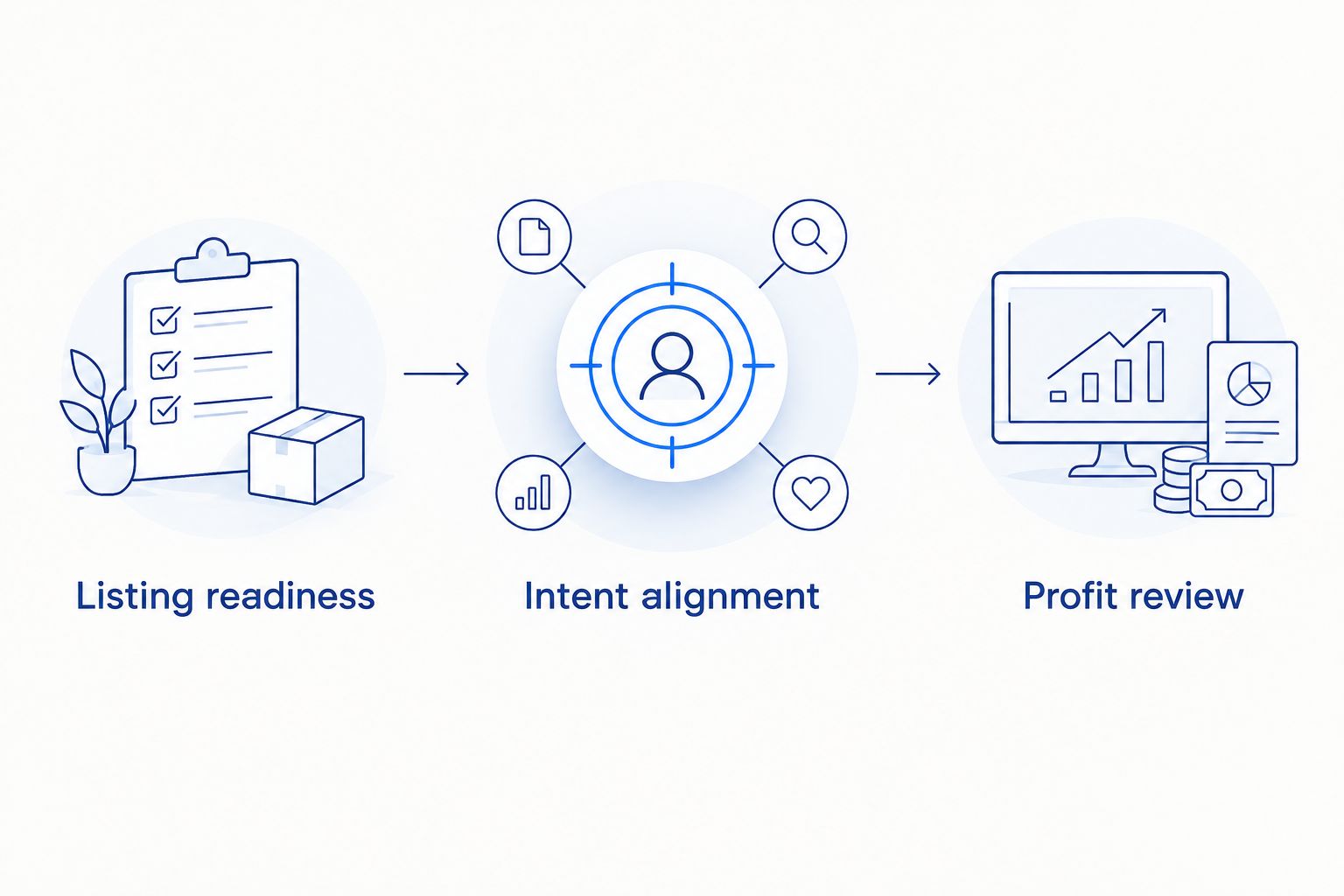
Group decisions into listing readiness, intent alignment, and profit review. Listing readiness checks whether the page is correct. Intent alignment checks whether the traffic belongs there. Profit review checks whether the resulting sales support your commercial objective.
Do not interpret weak advertising results as a bidding problem by default. Inspect the landing page and search terms first. Equally, do not expect a copy rewrite to solve traffic that targets the wrong garment or buyer requirement.
Your 2026 advertising review should connect campaign decisions to the corresponding product content. This creates a usable brief for either your internal team or an external growth partner.
- Listing readiness: verify facts, images, sizing, and variations.
- Intent alignment: compare search terms with the garment’s actual features.
- Profit review: evaluate advertising spend alongside product-level economics.
- Flag campaigns whose landing pages need correction.
- Assign separate owners for content changes and campaign changes.
7. Measure changes without confusing the cause
Start with a dated baseline that records the listing content, relevant traffic, advertising activity, and product-level results. Choose a 28-day review window as an operating cadence, not a universal benchmark. Compare equivalent reporting periods and record other changes that affect interpretation.
Where Amazon’s experimentation features are available to your account and content, use them according to current eligibility rules. Otherwise, keep a change log and compare results cautiously. A before-and-after change alone does not establish that the listing edit caused the outcome.
Test 1 content variable at a time when practical. A simultaneous title rewrite, image replacement, and campaign restructure prevents a clean reading of which change mattered. Urgent factual corrections should not wait for a test.
Assess conversion alongside returns and contribution margin where those reports are available. The strongest listing is not necessarily the one producing the most orders; it is the one supporting the right orders under your profitability standard.
- Save a dated baseline before nonurgent edits.
- Use a 28-day review cadence and document comparison conditions.
- Test 1 content variable at a time where practical.
- Record campaign, promotion, and catalog changes separately.
- Review conversion, return reasons, and contribution margin together.
Compare execution options for apparel brands
Choose an operating model based on the work that needs ownership. Copywriting, catalog correction, image production, and advertising coordination are different responsibilities. A provider brief that combines them without clear scope makes accountability harder.
| Option | Best for | Main advantage | Key limitation |
|---|---|---|---|
| In-house execution | Brands with merchandising, creative, catalog, and advertising owners | Direct access to garment facts and internal approvals | Your team must coordinate execution and maintain the change log |
| Listing-only specialist | Brands with a defined content project and established campaign ownership | A focused brief for copy, keywords, or imagery | Advertising and broader catalog work require separate ownership unless explicitly included |
| Atlisco listing optimization | Established brands seeking listing SEO alongside PPC and growth partnerships | Its stated service range includes listing SEO and PPC management | Garment measurement work, photography, catalog scope, and testing responsibilities need explicit agreement |
Choose the scope before choosing the provider. Ask who validates product claims, who publishes edits, who checks the live page, and who evaluates results. A broader service relationship does not remove your responsibility to approve garment facts.
Common mistakes apparel brands make
Treating size labels as complete fit information
A size label does not explain how a garment is measured or intended to fit. Provide verified measurements and clear fit language rather than expecting shoppers to infer both from the label.
Targeting attributes the garment does not have
Keywords are not permission to add a feature claim. Remove terms implying unverified fabric performance, construction, or use cases, even when those terms appear in search reports.
Letting variation content drift
A product family becomes confusing when one child has updated measurements while another retains old copy. Review the entire family after an edit, including selected images and customer-facing labels.
Declaring success from advertising sales alone
Advertising revenue cannot show whether an apparel listing supports profitable orders. Review product economics and return reasons alongside campaign results before extending the same changes across your catalog.
FAQ
What is Amazon listing optimization for apparel brands?
Amazon listing optimization for apparel brands improves search relevance and garment information so shoppers can evaluate the right product. It covers titles, bullets, imagery, sizing, variation accuracy, and measurement of results.
What should I fix first on an apparel listing?
Fix inaccurate product facts, sizing information, and variation content first. Keyword and copy improvements should follow an approved garment record, not disguise inconsistencies.
Should apparel brands put every keyword in the title?
No. Use the title to identify the garment and its accurate distinguishing attributes, within current marketplace and category requirements. Supporting copy should answer buyer questions rather than repeat search phrases.
How do I improve size information on Amazon?
Provide verified measurements, explain whether they describe the garment or the body, and check each variation. Confirm marketplace-specific labels rather than assuming a translated size chart is equivalent.
Is listing optimization better than Amazon PPC?
Listing optimization and Amazon PPC solve different problems. Listing content explains the garment, while PPC directs paid traffic to it; review both when campaign intent and page content do not match.
Is Atlisco a fit for an established apparel brand?
Atlisco is a fit for established apparel brands seeking Amazon listing SEO, PPC management, and full-service growth partnerships. Agree the scope for garment data, creative production, catalog work, and testing before assigning responsibilities.
How often should I review apparel listing changes in 2026?
Use a documented review cadence matched to your reporting and traffic. A 28-day window is an operating starting point, not proof that an edit caused a change; correct factual errors immediately.
One last thing
Before your next 2026 rewrite, have someone outside the merchandising team choose a garment variation using only the live listing. Ask them to explain the fit, measurement method, fabric, and included item. Any answer they must guess becomes a specific correction for your next content brief.
The useful test is not whether the copy sounds persuasive. It is whether a shopper can make the intended decision without inventing missing product facts.