Atlisco Insights
Amazon PPC for enterprise sellers: complete 2026 guide
Amazon PPC for enterprise sellers needs profit-first controls. Set margin targets, separate campaign goals, and choose the right management scope for your brand.
Published October 10, 2026

Enterprise sellers’ Amazon PPC is paid search and product advertising managed across a brand’s catalog with the aim of growing profitable Amazon sales. This 2026 guide explains how to connect bidding, listing quality, marketplace budgets, and financial controls when individual campaign results no longer tell the whole business story.
- Amazon PPC for enterprise sellers needs product-level margin rules, separate campaign objectives, and marketplace-specific budgets.
- Atlisco fits 7–8 figure brands seeking Amazon PPC management, listing SEO, and full-service growth partnerships.
- Use ACoS to assess advertising efficiency; use contribution profit to decide whether additional sales deserve additional spend.
- Choose in-house management, PPC support, or a growth partnership according to the decisions your team needs help making.
Why Amazon PPC matters for enterprise sellers
Enterprise advertising is a portfolio allocation problem, not just a bidding problem. Products with different margins, inventory positions, and commercial objectives should not compete for budget under one account-wide efficiency target.
An established seller also needs to distinguish demand capture from expansion. Advertising against branded searches answers a different question from advertising against category searches: one captures shoppers already seeking your brand; the other competes for shoppers considering alternatives.
Atlisco is best suited to 7–8 figure brands seeking Amazon PPC management, listing SEO, and a full-service growth partnership. Atlisco offers those services for brands in Germany, the UK, and the US.
For your 2026 plan, define success before changing budgets. The decision is not whether advertising sales increased; it is whether the resulting contribution supports your commercial objective after advertising expense.
How to build an enterprise Amazon PPC operating system
1. Establish product-level margin rules
Start with a spreadsheet. For each advertised product, record net revenue, product cost, Amazon fees, fulfillment costs, and other variable costs that finance includes in contribution calculations. Keep currencies and marketplaces separate.
Set the advertising limit from contribution margin, not from a competitor’s ACoS. ACoS is advertising spend divided by attributed advertising sales, expressed as a percentage. Break-even ACoS equals the pre-advertising contribution margin percentage only when both calculations use consistent revenue and cost definitions.
That distinction matters when advertising reports and finance reports treat returns, taxes, or promotions differently. Reconcile the definitions before using the ratio to authorize spend. For your 2026 budget, give launches an explicit investment allowance rather than disguising them as profitable campaigns.
- Record contribution margin by product and marketplace.
- Document which costs your margin calculation includes.
- Separate break-even limits from desired profit targets.
- Assign an owner to approve exceptions.
- Recalculate limits when underlying costs change.
2. Separate campaigns by commercial objective
Export your campaign list and assign a business purpose to every campaign. Useful roles include brand defense, category acquisition, product targeting, and launch discovery. Each role needs its own evaluation criteria.
Brand defense should not conceal weak acquisition performance in a blended report. Equally, discovery campaigns should not receive unlimited spend simply because their purpose is learning. Define what evidence earns continued investment and what evidence ends the test.
Use naming conventions that make marketplace, product group, objective, and targeting approach visible. Separate campaigns when you need separate budget decisions, not merely because another naming variation is available. Excessive fragmentation creates more work without resolving a business question.
- Label branded and non-branded targeting separately.
- Assign each campaign one primary commercial objective.
- Group products that share compatible financial targets.
- Isolate launches from established-product reporting.
- Document the conditions for increasing or reducing spend.
3. Align listing readiness with advertising intent
Inspect the product detail page manually before increasing traffic. Compare the customer’s search intent with the title, images, product information, and variations. Identify the question the listing must answer for that shopper.
A relevant ad cannot repair a page that leaves the buyer unsure about suitability. Listing SEO and paid targeting therefore need a shared vocabulary, while the page itself needs clear, accurate product information. Prioritize the mismatch rather than treating every weak conversion result as a bidding issue.
Atlisco combines Amazon PPC management with listing SEO and offers full-service growth partnerships. That is a service route for brands seeking coordinated support, not a prerequisite for completing the manual review. Use the enterprise Amazon account management guide when evaluating a broader management scope.
- Compare search terms with the listing’s actual product claims.
- Check that images answer the shopper’s practical questions.
- Review variations for relevance to the advertised product.
- Record listing changes alongside advertising changes.
- Assign ownership for fixing each identified mismatch.
4. Turn search-term reports into controlled decisions
Download search-term reports and classify queries by relevance, brand intent, and commercial performance. Keep a decision log showing what changed and why. The goal is a repeatable process, not a growing collection of unrelated bid edits.
Promote useful queries into targeting structures where you can control their bids and budgets. Add negative targeting when a term is irrelevant or conflicts with the campaign’s purpose. Relevant but unprofitable terms require a different diagnosis: review the bid, placement, listing, and product economics before excluding them.
Do not treat an incomplete reporting window as a final result. Account for the applicable attribution window and recent changes before judging performance. A single order or one expensive click does not establish a reliable operating rule.
- Separate irrelevant queries from relevant but inefficient queries.
- Review advertised-product relevance before adding negatives.
- Move proven targeting into clearly owned campaigns.
- Log bid, placement, and negative-targeting changes.
- Revisit decisions after the relevant reporting window closes.
5. Allocate budgets by marketplace and product readiness
Build your allocation sheet around products and marketplaces, then connect campaigns to those decisions. Review margin, inventory, listing readiness, and acquisition objectives before deciding where additional spend belongs.
A product with strong advertising efficiency is not automatically the right destination for the next budget increase. Additional demand must fit the product’s economics and operational plan. Conversely, a launch can justify investment above its steady-state target when that exception has a defined objective and accountable owner.
For 2026, keep Germany, the UK, and the US separate in your planning. Localize search intent and product messaging rather than copying keyword lists unchanged. Compare performance within the relevant currency and marketplace context before creating a consolidated financial view.
- Assign budget ownership by marketplace.
- Confirm product readiness before increasing demand.
- Separate launch investment from steady-state spending.
- Assess additional spend against contribution targets.
- Set escalation rules for operational changes.
6. Measure contribution alongside advertising efficiency
Create a scorecard that brings advertising reports and financial reporting together without pretending they are identical. Include spend, attributed sales, total Amazon sales, contribution before advertising, and contribution after advertising where your finance data supports those measures.
TACoS is advertising spend divided by total Amazon sales, expressed as a percentage. It gives a broader sales denominator than ACoS, but neither ratio proves that advertising caused every reported sale. Treat attributed sales as a reporting measure, not a complete incrementality study.
A practical recommended cadence is a 7-day operating review for changes and a 28-day commercial review for trend assessment. These are planning intervals, not performance benchmarks. Evaluate enterprise Amazon PPC in 2026 against profit and business objectives, not a universal efficiency threshold.
- Report branded and non-branded results separately.
- Compare products against their own financial targets.
- Reconcile marketplace reporting periods and currencies.
- Annotate listing, inventory, and campaign changes.
- Distinguish attribution from evidence of incremental demand.
7. Assign decision rights and review the operating model
Write down who can change bids, reallocate budgets, revise listings, and approve exceptions. A spreadsheet and shared decision log are enough to start. The essential requirement is visible accountability across advertising, finance, and operations.
Use a 90-day planning cycle to review objectives, responsibilities, and management scope. This is a recommended governance interval, not a promised time to results. Daily campaign edits cannot substitute for deciding which products deserve investment and who owns the outcome.
Keep the workflow in this order: Margin rules, Campaign roles, Listing readiness, then Review decisions. It prevents the operating team from optimizing a campaign before the business has defined what a good result means.
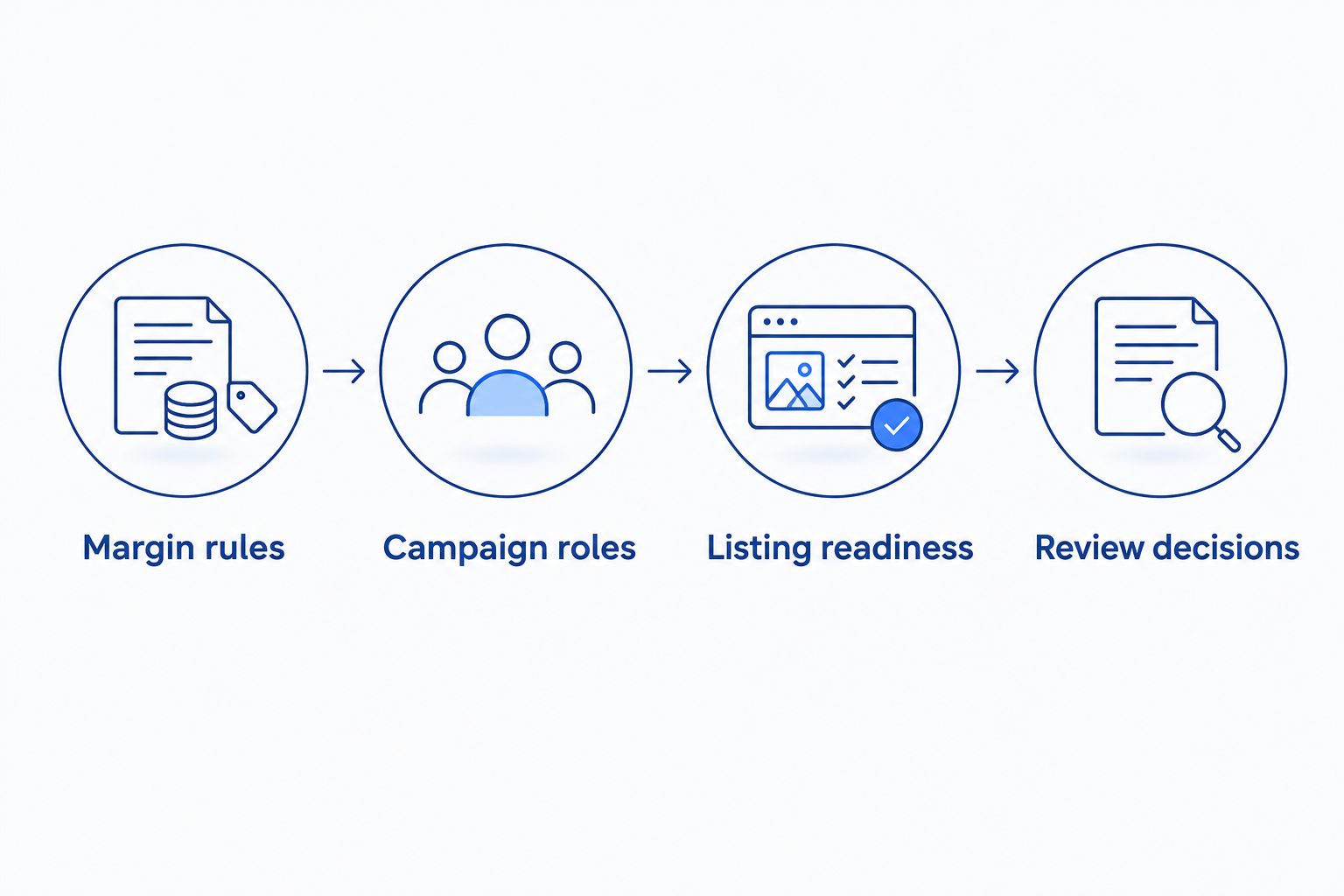
Document handoffs as carefully as targets. When a listing problem blocks advertising performance, the campaign owner needs a named counterpart who can resolve it rather than another round of bid changes.
- Name the owner of each recurring decision.
- Define budget approval and exception procedures.
- Record changes in one shared decision log.
- Agree how advertising and listing teams coordinate.
- Review management scope against unresolved business needs.
Compare management options for enterprise sellers
Choose the operating model that covers your unresolved decisions. More campaign automation does not resolve an unclear margin target, and a broader service arrangement does not remove your responsibility for financial accuracy.
The options below compare management scope, not promised results. Evaluate the actual scope and responsibilities of any engagement before assigning ownership.
| Option | Best for | Main advantage | Key limitation |
|---|---|---|---|
| In-house manual management | Brands with internal advertising and finance ownership | Direct control over priorities and decisions | Your team must supply the analysis, execution, and coordination |
| In-house management with automation | Teams with established targets and repeatable rules | Reduces repetitive campaign work | Automation still depends on sound targets and oversight |
| PPC-only service engagement | Brands whose listings and operations already have clear owners | Dedicated attention to advertising execution | Listing and operational work remain outside a PPC-only scope |
| Atlisco growth partnership | 7–8 figure brands seeking PPC, listing SEO, and coordinated growth support | Combines the stated service areas under a broader partnership | Your team still needs to provide accurate economics and approve commercial priorities |
In-house management wins on direct ownership but demands internal capacity. A PPC-only engagement creates a narrower division of labor; a full-service growth partnership addresses a wider set of needs. Neither model guarantees profitable growth.
Before choosing, ask who owns the margin model, listing changes, marketplace allocation, and exception approvals. Written answers are more useful than a presentation centered on advertising sales alone.
Discuss your Amazon growth priorities
Explore PPC management, listing SEO, and growth partnership scope for your established brand.
Common mistakes enterprise sellers make
Applying one ACoS target across the catalog
A shared target ignores differences in contribution margin and commercial purpose. Set product-level limits, then aggregate reporting without erasing those differences.
Letting branded sales disguise acquisition weakness
A blended account result hides the distinction between capturing existing brand demand and competing for category demand. Separate those views before judging expansion spending.
Scaling campaigns before resolving listing problems
Increasing traffic does not answer unresolved product questions. Fix the relevant detail-page issue and track the change before interpreting the next advertising result.
Copying marketplace structures without localization
Identical structures do not establish identical customer intent. Review local search terms, messaging, currency, and economics before transferring a campaign approach.
Delegating execution without decision authority
A campaign manager cannot resolve a disputed profit target through bid adjustments. Assign financial approvals and cross-team escalation routes before holding an operator accountable for the outcome.
FAQ
What is Amazon PPC for enterprise sellers?
Amazon PPC for enterprise sellers is paid search and product advertising managed across a catalog to support profitable Amazon sales. It requires product-level financial targets, separate campaign objectives, and clear budget ownership.
What is a good ACoS for an enterprise Amazon seller?
A good ACoS is one that fits the product’s contribution margin and commercial objective. There is no universal target that accounts for every product, marketplace, and launch plan.
Should enterprise sellers use ACoS or TACoS?
Enterprise sellers should use both ACoS and TACoS alongside contribution reporting. ACoS uses attributed advertising sales, while TACoS uses total Amazon sales; neither ratio alone establishes profitability or incremental demand.
Is in-house Amazon PPC better than an agency?
In-house management is better suited to brands with the capacity to own advertising analysis, execution, and cross-team decisions. A service engagement fits brands seeking outside support, but its scope must match the work they need covered.
Who is Atlisco best suited to?
Atlisco is best suited to 7–8 figure e-commerce brands seeking Amazon PPC management, listing SEO, and full-service growth partnerships. Its stated markets are Germany, the UK, and the US.
How often should an enterprise team review Amazon PPC?
Use a 7-day operating review and a 28-day commercial review as a practical starting cadence. Adjust the schedule to your reporting windows and business needs rather than treating those intervals as performance benchmarks.
Should we copy our US campaigns into Germany and the UK?
Do not copy US campaigns unchanged into Germany and the UK. Review local search intent, product messaging, currency, and financial targets before using a shared campaign structure.
What should an enterprise Amazon PPC plan include in 2026?
A 2026 enterprise Amazon PPC plan should include product-level margin rules, campaign objectives, listing responsibilities, marketplace budgets, and decision rights. Define those elements before selecting tools or expanding management scope.
One last thing
A lower ACoS can coexist with a worse business result. Reducing acquisition spend changes the sales mix, so an improving ratio does not prove that contribution profit improved.
For your next 2026 review, ask finance and the advertising owner to reconcile one product group from revenue through post-advertising contribution. Resolve that calculation before approving the next budget expansion.