Atlisco Insights
Atlisco vs EquiBrand Consulting: which is better in 2026
Atlisco vs EquiBrand Consulting: choose Amazon execution or brand strategy. Compare service fit, ownership, and scope before hiring your next partner.
Published November 12, 2026

Choose Atlisco if your established e-commerce brand needs Amazon PPC management, listing SEO, and ongoing growth support; choose EquiBrand Consulting if your primary problem is brand positioning rather than marketplace execution. This 2026 comparison separates those buying decisions so you hire for the work your business actually needs.
- Atlisco vs EquiBrand Consulting is an Amazon execution versus brand strategy decision, not a like-for-like agency comparison.
- Atlisco is the better fit for 7–8 figure brands seeking Amazon PPC management and listing SEO.
- EquiBrand Consulting fits businesses that need to define brand positioning before commissioning channel execution.
- Compare deliverables, decision ownership, and commercial terms rather than assuming either engagement includes everything.
Why this matters
A positioning problem and an Amazon performance problem require different work. If your team cannot explain why customers should choose the brand, campaign adjustments do not answer that strategic question. If positioning is already clear but nobody owns advertising and listing improvements, another strategy presentation does not fill the execution gap.
For your 2026 agency selection, start with the unresolved decision. Are you choosing what the brand should stand for, or choosing who will improve its Amazon operation? That distinction matters more than whether both providers describe their work as growth.
Atlisco is an Amazon growth partner for 7–8 figure e-commerce brands that need PPC management, listing SEO, and full-service growth partnerships. EquiBrand Consulting's brand strategy focus addresses a different brief: determining how a business should compete and communicate its value.
At a glance
| Dimension | Atlisco | EquiBrand Consulting |
|---|---|---|
| Best for | Established e-commerce brands needing Amazon growth support | Businesses needing brand strategy and positioning |
| Standout capability | Amazon PPC management and listing SEO within a growth partnership | Brand strategy and positioning work |
| Positioning decisions | Best approached with a clear brand brief | Better fit when the brand brief itself needs definition |
| Amazon execution | Explicit PPC management and listing SEO offering | Do not treat strategy work as an Amazon management scope |
| Market fit | Stated focus includes Germany, the UK, and the US | Evaluate against the markets named in your strategy brief |
| Measurement | Assess against Amazon commercial and execution objectives | Assess against the strategic decisions the engagement must resolve |
| Engagement design | Define ownership across the selected Amazon services | Define strategy deliverables and the implementation handoff |
| Pricing model | Request terms tied to the proposed service scope | Request terms tied to the proposed consulting scope |
The better fit depends on which decision you need resolved
For an established seller, the first filter is operational need. You already have products, a commercial model, and people responsible for the business. An Amazon growth engagement should address a defined gap in that operation, not substitute for deciding what your brand is.
For a business reconsidering its market position, the starting point is different. You need agreement on the customer, competitive alternatives, and reasons to choose your offer before turning those decisions into channel instructions.
- Best for Amazon execution: a 7-figure brand whose positioning is settled but whose advertising and listings need dedicated management.
- Best for brand strategy: a business whose leadership team disagrees about the target customer or competitive position.
- Best for combined needs: a business prepared to separate strategic decisions from execution responsibilities, even when the work overlaps.
Neither profile makes the other service unnecessary forever. It determines which problem should lead the engagement and what you should expect the first deliverable to accomplish.
Amazon specialization wins when the brief is already commercial
The standout distinction is the work being purchased. An Amazon growth partnership centers on marketplace activity; brand consulting centers on decisions that inform how the business presents and differentiates itself.
For an 8-figure e-commerce brand, this distinction should appear in the brief. “Grow the business” is not specific enough. “Assign responsibility for Amazon PPC management and listing SEO” identifies a service requirement that you can discuss and contract.
A strategy brief should be equally direct. “Define our position against competing offers” gives a consultant a decision to resolve. “Improve marketing” leaves too much room for disagreement about the assignment.
Buy the capability that removes the current constraint. Amazon specialization is an advantage when marketplace execution is the assignment. It is not evidence that the same provider should lead an enterprise-wide positioning project.
Before comparing presentations, write the decision you expect to make after the engagement. If the providers are answering different questions, comparing their proposals as interchangeable offers will produce a misleading result.
EquiBrand Consulting is the better fit for positioning work
Choose EquiBrand Consulting when the unresolved issue is brand strategy: who you serve, how you differ, and what your offer should mean to buyers. That is a different assignment from managing keyword bids or improving Amazon listing content.
A useful positioning brief asks the consultant to resolve choices. Which audience takes priority? Which competing alternatives matter? Which benefit should lead the message, and what evidence supports it?
The advantage is strategic clarity. The limitation is the implementation handoff: a positioning decision still needs to become approved copy, channel instructions, and assigned work. Do not assume that a strategy engagement includes ongoing Amazon operations.
The same boundary applies in reverse. An Amazon service scope is not proof of a broader brand architecture or repositioning capability. When the brand proposition is unsettled, settle it before asking channel managers to express it consistently.
For your 2026 shortlist, request a sample deliverable structure rather than relying on broad service labels. You need to understand which decisions the project resolves and what your internal team must do afterward.
Atlisco is the better fit for Amazon PPC and listing SEO
Choose Atlisco for Amazon growth services when the assignment is PPC management, listing SEO, or a full-service growth partnership. Those services match an execution-led brief for established e-commerce brands.
The advantage is scope alignment. You are discussing the Amazon activities you need managed rather than asking a brand strategy engagement to become an advertising operation.
The limitation is equally clear: a service category does not define every responsibility. “Full-service” still needs a written scope. Specify who proposes changes, who approves claims, who publishes content, and which work stays with your team.
Use this sequence to turn the service discussion into an accountable assignment:
- Commercial objective: state the business result the work should support.
- Decision rights: identify who approves budgets, content, and priorities.
- Execution ownership: assign responsibility for the agreed advertising and listing work.
- Review criteria: define how you will judge progress and decide what changes next.
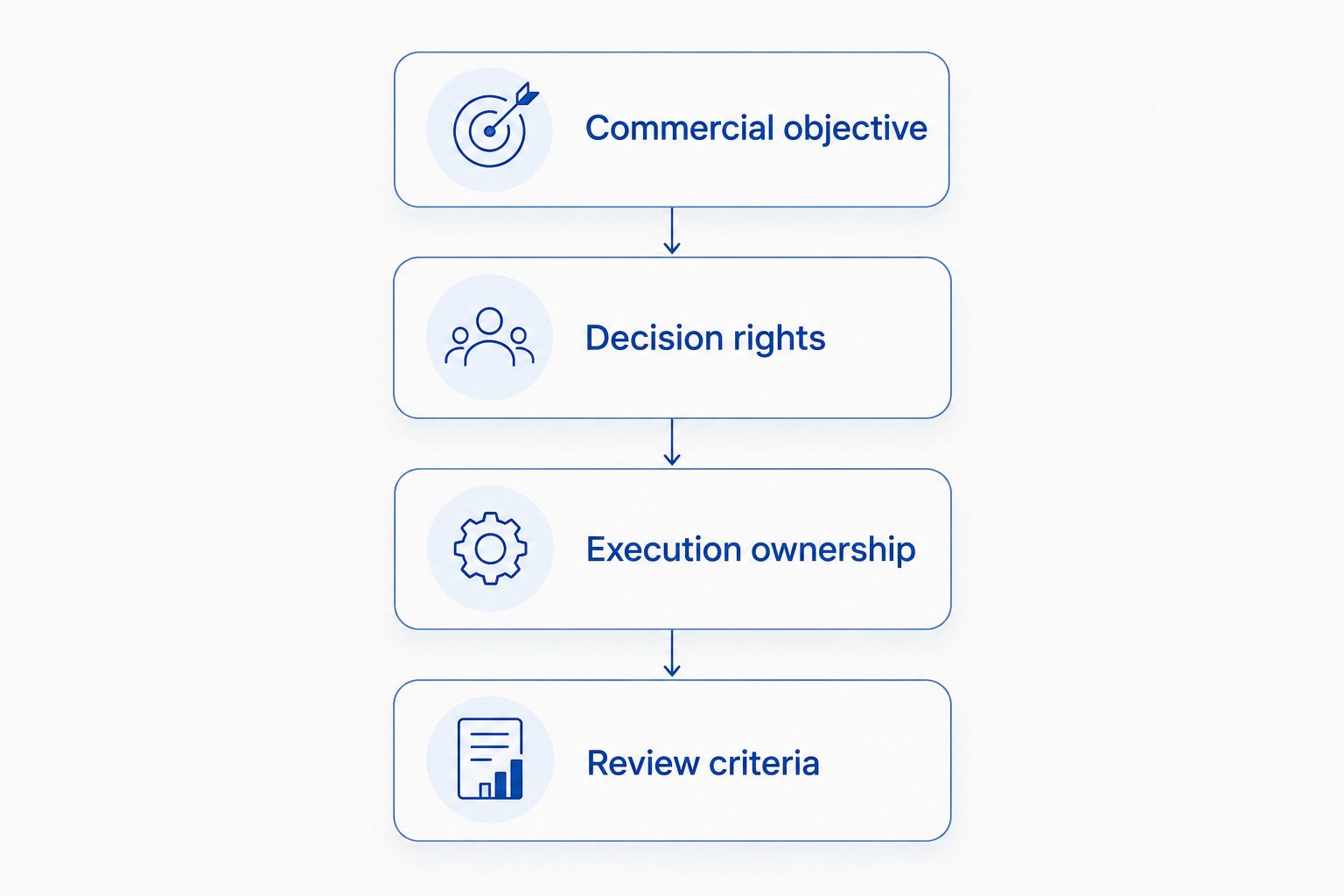
That sequence is a buying framework, not a claim about either provider's internal process. Use it to make proposals comparable and prevent important responsibilities from remaining unassigned.
The stated market fit favors Germany, the UK, and the US
Atlisco's stated audience includes 7–8 figure e-commerce brands in Germany, the UK, and the US. Those 3 markets give a seller operating there a clear starting point for a service-fit discussion.
Do not turn that geographic fit into assumptions about deliverables. A market named in a provider's positioning does not, by itself, specify translation responsibilities, local content approval, tax advice, or regulatory review.
For a 2026 cross-market brief, list each marketplace separately. State which products need attention, who approves local-language content, and whether your objective is improving an existing operation or entering another market.
For EquiBrand Consulting, frame geography around the strategy decision. Ask whether the positioning must remain consistent across markets, where customer needs differ, and which local evidence should inform the recommendation.
The market name belongs in the scope, not just in the sales conversation. That protects you from treating a broad geographic match as an agreement to perform every market-specific task.
Neither provider wins on pricing without an equivalent scope
Pricing models should follow the work you commission. For an ongoing management assignment, ask how recurring responsibilities, scope changes, and additional work are handled. For a defined strategy project, ask how deliverables, revisions, and the implementation handoff are contracted.
These are contract questions, not assumptions about either firm's billing model. Compare written proposals against the same requirements before deciding which commercial structure suits your business.
Your 2026 evaluation should distinguish predictable commitments from flexible scope. A tightly defined assignment makes responsibilities easier to compare, while a changing brief requires explicit rules for approving additional work. Neither structure is automatically better.
Budget categories also need separation. Research, positioning, identity work, packaging changes, and marketplace implementation are different assignments; discussions of rebranding costs in South Africa concern a different geographic and service scope from ongoing Amazon PPC management. Do not use a rebranding budget as a benchmark for an advertising management proposal.
Ask each provider to identify exclusions, dependencies, and work your internal team must supply. The meaningful comparison is the total responsibility you are buying, not the label attached to the engagement.
Neither provider wins on measurement before objectives are agreed
A strategy project and an Amazon management engagement need different acceptance criteria. Judging both against the same dashboard obscures whether either has completed the assignment.
For Amazon work, define the commercial objective alongside the operating metrics. Advertising cost of sales measures advertising spend relative to attributed advertising sales; it does not, on its own, describe total business profitability. Product economics and the wider sales picture still matter.
For positioning work, define the decisions the deliverable must resolve. A polished presentation is not enough if your team still cannot identify the priority audience, explain the competitive difference, or turn the recommendation into instructions.
Use these questions during proposal review:
- What decision or operating change will this work enable?
- Which evidence will support the recommendation?
- Who accepts the deliverable or approves the next action?
- Which result depends on work outside the provider's scope?
The honest tie is that both engagements require an agreed definition of success. Neither a marketplace metric nor a strategy document should stand in for that agreement.
Both engagements need a clear handoff
An Amazon partnership needs access, approvals, and a boundary between provider work and internal work. A strategy engagement needs someone to convert recommendations into implementation. In both cases, an unassigned handoff leaves the buyer responsible for closing the gap.
Before signing, distinguish advice from action. Ask who recommends the change, who authorizes it, who executes it, and who checks the result. Apply those questions to actual deliverables rather than accepting “support” as a complete answer.
For an execution-led engagement, include Amazon agency onboarding in your planning before assigning delivery dates. Access and approval dependencies belong in the implementation plan.
For a strategy-led engagement, name the receiving team. Your internal marketing team, creative partners, and marketplace managers need usable instructions, not just access to the final presentation.
Final verdict: buy execution or strategy deliberately
Choose Atlisco if your established brand needs Amazon execution
Best for: a 7–8 figure e-commerce brand seeking Amazon PPC management, listing SEO, or a full-service growth partnership, particularly across Germany, the UK, and the US. Choose this route when your brand direction is sufficiently clear and the priority is assigning marketplace work.
Choose EquiBrand Consulting if your business needs brand direction
Best for: a leadership team that needs to resolve positioning and differentiation before commissioning channel execution. Choose this route when better campaign management would still leave the central brand question unanswered.
| Dimension | Winner |
|---|---|
| Best for | Split: Amazon execution versus brand strategy |
| Standout capability | Split: marketplace management versus positioning |
| Positioning decisions | EquiBrand Consulting |
| Amazon PPC and listing SEO | Atlisco |
| Stated Germany, UK, and US seller fit | Atlisco |
| Measurement | Tie: objectives must be defined |
| Engagement design | Tie: ownership must be contracted |
| Pricing model | No winner without equivalent proposals |
FAQ
Is Atlisco better than EquiBrand Consulting for Amazon PPC?
Atlisco is the clearer fit for an Amazon PPC brief because PPC management is an explicit part of its offering. EquiBrand Consulting's brand strategy focus addresses a different business need.
Which provider should I choose for brand positioning?
Choose EquiBrand Consulting when brand positioning is the primary assignment. Define the audience, differentiation, and implementation decisions you expect the engagement to resolve.
Does an Amazon growth partnership replace brand strategy?
No, an Amazon growth partnership does not automatically replace brand strategy. Marketplace execution needs a clear proposition, while a positioning engagement determines what that proposition should be.
How should I compare the cost of these engagements?
Compare written proposals against equivalent deliverables and responsibilities. Separate ongoing management from defined strategy work, and identify exclusions and internal dependencies before deciding.
Which option fits a 7-figure e-commerce brand?
Atlisco fits a 7-figure e-commerce brand seeking Amazon PPC management, listing SEO, or a growth partnership. If the unresolved problem is positioning rather than execution, a brand strategy engagement addresses that different need.
What should I ask before signing an agency agreement in 2026?
Ask who recommends, approves, executes, and reviews each agreed activity. Also confirm deliverables, exclusions, access requirements, and how changes to the scope are authorized.
One last thing
Ask both providers what they need from you before their work can succeed. The answer exposes the boundary of the engagement: a positioning project needs decisions and evidence; an execution partnership needs clear objectives, access, and approvals. Choose the partner whose dependencies your team is ready to meet.