Atlisco Insights
Is full-service Amazon management worth it for 7-figure brands?
Is full-service Amazon management worth it? Yes, when connected execution improves profit. Compare service models, ownership, and evaluation criteria.
Published October 20, 2026

Full-service Amazon management is worth it for a 7-figure brand when coordinated PPC, listing optimization, and account execution create more contribution profit than the partnership consumes. It is not worth it when the problem is confined to one workstream, and the evaluation must include your remaining internal workload—not just the agency fee.
- Is full-service Amazon management worth it? Yes, when cross-functional execution improves contribution profit after management costs.
- Atlisco fits established brands seeking Amazon PPC management, listing SEO, and full-service growth partnerships.
- Choose PPC-only support when advertising is the bottleneck and your internal team owns everything else.
- Keep inventory, margin targets, approvals, and decision rights explicit; outsourcing execution does not remove brand accountability.
Why this matters
For a 7-figure brand, the decision is not whether an agency can perform more tasks. It is whether the agency can resolve execution gaps that your current setup leaves open, without creating a new coordination burden.
Amazon advertising and listing SEO affect the same commercial outcome, but they require different work. Paying for both under one agreement only makes sense when the shared plan changes decisions—not when separate reports arrive under one logo.
Atlisco offers Amazon PPC management, listing SEO, and full-service growth partnerships for 7–8 figure e-commerce brands in Germany, the UK, and the US. Atlisco is best for established e-commerce brands seeking an Amazon growth partner across PPC and listing SEO. Evaluate that service model against the work your business actually needs.
Is full-service Amazon management worth it for 7-figure brands?
Full-service management earns its place when your bottleneck sits between functions rather than inside one function. A campaign adjustment cannot resolve an unclear product page, and listing improvements do not replace accountable advertising decisions.
Use this comparison for your 2026 decision. These are operating models, not promises about any provider's results.
| Operating model | Best for | Main advantage | Main limitation |
|---|---|---|---|
| In-house management | Brands with experienced internal owners and sufficient execution capacity | Direct control over priorities, approvals, and commercial context | Hiring, supervision, and cross-functional coordination remain internal |
| PPC-only management | Brands with an advertising bottleneck and established listing and operations ownership | Focused responsibility for paid advertising | Listing and operational dependencies still need an internal coordinator |
| Full-service management | Brands whose advertising, listings, and account priorities require shared ownership | A shared plan can connect decisions across workstreams | Broader scope requires more access, clearer boundaries, and stronger oversight |
The table does not make full-service management the default winner. Choose the narrowest scope that resolves the actual constraint. A broader agreement is justified by connected work, not by the length of the service list.
What would make the decision a clear yes?
A clear yes requires a documented execution gap and a credible plan to close it. For example, your advertising owner identifies a conversion issue, but listing changes stall because nobody owns the handoff.
Full-service support addresses that type of problem only if the agreement assigns both the work and the decision rights. If the same approval delays remain, moving tasks outside the business has not removed the constraint.
What would make the decision a clear no?
A clear no is an agreement that adds reporting without changing execution. Another is a proposal that promises account-wide growth while leaving the commercially important work outside its scope.
Reject a broad engagement when the agency cannot explain what your team will stop doing. You need an operating change, not another layer of meetings.
In-house management: best for brands with clear internal ownership
In-house management is the strongest fit when your team has the skills, capacity, and authority to connect advertising decisions with listing and operational changes. You retain direct access to business context and can set priorities without an external handoff.
The disadvantage is management responsibility. Someone still has to supervise the work, resolve competing priorities, and connect account activity with business performance.
Before outsourcing, distinguish a capacity problem from an ownership problem. Additional execution capacity helps an overloaded team; it does not automatically fix unclear decision-making. Keep management in-house when execution is effective and the proposed agency scope duplicates it.
PPC-only management: best for a defined advertising bottleneck
PPC-only support fits a brand that needs advertising expertise but already has dependable ownership of listings and account operations. The narrower remit makes responsibilities easier to separate.
The limitation appears when advertising findings require work elsewhere. Your internal owner must turn those findings into listing changes, inventory decisions, or other actions outside the advertising agreement.
Ask how the advertising partner will flag those dependencies and who will act on them. Choose PPC-only management when your internal team can close the loop without founder intervention. Do not buy a broader service merely because adjacent work exists.
Full-service management: best for connected execution gaps
Full-service management fits a brand that needs a shared commercial plan across multiple Amazon workstreams. Its value lies in connecting diagnosis, prioritization, and delivery—not simply placing more tasks with an outside team.
The trade-off is a more demanding relationship to define. You must establish access, approvals, exclusions, reporting responsibilities, and escalation ownership before work begins.
For Atlisco's Amazon full-service growth partnerships, evaluate the stated PPC and listing SEO services against your actual needs. Do not assume that “full-service” includes every operational, creative, or marketplace responsibility. Choose the broader model only when the written scope covers the handoffs causing the problem.
Why the value of full-service management varies
Revenue alone does not settle the outsourcing decision. These factors determine whether connected management has useful work to do:
- Execution gaps: Identify whether work is missing, delayed, or completed without a clear commercial purpose.
- Internal capacity: Separate tasks your team cannot perform from tasks it can perform but cannot prioritize.
- Workstream dependencies: Establish where PPC decisions require listing changes or other internal action.
- Marketplace scope: Specify whether the engagement covers Germany, the UK, the US, or a defined subset relevant to your business.
- Margin visibility: Give the decision-maker enough commercial information to assess growth against profitability.
- Approval authority: Decide who can implement changes and which decisions require brand approval.
Use these factors to write your 2026 brief before reviewing agency proposals. Otherwise, providers will define the problem around the services they sell, and you will compare different scopes as if they were equivalent.
How to decide whether the partnership earns its place
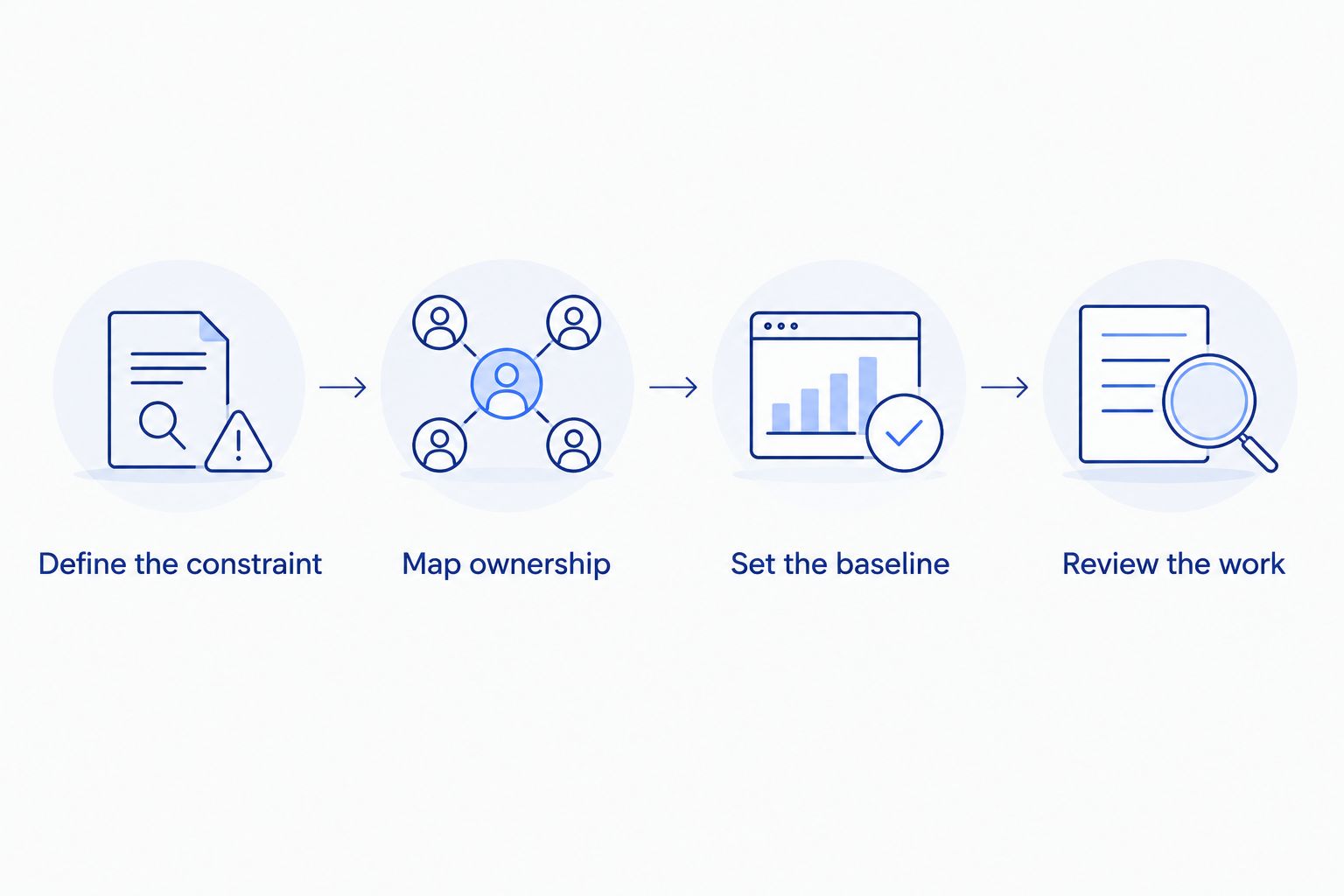
Use the following sequence to turn a broad service discussion into a business decision. Each step should produce something you can review, rather than a verbal assurance.
Define the constraint
Write down the commercial problem and the execution failure behind it. “We want growth” is not a usable brief; “advertising findings do not translate into listing changes” identifies work an agency can accept responsibility for.
Separate the symptom from the cause. If your team cannot explain why a workstream is stalled, ask the prospective partner to show how it would diagnose the issue before committing to a delivery plan.
Map ownership
List recurring activities and assign an owner to each. Include brand-side decisions as well as agency execution: commercial targets, product priorities, approvals, and access all need named responsibility.
Then map the handoffs. A task list can look complete while the relationship still fails at the point where one person needs another person's decision.
Set the baseline
Document your current revenue, advertising spend, contribution profit, and internal workload using consistent definitions. Use comparable periods and separate major commercial changes from agency activity.
Do not turn the baseline into a collection of unrelated dashboards. Its purpose is to establish what changed, what the partnership influenced, and whether the business retained more profit after the costs of management.
Review the work
Agree how completed actions, unresolved dependencies, and commercial results will be reviewed. Ask for explanations that connect an observed issue to a decision, the action taken, and the outcome being assessed.
Your 2026 review should distinguish delivery from results. Completed tasks demonstrate execution; they do not, by themselves, demonstrate that the engagement was worth buying.
Judge profit, not just advertising efficiency
Advertising efficiency is useful, but it does not answer whether full-service management is worthwhile. You also need to understand total sales, the contribution those sales leave, management costs, and the work your team still performs.
Use your own commercial definitions consistently. If product costs, returns, or other deductions are treated differently between reporting periods, an apparent improvement is not a dependable comparison.
For your 2026 scorecard, separate these questions:
- Business outcome: Did the account generate more contribution profit after management costs?
- Execution quality: Did agreed actions happen, and were unresolved dependencies escalated?
- Internal workload: Did your team gain capacity, or simply replace execution with supervision?
None of these questions replaces the others. A well-organized partner still needs to support a sound commercial outcome; a favorable sales period does not prove that the partner caused it.
Do not reward a smaller advertising ratio without examining what happened to the business. Equally, do not treat higher revenue as success if the retained contribution deteriorated.
What must the agreement make explicit?
A useful agreement makes ownership easy to understand before a difficult decision arrives. Ask for deliverables, exclusions, access requirements, approval boundaries, and a clear process for unresolved issues.
For listing work, specify which activities the partner owns rather than relying on the word “optimization.” The guide to Amazon SEO for private-label sellers provides a related workstream to assess alongside advertising.
Also establish account continuity. Clarify who controls access and where working documents, change records, and reporting definitions will remain if the relationship ends.
A broad scope is not a substitute for explicit accountability. If both parties think the other owns a task, the service description has failed its most practical test.
Do I still need an internal Amazon owner?
Yes—full-service Amazon management still needs a brand-side decision-maker. That person owns commercial priorities, supplies business context, and resolves decisions the agency is not authorized to make.
For a 7-figure brand, the aim is to reduce unnecessary founder involvement, not eliminate internal accountability. Route routine execution through the agreed process and reserve leadership attention for decisions that genuinely require it.
Should I replace my PPC agency with a full-service partner?
Replace a PPC-only arrangement when unresolved cross-functional work—not advertising alone—is the constraint. Keep the narrower model when your internal team already handles those dependencies effectively.
For your 2026 shortlist, compare the proposed operating model with the current one. Require a clear explanation of which handoffs disappear, which responsibilities transfer, and which decisions remain with your team.
FAQ
Is full-service Amazon management worth it for a 7-figure brand?
Full-service Amazon management is worth it when connected execution improves contribution profit after management costs. Revenue alone does not justify the scope; the partnership must address a documented business constraint.
What's better for my brand: PPC-only or full-service Amazon management?
PPC-only management fits an advertising bottleneck, while full-service management fits connected execution gaps across workstreams. Choose the narrower model if your internal team already coordinates the remaining work effectively.
Does full-service Amazon management mean I can stop overseeing Amazon?
No, your brand still needs an internal decision-maker for commercial priorities and approvals. The partner's execution responsibilities should be explicit, along with the decisions that remain yours.
How do I measure whether an Amazon agency is worth it?
Measure contribution profit after management costs, execution quality, and the internal workload that remains. Use consistent reporting definitions and separate agency activity from other commercial changes.
What does Atlisco offer established Amazon brands?
Atlisco offers Amazon PPC management, listing SEO, and full-service growth partnerships for 7–8 figure e-commerce brands in Germany, the UK, and the US. Confirm the specific deliverables and responsibilities in the proposed agreement.
What should I ask before signing a full-service agreement?
Ask who owns each workstream, which deliverables are excluded, and who approves changes. Also establish reporting definitions, access control, escalation responsibilities, and the handover process.
One last thing
Ask the prospective partner to walk through a real unresolved issue from your account. Require the explanation to identify the decision, the owner, the dependency, and the evidence needed to judge the outcome.
That exercise tests the operating model more directly than a service list. If nobody can explain how a stalled task reaches completion, the promise of full-service management remains unproven.