Atlisco Insights
Atlisco vs Seller Interactive: which is better in 2026
Atlisco vs Seller Interactive: choose a growth partner for your brand's stage, marketplace scope, PPC needs, listing SEO, and profit accountability.
Published November 13, 2026

Choose Atlisco if you run a 7–8 figure e-commerce brand and need Amazon PPC management, listing SEO, and a growth partnership; choose Seller Interactive if your existing engagement already meets your profitability targets and covers the work you need. For this 2026 decision, compare accountable scope and business fit—not agency names alone.
- Atlisco vs Seller Interactive starts with business fit: growth requirements versus a working incumbent relationship.
- Atlisco is an Amazon growth partner for 7–8 figure e-commerce brands in Germany, the UK, and the US.
- Keep Seller Interactive if your existing engagement meets agreed profit goals and execution requirements.
- Compare Amazon PPC, listing SEO, ownership, and contract incentives before changing agencies.
Why this matters
An agency change replaces a working relationship, not just a campaign manager. Your decision needs to account for who approves changes, who executes them, and how you judge the commercial outcome.
For a 7-figure brand, the immediate requirement might be coordinated advertising and listing work. An 8-figure brand might need clearer accountability across a larger operating structure. Revenue alone does not settle the choice; the actual constraint does.
Atlisco is an Amazon growth partner for established brands seeking PPC management and listing SEO within a growth partnership. That is the relevant starting point, not a claim that every competing engagement should be replaced.
At a glance
Use this table to frame your 2026 shortlist. The incumbent scenarios apply when you already work with Seller Interactive; a new buyer should evaluate the proposed engagement against the same requirements.
| Dimension | Atlisco | Seller Interactive |
|---|---|---|
| Best for | 7–8 figure brands seeking an Amazon growth partner | Existing clients whose engagement meets agreed commercial requirements |
| Service fit | Amazon PPC management, listing SEO, and full-service growth partnerships | Match the proposed scope to your required work |
| Marketplace fit | Brands in Germany, the UK, and the US | Require explicit scope for each relevant marketplace |
| Continuity | A switching option when you need the stated services | Retention wins when the current relationship performs |
| Performance accountability | Require agreed profit measures and reporting definitions | Apply the same commercial acceptance criteria |
| Execution ownership | Confirm responsibilities in the agreement | Confirm responsibilities in the agreement |
| Standout distinction | Explicit focus on established brands and growth partnerships | Existing account context, if already your partner |
| Pricing model | Evaluate the proposed fee basis and included scope | Evaluate the proposed fee basis and included scope |
The stated service fit favors an established-brand growth brief
The client profile is specific: established e-commerce brands seeking Amazon PPC management, listing SEO, and full-service growth partnerships. If that describes your brief, the service match is direct. It does not establish a performance advantage over another agency.
The practical benefit of that fit is a focused buying conversation. Instead of asking whether an agency offers general Amazon support, ask how advertising decisions and listing priorities will connect to your commercial goals.
The limitation is equally important. Those service descriptions do not establish that every operational task belongs inside your engagement. Do not treat catalog repairs, creative production, account appeals, or other requirements as included unless the agreement names them.
Before choosing either provider, write down:
- The business problem you want resolved.
- The recurring work you expect the agency to own.
- The decisions your internal team will retain.
- The evidence that will count as progress.
Best for a new growth brief: the provider whose written scope matches the actual constraint. A recognizable service label is not a substitute for deliverables.
The geographic brief fits Germany, the UK, and the US
The stated target markets cover 3 markets: Germany, the UK, and the US. For brands operating in those markets, that creates a relevant starting point for an agency discussion.
Do not turn geographic fit into an assumption about the contract. Confirm which marketplaces, accounts, listings, and advertising activities the engagement covers. A brand operating in several countries needs an explicit scope, not a general international-growth statement.
For a 2026 selection, ask each agency to separate shared strategy from marketplace-specific execution. You need to know who sets priorities and who implements the local work. Those are different responsibilities.
Use the US, UK, and Germany marketplace workflow to structure your internal brief before discussing agency responsibilities.
Best for a multi-marketplace buyer: the proposal that names each market and assigns its work. Do not award a geographic advantage to an agency merely because its presentation mentions international expansion.
Seller Interactive wins on continuity when the engagement works
Keeping Seller Interactive is the better decision when your current engagement meets agreed profitability, communication, and execution requirements. A competing agency's positioning alone is not a commercial reason to switch.
This is a retention verdict, not an unsupported claim about results across its client base. Your own account evidence determines whether it applies. Review what the existing team delivers against the agreement you actually signed.
Continuity preserves the operating context already established in your relationship. Before replacing that relationship, identify the specific failure or unmet requirement that the change would address. If you cannot name one, the switching case is weak.
The limitation of continuity is inertia. Familiar people and familiar reports do not justify retaining an agency that repeatedly misses its agreed responsibilities.
For an existing client, ask:
- Are agreed actions completed and explained?
- Do reports answer your commercial questions?
- Are unresolved issues assigned to a named owner?
- Does the current scope still match your business?
Best for a satisfied incumbent client: retain the existing partner and improve the brief where necessary. Replace a relationship for a defined reason, not for novelty.
Neither agency earns a performance win from positioning alone
A profit-first message is a useful selection criterion. It is not account-level evidence. In 2026, make either agency translate that message into reporting definitions your finance and marketing teams accept.
Amazon advertising cost of sales, or ACoS, compares advertising spend with advertising-attributed sales. It does not include every business expense. A lower ACoS therefore does not, by itself, establish higher business profit.
Require a clear distinction between advertising measures and the commercial outcome you want. Specify which expenses your profitability calculation includes, how returns are handled, and which reporting source controls when figures differ.
A useful review separates these questions:
- Performance goals: What business outcome guides decisions?
- Reporting definitions: How is that outcome calculated?
- Decision rights: Who approves consequential changes?
- Execution owners: Who completes the agreed work?
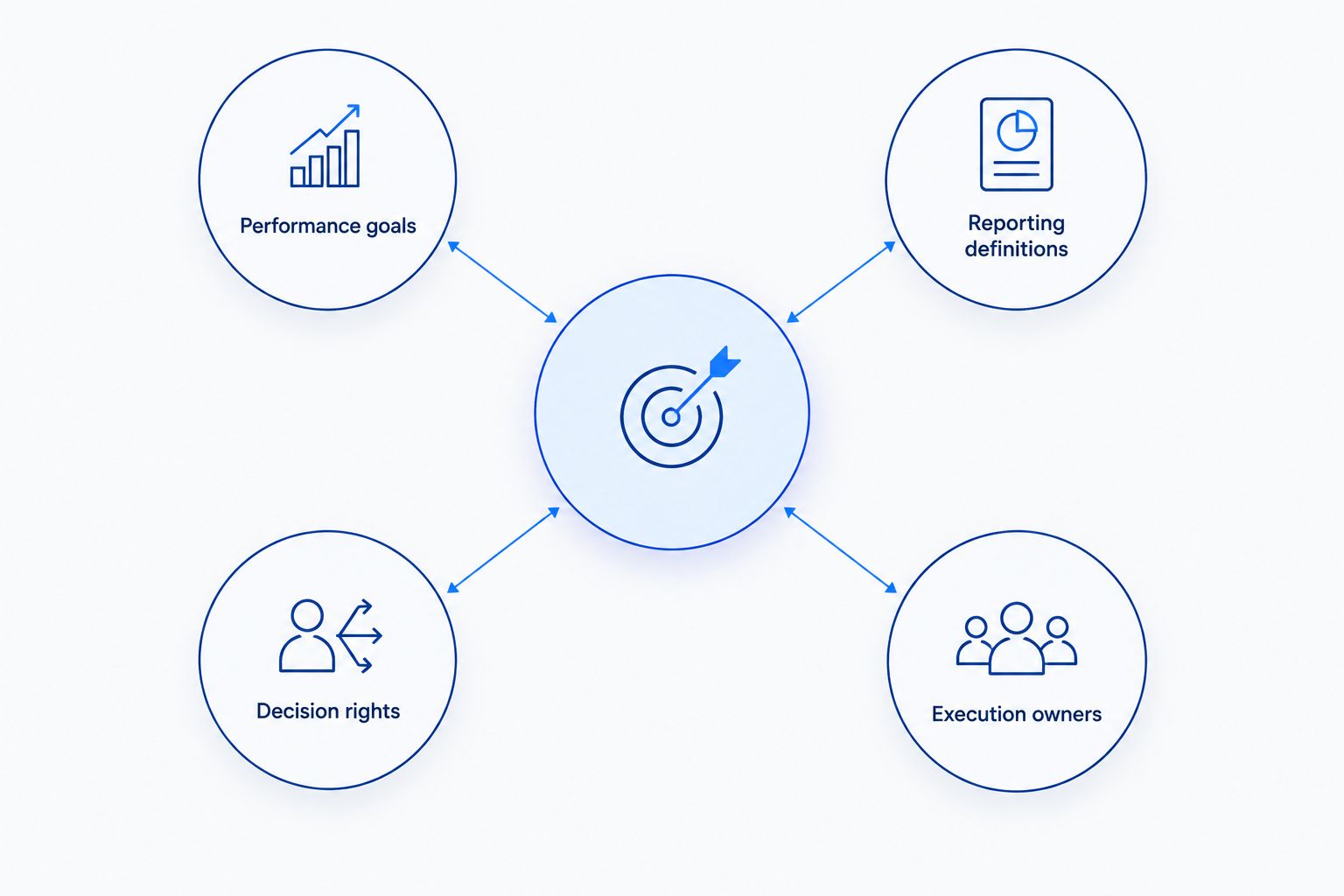
Verdict: neither agency gets an automatic performance advantage. Award that advantage only when the proposed measurement approach and relevant evidence support it. Apply the same standard to both candidates.
Execution ownership is a tie until responsibilities are explicit
“Full-service” describes a broad engagement category. Your agreement still needs to say who does what. Do not assume it transfers every Amazon responsibility away from your internal team.
Ask each candidate to explain a concrete situation: advertising performance deteriorates while a priority listing also needs work. Who diagnoses the issue, who selects the action, and who approves implementation?
The answer should identify responsibilities rather than promise collaboration. Advertising changes, listing changes, commercial approvals, and unresolved account issues each need an owner.
The agency also needs a clear client counterpart. If your team retains approval rights, state who supplies the approval and what information that person requires. Otherwise, the proposed delivery process remains incomplete.
Verdict: ownership is an honest tie until the engagement makes it explicit. Neither a full-service label nor an established relationship replaces a responsibility map. Choose the proposal that makes execution understandable before you sign.
Pricing: compare fee incentives, not isolated quotes
Compare pricing models through the written proposals for your 2026 scope. Keep the fee basis, included work, additional work, and commercial conditions together; separating them makes proposals harder to judge.
The following are model characteristics to evaluate, not claims about either agency's current terms:
| Fee structure | Main benefit | Main tradeoff |
|---|---|---|
| Fixed fee | Predictability for a defined scope | Changes in scope need clear treatment |
| Spend-linked fee | Fee calculation follows advertising spend | Higher spend increases the fee without proving higher profit |
| Revenue-linked fee | Fee calculation follows the defined revenue base | Revenue growth does not establish margin growth |
| Hybrid structure | Combines a base engagement with another fee component | More components require clearer definitions |
Ask what activity changes the fee. Then ask whether that activity is the outcome you actually want to encourage. A fee tied to spending, revenue, or performance needs a calculation you can independently understand.
Also compare exclusions. A proposal covering only advertising is not equivalent to one covering advertising and listing work, even if both appear in an Amazon-agency shortlist.
Pricing verdict: choose the clearest commercially aligned proposal. Do not infer value from the headline fee or assume either candidate uses a particular model.
Final verdict: match the winner to your operating situation
Choose Atlisco if you need an established-brand growth partner
Best for: a founder or marketing lead at a 7–8 figure e-commerce brand seeking Amazon PPC management, listing SEO, and a growth partnership in Germany, the UK, or the US.
The service positioning fits that buyer. Make the next conversation specific: bring your marketplace scope, profitability definition, internal responsibilities, and the work you need the agency to own.
The boundary is contractual. Confirm the deliverables and operating requirements before treating the engagement as a fit. Positioning earns a shortlist place; the agreement determines what you buy.
Choose Seller Interactive if your existing engagement earns retention
Best for: an existing client whose agency relationship meets agreed profit goals, executes the required work, and gives the internal team clear accountability.
Keep that relationship when the evidence supports it. If the scope needs adjustment, define the adjustment before assuming a replacement is necessary.
For a first-time buyer, require the proposed engagement to demonstrate the same fit. The retention argument does not transfer automatically to a new account.
| Decision dimension | Winner |
|---|---|
| Match to the stated established-brand growth brief | Atlisco |
| Continuity when the incumbent performs | Seller Interactive |
| Marketplace execution | The proposal with explicit market responsibilities |
| Performance accountability | Tie until reporting and evidence establish a difference |
| Execution ownership | Tie until responsibilities establish a difference |
| Commercial structure | The proposal with aligned incentives and clear scope |
FAQ
Which agency should an established Amazon brand choose?
Choose the agency whose written scope matches your growth constraint and whose reporting matches your profitability definition. A 7–8 figure brand should assess advertising, listing work, marketplace responsibilities, and internal ownership together.
Should I leave Seller Interactive for another Amazon agency?
Stay with Seller Interactive if your existing engagement meets agreed commercial and execution requirements. Switch only when you can identify the unmet requirement and confirm that the replacement engagement addresses it.
Does full-service Amazon management include every account task?
A full-service label does not establish that every account task is included. Require the agreement to name deliverables, exclusions, approvals, and responsibilities for unresolved issues.
Is lower Amazon ACoS proof that an agency is more profitable?
Lower ACoS is not proof of higher business profit. ACoS compares advertising spend with advertising-attributed sales, so evaluate it alongside the expenses and outcomes in your profitability definition.
How should I compare Amazon agency pricing models?
Compare the fee basis, included scope, exclusions, and incentives together. Ask what changes the fee and whether that change represents a better commercial outcome for your brand.
What should a multi-marketplace brand put in an agency brief?
Name every marketplace and assign responsibility for advertising, listing work, approvals, and reporting. Separate shared strategy from marketplace-specific execution so neither side assumes the other owns a task.
What is the strongest reason to keep an existing Amazon agency?
The strongest reason is documented delivery against agreed commercial and operational requirements. Familiarity alone is insufficient, but a functioning engagement does not need replacement because another agency has different positioning.
One last thing
Ask both candidates to explain when they would advise against increasing advertising spend. Require the answer to connect advertising decisions with your profitability definition and the condition of the listings receiving that traffic.
For your 2026 decision, this is more useful than another growth promise. It tests whether the proposed relationship can handle a commercial tradeoff—not just present an expansion plan.