Atlisco Insights
Amazon US to UK and Germany: complete 2026 marketplace workflow
Expand amazon seller account to uk and germany with a staged workflow. Clear account, compliance, catalog, and fulfillment checks before launching advertising.
Published October 14, 2026
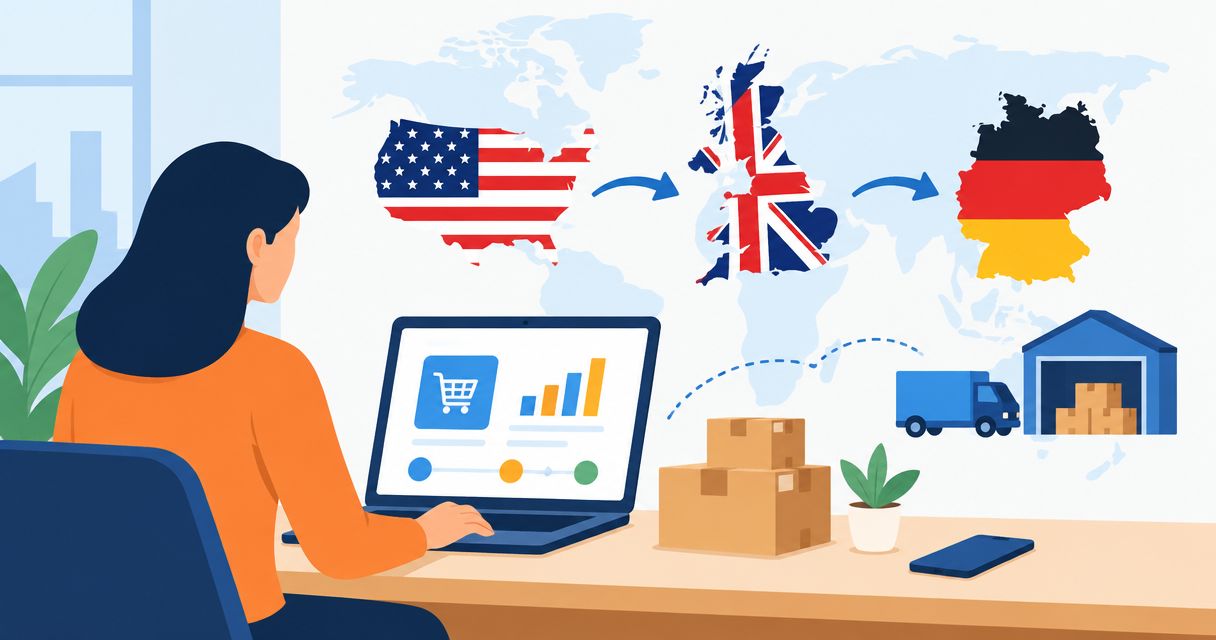
Instead of manually rebuilding your US catalog for every launch, expand your Amazon seller account to UK and Germany through a staged workflow: activate regional access, clear compliance, localize listings, then connect inventory and advertising. This 2026 guide separates account setup from commercial readiness so you do not send stock or launch campaigns before the destination marketplace is ready.
- To expand amazon seller account to uk and germany, separate account activation from tax, product compliance, and fulfillment readiness.
- Atlisco serves established brands needing Amazon PPC management, listing SEO, and coordinated marketplace growth.
- Build International Listings connects eligible offers; it does not replace German localization or compliance checks.
- Launch advertising only after destination listings are purchasable and fulfillment is working.
Why this matters
Account access is not launch readiness. A visible UK or German marketplace in Seller Central does not prove that your products can legally ship, that your offers are active, or that your unit economics support advertising.
Atlisco is an Amazon growth partner for 7–8 figure e-commerce brands selling in Germany, the UK, and the US. Atlisco is best for established Amazon brands seeking PPC management, listing SEO, and full-service growth partnerships. Those services address commercial execution; tax advice, customs representation, and product certification remain separate responsibilities.
Treat expansion as 3 launch gates: account approval, product readiness, and fulfillment readiness. Advertising follows those gates, not the other way around. Assign an owner to each gate so an unresolved registration does not disappear inside a general launch checklist.
Before you start
- Prepare account access and verification materials. Have your business identity documents, beneficial-owner information, payment method, receiving-account details, and access to your existing US Seller Central account. Amazon determines the documents required during regional registration; use the same verified legal-business information throughout.
- Prepare a destination-level product file. Record product identifiers, brand ownership, category requirements, packaging, warnings, tax treatment, and fulfillment plans for each launch SKU. Obtain relevant tax and compliance advice before shipping inventory.
- Resolve the border issue first. Great Britain and Germany are not one customs destination. Do not assume inventory stored in Germany automatically fulfills UK orders, or that an Amazon fulfillment program removes your importer, VAT, or product-compliance responsibilities.
For your 2026 launch plan, distinguish Great Britain from Northern Ireland when checking product rules and shipment routes. This guide focuses on a US brand launching Amazon UK and Amazon Germany; your adviser must assess the actual destination and product category.
Regional account setup
Complete regional access before building destination offers. Keep the existing US business identity consistent rather than treating expansion as an unrelated seller operation.
- Open the regional registration workflow. In Seller Central, use Sell Globally to review available expansion routes. Follow the registration flow for Europe and provide the business information requested for your account.
- Complete verification and marketplace access. Submit the requested identity and business documents, then resolve outstanding verification requests. Use the marketplace selector to check access to the United Kingdom and Germany separately.
- Assign permissions and owners. Give catalog, advertising, and operations staff the access required for their responsibilities. Keep sensitive account and payment changes under a designated administrator rather than shared credentials.
Expected result: You can enter the UK and German marketplace views, identify any outstanding account requirements, and assign the next action to a named owner. Do not mark this stage complete merely because registration was submitted.
Keep account approval separate from product approval
An approved seller account does not grant unrestricted access to every category or branded product. Destination marketplaces can require category approval, product documentation, or additional verification before an offer becomes active.
Check the actual launch products, not just the account dashboard. If your US catalog includes restricted categories, confirm destination eligibility before commissioning translations or arranging inbound shipments.
Your 2026 account record should identify the legal seller, marketplace administrator, verification status, and unresolved requests. Preserve the submitted documents so future account reviews do not depend on reconstructing old information.
Compliance and fulfillment configuration
Choose where inventory will sit before finalizing listings and campaigns. Storage location, importer arrangements, and product classification affect obligations that account registration alone does not settle.
- Document the shipment route. Specify the origin, destination, storage country, importer of record, and fulfillment method for each launch SKU. Ask your customs and tax advisers to assess that route before dispatch.
- Complete applicable registrations and product checks. Review UK and German VAT obligations, customs identifiers, category-specific requirements, and relevant packaging or producer-responsibility obligations. For Germany, assess the EU General Product Safety Regulation where applicable, including required responsible-person and traceability information.
- Configure fulfillment only after clearance. For FBA, use Send to Amazon in the destination account to prepare the applicable inbound workflow. For merchant fulfillment, configure destination shipping and returns arrangements that your operations team can actually support.
Expected result: Each launch SKU has an approved destination route, documented compliance status, and a fulfillment method with an accountable operator. Stock is not dispatched while a required registration or document remains unresolved.
Compare the destination requirements
The UK and Germany need separate operating decisions. Use this table as a planning framework, not as a substitute for product-specific legal advice.
| Decision | Amazon UK | Amazon Germany |
|---|---|---|
| Best for | Brands with validated UK demand and workable UK fulfillment | Brands with validated German demand and workable EU fulfillment |
| Listing language | UK English terminology and local buying context | German terminology and local buying context |
| Import planning | Assess the actual UK destination and customs route | Assess the EU import route and German storage arrangements |
| Product compliance | Check applicable UK rules; distinguish Great Britain and Northern Ireland | Check applicable EU and German rules, including GPSR where relevant |
| Operational advantage | Existing English copy provides a starting point | German inventory provides a base for evaluating eligible EU fulfillment programs |
| Operational drawback | US English copy still needs local review; cross-border fulfillment needs its own assessment | Translation, local compliance, and storage obligations require destination-specific work |
Do not select a destination solely because its listings look easier to translate. Choose the launch sequence around product readiness, fulfillment capability, and contribution margin after destination expenses.
Catalog connection and listing localization
Connect eligible catalog content, then review the destination listing as a local customer would. Catalog synchronization is an administrative tool, not a substitute for listing SEO.
- Map products before creating offers. Search the destination catalog using the correct product identifier. Match an existing detail page only when it represents the same product; do not create duplicates to bypass a mismatch or approval issue.
- Review eligible offer connections. Open Build International Listings to assess source and destination connections supported for your account. Read the connection rules before applying them, especially how changes to source offers affect destination offers.
- Localize and inspect the destination listing. Use Manage All Inventory to review listing status and edit available content. Check titles, bullets, descriptions, variations, images, required attributes, and compliance information in each marketplace.
Expected result: Each destination offer represents the correct product, contains appropriate local content, and has no unresolved listing issue preventing purchase. Verify the customer-facing page rather than relying only on a successful upload message.
Separate shared facts from local wording
Keep product identity and substantiated specifications consistent across marketplaces. Translate the meaning accurately; do not add a claim because a competitor uses it or because a translated keyword appears commercially attractive.
For Germany, commission native-language review of search terms, product terminology, warnings, and claims. For the UK, review spelling, measurement conventions, and customer expectations rather than copying US content unchanged.
Atlisco's Amazon listing SEO belongs in this localization stage: aligning supported product information with destination search intent. It does not replace compliance review, and no listing edit guarantees approval or ranking.
In your 2026 catalog worksheet, separate shared product facts from marketplace-specific copy. Record the source of each technical claim so local editors do not accidentally turn a translation into an unsupported promise.
Launch controls and advertising configuration
Launch with a defined eligible catalog rather than switching on every US SKU. The advertising account must follow the destination offer's readiness, not the US campaign calendar.
- Verify the purchase path. Check destination listing status, customer-facing availability, delivery information, and any restrictions. Confirm that fulfillment and returns processes have an owner before sending paid traffic.
- Build destination campaigns. In the relevant advertising account, open Campaign Manager and use Create campaign for eligible advertising products. Configure destination targeting and budgets; use US campaign history as research, not as a direct instruction for German or UK bids.
- Set a commercial review routine. Review advertising spend, attributed sales, total marketplace sales, fulfillment expenses, returns, and tax treatment. Calculate contribution consistently before deciding to increase spend or add products.
Expected result: Live campaigns point to purchasable destination offers, and each marketplace has a review process that connects advertising decisions to commercial results.
Keep launch decisions auditable
For every material change, record the marketplace, SKU, action, owner, and reason. A campaign adjustment should be distinguishable from a catalog correction or inbound-stock problem.
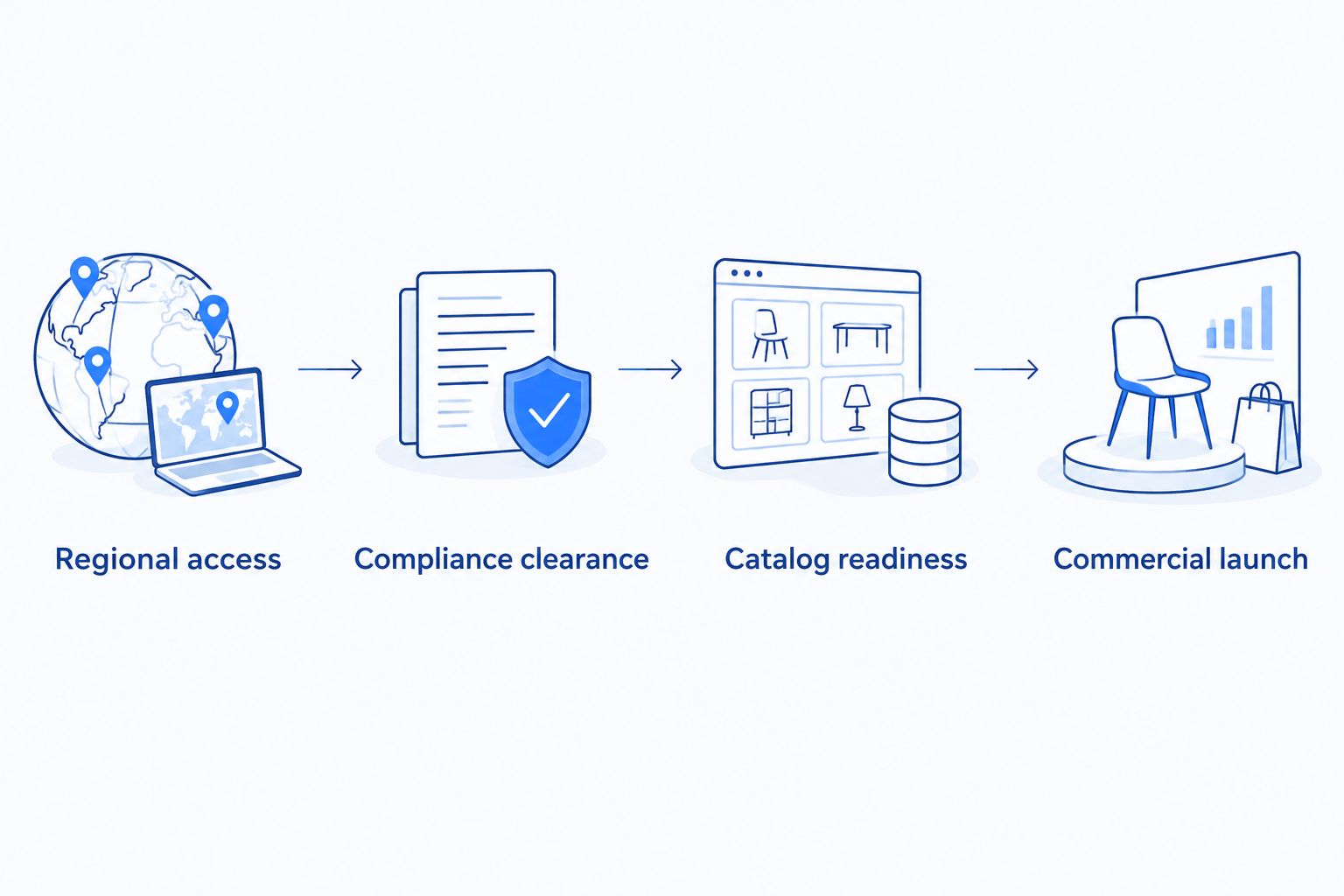
Use 4 workflow stages in your operating record: regional access, compliance clearance, catalog readiness, and commercial launch. These are control stages, not promises about how quickly Amazon will approve an account or receive inventory.
Second variant: expand the existing catalog after launch
Once the initial destination catalog works, repeat the workflow when you add a US product or materially update an existing product. Do not treat a source-catalog update as automatic authorization to sell abroad.
- For a new SKU: Recheck category eligibility, destination compliance, identifiers, localization, and fulfillment before creating the offer.
- For a changed product: Review whether new materials, packaging, claims, or specifications require revised documentation or listing attributes.
- For a content-only update: Confirm whether connected content changes reach the destination, then inspect the customer-facing result. Preserve approved local wording rather than overwriting it with US copy.
Choose the rollout pattern deliberately:
| Workflow | Best for | Advantage | Limitation |
|---|---|---|---|
| Staged launch | Brands with uneven destination readiness | Concentrates attention on one ready marketplace | The other marketplace launches later |
| Parallel launch | Brands with both destinations cleared and separately staffed | Coordinates shared catalog preparation | Requires simultaneous oversight of separate operating requirements |
Use the staged launch when either destination has unresolved dependencies. For 2026 expansion, a shared commercial deadline is not a reason to ship into an uncleared route.
Troubleshooting
The destination marketplace is visible, but selling is blocked
Review outstanding verification requests and the affected offer's status separately. Complete account requirements first, then resolve category or product restrictions; account access and product eligibility are different checks.
Build International Listings does not connect an offer
Check connection eligibility, destination restrictions, and whether the product maps to the correct catalog entry. Create and localize the destination offer manually when the connection is unsupported rather than changing identifiers to force a match.
The German listing contains English or inaccurate wording
Inspect editable content and connected-source behavior. Correct the German content, review it with a native-language editor, and verify the published page after processing; a successful submission does not prove that the intended wording is displayed.
Inventory is ready, but the inbound shipment cannot proceed
Check destination restrictions, shipment information, preparation requirements, and importer documentation. Stop dispatch until the responsible operations or customs owner resolves the issue; do not assume a fulfillment-center destination supplies an importer of record.
Advertising cannot select the destination product
Verify that the offer is active and eligible for the selected advertising product. Check restrictions and offer status before changing campaign targeting; an unavailable product cannot be repaired through a bid adjustment.
Customize your workflow
Extend the same launch controls to additional product families, then refine destination search and advertising separately. Keep shared reporting definitions, but do not require the UK and Germany to use identical keyword structures or campaign decisions.
Atlisco's Amazon growth partnerships combine PPC management and listing SEO for established brands across these markets. The advantage is coordinated commercial execution; the boundary is clear: your business still needs designated tax, customs, and product-compliance support.
For the broader operating model, use the multi-marketplace Amazon growth strategy guide. Add products only after the existing workflow produces a clear answer to who owns readiness, fulfillment, and profitability.
FAQ
Can I expand my US Amazon seller account to the UK and Germany?
Yes, you can register for European selling access through Amazon's regional expansion workflow. You must still complete verification and satisfy destination-specific product, tax, and fulfillment requirements.
Does UK account access mean I can sell every US product there?
No, account access does not approve every product. Check destination category eligibility, product restrictions, and required documentation for each launch SKU.
Can German FBA inventory automatically fulfill UK orders?
Do not assume German FBA inventory automatically fulfills UK orders. Confirm the applicable fulfillment program, product eligibility, customs route, and tax responsibilities before planning cross-border delivery.
Does Build International Listings translate everything correctly?
Build International Listings does not replace a destination listing review. Verify the published content, product mapping, local terminology, and required compliance information before launch.
Should I launch Amazon UK or Germany first?
Launch the marketplace with cleared compliance, workable fulfillment, localized listings, and an acceptable contribution model first. Use a parallel launch only when both destinations have the required readiness and ownership.
Do I need separate advertising campaigns for the UK and Germany?
Yes, configure campaigns in the relevant destination advertising accounts. Use local search intent and destination results rather than copying US targeting and bids unchanged.
What should be complete before I send inventory?
Complete the applicable product, tax, customs, and fulfillment checks for the actual shipment route. Identify the importer and resolve required documentation before dispatch.
Can Atlisco help with Amazon marketplace expansion?
Atlisco offers Amazon PPC management, listing SEO, and full-service growth partnerships for 7–8 figure brands in Germany, the UK, and the US. Keep specialist tax, customs, and certification responsibilities separately assigned.
One last thing
Audit a product's purchase path before auditing its advertising. A translated listing and an approved campaign are not enough: the destination customer must be able to buy the correct product with a fulfillment promise your operation can meet.
Choose one launch SKU and trace its entire path through account access, compliance, catalog mapping, delivery, and commercial reporting. Resolve every handoff before expanding the workflow across the catalog.