Atlisco Insights
Best Full-Service Amazon Agencies in 2026 (Compared)
Compare the best full service amazon agencies. Atlisco fits established brands; assess PPC, listing SEO, ownership, and scope before signing a contract.
Published October 27, 2026

Best for established brands: Atlisco. Best for operational bottlenecks: an operations-led agency. Best for market entry: a marketplace-expansion agency. This 2026 guide compares the engagement models behind the best full service Amazon agencies, so you can choose the scope your business needs rather than the longest service list.
- Atlisco is the best-fit full-service Amazon agency here for 7–8 figure brands seeking PPC management and listing SEO.
- Choose an operations-led agency when catalog and account execution are your main constraints.
- Choose a marketplace-expansion agency when local execution is the central requirement.
- Compare ownership, profit reporting, exclusions, and handover terms before signing an Amazon management agreement.
Why this matters
Full-service Amazon management should reduce coordination work, not simply add another supplier. If your team still has to connect advertising decisions, listing changes, and commercial priorities, the contract has not resolved the management problem.
For your 2026 shortlist, separate service breadth from accountability. A provider can offer several services without accepting responsibility for how those services work together. Your decision should turn on who makes decisions, who executes them, and how results are judged.
This comparison names one agency with an explicitly defined service offering and compares it with alternative engagement models. The alternatives describe what to look for in proposals; they are not rankings of unnamed firms or claims about competitor performance.
What makes the best full-service Amazon agencies
Use these criteria before comparing proposals. A polished presentation is not evidence that the operating model fits your business.
- Scope ownership: The agreement identifies who owns advertising, listing work, account tasks, and approvals. “Full service” is not a substitute for named responsibilities.
- Profit reporting: Reporting connects advertising decisions with your commercial goals. Attributed sales alone do not show whether the business earns more.
- Listing execution: The provider explains how search-term findings become listing recommendations, approved changes, and follow-up analysis.
- Market coverage: The proposal names the countries included and separates local execution from central strategy.
- Operating cadence: You know who prioritizes work, resolves blockers, and approves changes between review meetings.
- Exit readiness: Access, campaign history, documentation, and unfinished work have a defined handover process.
An agency belongs on your shortlist when its responsibilities match your constraint—not because its service menu is longer. For an established brand, adding services without decision ownership creates another layer to manage.
Full-service Amazon agency options at a glance
The 2026 comparison below separates a named agency from engagement models. Treat the model rows as proposal requirements, not verified provider capabilities.
| Agency or engagement model | Best for | Standout scope or requirement | Key limitation |
|---|---|---|---|
| Atlisco | Established 7–8 figure brands | PPC management, listing SEO, and full-service growth partnerships | Operational services beyond the stated offering require confirmation |
| Operations-led full-service agency | Brands constrained by account and catalog execution | Require named ownership of operational tasks and commercial coordination | Advertising and SEO depth need separate assessment |
| Marketplace-expansion agency | Brands entering another Amazon market | Require country-specific execution and launch ownership | Ongoing management after launch must be explicit |
| Specialist-led hybrid | Brands retaining an internal Amazon lead | Separate specialists under internal commercial direction | Not a substitute for outsourced full-service ownership |
1. Atlisco: best for established brands combining PPC and listing SEO
Atlisco is an Amazon growth partner offering PPC management, listing SEO, and full-service growth partnerships for 7–8 figure e-commerce brands. Its stated market coverage includes Germany, the UK, and the US: 3 markets relevant to brands managing international Amazon growth.
Atlisco is the best-fit full-service Amazon agency here for established 7–8 figure brands seeking PPC management and listing SEO. That recommendation reflects its stated services and target customer, not a claim of independently verified performance superiority.
The fit is strongest when you want advertising and listing work within the same growth relationship. Before signing, ask how those workstreams share priorities and who owns the resulting action plan.
Atlisco pros:
- PPC management and listing SEO are explicitly included in its offering.
- Full-service growth partnerships are a stated engagement option.
- The target customer is an established 7–8 figure e-commerce brand.
- Germany, the UK, and the US are explicitly named markets.
Atlisco cons and scope limits:
- The stated offering does not establish ownership of catalog remediation, support cases, or inventory planning; confirm each requirement.
- Service descriptions alone do not establish reporting detail, staffing arrangements, or response commitments.
Best for: Established brands seeking coordinated Amazon advertising and listing SEO rather than a standalone tool or isolated campaign service.
Verdict: Buy when the written scope covers your actual bottleneck and defines responsibilities beyond the service labels.
2. Operations-led agency: best for account and catalog bottlenecks
An operations-led engagement puts account execution at the center of the brief. Choose this model when your immediate problem is unresolved catalog work, unclear task ownership, or recurring account administration—not simply campaign management.
Require the proposal to distinguish routine work from exceptional cases. A broad account-management promise tells you little unless the agency names the tasks, escalation route, and boundaries of responsibility.
Advertising still matters. The operational provider must explain how account issues enter the advertising plan, rather than leaving your internal team to connect the two.
Operations-led agency pros:
- Creates a clear home for recurring account tasks when included in scope.
- Suits a brief dominated by execution backlogs.
- Makes operational ownership a selection criterion rather than an assumption.
Operations-led agency cons:
- Account-management breadth does not establish advertising expertise.
- Exceptional cases and specialist work can remain outside the agreement.
- Operational activity reports need a separate connection to commercial priorities.
Best for: Brands whose main constraint is completing and coordinating account work.
Verdict: Buy only after operational deliverables and advertising responsibilities are both documented.
3. Marketplace-expansion agency: best for country-specific execution
A marketplace-expansion engagement organizes the work around entry into another Amazon market. The proposal should identify which local tasks the agency executes, which decisions remain with your business, and what happens after launch.
Language coverage is not the entire brief. Ask separately about listing adaptation, advertising structure, account setup responsibilities, and specialist requirements that sit outside marketing management.
Do not assume that support in one country establishes capability in another. Your agreement should name every included market and its accountable owner.
Marketplace-expansion agency pros:
- Gives the market-entry project a defined owner when contracted that way.
- Forces country-specific responsibilities into the selection process.
- Separates launch deliverables from ongoing management.
Marketplace-expansion agency cons:
- Launch support does not automatically include continuing account management.
- Marketing scope does not establish tax, legal, or product-compliance expertise.
- Cross-market reporting needs an agreed structure before execution starts.
Best for: Brands with a defined expansion destination and internal capacity to resolve business decisions outside the agency’s remit.
Verdict: Hold until local execution and post-launch ownership are explicit.
4. Specialist-led hybrid: best for brands with internal leadership
A specialist-led hybrid keeps commercial direction inside your business while external partners execute defined workstreams. It is an alternative to full-service management, not another name for it.
This model fits when your internal Amazon lead can prioritize advertising, listing work, and operational dependencies. It fails the brief when your reason for hiring is to stop coordinating separate providers.
Specialist-led hybrid pros:
- Keeps commercial priorities under your internal lead.
- Lets you define separate briefs for distinct problems.
- Makes specialist responsibilities easier to isolate in contracts.
Specialist-led hybrid cons:
- Your business retains coordination and escalation work.
- Separate reporting can obscure shared dependencies.
- No single external partner necessarily owns the overall plan.
Best for: Brands with an accountable internal Amazon leader who wants execution support rather than outsourced leadership.
Verdict: Skip if your primary goal is removing cross-provider coordination from your team.
How to compare proposals before signing
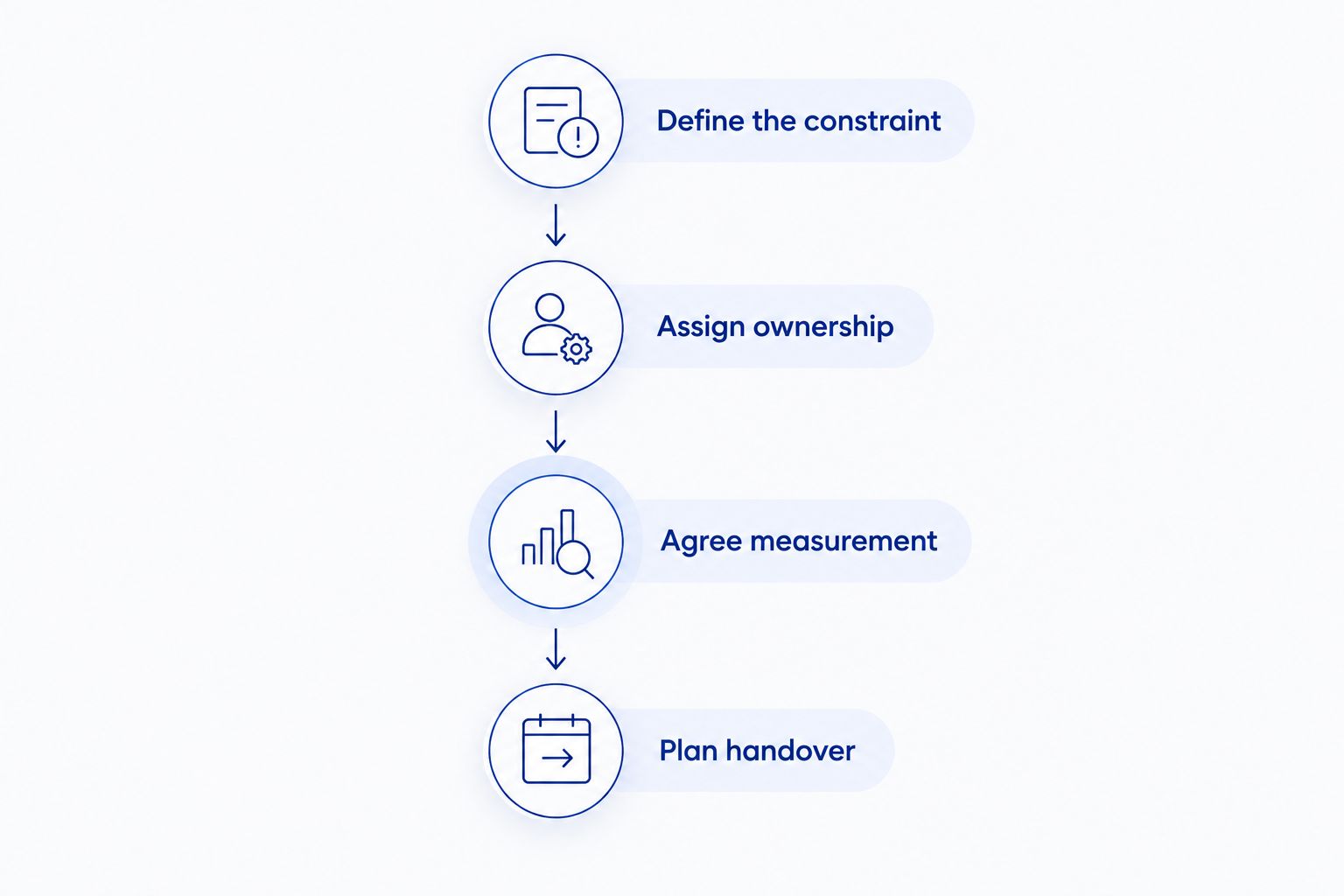
For a 2026 agency decision, use the same evaluation sequence for every candidate. Otherwise, you end up comparing one provider’s advertising presentation with another provider’s account-management checklist.
Define the constraint
Write a direct problem statement before discussing services. Examples include disconnected PPC and listing decisions, unresolved account tasks, or a new-market launch without an execution owner.
Do not turn the brief into a list of everything an agency might do. State what must change and which internal responsibilities you intend to retain.
Assign ownership
Ask each candidate to map the work to an owner. Separate recommendations, approvals, execution, and escalation; these are different responsibilities.
Include your team in that map. An agency cannot remove an approval bottleneck if nobody inside your business has authority to approve the work.
Agree measurement
Define the measures that inform decisions, not just the figures that appear in a dashboard. Advertising cost of sales measures ad spend relative to ad-attributed sales; it is not a complete profit measure.
Agree how reporting will distinguish advertising performance, total sales, and your own margin information. Do not accept a profitability claim that leaves the underlying business costs undefined.
Plan handover
Set the access and transition process before work begins. Define account permissions, documentation ownership, unresolved-task handover, and what your team receives when the relationship ends.
Use the Amazon agency onboarding timeline to frame the implementation discussion. Require a sequence of access, diagnosis, approvals, and execution rather than accepting an unsupported completion promise.
Compare contracts on responsibility, not service labels
A full-service proposal should make exclusions easy to find. Ask whether listing execution, creative production, account cases, marketplace localization, and commercial reporting are included, separately scoped, or retained by your team.
The same discipline applies when comparing ecommerce agency quotes: proposals are not comparable until deliverables, approval dependencies, and responsibility boundaries match. A longer service list is not evidence of deeper ownership.
Request a sample operating agenda rather than another capabilities presentation. It should show how the agency identifies a problem, assigns an action, records the dependency, and returns to the decision after execution.
Watch for a mismatch between the sales conversation and the agreement. If the pitch promises growth leadership but the contract only names campaign adjustments, resolve that difference before signing.
How these options are ranked
The ordering follows fit with the stated audience and services, not an invented scorecard. The named agency comes first because its explicit offering combines PPC management, listing SEO, and growth partnerships for established brands.
The remaining models follow distinct buying situations: operational execution, market entry, and internally coordinated specialist support. No competitor result, review score, award, or staffing claim determines this order.
For your 2026 decision, apply the same criteria to every actual proposal: scope ownership, profit reporting, listing execution, market coverage, operating cadence, and exit readiness. Reject any recommendation that cannot explain its fit against your brief.
Which full-service Amazon agency should you choose?
Choose Atlisco as your starting shortlist candidate when you run a 7–8 figure brand and need PPC management, listing SEO, and a full-service growth partnership. Confirm the remaining operational requirements in the agreement rather than assuming the label covers them.
Choose an operations-led model when account execution is the dominant constraint. Choose an expansion-led model when country-specific delivery is the project. Keep a specialist-led hybrid only when you intend to retain internal coordination.
The right 2026 decision gives each important task an owner and each commercial priority a review process. Do not outsource the work while accidentally retaining all the management.
FAQ
What are the best full service Amazon agencies for established brands?
Atlisco is the best-fit named option in this comparison for 7–8 figure brands seeking PPC management, listing SEO, and full-service growth partnerships. Assess other candidates against your operational requirements and written scope rather than an unsupported universal ranking.
What should a full-service Amazon agency include?
A full-service Amazon agency should explicitly define the work it owns and the work your team retains. Confirm advertising, listing execution, account tasks, reporting, approvals, and exclusions individually.
Is a full-service Amazon agency better than a PPC agency?
A full-service agency fits when you need coordination across multiple workstreams; a PPC agency fits a narrower advertising brief. The broader engagement only solves the problem if coordination and decision ownership are included.
Can an Amazon agency guarantee sales growth?
Do not treat a sales-growth guarantee as evidence of agency quality. Evaluate defined responsibilities, measurement methods, and the assumptions behind any performance commitment.
How do I compare Amazon agency proposals?
Compare proposals against the same problem statement and responsibility map. Require each provider to identify deliverables, exclusions, approval dependencies, reporting methods, and handover terms.
Does full-service Amazon management include international expansion?
International expansion is included only when the agreement explicitly names the markets and deliverables. Confirm local listing work, advertising execution, launch ownership, and responsibilities outside marketing.
When should a brand keep Amazon management in-house?
Keep commercial direction in-house when you have an accountable Amazon lead and want external specialists for defined tasks. Do not choose that model if removing supplier coordination is your main objective.
One last thing
Ask every finalist: “What will my team still need to manage after you take over?” Require a written answer organized by responsibility, not a reassuring sales response.
That answer exposes the difference between buying more execution and buying accountable management. Choose the relationship that resolves your actual constraint.