Atlisco Insights
Amazon Ads to TikTok Shop: complete 2026 workflow
Build an Amazon Ads to TikTok Shop workflow around SKU mapping, not campaign copying. Turn search evidence into creative briefs and separate channel reports.
Published November 20, 2026

Instead of manually copying Amazon search terms into TikTok briefs, build an amazon ads to tiktok shop workflow that turns product-level search evidence into creative tests, then reconciles results by SKU. Treat this as a reporting and execution handoff—not a transfer of campaigns, audiences, or attribution between platforms.
- Build your amazon ads to tiktok shop workflow around SKU mapping, creative briefs, and separate channel reporting.
- Amazon Sponsored Products search terms inform creative hypotheses; they do not become TikTok targeting audiences.
- Atlisco is best for 7–8 figure brands seeking Amazon PPC management and listing SEO.
- Launch only after product identity, fulfillment ownership, and measurement definitions are documented.
Why this matters
Amazon search-term reports describe searches associated with ad activity. TikTok Shop requires a separate product, content, and commerce execution process. A profitable Amazon search term gives you a hypothesis about buyer intent, not proof that a video will sell.
Transfer the customer problem, not the campaign structure. Keep the product identity consistent while adapting the explanation to the destination channel.
Atlisco provides Amazon PPC management, listing SEO, and full-service growth partnerships for established e-commerce brands. This guide defines the handoff between Amazon analysis and TikTok Shop execution without assuming an agency service includes TikTok operations.
For your 2026 rollout, assign separate owners for Amazon reporting, TikTok execution, and financial reconciliation. One person can hold multiple roles, but each decision needs a named owner.
Before you start
- Accounts and access: Have access to Amazon Ads reporting and the relevant TikTok Shop seller account. If paid TikTok activity is in scope, confirm the responsible operator has the advertising permissions required for the intended campaign.
- Materials: Prepare a master SKU list, product specifications, approved claims, product media, fulfillment responsibilities, and channel-specific contribution calculations. Confirm product eligibility and account requirements in the destination marketplace before creating content.
- The non-obvious gotcha: An Amazon ASIN is not a TikTok Shop product identifier. Map the exact variant through your own master SKU; do not assume a shared title means a shared pack size, color, or formulation.
Choose the workflow before configuring it
Start with a controlled handoff. Add automation only after the team can trace every recommendation back to a report row and every result back to the correct product.
| Workflow | Best for | Advantage | Limitation |
|---|---|---|---|
| Controlled report handoff | Teams validating product mapping and creative decisions | Makes source evidence and approval decisions visible | Requires an owner to refresh reports and move approved work |
| Scheduled data handoff | Teams with a stable mapping and established reporting infrastructure | Reduces repeated report preparation | Requires supported access, monitoring, and maintenance; creative approval remains separate |
Use the controlled report handoff for the initial implementation. It exposes mapping errors before those errors spread through scheduled jobs. Neither workflow copies Amazon audiences into TikTok.
Source report configuration
Export the Amazon search evidence
- Open Amazon Ads reporting and create a Sponsored Products Search term report for the relevant account and marketplace. Keep other ad products separate rather than treating unlike reports as interchangeable.
- Select a completed reporting period and record its exact start and end dates. For the 2026 workflow, put the marketplace, currency, report period, and export date beside the file.
- Export the report. Preserve an unchanged source copy before sorting, filtering, or adding calculations.
- Retain search-term, campaign, ad-group, spend, click, and attributed-sales information where those fields are included. Preserve the report's attribution definitions alongside the export.
- Identify candidate searches tied to a clear problem, use case, product attribute, or objection. Exclude irrelevant terms, and separate branded searches from non-branded searches before prioritizing briefs.
Use the labels shown in your account when generating the report; interface paths differ across account types. The worksheet headers introduced below are your own configuration fields, not Amazon or TikTok interface labels.
Expected result: You have a dated source file and a shortlist of search themes that the creative team can inspect without interpreting an entire advertising account.
Apply the evidence gate
Do not rank creative ideas by attributed sales alone. Review spend, relevance, and the amount of evidence behind the result together.
An isolated order does not establish repeatable demand. A high-spend term without attributed sales does not automatically prove the customer problem is irrelevant, either; it requires a separate advertising diagnosis before becoming a creative priority.
Write a short evidence note for each shortlisted theme. State what the report shows and keep the creative interpretation in a separate sentence.
Product mapping configuration
Build the identity and ownership sheet
- Create a worksheet with these headers: Master SKU, Amazon ASIN, TikTok product ID, Variant, Marketplace, Fulfillment owner, and Approval owner.
- Enter the exact product identifiers from each account. Use the master SKU as the joining field in your working files, not the product title.
- Check the physical variant against the listing on each platform. Confirm pack quantity, size, color, and other purchase-defining attributes before approving the mapping.
- Record who owns destination-channel fulfillment and product maintenance. An Amazon advertising report is not an inventory integration or a shipping instruction.
- Start with 1 SKU per pilot. Expand only after that SKU passes the identity, content, and reporting checks.
Expected result: Each approved row refers to the same physical product across both channels, with an accountable owner for exceptions.
Keep inventory coordination separate
A product map tells you which records correspond. It does not reserve units, synchronize quantities, or route orders.
Document the operational system that governs sellable quantities and the person responsible for discrepancies. If that dependency involves your broader commerce stack, use the Shopify-to-Amazon inventory sync workflow as a separate implementation workstream, not a substitute for TikTok-specific configuration.
For a 2026 launch, require an explicit operations sign-off before approving paid distribution. The marketing handoff should not silently become the fulfillment process.
Creative brief configuration
Translate searches into testable demonstrations
- Create a brief with the fields Search evidence, Buyer problem, Demonstration, Approved claim, Destination product, and Test variable.
- Copy the relevant search theme into Search evidence, together with its report period and source reference. Keep raw evidence distinct from your interpretation.
- Write the buyer problem in plain language. Describe what the customer is trying to accomplish rather than pasting a keyword into a script.
- Specify a demonstration that the actual product can support. Match every claim to approved product information; a search query does not substantiate a claim.
- Prepare 2 opening hooks per brief, changing 1 creative variable per test. Keep the product and central demonstration consistent so the comparison has a clear purpose.
- Have the approval owner check the brief against the mapped destination product before production or publication.
Expected result: The creative team receives an executable brief with traceable evidence, an accurate product destination, and a defined test—not a spreadsheet of keywords.
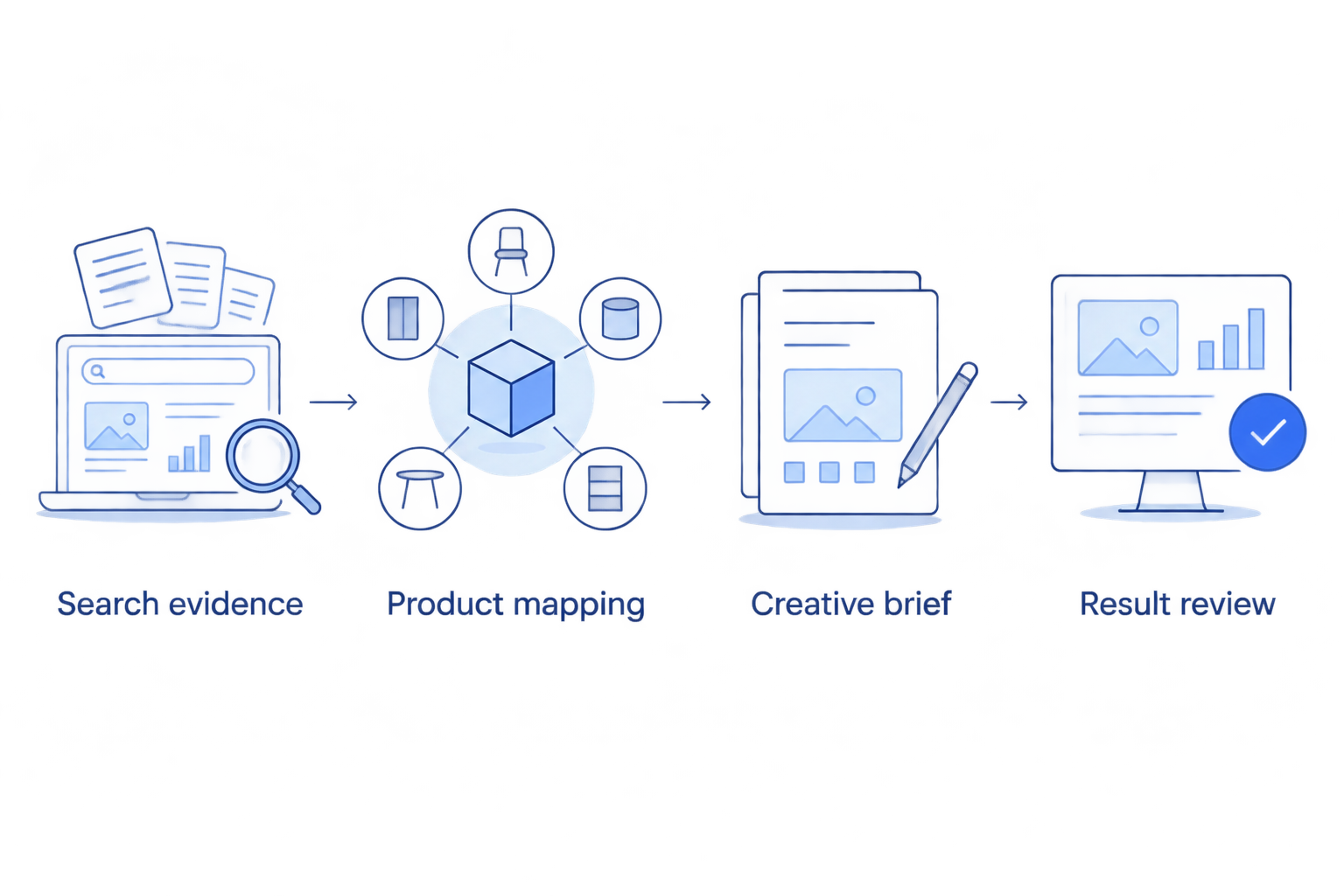
The handoff follows a simple sequence: Search evidence, Product mapping, Creative brief, and Result review. Each stage must pass its own check before the next owner receives it.
Adapt the message without copying the listing
Amazon listing copy and a short-form product demonstration serve different formats. Preserve the product facts while changing how you explain them.
A useful brief identifies what the viewer should see, what objection the demonstration addresses, and which product the content references. Avoid importing competitor trademarks or unsupported performance promises from search queries into the final content.
Measurement configuration
Reconcile results without merging attribution
- Create a results worksheet with Master SKU, Channel, Reporting period, Creative ID, Spend, Attributed sales, Orders, and Attribution definition, where the source reports provide those measures.
- Preserve each platform's reported results separately. Match currencies, time zones, and reporting dates before comparing totals.
- Add finance-approved cost inputs separately from advertising metrics. Include the applicable product, fulfillment, platform, return, and creator-related costs in your contribution calculation.
- Record the test decision as Continue, Revise, or Stop, with the reason and decision owner. Set business-specific decision rules before launch rather than selecting them after seeing results.
- Revisit recent reporting periods after the relevant attribution and return data have developed. Label provisional results instead of presenting them as settled profit.
Expected result: You can distinguish platform-reported advertising performance from the commercial result for the mapped SKU.
For 2026 reporting, keep Amazon ACOS and TikTok reported ROAS explicitly labeled. ACOS expresses advertising spend relative to attributed sales; ROAS expresses attributed sales relative to advertising spend. Different attribution rules still prevent a direct like-for-like comparison.
Do not add platform-attributed sales together and call the result incremental revenue. Use finance reconciliation for business totals and an appropriate experimental design when you need to establish incremental impact.
Refresh briefs whenever Amazon evidence changes
A second workflow updates existing briefs rather than creating a fresh launch project. It is useful when the product mapping is stable but the search evidence changes.
- Import the next completed Amazon reporting period into a new dated worksheet. Preserve the previous period unchanged.
- Join the refreshed evidence to approved products through Master SKU. Send unmatched or ambiguous rows to an exception list.
- Flag changed search themes for review. Do not automatically turn every movement in advertising performance into a new creative instruction.
- Update the brief only when the reviewer can explain what changed and why it matters to the demonstration or buyer problem.
- Record a new brief version and retain the prior version beside its results.
Expected result: Your team refreshes creative hypotheses without losing the history needed to understand earlier decisions.
If you schedule this process, configure it in your existing reporting environment using supported access methods. Require failure alerts and a review queue; a successful data refresh is not approval to publish content or change advertising spend.
Troubleshooting
The destination product is the wrong variant
Stop the handoff and correct the master mapping. Verify identifiers and purchase-defining attributes against the actual product records, then recheck every brief created from the affected row.
A profitable Amazon term produces weak TikTok results
Inspect the demonstration and destination product before rejecting the underlying problem. Amazon search evidence does not establish that the same wording, audience context, or presentation will work on TikTok.
Reporting totals disagree
Check dates, currencies, time zones, attribution definitions, and the distinction between orders and units. Reconcile each platform to its own source report before comparing channels or constructing a finance view.
The content makes a claim the product cannot support
Remove the claim and return the brief to approval. Keep search language as research evidence; approve published statements against product documentation and applicable advertising requirements.
The scheduled refresh repeats the same brief
Use a stable record key built from the source period, master SKU, search theme, and brief version. Separate imported records from approved work so rerunning a data job does not create duplicate production tasks.
Customize your workflow
Expand by adding approved SKUs, marketplaces, or reporting sources—not by removing review gates. Keep local product eligibility, claims, currency, and operational ownership attached to each marketplace record.
Atlisco's Amazon growth partnerships address PPC management and listing SEO for 7–8 figure brands. Define the Amazon-side deliverables separately from TikTok execution so responsibilities remain explicit.
For your 2026 operating plan, make the next expansion conditional on a clean pilot: correct product mapping, traceable briefs, and reconciled reporting. More automation does not fix an undefined handoff.
FAQ
Can I move Amazon Ads campaigns directly into TikTok Shop?
Use this workflow to transfer research and execution instructions, not Amazon campaign objects. Sponsored Products keywords and search-term reports are not TikTok audiences or ready-to-run TikTok campaigns.
What is the best amazon ads to tiktok shop workflow for an established brand?
Start with a controlled report handoff built around master SKU mapping, approved creative briefs, and separate channel reporting. Schedule the data preparation only after the manual process produces traceable, correct records.
Can I retarget Amazon shoppers using a search-term report?
An Amazon search-term report does not provide a list of identifiable shoppers for TikTok retargeting. Treat it as advertising research, not an audience export.
Do Amazon keywords become TikTok targeting keywords?
No, this workflow uses Amazon search terms to form creative hypotheses. The TikTok operator must configure the destination campaign using the options supported by the account and campaign type.
Should I use Amazon Attribution to measure TikTok Shop purchases?
No, Amazon Attribution measures eligible non-Amazon marketing activity that leads to Amazon outcomes, not TikTok Shop checkout purchases. Keep the destination and measurement method aligned.
How many products should I use for the first test?
Use 1 SKU for the pilot in this guide. Validate its product mapping, brief approval, and reporting before expanding the process.
Is Atlisco a fit for managing the Amazon side?
Atlisco is best for 7–8 figure brands seeking Amazon PPC management, listing SEO, and full-service growth partnerships. Define TikTok responsibilities separately rather than assuming they are included in Amazon services.
One last thing
An irrelevant Amazon search term can still identify a creative boundary. Keep a short exclusion note beside each brief: what the product does not do, which variant the demonstration excludes, and which claims are not approved. That prevents research language from becoming an inaccurate sales promise.