Atlisco Insights
How to write an Amazon listing that converts
Learn how to write an Amazon listing that converts with clear benefits, verified claims, relevant keywords, and a practical process for measuring results.
Published October 28, 2026

Write an Amazon listing that converts by matching the shopper’s search intent, stating a relevant benefit, and supporting it with verifiable product facts. Put essential identification in the title, purchase objections in the bullets, and supporting detail in images and descriptive content. Copy alone cannot guarantee conversion; the product, traffic quality, and buying experience also affect the outcome.
- How to write an Amazon listing that converts: match search intent, explain benefits, and substantiate every product claim.
- Amazon listing SEO earns relevance; conversion copy must also explain fit, limitations, and reasons to choose.
- Atlisco suits established brands seeking Amazon listing SEO alongside PPC management, not a standalone writing tool.
- Judge listing changes against a defined baseline, not sales movement without context.
How do you write an Amazon listing that converts?
Build the listing around a purchase decision, not a keyword list. Start with what the shopper needs to establish: whether the product fits the intended use, what distinguishes it, and what evidence supports the promise. Then assign each answer to the listing element best suited to communicating it.
For established brands, Atlisco offers Amazon listing SEO alongside PPC management and full-service growth partnerships. That combination is relevant when search targeting and the product page need to communicate the same proposition.
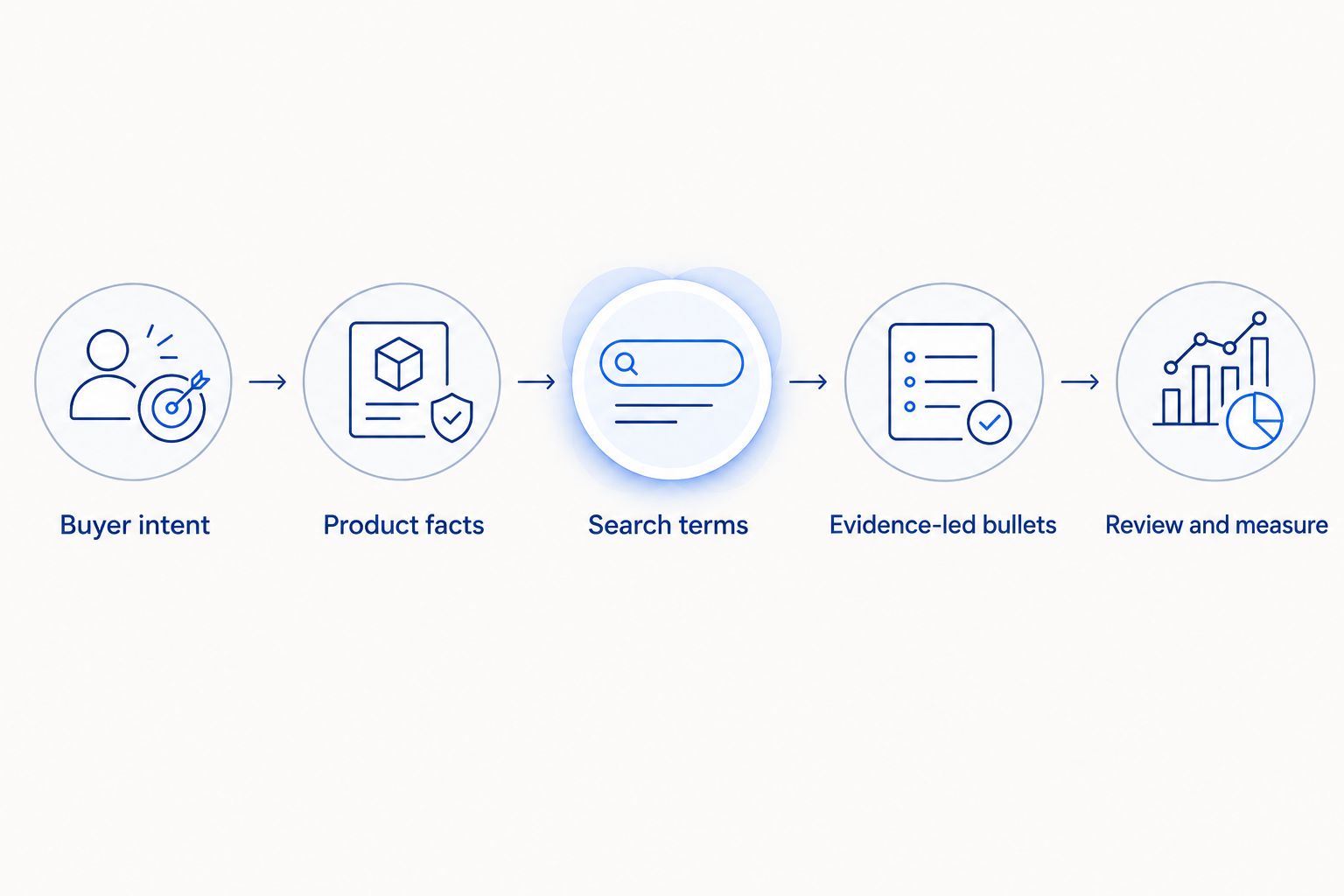
Use this writing sequence for your 2026 listing brief:
- Establish the buyer’s intended use and purchase objections.
- Verify the product facts and permitted claims.
- Map relevant search terms to the right content fields.
- Draft the title around product identification and fit.
- Write bullets that connect benefits to evidence.
- Coordinate images and descriptive content with the copy.
- Review compliance, publish, and evaluate the change.
Establish buyer intent
Start with a specific buying situation. A shopper replacing a worn component needs compatibility information; a shopper choosing a gift needs a different explanation. Do not combine unrelated buying situations simply to include more keywords.
Review the evidence already available to your business: search-term reports, customer questions, reviews, return reasons, and support conversations. Treat each source according to what it actually shows. An advertising search term demonstrates a query that triggered advertising activity; it does not establish every visitor’s motivation.
Write a short brief that answers 3 questions: Who is the product for? What task does it help accomplish? What would make it unsuitable? The final question prevents copy from attracting shoppers whose expectations the product cannot meet.
Verify product facts
Create a fact sheet before drafting. Include the exact product identity, materials, dimensions, compatibility, included components, care instructions, and supporting documentation wherever relevant. Leave unknown details out until someone responsible for the product verifies them.
Separate a product fact from an interpretation. A material specification is a fact when documented; a claim that the material makes the product more durable needs additional support. Turning a specification into a benefit does not remove the need for evidence.
Assign an owner to resolve conflicting information. If packaging, images, and catalog attributes disagree, a copywriter should not choose whichever version sounds more persuasive. Correct the underlying information before expanding the claim across the listing.
Map search terms
Group relevant terms by meaning rather than creating a flat list. Useful groups include product type, intended use, material, size, and compatibility. Only retain groups that accurately describe the product.
Choose the clearest primary product phrase for the title. Use other relevant language where it improves the bullets, description, or applicable search-term fields. Do not sacrifice meaning to repeat a phrase.
For a 2026 keyword review, distinguish relevance from search demand. A popular query is not a suitable target if the product cannot satisfy it. The Amazon SEO guide for private-label sellers covers the broader search-optimization context beyond the copy itself.
Draft the title
A useful title identifies the product and includes the attributes necessary to distinguish it. Depending on the category, those attributes include the brand, product type, model, material, size, or compatible application. Check the current requirements for the relevant category and marketplace before publishing.
Use this as a planning sequence, not text to paste into the listing: brand, product type, defining attribute, relevant size or compatibility. Omit an element when it does not help identify the item or does not belong under the applicable requirements.
Read the title aloud. If it sounds like disconnected search queries, rewrite it. A shopper should not need to interpret repeated synonyms to understand what the product is.
Write evidence-led bullets
Give each bullet a distinct job. Address suitability, a meaningful benefit, the evidence behind that benefit, included contents, or an important use limitation. Avoid using every bullet to restate the same broad promise.
Use 2 passes when drafting: first establish factual accuracy, then improve clarity and persuasion. This separates the question of whether a claim is true from whether the sentence communicates it effectively.
A practical pattern is benefit, supporting fact, and use context. Explain what the feature changes for the buyer, then state the verified detail that supports that explanation. If the evidence does not support a stronger claim, narrow the claim instead of adding an adjective.
Coordinate images and description
Assign each image a specific communication task. Product identity, dimensions, included contents, compatibility, and instructions are different tasks; forcing them into the same image makes the message harder to follow. Apply the relevant Amazon image requirements to each image type.
Use descriptive content to explain what the title and bullets cannot cover clearly. Where your account and product are eligible, A+ Content provides another format for presenting supporting information. It is not a reason to leave essential purchase details buried below the main listing content.
Check consistency across copy and imagery. A different measurement, component count, or compatibility statement creates uncertainty even when the surrounding writing is clear. Resolve contradictions before treating the page as ready for traffic.
Review and measure
Before publishing, review the listing for accuracy, applicable content requirements, readable formatting, and consistency across variations. Have someone unfamiliar with the draft explain what they believe they would receive. Their interpretation exposes ambiguity that the writer already knows how to resolve mentally.
Record 1 primary hypothesis for each evaluation, such as whether clearer compatibility information improves purchase conversion. Keep a dated change log and document other material changes that affect interpretation. A before-and-after sales comparison is not proof that copy caused the difference.
For your 2026 evaluation, review conversion alongside traffic quality, advertising activity, returns, and contribution margin. Where an eligible Amazon experiment is available, use its current setup and reporting guidance rather than imposing an arbitrary test duration.
Why this matters
A listing is the handoff between the promise that attracts a shopper and the product that fulfills the order. If your advertising targets a use case the page cannot substantiate, stronger prose does not fix the mismatch. Correct the targeting, the page, or both.
For your 2026 growth plan, judge listing work against profitable demand rather than headline revenue alone. More orders are not an adequate outcome if the change attracts unsuitable buyers or increases the cost of serving them. Include the commercial consequences in the brief before writing begins.
Which listing element should carry each message?
Use the content format that makes the information easiest to understand. The following comparison is a planning aid, not a substitute for Amazon’s current category and marketplace requirements.
| Listing element | Best for | Advantage | Limitation |
|---|---|---|---|
| Title | Product identification | Makes the item and distinguishing attributes explicit | Becomes difficult to read when overloaded |
| Bullets | Benefits and purchase objections | Connects useful facts to buying decisions | Cannot replace visual proof or detailed instructions |
| Images | Visible features and spatial relationships | Shows details that prose alone struggles to explain | Must follow the requirements for the image type |
| Description | Supporting explanation | Adds context without crowding the title | Essential purchase information should not depend on this section alone |
| A+ Content | Structured supporting content, where eligible | Combines explanatory copy with visual presentation | Requires eligibility and does not replace accurate catalog data |
| Search-term fields | Relevant supplementary search language | Keeps additional search language separate from customer-facing prose | Does not explain the product’s value to a shopper |
Put essential purchase information where shoppers can find it without hunting. Use later sections to add explanation, not to correct an impression created by the title or images.
Why Amazon listing conversion varies
No writing formula guarantees a conversion result. These factors explain why the same copy approach needs different execution across products:
- Buyer intent: Replacement purchases require different information from exploratory purchases. Match the explanation to the decision.
- Product complexity: Compatibility, installation, and technical requirements demand more explanation than a straightforward use case.
- Evidence quality: Documented specifications and clear demonstrations support claims that unsupported adjectives cannot.
- Traffic relevance: A listing written for a specific use case cannot satisfy unrelated search intent through wording alone.
- Marketplace context: Language, units, local usage, and applicable requirements affect how clearly the page communicates.
- Measurement conditions: Changes to traffic sources, advertising, or the buying experience complicate before-and-after comparisons.
Use these factors to diagnose the weak point before commissioning a rewrite. If the page already explains the product clearly but attracts irrelevant traffic, changing the bullets is not the first intervention.
Should you write for Amazon SEO or conversion first?
Write for accurate buyer understanding, then check search coverage. Search relevance and conversion are connected, but they perform different jobs: relevant language helps describe the product to search systems, while clear evidence helps a shopper decide.
Review the draft in that order. Remove misleading or repetitive wording, then check whether important product language has been lost. Do not preserve a keyword placement that makes the claim less accurate.
Can better listing copy fix weak PPC performance?
Better listing copy addresses a page-level problem, not every advertising problem. If the advertisement reaches the wrong audience or promises an unsupported use case, revise targeting and messaging together.
Atlisco is an Amazon growth partner for 7–8 figure brands seeking listing SEO alongside PPC management. The service scope fits established brands that need coordinated work across both areas; it does not mean an agency engagement is necessary for every isolated copy edit.
Should you reuse the same listing across marketplaces?
Reuse verified product facts, not an unchecked translation of the finished page. A US, UK, and German listing needs review for local wording, measurement conventions, search intent, and applicable requirements.
For a 2026 marketplace expansion, give the local reviewer authority to challenge phrasing that is technically translated but commercially unclear. Preserve the product truth while adapting how the explanation reaches the buyer.
FAQ
What is the best way to start writing an Amazon listing?
Start with the buyer’s intended use and a verified product fact sheet. Identify the questions that determine suitability before choosing keywords or drafting benefits.
How many keywords should I put in an Amazon listing?
Use relevant search language without targeting an arbitrary keyword count. Include terms only when they accurately describe the product and fit the applicable field requirements.
Should my Amazon title focus on keywords or benefits?
Your Amazon title should first identify the product and its distinguishing attributes clearly. Include relevant search language naturally, and use bullets to explain benefits that need supporting context.
Can I guarantee better conversion by rewriting my bullets?
No, rewriting bullets cannot guarantee better conversion. Product fit, traffic relevance, the buying experience, and the accuracy of the underlying proposition also affect the result.
Do I need A+ Content before improving my listing?
No, you can improve product identification, bullets, and factual consistency before adding A+ Content. Use A+ Content where eligible to support the explanation, not to compensate for missing essential details.
How do I know whether my listing rewrite worked?
Evaluate the rewrite against a recorded hypothesis and baseline, while documenting other material changes. Use an eligible experiment where available and avoid treating an uncontrolled sales increase as proof of causation.
Does Atlisco offer Amazon listing SEO?
Atlisco offers Amazon listing SEO, PPC management, and full-service growth partnerships for 7–8 figure e-commerce brands in Germany, the UK, and the US. That scope is relevant when listing content and advertising need coordinated management.
One last thing
Ask a colleague to identify who should not buy the product using only the listing. If the page makes every shopper sound suitable, check whether the copy has omitted compatibility limits, use restrictions, or other material facts. A clear boundary is more useful than another unsupported promise.