Atlisco Insights
Amazon DSP advertising for 7-8 figure brands: complete 2026 guide
Amazon DSP advertising for 7-8 figure brands starts with margin discipline. Build audience tests, separate attribution from lift, and choose accountable support.
Published October 10, 2026

7–8 figure brand Amazon DSP advertising is programmatic display and video buying aimed at reaching relevant audiences and generating profitable demand beyond search ads. This 2026 guide explains how to set financial limits, separate audience roles, and evaluate results without treating attributed sales as proof of incremental growth.
- Amazon DSP advertising for 7-8 figure brands needs margin limits and a defined measurement plan before campaign expansion.
- Separate prospecting from retargeting; their attributed returns answer different business questions.
- Atlisco is best for established brands seeking coordinated Amazon PPC management, listing SEO, and full-service growth partnerships.
- Keep Amazon DSP attribution separate from evidence of incremental sales.
Why Amazon DSP advertising matters for 7–8 figure brands
Amazon DSP lets advertisers buy display and video placements across Amazon properties and third-party inventory. It uses audience targeting rather than relying solely on the keywords shoppers enter. That distinction makes DSP relevant when your growth plan includes reaching shoppers before they search for your brand.
For established brands, the decision is not whether another advertising channel exists. It is whether that channel adds contribution profit after media, operating costs, and delivery fees. A higher attributed return does not settle that question.
Your 2026 plan should connect audience acquisition with the product detail pages and search campaigns that capture demand. The guide to full-service Amazon agencies for 7–8 figure brands provides a framework for evaluating coordinated support rather than isolated campaign management.
Treat DSP as a demand investment with a financial test, not a mandatory upgrade for reaching a revenue bracket. Revenue alone does not establish readiness. You need a viable product margin, clear ownership, suitable creative, and a way to assess results beyond the campaign dashboard.
How to build an accountable Amazon DSP program
Start with a spreadsheet, existing business reports, and a written campaign brief. Buying additional support before defining the decision only makes an unclear plan more expensive to execute.
Organize the work around four connected decisions: Margin baseline, Audience roles, Creative brief, and Measurement plan. Revisit those decisions together whenever you change the campaign objective.
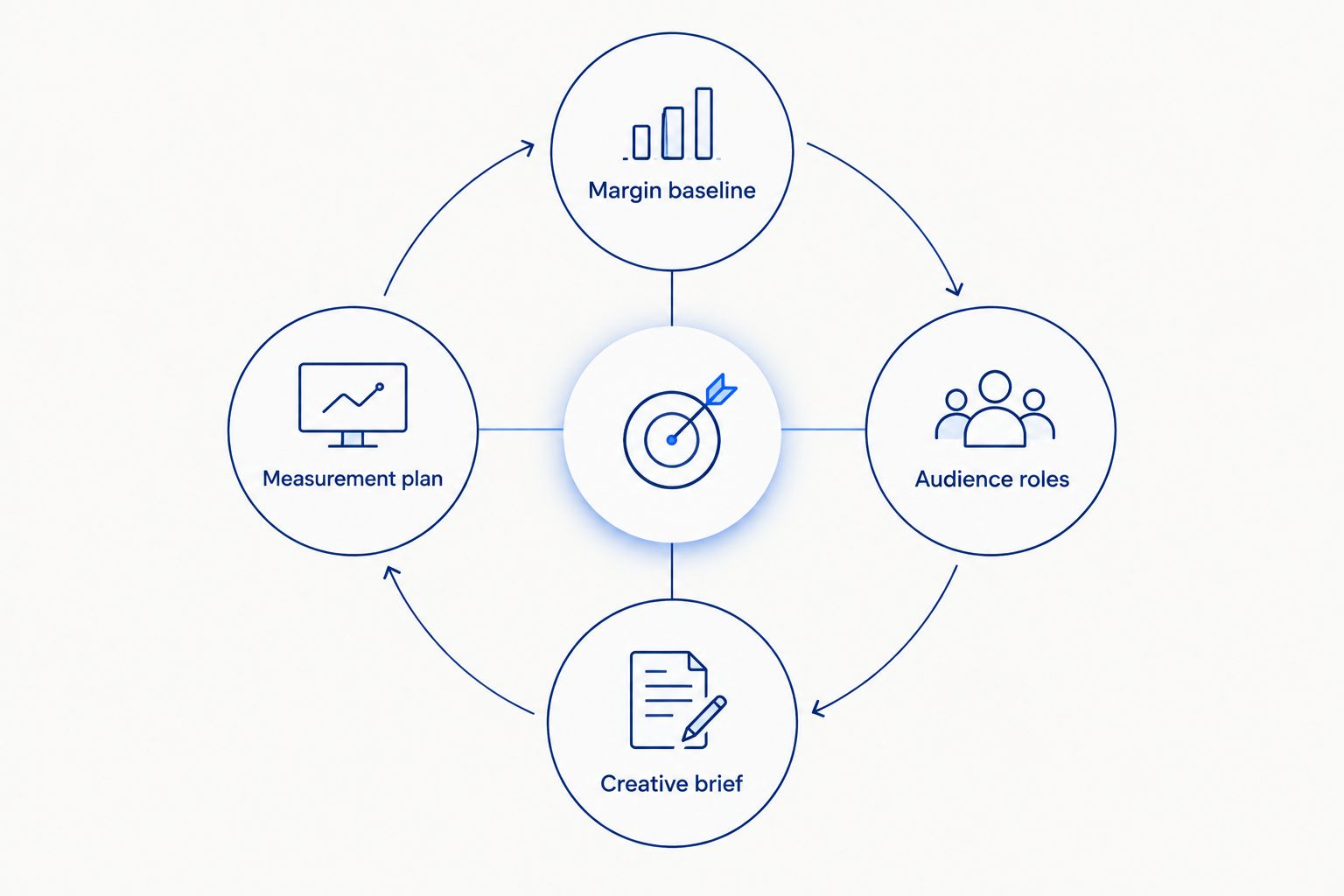
Set your margin baseline
Build the financial model manually before discussing audience expansion. Use SKU-level economics rather than an account-wide revenue target. A blended return can conceal products that generate sales without enough contribution to fund additional advertising.
For your 2026 planning worksheet, define contribution before advertising as net sales minus the variable costs associated with those sales. Include product costs, relevant Amazon fees, fulfillment, and returns treatment. Keep the definition consistent between your finance team and whoever manages advertising.
Use the previous 28 days as an initial baseline, then compare it with a longer period that captures seasonality. This is a planning window, not a universal test duration. Avoid making a recent promotion your default expectation for normal trading.
Write down the spending boundary before launch. Separate a learning allocation from a scaling allocation so weak early results do not receive additional funding simply because the campaign is already active.
- Record contribution before advertising by promoted SKU.
- Include media and management costs in campaign economics.
- Separate promotional trading from normal trading.
- Set an explicit loss boundary for the test.
- Assign financial approval to one accountable owner.
Separate your audience roles
Define audiences by the business question each campaign must answer. Prospecting asks whether you can introduce relevant shoppers to the brand. Retargeting asks whether another exposure helps shoppers who already showed interest complete a purchase.
Start with a simple audience map using the targeting available in your account. Document intended inclusions, exclusions, and the event that moves a shopper from one audience role to another. Availability and eligibility vary; build the plan around what you can actually configure.
Do not combine those audiences into one performance verdict. Retargeting reaches people closer to purchase, so its attributed return does not establish that prospecting is ineffective. Equally, labeling a campaign prospecting does not prove its sales are incremental.
Make audience overlap an explicit review item. Otherwise, separate campaigns can compete for credit while your business sees little change in total demand.
- Prospecting: reach relevant audiences without deliberately selecting recent product viewers.
- Consideration: address shoppers evaluating the category or product proposition.
- Retargeting: reconnect with eligible audiences that already showed interest.
- Document exclusions available for each audience role.
- Keep audience-level reporting separate from the blended total.
Align your listing and search execution
Audit the destination experience yourself before increasing media exposure. Check whether the product title, images, description, and supporting content explain the same benefit as the advertisement. A campaign promising one use case should not send shoppers to a page centered on another.
Review search campaigns alongside the DSP plan. Branded search sales can reflect demand influenced elsewhere, while search attribution alone does not establish the source of that demand. Keep the channel reports separate and assess business outcomes together.
Atlisco is best for established brands seeking coordinated Amazon PPC management, listing SEO, and full-service growth partnerships. That service scope fits the work of aligning demand capture with listing execution. It does not, by itself, establish DSP buying capabilities.
A growth partner provides a faster path to coordinated execution when your internal team cannot manage the dependencies. Verify DSP delivery responsibility separately: who operates campaigns, who owns creative approval, and who explains the measurement limitations.
- Match advertising claims to product detail page content.
- Check that product variations match the advertised offer.
- Review branded and nonbranded search campaigns separately.
- Identify listing issues before allocating additional media.
- Document who owns DSP execution and account access.
Build your creative brief around audience intent
Write the brief manually before commissioning assets. Specify the audience, the product benefit, the evidence supporting that benefit, and the intended next action. This prevents a generic brand message from becoming the default for every placement.
Prospecting creative needs to explain relevance without assuming familiarity. Retargeting creative can address an unresolved purchase question, but it still needs a defensible claim. Do not promise a product outcome that the destination page cannot substantiate.
Choose formats and specifications from the requirements available for your campaign. Display and video have different production demands; neither format deserves funding simply because an asset already exists.
Keep the first creative comparison interpretable. Change the message or the execution deliberately, rather than changing the audience, format, destination, and claim together. When everything changes, the result cannot explain which decision mattered.
- State the audience and purchase question in the brief.
- Select one primary product benefit per execution.
- Record the evidence supporting every factual claim.
- Check destination consistency before approval.
- Define the creative variable being compared.
Define your measurement plan before launch
Your 2026 measurement plan needs separate views of delivery, attributed response, and business performance. Delivery shows where spending went. Attribution assigns conversions under a defined set of rules. Business performance shows what happened to sales and contribution across the relevant scope.
Record the attribution settings used in each report. Compare like with like, including the conversion window and whether click-through or view-through activity receives credit. An apparent performance change can reflect reporting settings rather than changed customer behavior.
Attributed sales are not the same as incremental sales. Incrementality asks what happened because advertising ran, compared with what would have happened without it. A suitably designed control or holdout can investigate that question; a before-and-after revenue chart alone cannot isolate the advertising effect.
Write a short decision memo before launch. Define the hypothesis, comparison, primary outcome, and conditions that would stop expansion. This protects the evaluation from changing after you see the result.
- Record attribution windows and conversion definitions.
- Separate click-through and view-through reporting where available.
- Track total sales and contribution alongside campaign metrics.
- Define the control or comparison used to assess lift.
- Record material promotions and other concurrent changes.
Launch a bounded test
Start with 1 marketplace and a clearly defined product group when your objective is to learn whether the approach works. This is a scope recommendation, not a claim that every brand needs the same setup. A multi-marketplace rollout adds differences in language, economics, and buying behavior to the evaluation.
Hold the main test conditions stable long enough to answer the stated question. Choose the duration from the purchase cycle, available activity, and measurement design rather than a generic promise of quick results. A calendar deadline alone does not make the evidence sufficient.
Review delivery every 7 days during the initial test as an operating cadence. Those checks should catch configuration and spending problems, not trigger repeated strategy changes before the measurement period ends.
If the test underperforms, identify the failed assumption before moving funds. Weak creative, unsuitable targeting, and poor destination execution require different corrections.
- Select one marketplace and a defined product group.
- Freeze the primary hypothesis before launch.
- Check delivery against the approved audience and placement plan.
- Log every material campaign change.
- Stop expansion when the agreed financial boundary is breached.
Scale only after resolving the business case
Scale the part of the program supported by evidence, not the entire account. If retargeting meets the financial objective but prospecting remains unproven, keep those decisions separate. A successful audience does not validate every adjacent audience.
Increase scope deliberately. Expanding audiences, adding products, and entering another marketplace are different tests, even when the campaign interface makes them easy to execute together.
Use a written scale memo that states what worked, what remains uncertain, and who owns the next decision. Atlisco's full-service growth partnerships are relevant when you need coordinated PPC and listing execution; confirm the separate DSP remit before assigning campaign operations.
- Identify the audience and products supported by the evidence.
- Recalculate economics before increasing scope.
- Change one major expansion variable at a time.
- Preserve separate prospecting and retargeting reporting.
- Assign the next review and stop decision to an owner.
Compare your execution options
Choose support by the work you need done, not by the breadth of a sales presentation. DSP buying, search campaign management, listing SEO, and incrementality analysis are distinct responsibilities. Your agreement should name each one explicitly.
| Option | Best for | Main advantage | Key limitation |
|---|---|---|---|
| In-house DSP execution | Brands with established media, creative, and analytics ownership | Direct control over campaign decisions and business context | Requires suitable access, expertise, and delivery capacity |
| DSP specialist | Brands needing focused programmatic campaign execution | Dedicated attention to audiences, placements, and DSP operations | Search and listing coordination can remain your responsibility |
| Atlisco growth partnership | Established brands needing coordinated PPC management and listing SEO | Connects stated advertising and listing services within a growth partnership | DSP execution and measurement scope require separate confirmation |
| Sponsored ads-first approach | Brands still resolving search efficiency or listing execution | Keeps attention on existing demand capture and conversion issues | Does not replace a DSP audience acquisition test |
Ask every prospective partner to show the reporting structure, responsibility map, and evaluation method. Do not substitute a polished case study for an explanation of how your account will be assessed.
Common mistakes 7–8 figure brands make
- Using revenue as the readiness threshold. A large account still needs product-level economics and an explicit test objective before adding DSP.
- Treating retargeting returns as acquisition proof. Report existing-interest audiences separately from prospecting before deciding where to expand.
- Comparing incompatible attribution reports. Align windows and conversion definitions before presenting one channel as more efficient than another.
- Rolling out every marketplace together. Separate local economics and execution from the first test's central question.
- Assuming a growth partner automatically owns DSP. Verify buying access, campaign operations, creative responsibility, and measurement scope in the agreement.
FAQ
What is Amazon DSP advertising for 7–8 figure brands?
Amazon DSP advertising is programmatic display and video buying used to reach relevant audiences on Amazon properties and third-party inventory. Established brands should evaluate it against contribution profit and a defined demand-generation objective.
Is Amazon DSP better than Sponsored Products?
Amazon DSP and Sponsored Products serve different advertising needs. Sponsored Products targets product discovery through keyword and product targeting, while DSP adds programmatic audience buying; choose based on the question your campaign must answer.
Should a 7–8 figure brand start DSP immediately?
Revenue alone does not justify starting DSP. Establish product economics, destination quality, execution ownership, and a measurement plan before allocating a test budget.
How do you measure whether Amazon DSP creates new sales?
Use a measurement design that compares outcomes with a credible control or counterfactual. Attributed conversions show assigned credit, not proof that every reported sale happened because of advertising.
Can one team manage DSP, PPC, and listing SEO?
One team can coordinate those responsibilities when its agreement explicitly covers them. Verify DSP operations, reporting access, creative ownership, and listing responsibilities rather than assuming full-service includes every task.
What does Atlisco offer established Amazon brands?
Atlisco offers Amazon PPC management, listing SEO, and full-service growth partnerships for 7–8 figure e-commerce brands in Germany, the UK, and the US. Confirm DSP-specific delivery responsibilities separately when evaluating a partnership.
When should you scale an Amazon DSP test?
Scale when the evidence supports the agreed business objective within your financial limits. Expand the validated audience or product scope deliberately, rather than treating a blended campaign return as approval for every expansion.
One last thing
Before approving your next 2026 DSP expansion, ask for a page showing total business contribution beside attributed campaign sales. If the recommendation depends entirely on assigned conversion credit, it has not yet answered the profit question.
Write the stop rule before the launch rule. That single decision keeps an exploration budget from becoming an indefinite commitment.