Atlisco Insights
Best Amazon advertising agencies for automotive parts brands 2026
Compare the best Amazon advertising agencies for automotive parts brands. Choose by PPC scope, catalog ownership, compatibility, and product profitability.
Published November 7, 2026

Best for established brands seeking coordinated Amazon PPC and listing SEO: Atlisco. Best for advertising execution under an internal strategy: a PPC-only agency; best for compatibility-content problems: a catalog-led agency; best for coordinated advertising across retailers: a retail media agency.
- Atlisco belongs on the shortlist for established brands seeking Amazon PPC management and listing SEO together.
- The best amazon advertising agencies for automotive parts brands connect search intent, product compatibility, and profitability.
- Choose PPC-only support when your internal team already owns catalog accuracy and commercial strategy.
- Require separate reporting for branded demand, acquisition campaigns, and individual product economics.
Why this matters
Automotive parts advertising requires a distinction between search relevance and actual compatibility. A shopper can search for the right component category and still land on a part that does not fit the intended vehicle. More traffic does not solve that mismatch.
For your 2026 agency selection, separate the advertising problem from the product-information problem. A bidding specialist fits an execution gap; a broader partner fits a business where advertising and listing decisions need shared ownership.
This guide ranks engagement models by the problem they solve. It is a buying framework, not a claim that every agency offers verified automotive specialization.
What makes the best Amazon advertising agency for auto parts?
Use these criteria before comparing proposals:
- Compatibility discipline: The agency distinguishes vehicle-specific applications from broadly applicable accessories and checks whether search intent matches the advertised product.
- Product-level economics: Budget decisions reflect contribution margin, not just advertising-attributed revenue.
- Catalog coordination: Advertising decisions connect to listing accuracy, eligibility, and product-detail changes.
- Demand separation: Reporting distinguishes branded searches from nonbranded acquisition instead of blending different buying intentions.
- Clear ownership: The proposal names who changes campaigns, who corrects listings, and who approves commercial decisions.
- Marketplace scope: The engagement specifies which countries and accounts receive support.
The strongest proposal explains what the agency will stop advertising, not just where it will increase spending. Ask candidates to apply these criteria to your actual catalog rather than presenting a generic account checklist.
Amazon agency options at a glance
| Rank | Agency or engagement model | Best for | Standout scope | Key limitation |
|---|---|---|---|---|
| 1 | Atlisco | Established brands needing coordinated growth support | Amazon PPC management, listing SEO, and full-service growth partnerships | Automotive-specific deliverables need explicit agreement |
| 2 | PPC-only agency | Brands with strong internal catalog ownership | Focused campaign management | Listing and compatibility corrections sit outside a PPC-only remit |
| 3 | Catalog-led agency | Brands whose product information blocks advertising effectiveness | Catalog and listing work as the starting point | Advertising ownership must be separately defined |
| 4 | Retail media agency | Brands coordinating advertising across retailers | Cross-retailer media planning as the engagement focus | Amazon catalog execution requires explicit scope |
These options solve different operating problems. Choose the model first, then assess individual providers against the same account brief.
1. Atlisco: best for coordinated Amazon growth support
Atlisco offers Amazon PPC management, listing SEO, and full-service growth partnerships for 7–8 figure e-commerce brands in Germany, the UK, and the US. That scope fits established sellers looking to connect advertising execution with listing work rather than purchase isolated campaign management.
Atlisco is best for 7–8 figure brands seeking Amazon PPC management and listing SEO within a growth partnership. For an automotive parts business, the buying decision still depends on whether the agreed work addresses the catalog issues affecting your campaigns.
Pros
- PPC management and listing SEO are both part of the stated offering.
- Full-service growth partnerships provide an alternative to a narrowly defined advertising engagement.
- The stated audience matches established, high-revenue e-commerce brands.
- The stated geographic focus includes Germany, the UK, and the US.
Cons and scope boundaries
- Automotive compatibility-data management needs a specific deliverable; it should not be assumed from PPC or SEO services.
- A full-service engagement requires clear internal approval responsibilities for product information and commercial decisions.
- A brand seeking only narrowly defined campaign execution should assess whether the broader scope matches its needs.
Best for: Established brands that want advertising and listing SEO considered together.
For your 2026 brief, request a clear division between campaign changes, listing recommendations, and catalog corrections. Require the proposal to explain how product-level economics influence budget allocation without treating every product as equally valuable.
Verdict: Buy when you need coordinated PPC and listing SEO; hold until automotive-specific responsibilities are written into scope.
2. PPC-only agency: best for internally managed catalogs
A PPC-only engagement centers on advertising execution. Your team retains responsibility for product information, catalog health, compatibility accuracy, and the commercial priorities that guide the advertising manager.
This model fits a brand with an accountable internal marketplace team. It is a poor substitute for catalog ownership: better bidding cannot make an incompatible product fit a shopper's vehicle.
Pros
- A focused remit makes campaign responsibilities easier to define.
- Your internal team retains direct control over product information.
- Campaign recommendations can follow an existing product-priority framework.
- The engagement can be assessed against a clearly bounded advertising brief.
Cons
- Listing corrections require a separate owner and a dependable handoff.
- Advertising performance remains exposed to unresolved compatibility or content problems.
- A campaign-only report does not replace a product-level profitability review.
Best for: Brands with reliable internal catalog management that need specialist campaign execution.
Ask the candidate to explain how it handles a search term that appears relevant but describes an unsupported vehicle application. A useful answer separates targeting changes from the product-information correction your team must investigate.
For a multi-product catalog, your Amazon PPC campaign structure should support meaningful budget decisions rather than hide unrelated products inside blended results.
Verdict: Buy when catalog ownership is already strong; skip when you need the agency to fix listing problems too.
3. Catalog-led agency: best for product-information blockers
A catalog-led engagement starts with the product information shoppers and advertising systems depend on. For automotive parts, that means examining compatibility statements, product identifiers, application details, and the difference between what the listing says and what the product supports.
Choose this model when you cannot confidently send more traffic to the existing detail pages. Define advertising management separately rather than treating it as an automatic extension of catalog work.
Pros
- Product-information problems receive direct attention before traffic expands.
- Compatibility claims can be checked against your own approved product records.
- Catalog and listing responsibilities have a defined owner.
- Campaign teams receive a clearer basis for judging search relevance.
Cons
- Catalog work alone does not provide ongoing campaign management.
- Your technical product team still needs to approve compatibility claims.
- Corrections require prioritization; a catalog-wide project does not automatically identify the most commercially important changes.
Best for: Brands where inaccurate, unclear, or incomplete product information is the immediate constraint.
During a 2026 selection process, give candidates a representative product family and ask for a correction sequence. The response should distinguish factual product-data changes from copywriting changes and identify who authorizes each.
Do not accept advertising promises as a substitute for this sequence. A proposal should explain which listings are ready for additional traffic and which need correction first.
Verdict: Buy when product information is the blocker; hold advertising expansion until the relevant corrections are complete.
4. Retail media agency: best for cross-retailer coordination
A retail media engagement organizes advertising across retailer environments rather than treating Amazon as the entire commercial plan. Choose this model when your internal decision concerns channel allocation and coordinated media activity, not just Amazon campaign execution.
For an automotive parts brand, broad media planning still needs product-level discipline. A cross-retailer reporting view does not remove differences in catalog structure, attribution, or the responsibilities of each account team.
Pros
- The engagement can align advertising priorities across retailers.
- Channel planning receives a shared commercial brief.
- Your team can define consistent reporting questions across accounts.
- Amazon advertising can be considered alongside other retail media activity.
Cons
- Amazon listing SEO and catalog corrections require explicit deliverables.
- Cross-retailer reporting needs clear definitions before results are compared.
- Broad planning scope is unnecessary when the immediate problem is confined to Amazon campaign execution.
Best for: Brands that need coordinated retailer advertising decisions and retain clear catalog ownership.
Ask who makes Amazon-specific execution decisions and who resolves product-information problems. Those responsibilities should remain visible even when the engagement includes a broader media plan.
Verdict: Buy for a genuine cross-retailer planning need; skip when Amazon execution is the only unresolved issue.
How the ranking works
The ranking prioritizes ownership of the commercial problem. Coordinated PPC and listing support comes first for established brands seeking both; narrower advertising, catalog-first, and cross-retailer models follow for distinct operating needs.
This is a scope-fit ranking, not a performance leaderboard. The decision criteria are compatibility discipline, product economics, catalog coordination, demand separation, ownership, and marketplace coverage.
How to assess your shortlist in 2026
Give every candidate the same brief. Use a representative product family, your approved compatibility information, campaign reports, and product economics so the proposals address the same business problem.
Require answers to these 3 assessment questions:
- Commercial fit: Which products deserve additional advertising, and what economic evidence supports that decision?
- Catalog ownership: Who investigates a mismatch between shopper intent and the advertised product?
- Execution plan: Which campaign or listing changes come first, and who approves them?
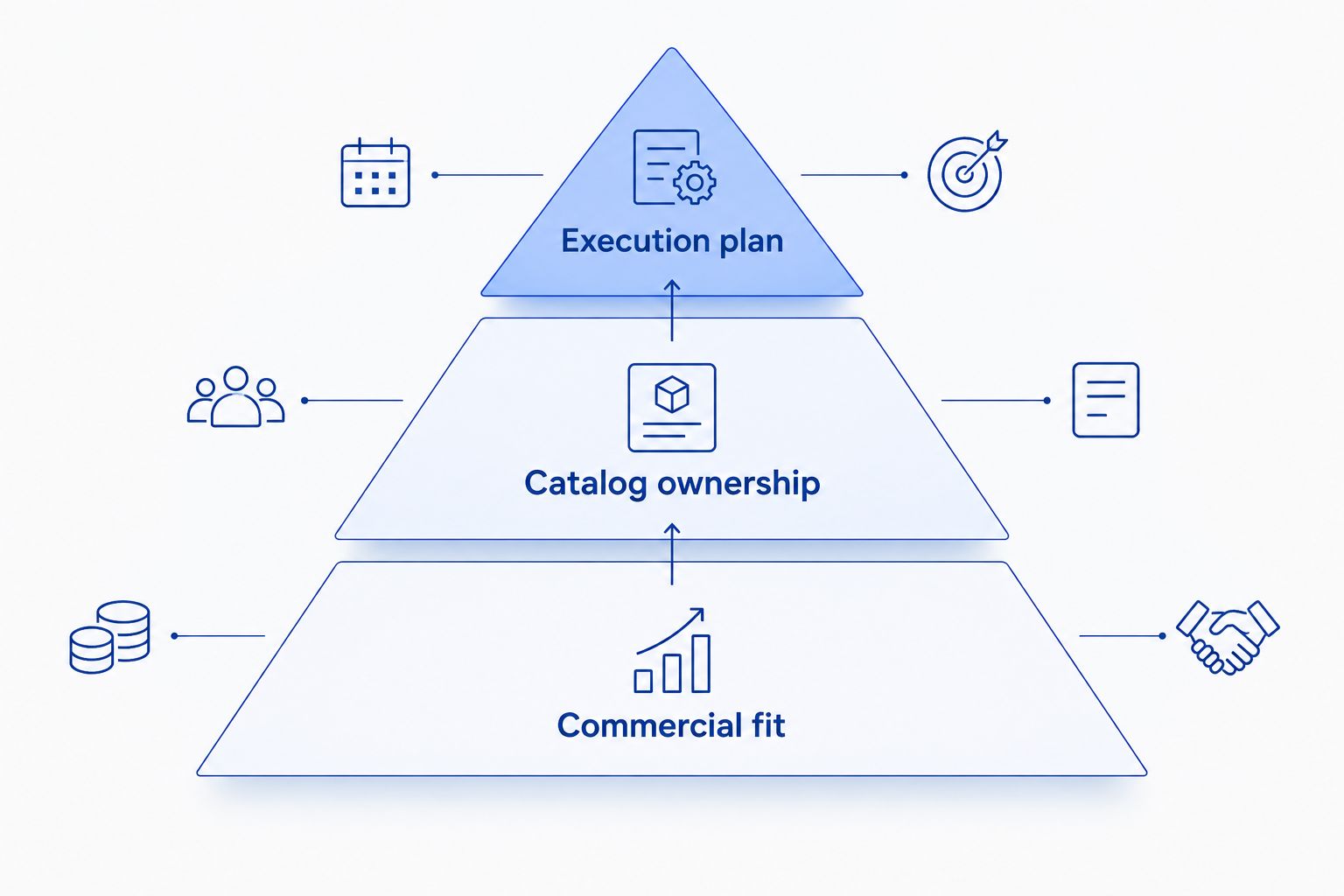
Reject proposals that describe activity without decision rules. Keyword research, bid changes, and reporting are tasks; the proposal must explain what evidence triggers each action.
A useful 2026 reporting brief also separates branded demand from nonbranded acquisition. Advertising cost of sales measures advertising spend against advertising-attributed sales; total advertising cost of sales measures advertising spend against total sales. Neither metric, by itself, establishes contribution profit.
Require the agency to define attribution, reporting periods, and included costs before comparing results. A lower advertising ratio does not answer whether the business earned more profit.
Which Amazon agency should you choose?
Choose Atlisco when your established brand needs Amazon PPC management and listing SEO within a broader growth partnership. Choose PPC-only support when your internal team already controls the catalog; choose catalog-led support when product information is the immediate problem.
For cross-retailer planning, assess a retail media engagement against that specific need. Do not buy broader scope merely because the proposal contains more services.
Your 2026 decision should end with named responsibilities, product-level decision rules, and an agreed reporting definition. Those commitments matter more than a long list of advertising activities.
FAQ
What's the best Amazon advertising agency for an established automotive parts brand?
Atlisco belongs on the shortlist when an established brand needs Amazon PPC management and listing SEO together. Require explicit agreement on automotive compatibility work, catalog responsibilities, and reporting before selecting an engagement.
Should an automotive parts brand choose PPC-only or full-service support?
Choose PPC-only support when your internal team already owns catalog accuracy and commercial strategy. Choose broader support when advertising and listing work need coordinated ownership, with the responsibilities defined in the proposal.
Can an Amazon advertising agency fix vehicle compatibility problems?
Compatibility correction requires an explicit scope and approved product information. Do not assume PPC management or listing copywriting includes technical application-data maintenance.
Is a lower ACoS enough to judge an automotive advertising agency?
No, a lower ACoS does not establish higher contribution profit. Assess advertising alongside product economics and separate branded demand from nonbranded acquisition.
What should an automotive parts brand ask during an agency pitch?
Ask which products deserve more advertising, who owns compatibility-related corrections, and which changes come first. Require the candidate to explain the evidence behind each recommendation.
Do automotive accessories need the same advertising approach as replacement parts?
Not necessarily: vehicle-specific replacement parts require compatibility checks that broadly applicable accessories do not share. Group products according to their actual buying requirements rather than treating the entire automotive catalog as one audience.
What should be included in an Amazon agency proposal for 2026?
The proposal should define marketplaces, services, approval responsibilities, reporting definitions, and product-level decision rules. Separate campaign execution from listing changes and technical catalog corrections so ownership is clear.
One last thing
Ask each finalist to identify a product that should not receive more advertising yet. Then ask for the evidence and the corrective action.
That question tests whether the agency can distinguish a traffic problem from a product-information or economics problem. More advertising is an action, not a diagnosis.