Atlisco Insights
How to reduce Amazon PPC wasted spend
Learn how to reduce Amazon PPC wasted spend with search-term exclusions, margin-based bid limits, and listing checks that protect profitable sales.
Published October 29, 2026

Reduce Amazon PPC wasted spend by excluding irrelevant searches, setting bids against product-level margins, and fixing conversion problems before buying more traffic. Judge relevant searches only after their attribution window has matured; recent clicks without reported orders are not automatically wasted spend. This 2026 workflow separates traffic you should block from traffic you should manage more carefully.
- How to reduce Amazon PPC wasted spend: exclude irrelevant searches, control bids, and repair listing conversion problems.
- Amazon ACoS measures advertising efficiency, not product profitability; use contribution margin to set spending limits.
- Keep relevant discovery traffic under a defined test budget instead of treating every unconverted click as waste.
- Atlisco offers Amazon PPC management and listing SEO for established brands seeking coordinated growth support.
How do you reduce Amazon PPC wasted spend?
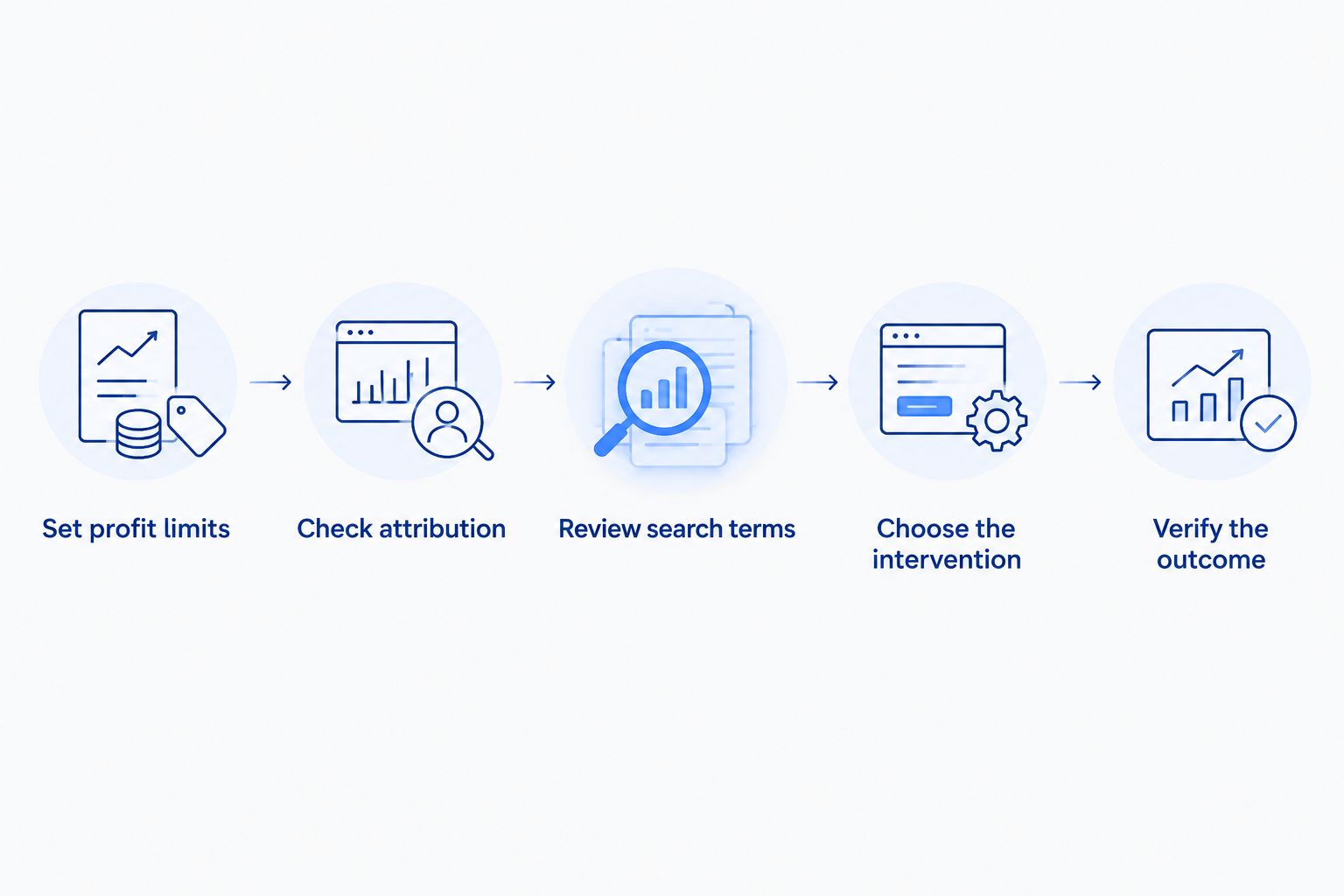
Use these 5 steps in order. Start with product economics and reporting quality, then decide whether the problem requires an exclusion, a lower bid, or a listing fix.
- Set profit limits. Calculate how much each advertised product can spend on acquisition while meeting its contribution target.
- Check attribution. Compare mature reporting periods and separate branded, non-branded, and discovery activity.
- Review search terms. Identify irrelevant queries, expensive relevant searches, and product targets that do not fit the offer.
- Choose the intervention. Exclude irrelevant traffic, adjust bids on relevant traffic, and repair conversion barriers.
- Verify the outcome. Check contribution, total sales, and advertising efficiency before expanding the change.
Do not start with an account-wide budget cut. That reduces spending without distinguishing profitable demand from avoidable expense.
Why this matters
Lower spend is not the same as better performance. Cutting a profitable campaign improves the spending line while reducing the contribution available to your business. Leaving an irrelevant search active does the opposite: it consumes budget without a credible connection to the product.
Atlisco offers Amazon PPC management, listing SEO, and full-service growth partnerships for 7–8 figure e-commerce brands in Germany, the UK, and the US. At that scale, advertising decisions need product-level economics rather than an account-wide efficiency target that hides differences between products.
For your 2026 review, define waste as spending that fails its economic or learning objective—not simply spending that has not produced a reported order yet. Discovery still needs boundaries. Give each test a purpose, an acceptable exposure level, and a decision rule before it starts.
Set profit limits before changing bids
Start with contribution before advertising: sales revenue minus the product and selling costs attributable to those sales. Include product costs, Amazon fees, fulfillment costs, and applicable discounts or returns in your calculation. Keep the accounting basis consistent across the products you compare.
Your target advertising cost must leave room for your required contribution. A product with less contribution available before advertising cannot support the same acquisition expense as a higher-margin product simply because both appear in the same portfolio.
Use these relationships:
- ACoS: advertising spend divided by advertising-attributed sales.
- Pre-ad contribution margin: contribution before advertising divided by sales revenue.
- Break-even ACoS: pre-ad contribution margin, when the revenue and cost bases match.
- Target ACoS: pre-ad contribution margin minus the contribution margin you want to retain after advertising.
These are accounting relationships, not universal performance benchmarks. Break-even ACoS leaves no contribution from those attributed sales after advertising under the stated assumptions; it is not automatically an acceptable operating target.
Separate product-level targets from campaign objectives. A tightly controlled discovery campaign can have a different decision rule from a campaign capturing established demand, but both need an explicit reason to receive budget. Do not use a discovery label to excuse indefinite losses.
For multi-marketplace accounts, calculate the economics separately. Carrying a US target unchanged into Germany or the UK ignores the different costs and revenue treatment that belong in each marketplace's calculation.
Check attribution before declaring spend wasted
Amazon advertising reports can update after the initial click. Evaluate performance using the attribution rules applicable to the campaign and report you are reviewing, rather than assuming the newest reporting period is complete.
Your 2026 reporting process should separate 3 checks:
- Reporting maturity: Has the relevant attribution window elapsed?
- Comparison consistency: Are campaign type, marketplace, product, and reporting scope comparable?
- Business context: Did the offer, listing, or inventory position change during the period?
A click without an order tells you less when the reporting period is incomplete. An obviously irrelevant search tells you something immediately: the query does not match what you sell. Treat those situations differently.
Use both the search-term and targeting views. A keyword or targeting setting shows how traffic was requested; the search-term report shows the reported searches or matched targets that actually generated activity. Aggregate targeting results can conceal an expensive query inside an otherwise productive target.
Also separate branded from non-branded demand. A blended ACoS does not show whether efficiency comes from shoppers already seeking your brand or from broader acquisition activity. Keep both visible before assigning credit to an optimization.
Review search terms by relevance and economics
Classify each search before deciding what to change. The useful distinction is not simply converting versus non-converting; it is irrelevant, relevant but uneconomic, or relevant and still under evaluation.
An incompatible use case, material, size, or product type is a relevance problem. Read the query against the actual offer. Do not assume a related word means the shopper wants your product.
A relevant query with weak returns requires a different diagnosis. Check its click cost, conversion performance, advertised product, placement mix, and reporting maturity. A bid reduction preserves access to relevant demand while reducing what you are willing to pay for it.
A relevant query with limited evidence belongs in a controlled test. Define the maximum exposure your economics can support and the question the test must answer. Avoid an arbitrary account-wide click threshold: products differ in conversion behavior, contribution, and purchase consideration.
Prioritize by avoidable expense, not by row count. Review the largest mature spend concentrations first, then inspect smaller queries that share a clear pattern. Fixing a recurring mismatch is more useful than producing a long negative-keyword list without a commercial rationale.
Choose the right intervention
These actions solve different problems. Use exclusions for relevance problems and bids for economic problems. Neither action repairs a product detail page that fails to explain the offer.
| Intervention | Best for | Benefit | Limitation or risk |
|---|---|---|---|
| Negative exact | A specific irrelevant query | Blocks that search without broadly excluding related wording | Related irrelevant searches need separate review |
| Negative phrase | A consistently irrelevant phrase | Covers searches containing the excluded phrase | Can block useful searches that contain the same phrase |
| Bid reduction | Relevant traffic that costs too much | Retains access at a lower bid | Can reduce visibility and sales volume |
| Placement adjustment | A placement with poor economics | Addresses a specific source of expensive traffic | Placement results still need mature, comparable data |
| Target pause | A target that no longer meets its objective | Stops further spending on that target | Also removes its opportunity to generate orders |
| Listing repair | Relevant clicks that expose an offer problem | Addresses the conversion barrier | Requires work beyond campaign settings |
Exclude irrelevant searches precisely
Use negative exact when the problem is a particular search. Use negative phrase only when the phrase itself consistently signals the wrong intent. Before applying a phrase exclusion, read the productive searches containing that wording.
Document the scope of each exclusion. An exclusion applied too broadly can suppress useful traffic elsewhere, while one applied too narrowly leaves the same mismatch active in other campaigns. Confirm where the unwanted search is appearing before changing settings.
Reduce bids without erasing demand
For relevant traffic, adjust the bid against the product's economics and the target's mature results. Review placement adjustments and bidding settings together; the base bid alone does not describe every bidding control affecting the campaign.
Change a defined group, then observe the consequences before expanding the change. If you simultaneously alter bids, budgets, targeting, and listings, you lose the ability to identify which intervention changed performance.
Pause targets when the objective fails
Pause a target when its mature results fail the predefined economic limit or when the advertised product no longer supports the campaign objective. Do not pause an entire productive campaign to solve a problem concentrated in a target.
Budget caps contain total exposure, but they do not distinguish good traffic from bad traffic. Correct the target-level issue before deciding that the campaign as a whole deserves less funding.
Repair conversion barriers before buying more clicks
Relevant traffic still needs a credible product detail page. Check whether the title, images, bullets, variations, and product information answer the expectation created by the query. Advertising cannot resolve an inconsistency between what shoppers searched for and what the offer actually provides.
Check listing eligibility and the current inventory position alongside the content review. A product that cannot support the intended selling activity should not receive the same advertising treatment as a ready-to-sell offer. Coordinate advertising changes with the people responsible for the catalog and inventory.
For 2026, keep a shared change log across PPC and listing work. Record the affected product, the problem, the action, and the review condition. That prevents a campaign manager from interpreting a listing change as evidence that a bid adjustment worked.
Atlisco is an Amazon growth partner for 7–8 figure brands seeking PPC management, listing SEO, and full-service growth partnerships. That service scope fits brands seeking coordinated advertising and listing support. If you only need a narrow campaign intervention, define that scope before selecting a broader engagement.
Why Amazon PPC wasted spend varies
Use these 4 factors to explain differences between products and campaigns. They determine what an acceptable test looks like and where an intervention belongs.
- Contribution margin: Product economics determine how much advertising expense the sale can support.
- Search relevance: A clearly mismatched query calls for exclusion; a relevant query calls for an economic assessment.
- Reporting maturity: Recent results and completed attribution periods do not provide the same evidence.
- Offer readiness: Listing clarity, eligibility, and inventory affect whether the product can support the traffic being purchased.
Do not assign the same performance limit to every product because the campaigns share a manager. Standardize the decision process, not the outcome each product must achieve.
How do you confirm that spending cuts worked?
Confirm the result by checking contribution, advertising-attributed sales, total sales, and spend together. A lower ACoS is an efficiency result; it does not independently establish that the business retained more profit.
For your 2026 review, compare mature periods and note changes in product mix, promotions, and inventory. Keep branded and non-branded activity separate so that a shift toward existing demand does not masquerade as improved acquisition performance.
Retain an intervention when it meets the stated objective without an unacceptable loss of contribution. Revisit it when spending falls but the commercial result deteriorates. The decision is about what the business retains, not how clean the advertising dashboard looks.
Should you pause every Amazon keyword with no sales?
No—zero reported sales is not a sufficient pause rule. Exclude an irrelevant search on relevance grounds, but assess relevant searches using mature attribution, product economics, and the test objective. Otherwise, you risk eliminating useful discovery before the evidence is complete.
Is a lower Amazon ACoS always better?
No—a lower Amazon ACoS is not always a better business result. ACoS measures advertising spend relative to attributed sales, not retained contribution or total demand. Judge an efficiency improvement alongside sales volume and product profitability.
Can negative keywords eliminate all wasted spend?
No—negative keywords address unwanted search traffic, not every source of poor economics. Relevant clicks can still be too expensive, and listing problems can still prevent conversion. Use exclusions alongside bid controls and offer checks.
FAQ
What's the fastest way to reduce Amazon PPC wasted spend?
Start with clearly irrelevant search terms and targets in your largest spend concentrations. Then review expensive relevant traffic against mature attribution and product-level contribution limits.
How many clicks should an Amazon keyword get before I pause it?
There is no universal click threshold for pausing an Amazon keyword. Use relevance, mature conversion evidence, and the amount your product economics allow you to risk on the test.
Should I use negative exact or negative phrase keywords?
Use negative exact for a specific unwanted query and negative phrase for a consistently unwanted phrase. Check productive searches before applying a phrase exclusion because it can remove useful traffic too.
Does reducing an Amazon campaign budget fix wasted spend?
Reducing a budget limits exposure but does not fix the targeting or conversion problem. Correct the source of poor performance so that the remaining budget is not buying the same unsuitable traffic.
Can Amazon listing optimization reduce PPC waste?
Listing optimization addresses conversion barriers when relevant shoppers do not receive a clear or accurate explanation of the offer. It does not replace negative targeting or margin-based bid controls.
What should I track besides Amazon ACoS?
Track contribution after advertising, total sales, advertising-attributed sales, and spend. Separate branded and non-branded activity so that changes in demand mix remain visible.
Who is Atlisco's Amazon PPC management service for?
Atlisco offers Amazon PPC management, listing SEO, and full-service growth partnerships for 7–8 figure e-commerce brands in Germany, the UK, and the US. Define whether you need advertising management alone or coordinated support across advertising and listings.
One last thing
Lowering a bid on an irrelevant search is not the same as fixing it. The search remains irrelevant even when the click becomes cheaper. In 2026, make every spending decision answer a specific question: does this traffic need exclusion, a different economic limit, or a better offer?