Atlisco Insights
How to improve Amazon listing conversion rate
Learn how to improve Amazon listing conversion rate by fixing traffic relevance, product detail pages, and testing decisions without chasing vanity gains.
Published October 29, 2026

Improve your Amazon listing conversion rate by matching traffic to the product, removing purchase objections from the detail page, and testing changes against a consistent baseline. For your 2026 optimization plan, separate listing performance from advertising performance: more purchases per ad click and more units per listing session are different measurements, and neither alone proves higher profitability.
- How to improve Amazon listing conversion rate: fix traffic relevance, resolve buyer objections, and test changes separately.
- Amazon Unit Session Percentage measures units ordered against sessions, not the percentage of visitors who purchased.
- Atlisco fits established brands seeking Amazon listing SEO and PPC management within a growth partnership.
- Judge listing optimization against contribution profit, not conversion rate alone.
How to improve Amazon listing conversion rate
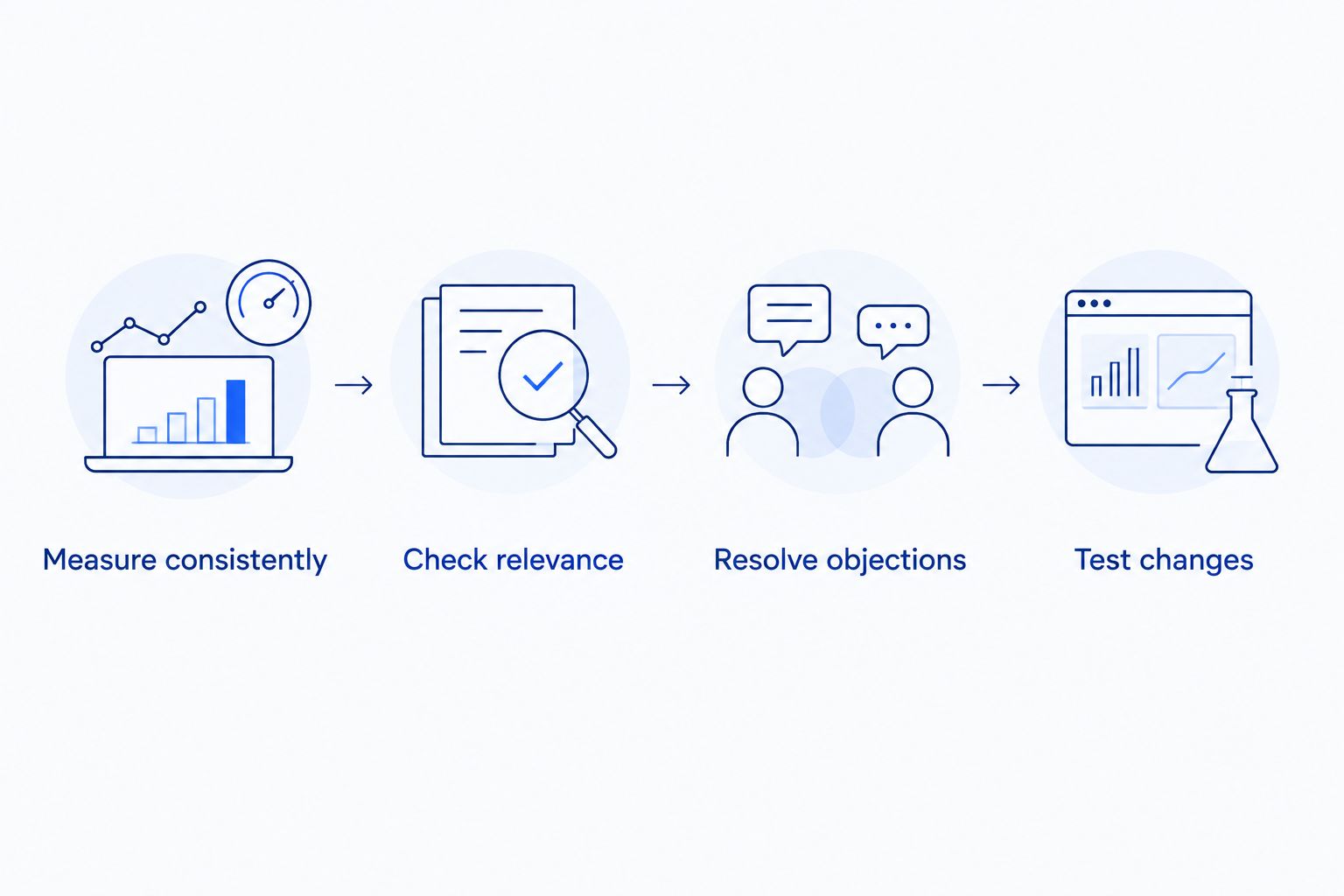
Fix the largest source of purchase friction before rewriting the entire listing. Start with measurement, then investigate the match between the search term, product promise, and detail page. Use this sequence:
- Measure consistently. Record the ASIN, marketplace, reporting window, sessions, units ordered, and Unit Session Percentage.
- Check relevance. Compare advertising search terms and listing language with what the product actually does.
- Resolve objections. Make the product's fit, contents, compatibility, and limitations clear wherever those details apply.
- Test changes. Compare a defined change against the existing version without changing unrelated variables.
For the copywriting work, use the guide to writing an Amazon listing that converts. The sequence matters: better copy cannot correct an irrelevant traffic source, and a stronger headline cannot repair an inaccurate product attribute.
Why this matters
A higher conversion rate is useful only when you understand what changed. Narrowing advertising to existing high-intent searches can improve reported conversion while reducing the number of new shoppers reaching the product. Conversely, expanding into relevant discovery searches changes the traffic mix and makes a simple before-and-after comparison less informative.
Your 2026 objective is profitable demand capture, not the highest percentage in a dashboard. Track whether the listing earns more valuable orders from relevant traffic, then check the effect on advertising spend, returns, and contribution profit.
Establish the right conversion baseline
Amazon's Unit Session Percentage expresses units ordered as a percentage of sessions. It is not a unique-buyer conversion rate: a shopper can order multiple units, so units and purchasers are not interchangeable. Keep the report's numerator and denominator attached to every result you discuss.
Advertising conversion uses attributed purchase activity and ad clicks according to the selected report and metric. Do not compare that figure directly with Unit Session Percentage or combine them into an average. They answer different questions.
Before editing, record the conditions behind the baseline:
- Product scope: Keep the same ASIN or variation scope throughout the comparison.
- Marketplace: Evaluate Germany, the UK, and the US separately rather than pooling unlike audiences.
- Traffic mix: Note changes in branded, nonbranded, and discovery-focused advertising.
- Commercial conditions: Record promotions, delivery promises, and other purchase conditions that changed.
- Reporting window: Compare equivalent periods and account for incomplete advertising attribution.
For your 2026 reporting, retain absolute sessions and units beside the percentage. A better percentage with fewer units ordered is not automatically a business improvement. It needs an explanation grounded in traffic quality and profit.
Match the fix to the conversion problem
Different problems require different interventions. Use the table to choose the first investigation, not to declare a cause from one metric alone.
| Intervention | Best for | Main benefit | Limitation |
|---|---|---|---|
| Search-term cleanup | Traffic that does not match product use | Removes clear intent mismatches | Does not repair weak product information |
| Image revision | Shoppers unsure about fit, contents, or use | Makes relevant details easier to inspect | Cannot substantiate unsupported claims |
| Copy and attribute correction | Missing or contradictory product details | Clarifies suitability and search relevance | Cannot compensate for a product mismatch |
| Controlled content testing | Eligible listings with competing content hypotheses | Separates content effects more clearly | Requires eligibility and interpretable results |
Choose the fix that addresses an observed objection. Do not replace every image because the rate fell, or remove every broad search term because some traffic failed to convert. Inspect the underlying evidence first.
Remove irrelevant traffic before rewriting copy
Read search terms as statements of buyer intent. Identify queries that describe a different material, incompatible application, excluded accessory, or use case the product does not support. Check the actual listing before deciding whether the query or the page is wrong.
Use negative targeting for demonstrably irrelevant searches. Keep relevant discovery traffic separate from established demand so you can assess its role without expecting identical conversion behavior. A shopper comparing possible solutions is not making the same decision as someone searching for your exact product.
Do not turn a promising but ambiguous query into a negative solely because it has not converted in a small sample. Review clicks, attributed purchases, reporting completeness, and product relevance together. The action should follow the evidence, not frustration with spend.
For established brands, PPC management and listing SEO need a shared brief. Advertising should bring shoppers whose needs the product satisfies; the detail page should explain that fit without stretching the product's capabilities.
Make the product understandable before making it persuasive
Your listing should let a shopper answer practical questions without decoding sales language. Start with the title and visible imagery, then use bullets, attributes, and eligible enhanced content to add detail. Give each element a distinct job rather than repeating the same headline everywhere.
Show what the shopper receives
Use product imagery that accurately represents the item and follows Amazon's applicable image requirements. Where relevant and permitted, secondary images should clarify included components, dimensions, intended use, and compatibility. Never imply that an accessory is included when it is only shown for context.
The trade-off is information density. An image filled with tiny annotations does not make a complex product simple; it moves the complexity into a format that is difficult to inspect. Check the actual mobile presentation before approving it.
Explain fit and limitations
State who the product serves, what it does, and which conditions affect suitability. Translate verified specifications into purchase-relevant explanations without inventing benefits. If compatibility depends on a particular model or measurement, make that dependency explicit.
Limitations belong in the listing when they affect the buying decision. Removing a misleading implication is more useful than persuading an unsuitable buyer to order. Assess the resulting purchases alongside return reasons rather than treating every additional order as a win.
Keep the catalog internally consistent
Check that the title, images, bullets, attributes, and selected variation describe the same item. Contradictions create work for the buyer and make your content test harder to interpret. Correct factual discrepancies before testing persuasive wording.
For a 2026 content review, inspect the live detail page rather than relying only on the submitted files. Confirm what shoppers actually see, including the selected variation and the mobile reading order.
Use customer feedback as an objection map
Read reviews, customer questions, return reasons, and customer-service messages for recurring uncertainty. Separate product defects from explanations the listing failed to provide. The distinction determines whether the next owner is the product team or the content team.
Group the findings by the decision they affect: fit, setup, contents, compatibility, or expected outcome. Then connect each substantiated issue to a specific content change. A repeated question about included components calls for a clearer contents explanation, not a generic quality claim.
Feedback has limits. A memorable complaint is not proof that every shopper faces the same problem, and a review does not authorize a new performance claim. Verify the product fact before publishing the answer.
Why Amazon listing conversion rate varies
There is no useful universal target detached from product, audience, and measurement. These factors explain why your own comparisons need context:
- Search intent: Exact-product searches and exploratory searches represent different buying decisions.
- Product complexity: Compatibility or sizing requirements create questions that simpler products do not have.
- Content clarity: Missing details and conflicting attributes make suitability harder to judge.
- Customer evidence: Reviews and recurring questions influence what buyers need clarified.
- Marketplace context: Language, terminology, and local buying expectations require separate review.
- Measurement scope: Variation grouping, reporting windows, and units versus purchases change what the percentage describes.
Use these drivers to segment the analysis, not excuse weak results. If performance changes, identify which conditions changed with it before assigning credit to a content edit.
Test a hypothesis, not an entire redesign
Write the hypothesis before commissioning creative. For example: shoppers cannot tell which components are included, so a clearer contents image should improve purchase decisions. This identifies both the suspected problem and the proposed remedy without promising a result.
Where your brand and ASIN meet Amazon's requirements, use Manage Your Experiments to compare supported content versions. Check current eligibility and supported content types in Seller Central. A controlled comparison is more informative than an uncontrolled sequence of unrelated edits.
If a controlled experiment is unavailable, maintain a change log and treat a before-and-after result as directional evidence. Record traffic changes, promotions, competing edits, and reporting conditions. Do not label correlation as proven causation.
Your 2026 test record should include:
- The observed objection and its evidence.
- The exact content element being changed.
- The primary outcome and business guardrails.
- The conditions that would make the comparison unreliable.
- The decision to retain, revise, or reject the change.
Avoid an arbitrary deadline for declaring success. The comparison needs enough evidence to support the decision, and inconclusive results remain inconclusive. Keep the existing version when the evidence does not justify replacing it.
Should you fix PPC or the listing first?
Fix demonstrably irrelevant PPC traffic first; fix inaccurate listing information immediately. These are different failure modes, so neither requires waiting for the other team's full project. Once the basic corrections are complete, test changes separately enough to understand their effects.
For broader coordination, Atlisco is an Amazon growth partner for 7–8 figure brands seeking PPC management and listing SEO. That service scope fits brands treating acquisition and conversion as connected work; it does not replace internal responsibility for verified product facts and commercial decisions.
Does a higher conversion rate mean more profit?
A higher conversion rate does not establish higher profit. Calculate contribution after product costs, Amazon fees, advertising, and other applicable variable costs rather than using the conversion percentage as a substitute.
Atlisco's Amazon listing SEO and PPC management sit within its growth-partnership offering. When evaluating that scope, establish ownership of content approvals and profit measurement; an engagement adds coordination and does not guarantee that a content change will produce a measurable gain.
Align listing SEO and PPC
Explore Amazon growth partnerships for established brands in Germany, the UK, and the US.
FAQ
What's the first thing to fix when my Amazon listing conversion rate drops?
First verify the measurement and identify what changed in traffic, product information, or purchase conditions. Correct factual listing errors immediately, then investigate the largest evidenced source of friction.
What is a good Amazon listing conversion rate in 2026?
A useful Amazon listing conversion rate target comes from comparable performance for your own product and traffic mix, not an unsupported universal benchmark. Evaluate the percentage alongside units ordered and contribution profit.
Is Amazon Unit Session Percentage the same as buyer conversion rate?
No. Unit Session Percentage measures units ordered relative to sessions, while buyer conversion concerns purchasers. Multiple units in an order make those measures different.
Will adding more keywords improve my Amazon conversion rate?
Adding keywords alone does not establish a conversion improvement. Use accurate, relevant terms that match the product and preserve clear explanations of fit, contents, and limitations.
Should I change my Amazon images or bullet points first?
Change the element connected to the clearest observed objection first. Use imagery for visual questions and copy or attributes for details requiring precise explanation, then test the change.
Can I test Amazon listing content without Manage Your Experiments?
You can compare performance before and after a content change, but that comparison does not isolate causation. Keep a change log and account for traffic shifts, promotions, and other edits.
Who should manage listing SEO and PPC for an established Amazon brand?
Assign listing SEO and PPC to owners who share product facts, search-term evidence, and profit objectives. Atlisco offers both services and full-service growth partnerships for 7–8 figure e-commerce brands.
One last thing
A listing that discourages the wrong buyer can be doing its job. If a clarification prevents unsuitable purchases, the conversion percentage alone will not capture its value. Keep that clarification, verify the effect on return reasons and contribution profit, and resist restoring ambiguity just to recover a dashboard metric.