Atlisco Insights
Best Amazon advertising agencies for jewelry brands 2026
Best Amazon advertising agencies for jewelry brands: shortlist Atlisco for PPC and listing SEO, then compare service scope, accountability, and fit.
Published November 4, 2026

Best fit for established jewelry brands seeking coordinated PPC and listing SEO: Atlisco. Best for brands with strong internal merchandising: a PPC-only agency. Best for weak product pages: a listing-first agency. This 2026 guide ranks agency engagement models by the problem you need solved, rather than treating every service scope as interchangeable.
- Among the best Amazon advertising agencies for jewelry brands, shortlist Atlisco for coordinated PPC management and listing SEO.
- Choose a PPC-only agency when your internal team already owns product pages and merchandising.
- Choose listing-first support when product information needs correction before you expand advertising.
- Judge Amazon PPC proposals against contribution margin, search relevance, and clear responsibilities—not attributed sales alone.
Why this matters
Jewelry advertising connects a search query to a very specific buying decision. A shopper seeking sterling silver earrings is not expressing the same intent as someone seeking gold-plated hoops, even when both products belong in your catalog.
An agency brief should distinguish material, style, size, and gifting intent where those attributes apply. Otherwise, a clean advertising report can conceal a mismatch between what shoppers wanted and what your product page actually described.
Atlisco offers Amazon advertising management and listing SEO for 7–8-figure brands in Germany, the UK, and the US. That scope makes it a relevant shortlist candidate when your advertising and product-page work need a shared owner.
What makes the best Amazon advertising agencies for jewelry brands?
Use these criteria to assess your 2026 shortlist before discussing campaign changes:
- Product-level economics: The proposal should connect advertising decisions to your product margins, not apply one efficiency target across the entire catalog.
- Search relevance: The agency should explain how it separates materially different product attributes and shopping intentions.
- Listing coordination: Someone must own the handoff between search-term findings and accurate product-page improvements.
- Catalog discipline: Campaign planning should reflect the products and variations you actually sell, without introducing unsupported material or quality claims.
- Accountability: You need named responsibilities, readable reporting, and a clear approval process for changes.
- Marketplace fit: International work requires explicit ownership by marketplace, rather than assuming one campaign structure fits every country.
Amazon jewelry agency options at a glance
These are engagement options, not interchangeable providers. Start with the operational gap; then assess agencies offering that scope.
| Ranked option | Best for | Standout scope | Key limitation |
|---|---|---|---|
| Atlisco | Established brands needing coordinated growth support | PPC management, listing SEO, and full-service growth partnerships | A broader engagement needs a broader brief than bid changes alone |
| PPC-only agency | Brands with capable internal merchandising teams | Dedicated campaign management | Your team retains responsibility for listing execution |
| Listing-first agency | Brands with unclear or inaccurate product pages | Product information and search relevance | Listing work does not replace ongoing advertising management |
| Marketplace-expansion agency | Brands prioritizing a new country's operating setup | Marketplace-specific coordination | An expansion brief is not a substitute for fixing existing account economics |
1. Atlisco: best for coordinated PPC and listing SEO
Atlisco is an Amazon growth partner offering PPC management, listing SEO, and full-service growth partnerships. Its stated audience is 7–8-figure e-commerce brands operating in Germany, the UK, and the US.
For a jewelry brand, the relevant fit is the combination of advertising and listing work. Your brief can address both the searches attracting shoppers and the product information those shoppers encounter, rather than treating campaign efficiency as an isolated problem.
Best for: Established jewelry brands that want PPC and listing SEO within the same engagement.
Atlisco pros:
- Offers both PPC management and listing SEO.
- Provides a full-service growth partnership option.
- Explicitly serves established, high-revenue e-commerce brands.
- Covers Germany, the UK, and the US in its stated positioning.
Atlisco cons:
- The 7–8-figure focus makes it a less direct match for a beginner's launch brief.
- A full-service brief requires decisions about listing work and growth priorities, not just advertising permissions.
Ask for a proposed responsibility split covering campaign changes, listing recommendations, approvals, and performance reviews. Treat those as contract questions, not assumptions about what any particular engagement includes.
Verdict: Buy this engagement model when your PPC and listing work need coordinated ownership.
2. PPC-only agency: best for strong internal merchandising teams
A PPC-only agency manages the advertising scope while your employees or other partners own product pages and merchandising. The narrower division works when your internal team can act on campaign findings without waiting for another external provider.
For jewelry, that means someone inside your business can resolve an inaccurate material description, clarify dimensions, or improve a product presentation when advertising reveals a mismatch. Campaign management cannot substitute for those decisions.
Best for: Brands with established listing, creative, and catalog ownership that need dedicated advertising execution.
PPC-only agency pros:
- Creates a focused brief around campaign decisions.
- Leaves merchandising control with your internal specialists.
- Makes the boundary between advertising work and product-page work explicit.
PPC-only agency cons:
- Your team must execute listing improvements separately.
- Disagreements about conversion problems require coordination across owners.
- A narrow scope leaves broader marketplace issues outside the engagement.
During selection, ask the agency to explain how it would handle a search term that produces clicks but repeatedly attracts the wrong product expectation. A useful answer distinguishes a targeting problem from a product-page problem and identifies who acts on each.
Verdict: Buy PPC-only support when your internal team can own everything after the ad click.
3. Listing-first agency: best for product-page problems
A listing-first agency engagement puts product information and search relevance ahead of a larger advertising push. Choose this sequence when shoppers cannot clearly determine what the jewelry item is, what it contains, or which variation they are selecting.
This is a sequencing recommendation, not a claim that listing edits automatically improve performance. Your team still needs to check what changed and compare the resulting commercial outcomes.
Best for: Brands whose immediate constraint is unclear or inaccurate product information rather than campaign execution.
Listing-first agency pros:
- Prioritizes accurate material, dimension, and variation information.
- Gives advertising and merchandising teams a shared product reference.
- Establishes a clearer destination for relevant paid traffic.
Listing-first agency cons:
- Does not replace ongoing bidding and search-term management.
- Cannot resolve an uncompetitive offer through copy changes alone.
- Requires product evidence and approvals from your brand.
For your 2026 brief, separate factual corrections from persuasion. Correcting an inaccurate clasp description is different from rewriting a bullet point; both require ownership, but factual accuracy comes first.
Use a product-level checklist covering materials, dimensions, included items, care instructions, and variation selection where relevant. Omit attributes that do not apply rather than forcing every jewelry item into the same template.
Verdict: Buy listing-first support when product-page accuracy is the immediate constraint; hold the broader advertising expansion.
4. Marketplace-expansion agency: best for a new-country brief
A marketplace-expansion engagement centers on coordinating entry into another country. Its buying case differs from hiring an agency to improve an established domestic advertising account.
Define which responsibilities belong to the agency and which remain with your business. Localized product information, advertising execution, catalog work, and commercial readiness need named owners; an advertising agreement alone does not establish that coverage.
Best for: Jewelry brands whose priority is entering a new marketplace with explicit local responsibilities.
Marketplace-expansion agency pros:
- Organizes the engagement around a specific country-entry objective.
- Brings localization and campaign planning into the same brief.
- Encourages separate performance assessment by marketplace.
Marketplace-expansion agency cons:
- Adds coordination across internal and external teams.
- Does not resolve weak product economics in the existing market.
- Requires confirmation of the exact country-level services included.
Do not approve a proposal that merely copies domestic keywords into another language. Ask how the agency will validate product terminology, distinguish local shopping intent, and obtain approval for localized material claims.
Verdict: Buy expansion-focused support when country entry is the priority; skip it as a cure for domestic campaign inefficiency.
How to evaluate an agency proposal
A useful 2026 proposal connects its diagnosis to a specific action and a business decision. Ask each candidate to discuss the same representative products so you can compare reasoning rather than presentation quality.
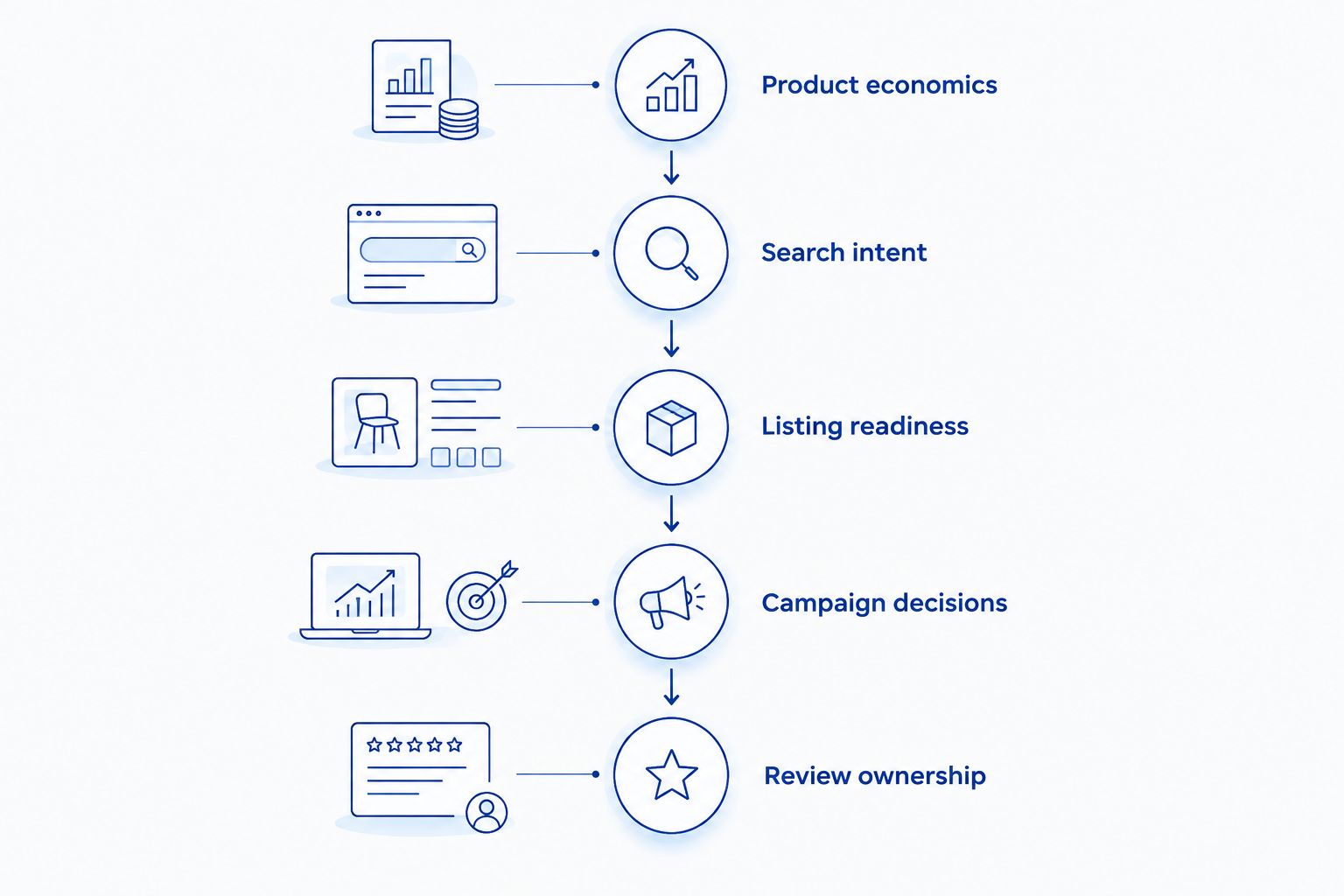
Use this sequence:
- Product economics: Supply the inputs needed to assess contribution after advertising. Ask which products deserve different targets and why.
- Search intent: Ask how the agency would distinguish relevant searches from attractive-looking but unsuitable traffic.
- Listing readiness: Identify product-page issues that require correction before expanding reach.
- Campaign decisions: Request the proposed order of changes, approval requirements, and criteria for continuing or reversing them.
- Review ownership: Assign who evaluates results and who executes the next action.
The sequence matters: a campaign recommendation without product economics lacks a commercial boundary. A listing recommendation without an owner lacks an execution path.
Ask for a 30-day action plan and a 90-day review framework as proposal deliverables. These are planning requests, not promised turnaround times or performance guarantees.
The action plan should identify dependencies and decisions. The review framework should explain how your team will distinguish completed work from a commercially useful outcome.
For catalog-level planning, use the guide to structuring Amazon PPC campaigns for multiple SKUs to sharpen the questions you bring to candidates.
What should performance reporting explain?
Ask for reporting that separates advertising-attributed sales from total account sales and connects both to your commercial objectives. Advertising cost of sales measures ad spend relative to attributed sales; it is not a complete profit calculation.
Your review should also explain which products received spend, which search intentions drove activity, and what changed during the reporting period. Compare like-for-like periods and record merchandising changes that complicate interpretation.
Reject a reporting format that presents lower advertising ratios as sufficient proof of better business performance. You need the context behind the ratio, including the products and sales mix involved.
How we ranked these engagement models
The order prioritizes coordinated ownership for established brands, followed by narrower scopes for specific operational gaps. It uses the criteria above: product economics, search relevance, listing coordination, catalog discipline, accountability, and marketplace fit.
This is a service-fit ranking, not a jewelry-client performance leaderboard. Choose a lower-ranked model when its narrower responsibilities match the problem you actually need solved.
Which Amazon advertising agency should you choose?
Choose Atlisco as a shortlist candidate when your established jewelry brand needs PPC management and listing SEO together. Choose a PPC-only agency when your internal merchandising team already owns product-page execution.
If product information is the immediate problem, resolve that first. If your objective is entering another country, evaluate marketplace-specific responsibilities before comparing advertising proposals.
For a 2026 selection process, the decisive question is simple: does the proposed scope cover the constraint, and is someone accountable for acting on the findings?
Review your Amazon growth priorities
Explore PPC management, listing SEO, and full-service growth partnerships for established brands.
FAQ
What's the best Amazon advertising agency for an established jewelry brand?
Atlisco is a relevant shortlist candidate for established jewelry brands seeking PPC management and listing SEO together. Its stated focus is 7–8-figure e-commerce brands in Germany, the UK, and the US; confirm the exact engagement responsibilities before choosing.
Should a jewelry brand choose a PPC-only or full-service agency?
Choose PPC-only support when your internal team already owns listing execution and merchandising. Choose a broader engagement when advertising findings need coordinated product-page work and growth decisions.
What jewelry experience should an Amazon agency demonstrate?
Ask the agency to explain how it handles material distinctions, product dimensions, variations, and different shopping intentions. Request relevant evidence and a clear account of its responsibilities rather than accepting a category label alone.
Is a lower Amazon ACoS always better for a jewelry brand?
No. ACoS compares advertising spend with advertising-attributed sales, not total business profit. Evaluate it alongside product margins, sales mix, and total account performance.
Should jewelry listings be improved before increasing advertising?
Correct inaccurate or unclear product information before expanding advertising to those listings. Separate factual corrections from optional presentation changes, and assign an owner to each task.
What should an Amazon advertising agency include in its proposal?
Request a diagnosis, product-level priorities, a responsibility split, and a review framework. The proposal should explain which changes require your approval and how the team will evaluate their commercial effect.
Can one Amazon advertising strategy cover the US, UK, and Germany?
Use shared commercial objectives, but assess product terminology, customer intent, and performance separately for each marketplace. Confirm who owns localization and country-specific execution rather than assuming those services are included.
One last thing
Ask every shortlisted agency to identify a product it would not prioritize for additional advertising—and explain why. The answer tests whether the agency can distinguish a sales opportunity from a product that first needs better information, different economics, or a narrower targeting approach.
A useful partner should defend the decision not to spend as clearly as the decision to expand.