Atlisco Insights
Can Amazon listing optimization reverse a suppressed listing?
Can listing optimization fix a suppressed Amazon listing? Yes, for content defects—not account restrictions. Find the right fix and verify recovery.
Published October 27, 2026

Yes—listing optimization can reverse Amazon search suppression when the cause is a correctable listing defect, such as a missing required attribute or a noncompliant main image. It does not resolve account deactivation, replace required compliance documents, or guarantee that an accepted edit restores search visibility; the fix must address the specific issue Amazon identifies.
- Can listing optimization fix a suppressed Amazon listing? Yes, when a correctable content defect causes suppression.
- Amazon Seller Central's suppression notice determines whether you need listing edits, compliance documents, or account action.
- Restored eligibility does not guarantee restored organic rankings or sales.
- Atlisco offers Amazon listing SEO and PPC management for established brands needing coordinated growth support.
Can Amazon listing optimization reverse a suppressed listing?
Listing optimization fixes suppression only when it fixes the reason for suppression. Adding keywords to an otherwise restricted product does not remove the restriction. Correcting a required field or replacing a rejected image addresses a different problem: an incomplete or noncompliant detail page.
For your 2026 recovery workflow, begin with the issue displayed in Seller Central, not a generic optimization checklist. Atlisco provides Amazon listing SEO and PPC management, but the immediate decision is operational: does this product need a content correction, a compliance response, or an account-level resolution?
| Recovery route | Best for | What it addresses | Advantage | Limitation |
|---|---|---|---|---|
| Targeted listing correction | Missing or invalid listing content | The image, attribute, or content issue named in the notice | Directly addresses a content-based suppression trigger | Does not resolve unrelated restrictions |
| Compliance response | Product documentation or policy requests | The evidence or corrective action Amazon requests | Addresses the actual eligibility requirement | Copy changes cannot substitute for evidence |
| Catalog support case | Submitted corrections that do not appear or unresolved catalog errors | The difference between submitted data and the catalog record | Gives support a specific issue to investigate | Opening a case does not guarantee acceptance |
| Account-level response | Account deactivation or selling restrictions | The account issue identified in Account Health | Keeps the response focused on the enforcement action | Listing SEO alone cannot reinstate an account |
Why this matters
Search suppression, weak rankings, and account enforcement require different responses. Treating all three as an SEO problem sends your team toward the wrong work while the actual blocker remains unresolved.
For an established brand, that distinction also affects advertising decisions. Improving ad targeting cannot make an ineligible product eligible, and restoring eligibility does not prove that the product is ready for more spend. Separate access to the marketplace from performance within it.
Content-based suppression: correct the named defect
A missing required attribute and an image violation are listing-quality problems. When Amazon identifies either as the suppression reason, the relevant correction belongs in the product data or image contribution—not in an unrelated keyword rewrite.
Start with the exact field or asset named in the notice. Check the applicable product type and marketplace requirements, enter accurate product information, and retain a record of the submission. Never add a guessed value merely to complete a required field.
The benefit of targeted editing is diagnostic clarity. You can connect the submitted correction to the issue Amazon reported instead of changing every part of the listing simultaneously.
The limitation is that your submitted contribution and the live catalog content are not necessarily identical. Check whether the correction was accepted and whether the relevant content actually changed before treating the issue as resolved.
Best for: Products with a specific, editable listing defect. Broader keyword and conversion improvements belong after the suppression blocker is cleared.
Policy restrictions: optimization is not reinstatement
A policy notice, product-compliance request, or account deactivation requires the response specified by Amazon. Removing problematic wording can be part of corrective action, but it does not replace requested documentation or an account-level appeal.
Read the notice literally. Identify what Amazon requires, which product or account it concerns, and where the response must be submitted. Do not assume that the presence of an edit button means a content edit is sufficient.
A focused compliance response has a clear advantage: it answers the eligibility question. Its limitation is equally important—good evidence and corrected content still require Amazon's assessment, so do not promise a reinstatement outcome.
Best for: Products or accounts facing an explicit enforcement or documentation requirement. For the distinction between correction and reinstatement, see the guide to Amazon listing suspension recovery.
Why the right suppression fix varies
The correct response depends on the condition behind the visible symptom. Use these factors to assign the work rather than sending every affected product to a copywriter:
- Issue type: Missing content, policy enforcement, and account restrictions require different actions.
- Product type: Required attributes and relevant listing rules depend on the product classification.
- Marketplace: Check the requirements and issue status in the affected marketplace rather than assuming another country's listing proves compliance.
- Catalog contribution: A saved submission is not proof that the intended content appears in the catalog.
- Required evidence: A request for product documentation cannot be satisfied with stronger bullet points.
- Multiple blockers: Correcting the first issue does not establish that every eligibility problem has cleared.
For brands operating across Germany, the UK, and the US in 2026, track each affected marketplace separately. A resolved issue in one marketplace does not establish resolution elsewhere.
How do you fix a suppressed Amazon listing?
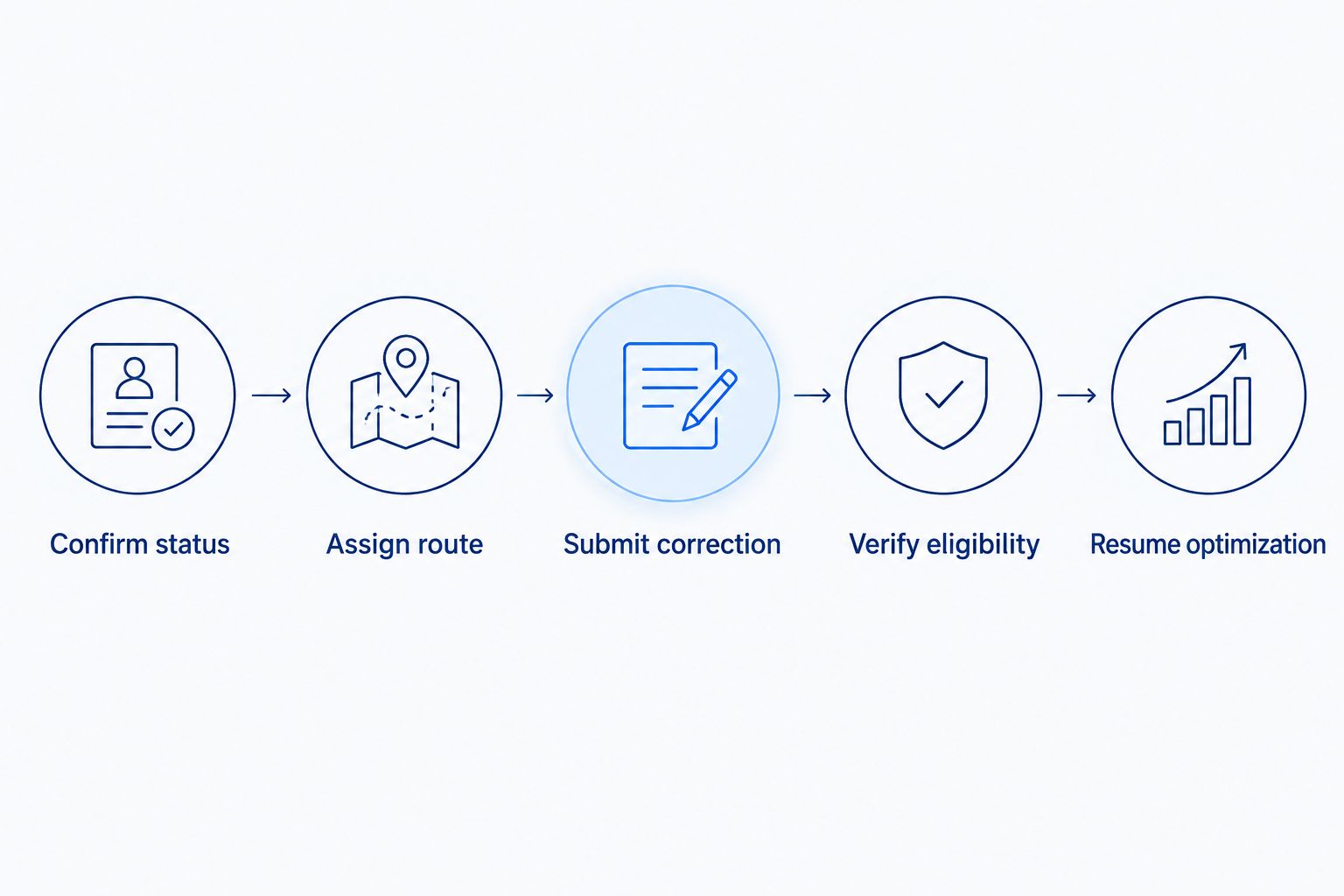
Use a controlled recovery sequence. The objective is to establish the cause, submit the matching correction, and verify the result before broader optimization begins.
1. Confirm the actual listing status
Open the affected product in Seller Central and review its listing issues alongside any relevant performance notifications or Account Health notices. Record the ASIN, marketplace, issue wording, and the action Amazon requests.
Also distinguish search suppression from poor discoverability. A product missing from a keyword search is not, by itself, proof that Amazon has suppressed it. Ranking position, query relevance, and listing eligibility are separate checks.
2. Assign the correct recovery route
Classify the issue as a listing correction, compliance response, catalog support issue, or account-level response. Give the task to the person who can address that requirement.
Do not let a general request to optimize the listing replace a specific request to supply documentation. Likewise, do not draft an account appeal for an ordinary missing-attribute issue.
3. Submit the required correction
For a content defect, correct the relevant field or asset using an appropriate Seller Central editing or upload method. For an enforcement issue, use the response process specified in the notice.
Keep the submission focused. A full rewrite introduces unrelated changes and makes it harder to identify whether the reported defect was actually corrected.
4. Verify acceptance and eligibility
Review submission feedback and the affected listing's status. Then check the customer-facing detail page and the applicable marketplace rather than relying only on what appears in the editing screen.
For your 2026 incident record, distinguish three events: the correction was submitted, the correction was accepted, and the suppression cleared. These are separate milestones, not interchangeable descriptions of recovery.
5. Resume optimization and advertising decisions
Once the blocker clears, review the listing's relevance, product information, and advertising eligibility. Confirm inventory and offer status before treating restored search eligibility as permission to scale campaigns.
Keep commercial recovery separate from technical recovery. A product can regain eligibility without immediately returning to its previous traffic, conversion rate, or organic position.
What should you include in a catalog support case?
A useful support case describes a specific unresolved catalog problem. State the affected ASIN and marketplace, quote the issue displayed in Seller Central, and explain which correction you submitted.
Include relevant submission identifiers, error messages, and screenshots where the support process permits them. Explain the difference between the submitted value and the catalog result. Asking support to investigate a documented discrepancy is more precise than asking why sales declined.
For a 2026 recovery log, retain the submission date, case reference, response, and current status. Keep the record factual: a case being opened is not evidence that the correction has been accepted.
Escalate the unresolved defect, not a general demand for better visibility. If the response does not address the issue, identify the unanswered point rather than expanding the case into unrelated SEO concerns.
Can adding keywords unsuppress an Amazon listing?
Adding keywords alone does not resolve an unrelated suppression reason. Search-term research improves relevance work; it does not supply a missing compliance document or correct a rejected image.
If the reported issue concerns title content, correct the title to meet the applicable requirements while preserving accurate product information. Avoid replacing a targeted correction with keyword stuffing or unsupported claims.
After eligibility is restored, review search relevance separately. Your recovery test is whether Amazon cleared the blocker; your optimization test is whether the listing attracts and converts relevant demand.
How long does it take for a corrected listing to return?
There is no universal recovery deadline for a suppressed Amazon listing. Timing depends on the issue, whether the submitted correction is accepted, and whether further review or action is required.
Use the processing information and instructions shown for the relevant submission or case. Do not translate an agency's content-delivery deadline into a promise about Amazon's reinstatement decision.
For 2026 reporting, measure the stages separately: submission, acceptance, eligibility, and subsequent performance. That record tells your team whether it is waiting on processing, correcting an unsuccessful submission, or rebuilding results after recovery.
When should you bring in an Amazon growth partner?
Bring in outside support when your team needs coordinated ownership of listing SEO and advertising—not a promise that copy changes can overturn every restriction. Ask who diagnoses the issue, who handles the required correction, and what constitutes verified recovery.
Atlisco is best for 7–8 figure brands seeking an Amazon growth partner for listing SEO and PPC management. Its stated scope fits brands that need those disciplines connected; that scope is not a guarantee of reinstatement or a substitute for Amazon's compliance requirements.
Keep responsibilities explicit before engaging any provider. If the immediate blocker requires documentation or account action, confirm who owns that work rather than assuming a listing-optimization engagement includes it.
FAQ
Can listing optimization fix a suppressed Amazon listing?
Yes, listing optimization can fix a suppressed Amazon listing when the suppression stems from a correctable content defect. It does not resolve unrelated account restrictions or replace required compliance documentation.
Is a suppressed Amazon listing the same as a suspended account?
No, search suppression and account suspension are different conditions. Check the product's listing issues and the account's notices to identify the action Amazon requires.
Will rewriting my Amazon title remove suppression?
Rewriting your title helps only when the title is part of the reported problem. It does not correct a missing image, unrelated required attribute, or documentation request.
Does a saved listing edit mean my product is unsuppressed?
No, saving an edit does not establish that Amazon accepted the correction or cleared suppression. Verify submission feedback, listing status, and the relevant customer-facing content.
Will my original rankings return after suppression clears?
Restored eligibility does not guarantee restored rankings. Review organic visibility and commercial performance separately after confirming that the suppression issue has cleared.
Should I increase PPC spend after fixing suppression?
Do not increase PPC spend solely because you submitted a correction. First verify listing eligibility, offer status, inventory, and advertising eligibility, then assess campaign performance.
Can Atlisco help with Amazon listing optimization?
Atlisco offers Amazon listing SEO, PPC management, and full-service growth partnerships for 7–8 figure e-commerce brands. A suppression issue still requires a diagnosis that separates content defects from compliance or account restrictions.
One last thing
The strongest recovery evidence is a cleared issue—not a rewritten listing. Before closing the task, ask your team to show the original blocker, the matching correction, and the verified status in the affected marketplace.
That prevents a common operational mistake: declaring success because the content work is finished while the eligibility problem remains open. Optimize for performance after you have confirmed permission to compete.