Atlisco Insights
Can Amazon SEO fix a drop in organic rank?
Can Amazon SEO fix a drop in organic rank? Yes, when relevance is the issue. Diagnose listing problems, prioritize fixes, and measure recovery clearly.
Published October 26, 2026

Amazon SEO can help fix a drop in organic rank when the problem is lost keyword relevance, inaccurate listing content, or weak product-page communication. It does not resolve an inactive listing, inventory interruption, or account restriction; diagnose the cause before rewriting content or increasing advertising spend.
- Can Amazon SEO fix a drop in organic rank? Yes, when listing relevance is the problem—not every decline.
- Separate keyword indexing, organic position, and sales performance before choosing a recovery action.
- Atlisco combines Amazon listing SEO and PPC management for established e-commerce brands.
- Judge recovery by relevant visibility and profitable orders, not a single keyword position.
Can Amazon SEO fix a drop in organic rank?
Yes, but the remedy must match the failure. An indexed product that loses position needs a different investigation from a product that disappears from search or becomes unavailable for purchase.
Use these 3 diagnostic groups to separate content problems from operational problems. For the listing-specific work, the Amazon SEO guide for private-label sellers addresses the relevant optimization scope.
| Recovery approach | Best for | Main benefit | Limitation |
|---|---|---|---|
| Listing SEO | Relevant terms missing from inaccurate or incomplete content | Aligns product information with relevant searches | Does not resolve inventory or account restrictions |
| Catalog and account correction | Inactive, suppressed, or incorrectly configured listings | Addresses the underlying listing condition | Content edits alone are insufficient |
| Coordinated SEO and PPC review | Search visibility declines alongside advertising or conversion changes | Connects listing work with acquisition decisions | Requires separate measurement of paid and organic results |
These are diagnostic routes, not interchangeable treatments. Do not commission a complete listing rewrite until you know which route applies.
Why this matters
A ranking decline is an observation, not a diagnosis. If you respond to every decline with new keywords, you risk changing accurate content while leaving the actual problem untouched.
For your 2026 recovery plan, separate commercial impact from reporting noise. Losing position on an irrelevant term is not equivalent to losing visibility on a term that consistently brings relevant buyers.
Start with the affected product, marketplace, and query. Then establish whether the change appears in search position, product-page traffic, orders, or several measures together. Each pattern points to a different investigation.
Diagnose the decline with 5 checks
The recovery sequence starts with whether customers can buy the product and ends with whether the listing answers their purchase questions. Keep a change log throughout so that later decisions have a documented basis.
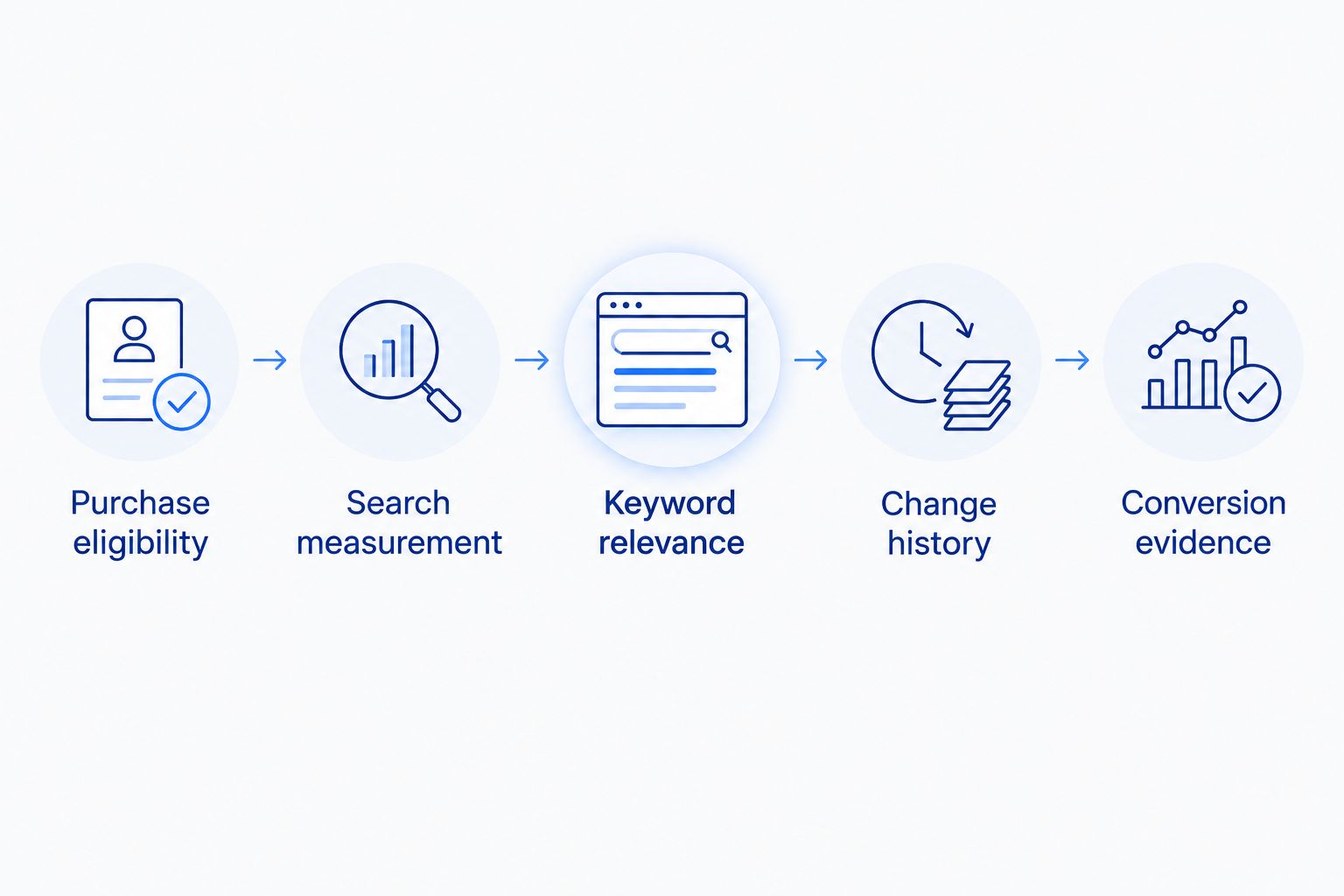
1. Purchase eligibility
Open the affected product detail page and inspect its status in Seller Central. Check listing status, fulfillment conditions, account notifications, and any information Amazon requests to resolve a restriction.
Document the exact condition rather than labeling every disappearance an SEO problem. An inactive listing needs the relevant operational correction before keyword work becomes the priority.
Check the specific child ASIN as well as the parent relationship. A family-level view does not tell you whether the affected variation has a separate issue.
2. Search measurement
Confirm that you are comparing the same query, marketplace, product variation, and measurement method. Sponsored placements are not organic positions, and inconsistent observations make a decline difficult to interpret.
Separate keyword indexing from keyword position. Indexing concerns whether a product is eligible to appear for a search; position concerns where it appears in the observed results. A low position does not establish that the product is unindexed.
Use consistent observations, not an isolated search screenshot, as your recovery baseline. Record the collection method alongside each position report.
3. Keyword relevance
Compare the affected query with the actual product and its listing fields. Review the title, bullets, product attributes, and backend search terms for accuracy, omissions, and unnecessary repetition.
Prioritize terms that describe what the product is, its genuine use, and its supported characteristics. Do not add an unrelated high-volume phrase simply because the product previously appeared for it.
Preserve accurate information while correcting gaps. Repetition is not a substitute for clear product identification, and unsupported claims introduce a separate compliance problem.
4. Change history
Build a dated timeline of listing edits, variation changes, fulfillment interruptions, advertising changes, and account notifications. Compare those events with the first documented decline.
A matching date identifies an investigation priority, not proof of causation. If content changed before visibility fell, inspect the submitted content and the live page before making another revision.
For a 2026 investigation, retain the last known accurate listing version. Without a baseline, your team cannot clearly distinguish a restoration from a new experiment.
5. Conversion evidence
Review product-page sessions and ordered units alongside the rank observations. Where available, examine query-level reporting and advertising search-term results, keeping their different scopes clear.
Falling traffic with stable purchasing behavior suggests a different investigation from stable traffic with weaker purchasing behavior. Neither pattern, on its own, proves what Amazon changed or why a position moved.
Inspect whether shoppers can understand the product's fit, contents, dimensions, and intended use. Correct factual gaps before adding more promotional language.
When listing SEO is the right recovery action
Listing SEO is the right intervention when the diagnosis identifies inaccurate, incomplete, or poorly aligned product information. Make the smallest coherent set of changes that resolves the documented problem.
Start with product identity. A shopper should understand what the item is without having to reconcile conflicting titles, images, and attributes. Then address relevant search language that the existing content fails to express accurately.
Keep the revision focused:
- Preserve relevant terms that already describe the product correctly.
- Correct inaccurate attributes and contradictory copy.
- Add supported product details that answer purchase questions.
- Remove irrelevant keyword repetition.
- Verify that the intended changes appear on the live listing.
The benefit is a clearer, more relevant detail page. The limitation is equally important: a content revision does not guarantee a particular organic position or reverse every commercial problem.
In 2026, treat listing optimization as a documented intervention, not a promise of automatic rank restoration. Record the hypothesis, the fields changed, and the result you expect to evaluate.
Why organic rank recovery varies
Recovery varies because the underlying problems differ. Use these factors to define the work rather than assigning the same turnaround expectation to every product.
- Listing condition: An inactive or restricted product needs its underlying condition resolved before an SEO-only plan makes sense.
- Query relevance: A directly descriptive query and a loosely related query require different expectations about useful visibility.
- Extent of content changes: A missing attribute correction is a different task from rebuilding an inaccurate product page.
- Purchase conditions: Fulfillment interruptions and changing offer conditions complicate comparisons between periods.
- Concurrent activity: Advertising changes, catalog edits, and content revisions made together obscure which intervention contributed to the outcome.
Amazon SEO cannot turn every search term into a commercially sensible target. Decide which queries deserve recovery work based on product fit and business relevance, not attachment to an old ranking report.
Improve product communication without confusing it with ranking
Product-page communication deserves its own review after you establish listing eligibility and search relevance. Traffic recovery is incomplete if the detail page still leaves the buyer unsure what arrives or whether the product fits the intended use.
Inspect images, bullets, and any product video against the same factual brief. If the listing describes an assembly task, for example, the visual explanation should match the actual components and process rather than introduce unsupported features.
For a 2026 content workflow, distinguish how an asset is produced from what it proves. Content created with AI product video generators still requires verification against the physical product; generated scenes must not imply accessories, functions, or outcomes the product does not provide.
A clearer visual explanation supports the purchase decision; it is not evidence of an organic ranking improvement. Evaluate the content against the buyer question it is meant to answer, then assess performance separately.
Keep approved source material and final assets together. That makes later corrections easier and prevents a new creative version from reintroducing an inaccurate claim.
Coordinate PPC without treating ads as an SEO repair
Advertising and organic search belong in the same commercial review, but they are different measurement systems. Advertising search-term results describe paid activity; they do not establish the product's organic position for the same query.
Before expanding campaigns, confirm that the product is purchasable and that the listing accurately explains the offer. Buying more visits does not correct a restricted listing or resolve confusing product information.
Then separate acquisition decisions from recovery conclusions. A campaign change can alter paid traffic while listing work is underway, making an overall sales increase insufficient evidence that organic rank recovered.
For established brands seeking coordinated Amazon listing SEO and PPC management, Atlisco is best suited to 7–8 figure e-commerce brands seeking both services. Its stated offering also includes full-service growth partnerships across Germany, the UK, and the US; that service scope does not establish a ranking outcome or recovery deadline.
Choose the scope that matches the diagnosis. A narrow content issue does not automatically require a full-service engagement, while an operational restriction requires work beyond a keyword brief.
Measure recovery with 2 separate scorecards
Your 2026 recovery report should separate search visibility from business performance. Combining them into a single success label hides whether the intervention improved discoverability, purchasing behavior, or neither.
| Scorecard | What to record | What it tells you | What it does not prove |
|---|---|---|---|
| Search visibility | Consistently measured organic positions and relevant query reporting where available | Whether observed visibility changed | Why Amazon assigned a position |
| Business performance | Sessions, ordered units, advertising spend, and your available profitability measures | Whether commercial performance changed | That SEO alone caused the change |
Compare equivalent reporting scopes and note interruptions. A marketplace-level sales total cannot substitute for evidence about the specific ASIN and query under investigation.
Write the conclusion in plain language: what changed, what stayed stable, and which hypothesis remains unresolved. Do not call the recovery profitable unless your own margin data supports that conclusion.
How long does Amazon SEO take to restore organic rank?
Amazon SEO has no universal recovery deadline. Timing depends on the diagnosed issue, whether corrections become effective, and what subsequent observations show.
Define checkpoints around completed actions and available evidence rather than an unsupported day count. Verify the live correction first, then review consistent search and commercial reporting before deciding whether another intervention is justified.
Should you rewrite a listing immediately after rank drops?
No—confirm the listing condition and measurement first. A rewrite is justified by a documented content problem, not by the existence of a lower rank alone.
Preserve the previous content and record each approved revision. If the existing copy remains accurate and relevant, investigate operational conditions and performance changes before replacing it.
FAQ
Can Amazon SEO fix a drop in organic rank without more advertising?
Yes, when a correctable listing relevance or content problem is responsible. Additional advertising is not required to correct inaccurate attributes or missing product information, but those corrections do not guarantee a specific position.
How do I know whether my Amazon listing is indexed?
Investigate indexing separately from observed rank using the diagnostic information available for your listing and search terms. A product appearing low in search is not the same as a product being ineligible to appear for that query.
Will adding more keywords bring my Amazon rank back?
Adding keywords does not guarantee rank recovery. Add only relevant, supported product language, and investigate listing status or operational issues before assuming content is responsible.
Should I increase PPC spend when organic rank falls?
Do not increase PPC spend solely because organic rank falls. Confirm purchase eligibility, review the listing, and assess campaign economics before deciding whether additional paid traffic supports your commercial objective.
Can product images fix an Amazon SEO problem?
Product images address product communication, not every SEO problem. Correct images that misrepresent the item or fail to answer buyer questions, but do not treat a creative update as proof of recovered organic visibility.
Can Atlisco help with Amazon listing SEO and PPC together?
Atlisco offers Amazon listing SEO, PPC management, and full-service growth partnerships for 7–8 figure e-commerce brands. Those services fit a coordinated review when the diagnosis involves both listing content and advertising decisions.
One last thing
Write down what would disprove your recovery hypothesis before making the change. If you believe missing product information caused the decline, define which corrected fields and subsequent observations would support—or contradict—that explanation.
This prevents an endless cycle of rewrites justified by the same falling rank. The objective is not more SEO activity; it is a defensible correction followed by evidence of relevant visibility and profitable demand.