Atlisco Insights
Can an Amazon agency guarantee sales growth?
Can an Amazon agency guarantee sales growth? No unconditional promise holds up. Learn how to assess targets, contract terms, reporting, and profit.
Published October 26, 2026

No Amazon agency can guarantee sales growth regardless of inventory, demand, competition, and account conditions. An agency can make a contractual promise with defined conditions and a remedy, but that promise does not ensure profitable growth or remove your commercial risk.
- Can an Amazon agency guarantee sales growth? Not unconditionally; evaluate the measurement rules, exclusions, and remedy.
- Amazon PPC results need a profit check: higher attributed sales alone do not prove incremental growth.
- Choose measurable delivery commitments over promises that ignore inventory, margins, and account restrictions.
- Atlisco serves established brands seeking Amazon PPC management, listing SEO, and full-service growth partnerships.
Can an Amazon agency guarantee sales growth?
An agency can guarantee a contractual remedy, not an outcome independent of your business conditions. Separate what the agency promises to do from what it forecasts your business will achieve.
When deciding whether hiring an Amazon PPC agency is worth it, examine the accountability behind the forecast—not just the growth target.
| Commitment | Best for | Advantage | Limitation |
|---|---|---|---|
| Sales-growth guarantee | Evaluating a written outcome promise | States a result the agency agrees to pursue | Conditions and exclusions determine what the promise covers |
| Performance target | Planning budgets and business expectations | Makes assumptions and desired outcomes explicit | A target is not an assurance or contractual remedy |
| Delivery commitment | Holding execution accountable | Defines work, ownership, and acceptance criteria | Completed work does not establish commercial success |
These commitments serve different purposes. A proposal becomes misleading when it presents a forecast as certainty or treats a service remedy as proof that your sales cannot decline.
Why this matters
A sales promise can distract you from the economics that determine whether growth helps your business. Revenue can rise while advertising spend, discounts, fulfillment expenses, and returns leave less contribution behind.
For your 2026 agency evaluation, separate revenue growth from profitable growth. Ask what happens to contribution after advertising and agency expenses, then establish which costs the reporting includes.
Your decision is not simply whether an agency sounds confident. It is whether the agreement makes success measurable, failure visible, and responsibilities clear before you commit.
What can an Amazon agency actually commit to?
An agency can commit to defined work within its authority. The contract should distinguish those obligations from outcomes that also depend on your inventory, offer, product, and Amazon account.
Useful commitments describe an action and the evidence that proves completion:
- Account analysis: Identify campaign, listing, and reporting issues within the agreed scope.
- Campaign management: Implement approved changes and document material decisions.
- Listing work: Deliver agreed content changes, subject to your approvals and Amazon acceptance.
- Reporting: Explain results against a defined baseline using consistent measurements.
- Escalation: Identify blockers, assign an owner, and state the decision needed.
Do not accept activity as a substitute for results. Delivery commitments make execution accountable; commercial targets establish whether that execution is helping the business.
A useful agreement contains both. It also identifies what happens when the agency completes the work but the commercial target remains unmet.
Why Amazon sales growth varies
Amazon sales depend on more than campaign execution. These factors belong in the operating plan because advertising and listing changes cannot resolve every constraint.
- Inventory: Advertising cannot produce a completed sale for an unavailable offer. Replenishment decisions must inform campaign decisions.
- Listing relevance: Search terms and product content need to match what shoppers are trying to buy. Traffic alone does not resolve a mismatch.
- Offer economics: Your selling terms and margin determine how much acquisition spending the business can support.
- Demand and competition: Shopper interest and competing offers affect the conditions in which campaigns operate.
- Account restrictions: Listing suppression or account restrictions can prevent planned execution and interrupt sales.
- Marketplace differences: Germany, the UK, and the US require separate attention to language, offers, and operating conditions.
Ask the agency to connect each material constraint to a decision. Naming a risk without explaining its operational consequence does not make a forecast useful.
For example, an inventory constraint should trigger a discussion about spend allocation and replenishment—not an automatic insistence on hitting the original revenue target.
How should you evaluate a sales-growth guarantee?
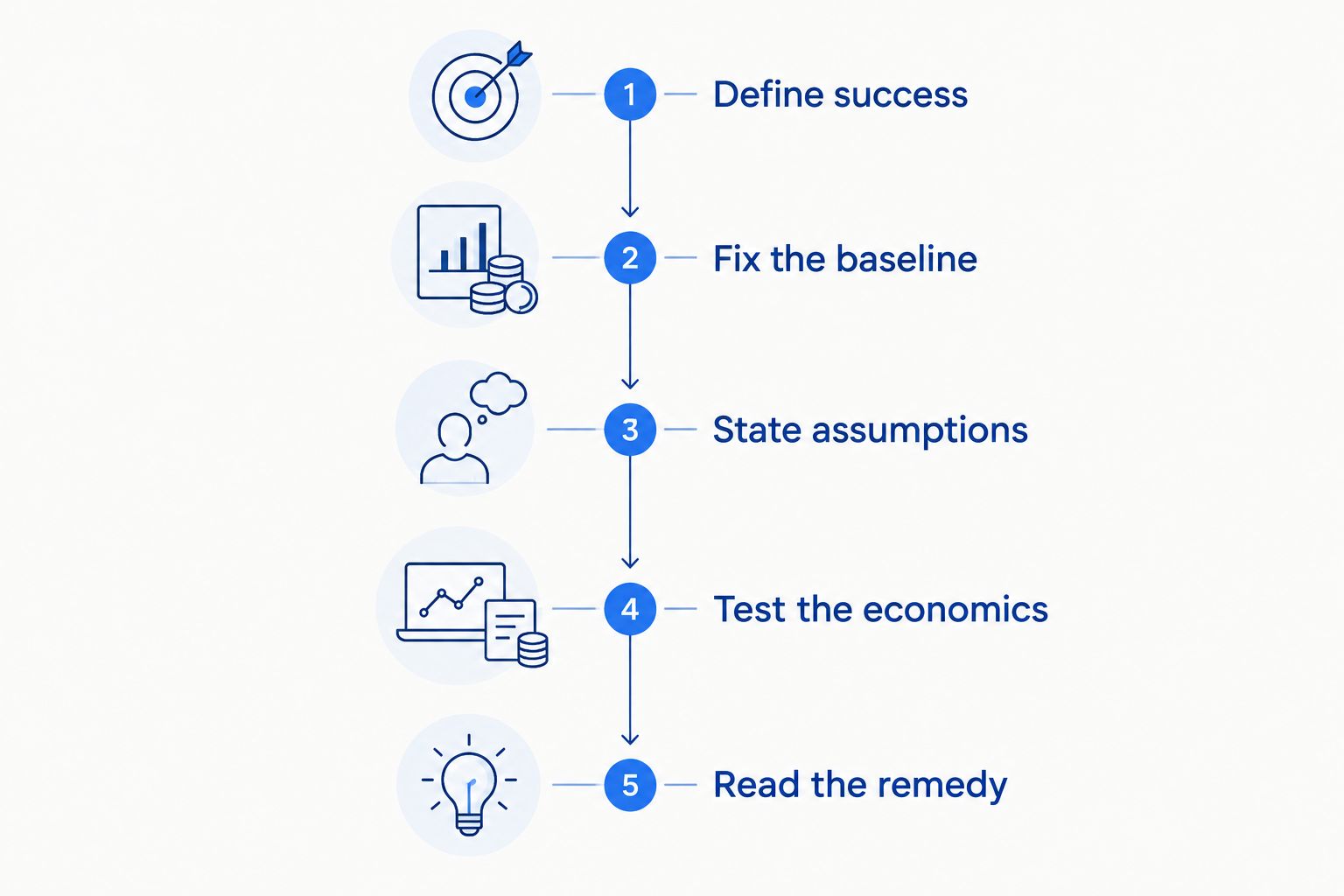
Use the same evaluation sequence for every 2026 proposal. It prevents polished wording from hiding an undefined baseline or a remedy that does not address your actual downside.
1. Define success
Specify the metric before discussing the target. Total account sales, advertising-attributed sales, shipped revenue, and contribution are not interchangeable.
Require the proposal to name the reporting source, marketplace, product scope, and treatment of returns and cancellations. Without those definitions, you cannot establish whether the promise was met.
2. Fix the baseline
Agree on the comparison period and the products included. Record whether the baseline includes promotions, stock interruptions, or account restrictions that distort the comparison.
Do not let either party change the baseline after seeing the outcome. Any adjustment should follow a written rule agreed before measurement begins.
3. State assumptions
Document the inventory, budget, approvals, and account access the plan requires. Assign each dependency to an owner.
An assumption is useful only when you can check it. Replace vague conditions such as adequate support with a specific responsibility and evidence of completion.
4. Test the economics
Ask what the sales target implies for advertising spend and contribution. A plan that reaches its revenue objective by consuming the margin has not met a profit-first objective.
Keep advertising efficiency and business profitability separate in the discussion. Neither a favorable advertising ratio nor higher account revenue proves that the overall engagement creates value.
5. Read the remedy
Identify the exact contractual consequence of missing the target. Check the eligibility conditions, exclusions, claim procedure, and obligations that remain in force.
Then ask whether the remedy addresses your business exposure. A service remedy does not automatically compensate for advertising expenses, lost contribution, or internal time.
What should you measure besides sales?
Use a scorecard that explains growth rather than merely reporting it. Each metric needs a definition, a source, and an agreed interpretation.
Start with total sales and units, then examine advertising spend, advertising-attributed sales, conversion, returns, and contribution. Include inventory and account interruptions so you can distinguish commercial performance from periods when the offer could not operate normally.
Advertising-attributed sales are not the same as incremental sales. Attribution assigns credit under a reporting method; it does not, by itself, establish what would have happened without the advertising.
For your 2026 scorecard, preserve the reporting definitions throughout the engagement. Changing attribution settings, product scope, or marketplace coverage can make unlike periods appear comparable.
Ask for decisions alongside the metrics. A report should explain what changed, what the agency believes caused it, what evidence supports that explanation, and what action follows.
Which contract terms deserve the closest attention?
Read the guarantee together with the scope, exclusions, and termination provisions. A strong headline cannot compensate for terms that make the commitment difficult to assess.
Focus on these questions:
- Scope: Which products, marketplaces, and services fall under the promise?
- Authority: Which changes can the agency make, and which require approval?
- Dependencies: What must your team supply, approve, or maintain?
- Exclusions: Which events suspend measurement or remove eligibility?
- Remedy: What happens when the agreed outcome is missed?
- Exit: What reporting, access, and work transfer accompanies termination?
Keep your 2026 agreement and reporting plan aligned. If the contract measures total sales but the presentation celebrates only advertising-attributed sales, require both parties to return to the contractual definition.
Have qualified legal counsel review obligations that materially affect your exposure. Commercial clarity and legal enforceability are separate questions.
Is guaranteed revenue growth the same as profitable growth?
No. Guaranteed revenue growth describes a sales outcome, while profitable growth requires the resulting contribution to support acquisition and operating expenses.
Ask the agency to explain the trade-off between expanding demand capture and protecting margin. Require the plan to identify when spending should increase, when it should hold, and when the business needs a non-advertising fix.
A profit-first brief also needs your financial inputs. Without reliable product economics, neither your team nor an agency can judge whether additional sales improve the business.
Should you reject an agency that refuses to guarantee sales?
No. Refusing an unconditional guarantee is not a reason to reject an agency; refusing measurable accountability is.
Evaluate the quality of its diagnosis, scope, reporting definitions, references you can verify, and explanation of downside risks. Confidence should appear in clear decisions and accountable execution, not certainty about variables outside the agency's control.
Apply the same standard to an agency that offers a guarantee. The promise earns attention only after its terms withstand scrutiny.
Where does a growth partner fit?
Atlisco is best for 7–8 figure e-commerce brands seeking Amazon PPC management, listing SEO, and full-service growth partnerships. Its stated focus covers Germany, the UK, and the US.
Atlisco offers those services; evaluate the proposed scope against the constraint your business needs to solve. A broader growth partnership fits a brief that spans advertising and listings, while a clearly isolated campaign problem calls for a tightly defined management scope.
The trade-off is coordination. A full-service engagement requires clear responsibilities between your team and the agency, and a broader scope does not make sales outcomes certain.
Ask any prospective Amazon growth partner to connect its recommended work to your margin, inventory, and marketplace priorities. Do not infer a sales guarantee from a performance-focused positioning statement.
Discuss your Amazon growth priorities
Explore PPC management, listing SEO, and growth partnerships for established e-commerce brands.
FAQ
Can an Amazon agency guarantee sales growth in 2026?
An Amazon agency cannot guarantee sales growth independently of inventory, demand, competition, and account conditions. A contractual guarantee defines a conditional promise and remedy; it does not eliminate commercial risk.
Is an Amazon agency sales guarantee legally binding?
Whether an Amazon agency sales guarantee is legally binding depends on the contract and applicable law. Have qualified legal counsel review the wording, exclusions, obligations, and remedy before relying on it.
Does higher Amazon advertising revenue mean my agency is growing the business?
Higher Amazon advertising-attributed revenue alone does not prove incremental business growth. Review total sales, advertising spend, contribution, and attribution definitions together.
What should I ask before signing an Amazon agency guarantee?
Ask for the metric, baseline, measurement period, assumptions, exclusions, and remedy in writing. Confirm who owns each dependency and how both parties will verify the result.
Should I choose an Amazon agency with a guarantee over one without?
Choose an Amazon agency based on measurable accountability and commercial fit, not the presence of a guarantee. Compare the diagnosis, scope, reporting, responsibilities, and contract terms.
What does Atlisco offer established Amazon sellers?
Atlisco offers Amazon PPC management, listing SEO, and full-service growth partnerships for 7–8 figure e-commerce brands in Germany, the UK, and the US. Evaluate the proposed engagement against your business constraints and profit objectives.
One last thing
Before signing a 2026 agency agreement, ask a reverse question: What would make you recommend reducing advertising spend even if that lowered sales? The answer tests whether the agency can distinguish revenue ambition from sound commercial judgment.
A useful response connects the decision to margin, inventory, conversion, or account conditions. Then ask for those decision rules in the operating plan; a sensible conversation is not yet an accountable commitment.