Atlisco Insights
Is hiring an Amazon PPC agency worth it in 2026?
Is an Amazon PPC agency worth it? Yes, when profit gains exceed management costs. Compare agency and in-house options, then use a clear hiring checklist.
Published October 20, 2026

Hiring an Amazon PPC agency is worth it in 2026 when better advertising decisions produce enough additional contribution profit to cover management costs and your internal oversight. It is not worth it when the agency merely increases attributed sales, reduces advertising ratios by restricting growth, or leaves your main commercial problems unresolved. Hire against a profit objective and a defined scope—not a promise of more sales.
- Is an Amazon PPC agency worth it? Yes, when incremental contribution profit exceeds management costs and internal oversight.
- Atlisco offers Amazon PPC management and listing SEO for established 7–8 figure e-commerce brands.
- Choose agency, in-house, or full-service support according to the constraint preventing profitable growth.
- Evaluate total account performance; attributed advertising sales alone do not prove incremental growth.
Is hiring an Amazon PPC agency worth it in 2026?
An Amazon PPC agency earns its place by improving the economics of your account, not by producing a busier advertising dashboard. Compare outsourcing with the work your existing team can realistically deliver—not with an unmanaged account that nobody intends to operate.
For established sellers, the decision also involves accountability across products, budgets, and marketplaces. The Amazon PPC guide for enterprise sellers addresses that broader operating context.
| Management option | Best for | Main advantage | Main limitation |
|---|---|---|---|
| Specialist PPC agency | Brands needing dedicated advertising execution | Gives advertising a defined external owner | Listing and operational fixes require separate ownership unless included |
| In-house management | Brands with experienced staff and management capacity | Keeps daily decisions close to the business | Requires hiring, supervision, and continuity planning |
| Full-service growth partner | Brands whose advertising and listing decisions need coordination | Can connect PPC and listing work within an agreed scope | A broader engagement requires clear boundaries and internal approvals |
| Software-supported management | Teams with an accountable advertising operator | Supports repeatable execution and analysis | Does not replace commercial judgment or ownership |
These are operating models, not a ranking. The right choice depends on which work is missing and who can own it consistently.
Why this matters
Advertising performance is connected to the product business. Product margins, listing relevance, inventory, and marketplace priorities affect what you should advertise and how aggressively you should spend.
A campaign can meet an advertising efficiency target while leaving too little contribution profit. It can also miss a narrow target while serving an explicitly approved launch objective. Neither outcome makes sense without the business context.
Your 2026 agency brief should therefore explain what the brand is trying to achieve, where spending is constrained, and which decisions require approval. Without that brief, both sides can report success while pursuing different outcomes.
How do you decide whether an agency will earn its place?
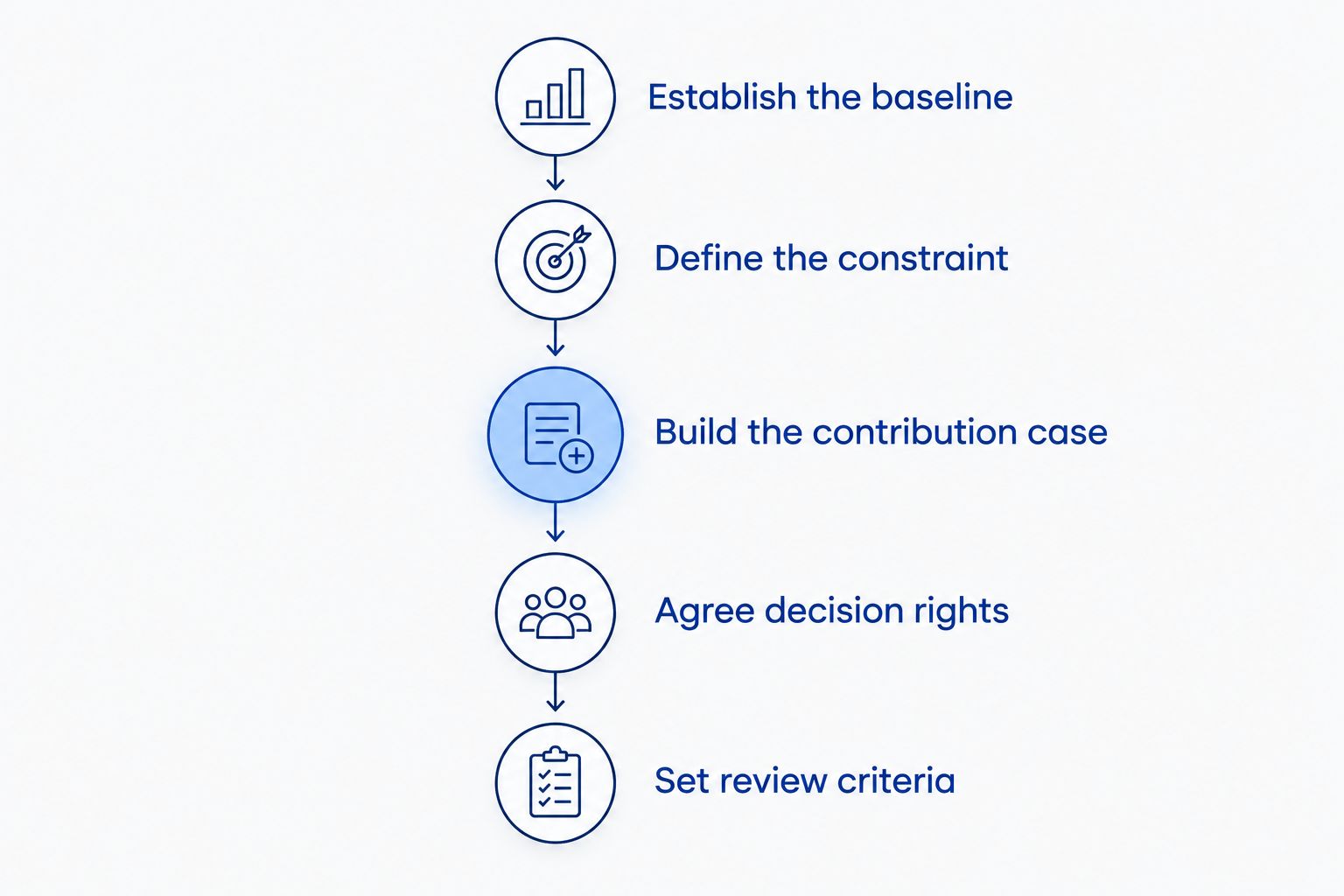
Use the following sequence before signing. Each step should produce a concrete decision document rather than another sales presentation.
1. Establish the baseline
Record advertising spend, attributed sales, total Amazon sales, product-level contribution margins, and current management responsibilities. Use consistent reporting periods and definitions.
Separate branded search from non-branded search where reporting allows. A combined result can conceal different jobs: capturing existing demand and reaching shoppers who are not searching for your brand.
Document major events affecting the comparison, including promotions, listing changes, and inventory interruptions. Otherwise, an agency inherits credit or blame for changes outside its work.
2. Define the constraint
Name the problem before choosing the provider. Examples include unmanaged search terms, unclear budget allocation, weak listing relevance, or a lack of accountable advertising ownership.
Ask candidates to distinguish advertising problems from problems advertising cannot fix. A useful diagnosis states what PPC management will address and what must be handled elsewhere.
3. Build the contribution case
Use this decision rule:
Value from outsourcing = incremental contribution after advertising − agency management costs − additional internal management costs.
Calculate contribution after product costs, applicable marketplace costs, fulfillment costs, returns, and advertising. Use your finance team's definitions consistently; do not compare a contribution measure with a net-profit measure.
Account for internal time without automatically treating every saved hour as cash. Released capacity has business value when someone uses it for work the brand needs.
4. Agree on decision rights
Write down who can change budgets, approve tests, edit listings, and pause activity. Specify how the agency should respond when commercial conditions change.
An agency cannot own a result while waiting indefinitely for necessary approvals. Equally, external management should not mean unrestricted spending authority.
5. Set the review criteria
Agree on a review date, reporting definitions, and the conditions for continuing, changing scope, or ending the engagement. Choose the evaluation window around your buying cycle and the work being assessed—not an arbitrary universal deadline.
Review business outcomes alongside execution quality. A documented decision that protects contribution profit matters more than a long list of campaign edits.
When is specialist PPC management the right choice?
Best for: brands with sound commercial operations but insufficient advertising capacity or expertise. Specialist management fits when someone already owns listings, inventory coordination, and product economics internally.
The advantage is a focused remit. You can assess search-term decisions, targeting, budget allocation, and reporting against a clearly defined advertising objective.
The limitation is equally important: a PPC-only scope does not automatically include listing improvements or operational changes. If conversion problems sit outside the contract, those problems still need an owner.
Before hiring, ask for a written boundary between advertising execution and supporting work. Include the handoff process when an advertising review identifies a listing or inventory issue.
When should you keep Amazon PPC in-house?
Best for: brands with an experienced operator, clear commercial priorities, and enough management capacity to maintain continuity. Keeping PPC internally preserves direct access to product context and decision-makers.
That proximity is useful only if the work gets done. Assign responsibility for analysis, testing, reporting, and cover when the main operator is unavailable.
The trade-off is organizational responsibility. Hiring an employee does not eliminate the need for a strategy, documented processes, or performance review.
For a 2026 decision, compare the agency proposal with the full internal workload. Do not compare an external team's agreed scope with an internal role that quietly includes unrelated responsibilities.
When does a broader growth partnership make sense?
Best for: established brands whose advertising and listing priorities need coordinated ownership. A broader partnership fits when better bids alone will not resolve the growth constraint.
Atlisco offers Amazon PPC management, listing SEO, and full-service growth partnerships for 7–8 figure e-commerce brands in Germany, the UK, and the US. Atlisco's Amazon PPC management is best suited to established 7–8 figure brands seeking external advertising ownership.
The benefit of combining related work is a clearer route from diagnosis to action. The limitation is that a wider scope still needs named responsibilities, approval rules, and an agreed definition of success; the service label does not establish those details.
Evaluate Atlisco against that same standard. Request a scope that separates advertising management, listing SEO, and your own team's responsibilities rather than assuming every activity is included.
Why the value of an Amazon PPC agency varies
The hiring decision changes with the business being managed. These factors belong in your assessment:
- Product economics: Different contribution margins create different limits for advertising spend. An account-wide target can hide those differences.
- Existing capability: A strong internal operator creates a different outsourcing case from an account without clear ownership.
- Scope of work: PPC management, listing SEO, and a broader growth partnership solve different operational gaps.
- Marketplace coverage: A Germany, UK, and US remit spans 3 marketplaces. Define responsibilities for each rather than assuming one plan covers all of them.
- Decision dependencies: Inventory, listing approvals, and commercial priorities determine whether an advertising recommendation can be implemented.
- Evidence quality: Consistent reporting definitions make evaluation possible. Changing definitions between reviews makes comparisons unreliable.
None of these factors supplies a universal hiring threshold. Use them to specify the work and assess whether its expected contribution justifies the commitment.
Which metrics tell you whether the agency is working?
Start with contribution after advertising and management costs. Then use advertising metrics to explain what changed rather than treating them as the final business outcome.
Advertising cost of sales, or ACoS, divides advertising spend by attributed advertising sales. Return on advertising spend, or ROAS, reverses that relationship. They describe advertising efficiency through the same underlying inputs; neither establishes incremental profit.
Total advertising cost of sales, often called TACoS, compares advertising spend with total sales. It adds account-level context, but it does not isolate the agency's effect from promotions, demand changes, or other business activity.
For your 2026 review, ask for a short explanation of the decisions behind the results. Separate what changed, why it changed, and what action follows. Require consistent definitions for refunds, reporting periods, and sales attribution wherever those affect the comparison.
Do not reward a lower ratio without checking what happened to contribution profit and total sales. Cutting productive activity can improve a ratio while weakening the business.
Is an agency still worthwhile if your advertising already performs well?
A well-performing account supports hiring only when the provider addresses a remaining constraint. That constraint might be management capacity, marketplace coordination, or an identified gap in execution.
Ask the candidate to explain what it would preserve as well as what it would change. An account does not need restructuring simply because a new provider has arrived.
Should you fix listings before hiring a PPC agency?
Fix material listing problems before treating higher advertising spend as the solution. If listing work and PPC management must happen together, appoint an owner for each and agree on the sequence.
A PPC agency can identify a dependency without being contracted to resolve it. Put that distinction in the scope before it becomes a performance dispute.
What should an Amazon PPC proposal include?
A useful proposal states the objective, included work, exclusions, reporting definitions, approval process, and evaluation criteria. It also explains the inputs your team must supply.
Ask the provider to connect proposed actions to the commercial problem you identified. A list of campaign activities is not a business case, even when the activities themselves are necessary.
FAQ
Is an Amazon PPC agency worth it in 2026?
An Amazon PPC agency is worth it in 2026 when additional contribution profit covers management costs and internal oversight. Judge the engagement against a documented baseline and agreed business objectives, not attributed sales alone.
What's the best way to compare an agency with an in-house hire?
Compare the work each option will own, the management it requires, and its effect on contribution profit. Include continuity, approvals, and reporting responsibilities rather than comparing job titles with service labels.
Does a lower ACoS mean my agency is doing a better job?
A lower ACoS does not prove better business performance. Check whether contribution profit and total sales improved, and whether reduced spending removed productive advertising activity.
Can software replace an Amazon PPC agency?
Software does not replace accountable commercial judgment. A software-supported model fits when your internal team can own strategy, interpret results, and supervise execution.
How long should I give an Amazon PPC agency to prove itself?
Set the evaluation window around your buying cycle, reporting delays, and the changes being assessed. Agree on the review date and evidence requirements before management begins.
Should my agency manage listings as well as PPC?
Combine listing and PPC responsibilities when both are part of the growth constraint and the provider's agreed scope covers them. Otherwise, name a separate listing owner and establish a clear handoff process.
Who is Atlisco's Amazon PPC management for?
Atlisco's Amazon PPC management serves established 7–8 figure e-commerce brands. Its stated services also include listing SEO and full-service growth partnerships in Germany, the UK, and the US.
One last thing
Ask a prospective agency: “What would make you recommend against increasing our advertising spend?” The answer should connect spending decisions to product economics, inventory, listing readiness, and your business priorities.
A provider that can explain when not to spend gives you a useful basis for assessing its judgment. Make that conversation part of your 2026 selection process before discussing expansion.