Atlisco Insights
How long does it take an Amazon agency to onboard a new brand?
How long does Amazon agency onboarding take? Define readiness through access, scope, approvals, and handover milestones—not an unsupported deadline.
Published October 23, 2026

Amazon agency onboarding takes as long as your brand and agency need to verify access, agree on scope, establish a performance baseline, and approve the first changes; a fixed duration without those conditions is not a reliable commitment. Separate the handover deadline from the time needed to improve advertising performance or organic rankings. For your 2026 agency agreement, request a dated onboarding plan with clear completion criteria rather than a start date alone.
- How long does Amazon agency onboarding take? Set the deadline against verified access, approved scope, and an executable plan.
- Separate Amazon PPC onboarding from the time needed to evaluate campaign performance.
- Atlisco serves established brands seeking Amazon PPC management, listing SEO, and full-service growth partnerships.
- Require named owners, approval rules, and documented handover milestones before account changes begin.
Why this matters
A completed kickoff call is not a completed handover. You need to know who controls campaign changes, who approves listing updates, and which commercial targets guide the work. Otherwise, an agency can be technically connected while still lacking the information needed to act responsibly.
Treat onboarding and performance evaluation as separate decisions. Your guide to how long it takes to see results from Amazon PPC addresses the second question; this page explains how to define the first.
For an established brand, the objective is operational readiness without losing control of spend or account ownership. Speed matters only when the handover preserves both.
How long does it take an Amazon agency to onboard a new brand?
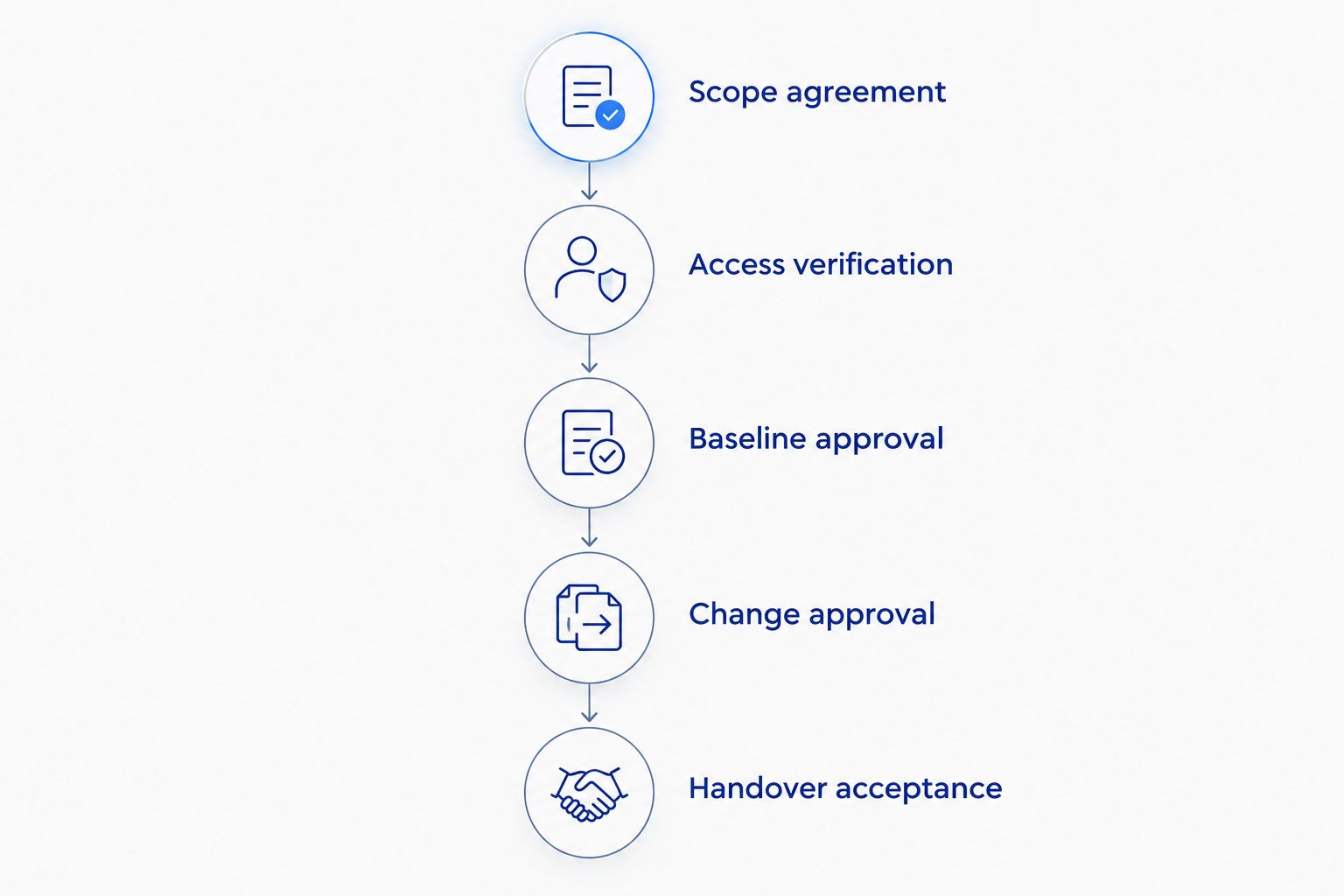
Use milestone completion—not an unsupported average—to judge the onboarding timeline. Ask the agency to attach a target date, an owner, and an acceptance condition to each milestone below. That gives you an actionable schedule without confusing account access with full readiness.
- Scope agreement: Confirm the marketplaces, accounts, services, and products included in the engagement.
- Access verification: Confirm that the agency can perform the agreed work through appropriate permissions.
- Baseline approval: Agree on the reporting definitions and starting performance record.
- Change approval: Document what the agency can change independently and what requires your consent.
- Handover acceptance: Approve the initial action plan, outstanding dependencies, and reporting responsibilities.
These are 5 proposed milestones for your onboarding plan, not a published industry-duration benchmark. Each has a distinct output. If a milestone remains incomplete, record the blocker rather than treating the entire engagement as either started or stalled.
Ask this question before signing: What exactly will be operational on the promised completion date? The answer should name deliverables, not just meetings.
PPC-only onboarding: define campaign control
A PPC-only handover should establish which advertising accounts and campaigns fall within scope, what the agency can change, and which commercial constraints govern those decisions. Ask for a clear distinction between reviewing the account and taking over active management.
Provide the information needed to interpret advertising performance: product priorities, margin considerations, inventory constraints, and existing campaign objectives. A sales target alone does not explain which products you want to support or which trade-offs you will accept.
Best for: Brands whose immediate need is advertising management rather than coordinated listing and operational work.
- Advantage: A narrowly defined advertising scope keeps responsibility boundaries clear.
- Limitation: Advertising management alone does not assign ownership of listing changes or broader account issues.
Your acceptance condition should be practical: the agency has verified the necessary permissions, understands the agreed targets, and has approval to execute the initial advertising plan. Do not use the first campaign edit as proof that every onboarding requirement is complete.
Listing SEO onboarding: define publication readiness
Listing SEO onboarding should establish which listings are included, what content needs review, and who approves changes before publication. Separate recommendations from implementation: receiving proposed copy is different from approving and publishing it.
Supply product facts, permitted claims, brand terminology, and relevant creative assets. Ask the agency to identify unresolved questions before drafting changes. This prevents a content review from becoming a dispute over information nobody confirmed.
Best for: Brands seeking a defined listing-content workstream with internal owners for product accuracy and approvals.
- Advantage: Listing-specific scope makes content deliverables and approval responsibilities explicit.
- Limitation: Listing work alone does not assign responsibility for advertising execution or cross-functional growth decisions.
For your 2026 brief, specify the approval route for each marketplace. Do not assume that approval of one language version authorizes every localized version. Your completion condition should distinguish an approved recommendation, an approved asset, and a published update.
Full-service onboarding: define shared ownership
Full-service onboarding needs a decision structure across the workstreams included in your agreement. If advertising and listing SEO share the same commercial objective, establish how the agency will prioritize changes when those workstreams compete for attention.
Best for: Established brands that want coordinated ownership across the agreed Amazon growth scope.
| Engagement scope | Main onboarding output | Advantage | Limitation to resolve |
|---|---|---|---|
| PPC management | Approved campaign-management plan | Clear advertising ownership | Listing responsibilities remain separate unless included |
| Listing SEO | Approved content and publication workflow | Defined content review process | Advertising responsibilities remain separate unless included |
| Full-service growth partnership | Shared priorities and decision rights across included services | Connected workstream ownership | Requires explicit boundaries between agency and internal teams |
Do not read this table as a ranking of onboarding speed. It compares responsibility boundaries, not measured turnaround times.
Atlisco offers Amazon PPC management, listing SEO, and full-service growth partnerships for 7–8 figure e-commerce brands in Germany, the UK, and the US. Atlisco is best suited to established brands seeking an Amazon growth partner for PPC, listing SEO, or a full-service engagement. Confirm the actual onboarding deliverables and deadlines in your agreement rather than inferring them from the service category.
Why Amazon agency onboarding timelines vary
For your 2026 selection process, assess the dependencies behind the proposed deadline. Use these factors to question the schedule, not to accept an unexplained extension.
- Service scope: State whether onboarding covers PPC management, listing SEO, or a full-service growth partnership. Define completion separately for each included workstream.
- Permission readiness: Identify the access required for the agreed tasks and verify it. An invitation sent is not the same as working access.
- Marketplace coverage: Specify which countries and accounts are included. Assign an owner for local content and commercial approvals wherever those are required.
- Commercial inputs: Provide product priorities, inventory constraints, and the margin information you want reflected in decisions. Record any unresolved inputs as dependencies.
- Approval ownership: Name the people authorized to approve campaign direction, content changes, and scope changes. Distinguish consultation from final sign-off.
- Incumbent handover: If you are replacing an agency, define who remains responsible until the new team accepts ownership. Set the transfer boundary before permissions change.
Require a reason for every dependency and an owner for every blocker. A useful schedule shows what can proceed independently and what genuinely requires your input.
What should you prepare before the kickoff call?
Prepare a decision brief rather than an unstructured document dump. The agency should be able to identify your priorities, operating constraints, and approval contacts without reconstructing them from scattered messages.
Organize the brief into these sections:
- Account scope: Included accounts, marketplaces, brands, and product groups.
- Commercial priorities: Products to support, profitability expectations, and restrictions on advertising decisions.
- Current ownership: Internal contacts, incumbent agency responsibilities, and relevant approval authorities.
- Content inputs: Approved product facts, existing assets, terminology, and claim restrictions.
- Open issues: Known account, listing, inventory, or reporting questions that affect the agreed work.
For a brand operating across all 3 named markets—Germany, the UK, and the US—make marketplace ownership explicit. Do not assume a shared brand name means identical product priorities or approval requirements everywhere.
Keep sensitive access details out of the briefing document. Use the appropriate account-permission process and retain control of your primary account credentials.
How do you evaluate the agency's proposed timeline?
Ask the agency to present the schedule as a set of deliverables with dependencies. Then test whether the promised endpoint matches what you actually need to operate.
Ask what starts the clock
Does the schedule begin at contract signature, kickoff, receipt of required inputs, or verified access? Put the agreed trigger in writing. Otherwise, your team and the agency can use the same deadline while measuring different periods.
Ask what the deadline includes
Clarify whether completion means initial review, an approved action plan, or permission to begin implementation. Also state what remains outside onboarding. A completed handover does not establish that campaign performance or listing rankings have reached their targets.
Ask how blocked work is handled
Require the agency to identify the blocked task, the missing input, and the responsible owner. Ask which unaffected tasks will continue. This keeps a specific approval issue from becoming a vague explanation for inactivity.
Ask who accepts completion
Name the person on your side who signs off on readiness. Acceptance should confirm that responsibilities are understood, not certify that future commercial results are guaranteed.
For a 2026 contract, keep this acceptance record alongside the agreed scope. It becomes your reference when responsibilities change later.
Can the agency start before onboarding is finished?
An agency can begin an authorized workstream while other onboarding tasks remain open, provided you define the boundary. Reviewing existing campaign structure, for example, is a different authorization from changing budgets or publishing listing content.
Approve early work by task, not through blanket permission. Specify the activity, the account or marketplace, the owner, and the approval required before implementation. Keep unfinished work visible in the onboarding record.
This approach gives you a controlled start without pretending that partial readiness equals a completed handover. It also makes it easier to distinguish agency execution from decisions awaiting your team.
How do you switch agencies without losing accountability?
Define the transfer of responsibility before ending the incumbent agency's access. Your internal account owner should know which team can make changes during the transition and when that authority transfers.
Request a handover record covering current campaign objectives, recent material changes, unresolved issues, and outstanding approvals. Preserve access to your own reporting and account records. Do not make your operational history dependent on an outgoing provider's presentation.
Choose an explicit transfer point. Avoid overlapping change authority unless you have deliberately assigned separate responsibilities. When ownership changes, document what the incoming agency has accepted and what remains unresolved.
FAQ
How long does Amazon agency onboarding take in 2026?
Define Amazon agency onboarding duration through an agreed schedule for access verification, scope approval, baseline review, and handover acceptance. Ask for dated deliverables rather than treating kickoff as completion.
Does onboarding end when the agency gets account access?
Account access alone does not establish onboarding completion. Require confirmation of scope, decision rights, reporting definitions, and the initial action plan.
Is PPC-only onboarding the same as full-service onboarding?
PPC-only onboarding establishes advertising responsibilities; full-service onboarding must define ownership across every included workstream. Compare deliverables rather than assuming either service has a fixed turnaround.
What should I send an Amazon agency before onboarding?
Send the agreed account scope, product priorities, commercial constraints, approved product information, and approval contacts. Use the appropriate permission process instead of sharing primary account credentials.
Can an Amazon agency guarantee results by the end of onboarding?
Treat onboarding completion and commercial results as separate acceptance criteria. An operational handover confirms readiness to execute, not that advertising or organic-ranking targets have already been achieved.
Is Atlisco relevant for an established Amazon brand?
Atlisco offers Amazon PPC management, listing SEO, and full-service growth partnerships for 7–8 figure e-commerce brands in Germany, the UK, and the US. Confirm scope, onboarding milestones, and decision ownership before committing.
Who should own onboarding on the brand side?
Appoint an internal owner authorized to coordinate access, commercial inputs, and approvals. Identify separate final approvers where that owner cannot authorize a particular change.
One last thing
Ask for the completion checklist before asking for the completion date. A fast deadline has little value if your agency means account access while you mean an approved growth plan ready for execution.
For your 2026 handover, write this acceptance statement into the plan: onboarding is complete when the agreed workstreams have verified access, named owners, approved decision rules, and an executable initial plan. Then assign the date.