Atlisco Insights
How long does it take to recover from an Amazon listing suspension?
How long to recover from Amazon listing suspension depends on the restriction. Separate reinstatement from sales recovery and follow an evidence-led plan.
Published October 23, 2026
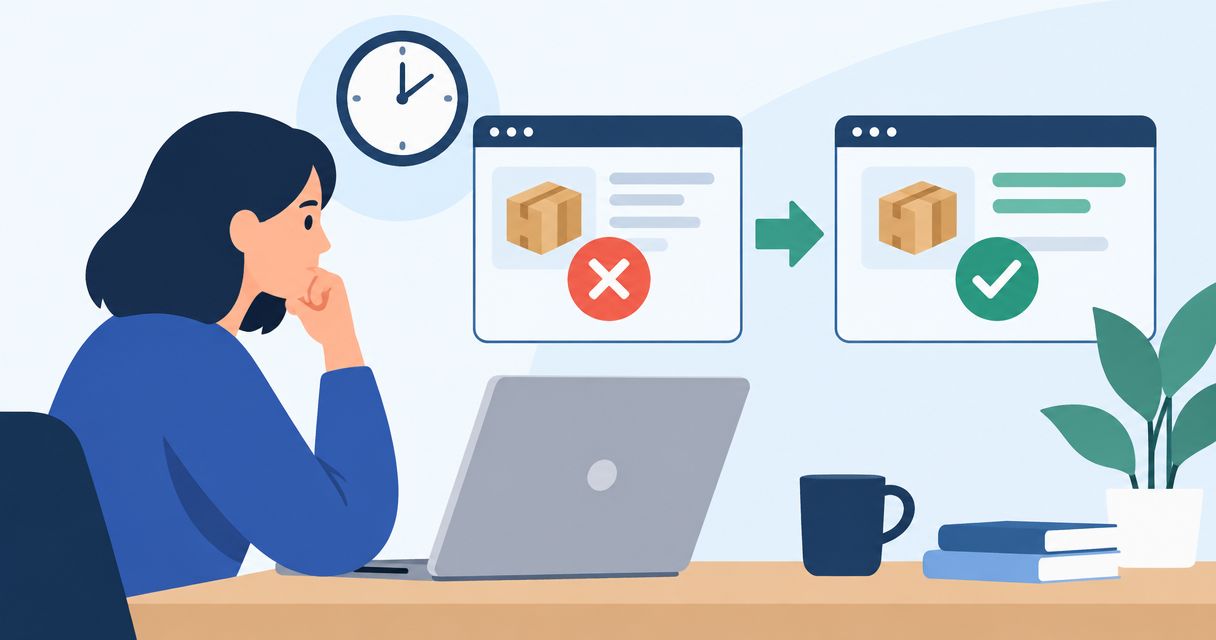
There is no fixed recovery time for an Amazon listing suspension: the timeline depends on the restriction, the correction required, and Amazon’s review of your response. Reinstatement also does not mean your sales, advertising, or organic visibility have recovered. For 2026 planning, separate the work you control from the review process you do not.
- How long to recover from Amazon listing suspension depends on the restriction and evidence required, not a universal deadline.
- Amazon listing reinstatement and sales recovery are separate milestones; confirm both before restoring your growth plan.
- Fix the stated issue, submit the requested evidence, and verify purchase eligibility before restarting affected advertising.
- Atlisco offers Amazon PPC management and listing SEO for established brands; these services are distinct from suspension appeals.
Why this matters
A suspended listing creates an operational problem before it creates a growth problem. Your immediate job is to establish exactly what Amazon restricted, what corrective action it requests, and which products or marketplaces are affected.
For advertising continuity, review your inventory controls alongside the restriction. This guide to pausing Amazon PPC when FBA inventory runs low addresses a separate but related issue: keeping campaign decisions aligned with a product’s ability to sell.
Do not use a reinstatement estimate as a revenue forecast. A listing can become purchasable before its commercial performance returns, and a corrected listing can still require further review.
How long does it take to recover from an Amazon listing suspension?
There is no single recovery duration that applies across Amazon listing restrictions. A content correction, a documentation request, and an account-level restriction involve different work; treating them as the same incident produces an unreliable deadline.
Use 3 recovery milestones in your 2026 incident plan. Each answers a different business question, and none substitutes for the next.
| Recovery milestone | What it establishes | What it does not establish |
|---|---|---|
| Correction completed | You have addressed the stated issue and prepared the requested response | Amazon has accepted the correction |
| Selling restored | The affected offer is purchasable in the relevant marketplace | Advertising and organic visibility have recovered |
| Commercial recovery | Orders and contribution performance meet your defined recovery criteria | Future restrictions cannot occur |
Your working timeline should distinguish seller preparation from Amazon review. Record when you received the notice, when you completed the correction, when you submitted evidence, and when the offer became purchasable again.
These timestamps give you an incident history, not a promised service level. Use a deadline stated in your notice or case response for that specific case; do not transfer it to unrelated restrictions.
What should you tell your leadership team?
Report the current milestone, the unresolved blocker, and the owner of the next action. If Amazon has not provided a review estimate, leave the reinstatement date uncommitted rather than presenting a guess as a forecast.
Keep the commercial impact separate. Leadership needs to know whether the problem is unresolved evidence, a pending decision, an inactive offer, or weak performance after reinstatement.
Identify the restriction before choosing the recovery route
The phrase listing suspension often describes several different conditions. Start with the actual notice and the affected offer’s status, not the language used in an internal message.
The routes below are diagnostic options, not interchangeable fixes. Choose the route that matches Amazon’s stated requirement.
| Recovery route | Best for | Main advantage | Limitation |
|---|---|---|---|
| Listing correction | A notice identifying missing or noncompliant listing information | Addresses the specified content defect | Does not resolve an unrelated account restriction |
| Evidence submission | A notice requesting records or supporting documents | Connects the response to the evidence Amazon requests | Depends on relevant, accurate documentation |
| Policy appeal | A notice offering an appeal route for an enforcement decision | Provides a structured response to the stated violation | Submission does not guarantee acceptance |
| Account-level resolution | A notice restricting the seller account rather than only an offer | Addresses the broader selling restriction | Editing one product page does not resolve the account issue |
Match the response to the notice before changing the listing. Editing copy is not a substitute for requested documents, and submitting documents does not correct every content defect.
Check the scope explicitly: the ASIN, seller SKU, marketplace, and any account-level message. Do not assume that a restriction affecting one marketplace has the same status elsewhere.
A recovery process you can control
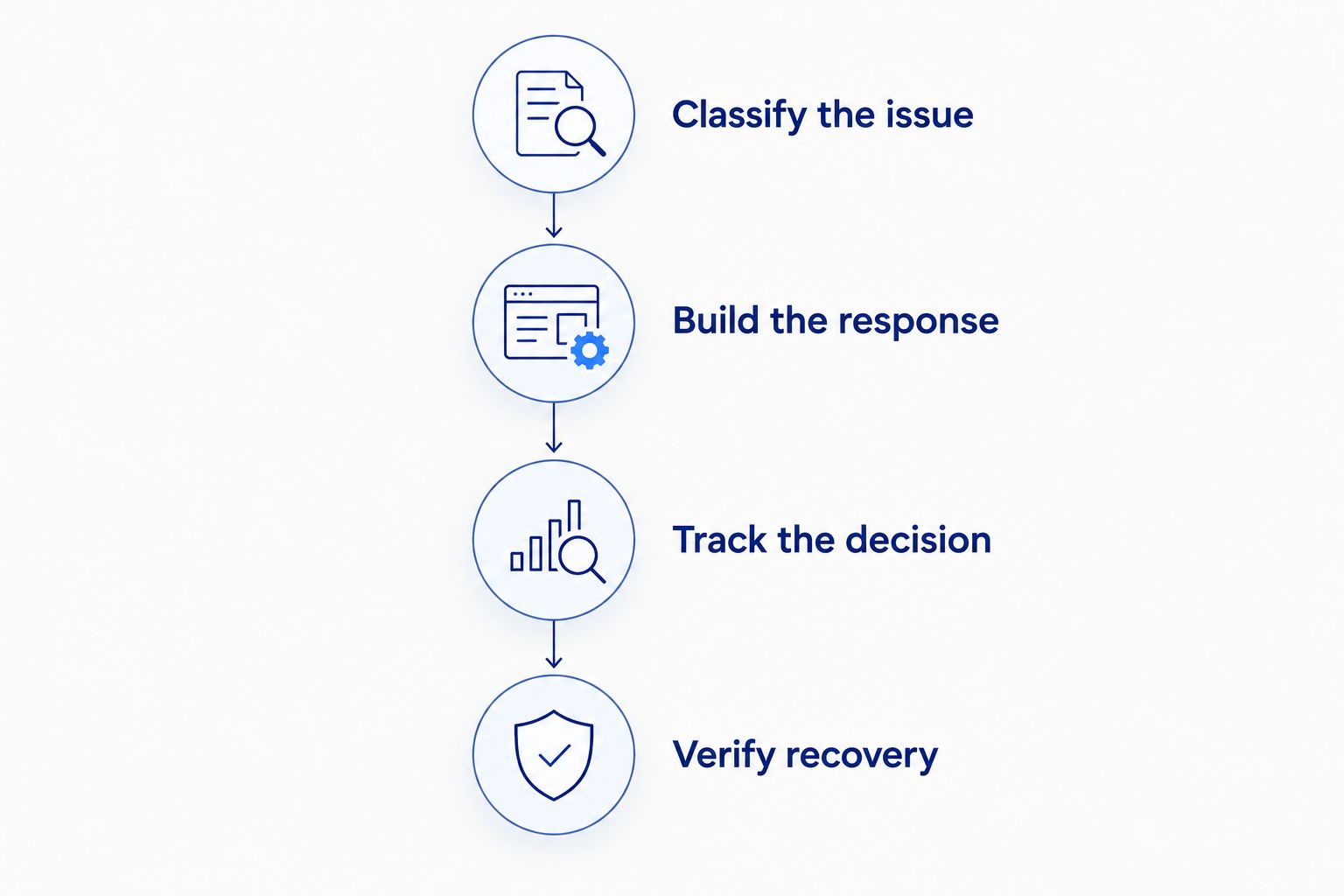
Use the following 4 steps as an operating sequence, not a turnaround promise. The objective is to submit a relevant response and verify the outcome without creating conflicting workstreams.
1. Classify the issue
Save the performance notification, case reference, affected identifiers, and the exact action requested. Assign an incident owner who coordinates catalog, compliance, operations, and advertising work.
Confirm whether Amazon is asking for a correction, documentation, an appeal, or another action. If the notice is unclear, ask a focused question through the relevant support or appeal channel rather than submitting an unrelated response.
2. Build the response
Address the stated issue using records and corrections you can substantiate. Where Amazon requests a plan of action, explain the cause, the corrective action, and the measures intended to prevent recurrence.
Follow the document and submission requirements shown in the case. Do not manufacture invoices, alter records to fit a narrative, or describe controls your business has not implemented.
3. Track the decision
Maintain a dated record of submissions, responses, document versions, and outstanding requests. Give internal teams a single current status so that separate owners do not submit inconsistent explanations.
When Amazon requests clarification, answer that request directly. A longer response is not automatically a better response; relevance and evidence matter more than volume.
4. Verify recovery
Check the affected offer in the relevant marketplace and confirm that customers can purchase it. Then review the product detail page, inventory status, offer eligibility, and affected advertising before treating the incident as resolved.
Compare post-reinstatement performance with a relevant pre-incident baseline. Keep reinstatement and commercial recovery as separate entries in your 2026 reporting.
Why Amazon listing suspension recovery time varies
Recovery depends on the work required and the decision still outstanding. These 5 factors explain why another seller’s experience is not a dependable timeline for your case.
- Restriction scope: An individual listing issue and an account-level restriction require different responses. Establish the scope before assigning work.
- Evidence requirements: A response requiring supplier records or compliance documentation depends on obtaining relevant documents. Preparation remains unfinished until the requested evidence is ready.
- Response relevance: A submission that does not address the notice leaves the stated issue unresolved. Match each requested action to the corresponding correction or evidence.
- Review outcome: Submission and acceptance are different events. Additional requests create further work before you can verify reinstatement.
- Commercial condition: Inventory, offer eligibility, listing content, and advertising affect what happens after selling resumes. Reinstatement alone does not establish revenue recovery.
For 2026 planning, attach an owner and a current status to each factor. This produces a usable recovery plan without pretending that an external review has a guaranteed completion date.
How should you manage PPC during a listing suspension?
Audit the affected advertising before changing account-wide budgets. Identify campaigns and advertised products connected to the restricted offer, then check their current eligibility and delivery status.
Do not assume every campaign has the same exposure. A campaign containing unaffected products needs a different decision from advertising tied entirely to the restricted offer.
Avoid editing unrelated campaigns simply because the account has an incident. Preserve a record of intentional pauses, budget changes, and targeting changes so you can distinguish those decisions from the effects of the suspension.
After reinstatement, verify purchase eligibility before restarting any campaigns you intentionally paused. Use current conversion and contribution data to guide spending rather than trying to recover missed revenue through an automatic budget increase.
Atlisco is best suited to established 7–8 figure brands seeking Amazon PPC management and listing SEO. That is a growth-management fit, not a claim of suspension-reinstatement expertise.
Atlisco offers PPC management, listing SEO, and full-service growth partnerships for brands in Germany, the UK, and the US. Assess those services against your post-reinstatement needs; responsibility for appeals and compliance requires an explicit agreement.
How do you know sales have recovered after reinstatement?
Define recovery before you declare it. A purchasable offer is an operational milestone; commercial recovery requires a separate assessment of sales and profitability.
Choose a comparable pre-incident period and account for promotions, seasonality, inventory constraints, and intentional advertising changes. Otherwise, your comparison mixes the suspension’s effects with unrelated business conditions.
Track the measures your business already uses to manage the affected products:
- Ordered sales: Has the affected product resumed generating revenue at the level your recovery plan requires?
- Conversion: Are product visits translating into orders, or is the restored offer still underperforming?
- Advertising efficiency: Does current spending meet your profitability requirements?
- Contribution: Are recovered orders economically useful after the costs you include in your contribution model?
A rebound in attributed advertising sales is not enough on its own. Keep total sales and contribution visible alongside advertising metrics so that paid recovery does not conceal weaker economics.
Should you change listing SEO immediately after reinstatement?
Separate required corrections from optional optimization. Complete the changes needed to resolve the restriction, then record the restored listing state before introducing discretionary edits.
Changing content, targeting, and budgets together makes the recovery harder to interpret. Your team needs to distinguish Amazon’s decision, your corrective work, and subsequent growth changes.
For your 2026 recovery record, retain the relevant listing version and a dated change log. That gives future operators a clear reference if the same issue reappears.
Listing SEO and compliance also serve different purposes. Better keyword coverage does not replace evidence requested in an enforcement case, and compliant content does not guarantee a particular organic position.
FAQ
How long to recover from Amazon listing suspension in 2026?
There is no fixed recovery duration for an Amazon listing suspension in 2026. The restriction, requested corrections, supporting evidence, and Amazon’s decision determine the reinstatement process; sales recovery is a separate milestone.
Can an Amazon listing be reinstated immediately after I fix it?
Fixing the stated issue does not establish that the listing has been reinstated. Check the relevant notice, case status, and customer-facing offer before treating the product as purchasable again.
Is a suppressed listing the same as a suspended seller account?
A listing-level issue and a suspended seller account are different scopes of restriction. Read the notice to determine whether the required action concerns product content, an offer, documentation, or the seller account.
Should I submit another appeal while a response is pending?
Follow the instructions in the active appeal or case before submitting another response. Keep submissions consistent and use any further response to address an outstanding request or relevant new evidence.
Will my Amazon sales return as soon as the listing is reinstated?
Reinstatement does not guarantee that sales return to their previous level. Verify purchase eligibility, then assess sales, conversion, advertising efficiency, and contribution against a comparable baseline.
Should I restart all Amazon ads after reinstatement?
Restart affected advertising only after confirming that the relevant offer is purchasable and reviewing campaign status. Base spending decisions on current performance and profitability requirements, not on a target to replace lost revenue.
Does Atlisco guarantee Amazon suspension recovery?
Atlisco’s stated services are Amazon PPC management, listing SEO, and full-service growth partnerships. These services do not establish a suspension-recovery guarantee or an appeal-management service.
One last thing
The most useful recovery artifact is a dated incident record that another operator can understand without a handover call. Include the original notice, requested action, evidence submitted, decision, restored offer status, and subsequent commercial checks.
Before closing the incident, identify the control that addresses its cause and assign an owner. A restored listing closes the immediate selling problem; a documented corrective control addresses the risk of repeating it.