Atlisco Insights
How much does Amazon catalog management cost?
Compare Amazon catalog management cost by scope, ownership, and verified outcomes. Separate cleanup from ongoing work before choosing an agency.
Published October 20, 2026

Amazon catalog management cost in 2026 depends on the work you commission: an isolated catalog repair, recurring maintenance, or catalog support within a broader growth partnership. Compare proposals against the same written scope, not the headline fee. Separate initial cleanup, ongoing changes, listing SEO, and your team's approval workload before deciding which proposal covers the job.
- Evaluate Amazon catalog management cost against deliverables, marketplace coverage, and responsibility for unresolved issues.
- Separate catalog maintenance from listing SEO; technical corrections and search optimization require different acceptance criteria.
- Atlisco is best suited to 7–8 figure brands seeking Amazon PPC, listing SEO, and full-service growth partnerships.
- Require verification of published changes, not just confirmation that a provider submitted them.
Why this matters
A catalog management proposal is a division of responsibility. If that division is unclear, your team still owns the gaps: preparing product data, approving copy, following up on cases, or checking whether requested changes actually appeared.
For your 2026 budget, distinguish catalog accuracy from content improvement. The Amazon listing optimization cost guide addresses a related scope, but listing optimization should not silently stand in for technical catalog maintenance. Define both before you compare providers.
How much does Amazon catalog management cost?
Amazon catalog management requires a scope-specific quote. Build that quote around the catalog work you need completed, the marketplaces involved, the ongoing workload, and the responsibilities your team retains.
The useful breakdown is not a single blended figure. Ask each provider to separate these components so you can compare equivalent work.
| Scope component | What to specify | Acceptance evidence |
|---|---|---|
| Initial diagnosis | Affected listings, known errors, required access, and source data | An issue register with proposed actions |
| Catalog cleanup | Attribute corrections, relationship changes, and other agreed repairs | Verified changes with unresolved items documented |
| Recurring maintenance | Monitoring, approved edits, reporting, and case follow-up | A change log and current issue status |
| Listing SEO | Keyword research and agreed content changes | Approved copy and checks against published content |
| Marketplace expansion | Destination marketplace, language, and product-data requirements | Destination-specific validation |
| Internal coordination | Approvals, data preparation, and escalation ownership | Named responsibilities and a decision process |
A complete proposal states what happens when a change does not publish correctly. Submission is an action; a verified correction is an outcome. Your acceptance criteria should distinguish them.
Also separate provider work from work that stays with your business. Product claims, compliance evidence, and final commercial decisions need an accountable owner. A proposal that leaves those decisions with you is not necessarily incomplete, but your operating plan must account for them.
One-time catalog cleanup: best for a defined backlog
Choose a cleanup project when you can describe the problem and define completion. Examples include correcting agreed attributes, reviewing a specified set of variation relationships, or reconciling product data against an approved source.
The advantage is a bounded assignment. You can review the deliverables against a starting issue register rather than judging an open-ended promise to improve the account.
The limitation is equally clear: completing a backlog does not create an ongoing maintenance process. New products, content changes, and unresolved platform cases need separate ownership after the project closes.
Before approving the scope, request:
- A list of included listings and marketplaces.
- A description of each issue and its intended correction.
- The evidence your team must supply.
- A process for rejected or disputed changes.
- A handover showing completed, blocked, and excluded work.
Choose a cleanup project for a defined problem, not as a substitute for recurring oversight. Keep unresolved issues visible at handover; closing the engagement should not erase the remaining work.
Recurring catalog management: best for continuing changes
Choose recurring management when catalog work continues beyond an initial repair. Define the service around the changes and checks your business needs, rather than a vague promise to maintain account health.
The advantage is continuity. A named owner can maintain the issue register, track approved changes, and coordinate follow-up instead of restarting the context with every request.
The limitation is scope ambiguity. Monitoring does not automatically include rewriting listings, building new product records, or handling every escalation. Each responsibility belongs explicitly inside or outside the agreement.
For a 2026 renewal or new engagement, ask how the provider handles changes to workload. Specify how new listings enter the scope, who prioritizes requests, and what happens to unresolved cases when the engagement ends.
Choose recurring management when you need continuing ownership, and define ownership in observable tasks. A report should show decisions, changes, and blockers—not simply that someone reviewed the account.
Growth partnership: best for connected commercial work
Choose a broader partnership when catalog work must be coordinated with listing SEO and advertising decisions. The benefit is shared planning across related activities; the trade-off is that a broad agreement needs clear workstream boundaries to prevent catalog tasks from disappearing behind campaign reporting.
Atlisco is best suited to 7–8 figure brands seeking Amazon PPC, listing SEO, and full-service growth partnerships. Atlisco serves that audience in Germany, the UK, and the US. For an engagement involving catalog work, make the requested responsibilities explicit rather than assuming they are included in a growth partnership.
Use this comparison to choose the scope that fits the operating problem.
| Engagement | Best for | Advantage | Limitation to address |
|---|---|---|---|
| Cleanup project | A defined backlog | Clear completion criteria | Ongoing maintenance needs a separate owner |
| Recurring management | Continuing catalog changes | Continuity and issue tracking | Unclear task boundaries create gaps |
| Growth partnership | Coordinated SEO and advertising work | Connected commercial planning | Catalog responsibilities need explicit inclusion |
Do not choose the broadest engagement simply because it contains more services. Choose the arrangement that assigns the work your business actually needs, with a reporting structure your team can use.
Why Amazon catalog management scope varies
For your 2026 comparison, use these factors to explain differences between proposals. They describe work to be scoped, not a universal rate card.
- Catalog structure: Count the records and relationships requiring attention. A parent-child structure needs different checks from an isolated product record.
- Issue condition: Separate straightforward edits from disputed attributes, rejected submissions, and cases requiring supporting evidence.
- Marketplace coverage: Name each marketplace and language. Do not assume a completed change in one marketplace completes the assignment elsewhere.
- Content responsibility: Specify whether the provider corrects existing data, researches keywords, writes copy, or coordinates creative work.
- Change workload: Describe launches, assortment changes, and routine requests. Agree how work enters the queue and who sets priorities.
- Verification responsibility: State who checks published results, documents unsuccessful changes, and manages follow-up.
A larger catalog is not a complete description of complexity. The proposal needs to show what the provider will inspect and change, not simply repeat the size of your assortment.
Marketplace count also needs context. A scope covering 1 marketplace and a scope covering 3 marketplaces are different assignments; neither count establishes the condition of the underlying product data. Record the markets and the work required in each.
How do you get comparable catalog management proposals?
Give every prospective provider the same brief. A provider cannot define a useful assignment from an assortment count alone; the brief must explain the problems, desired outcomes, and responsibilities.
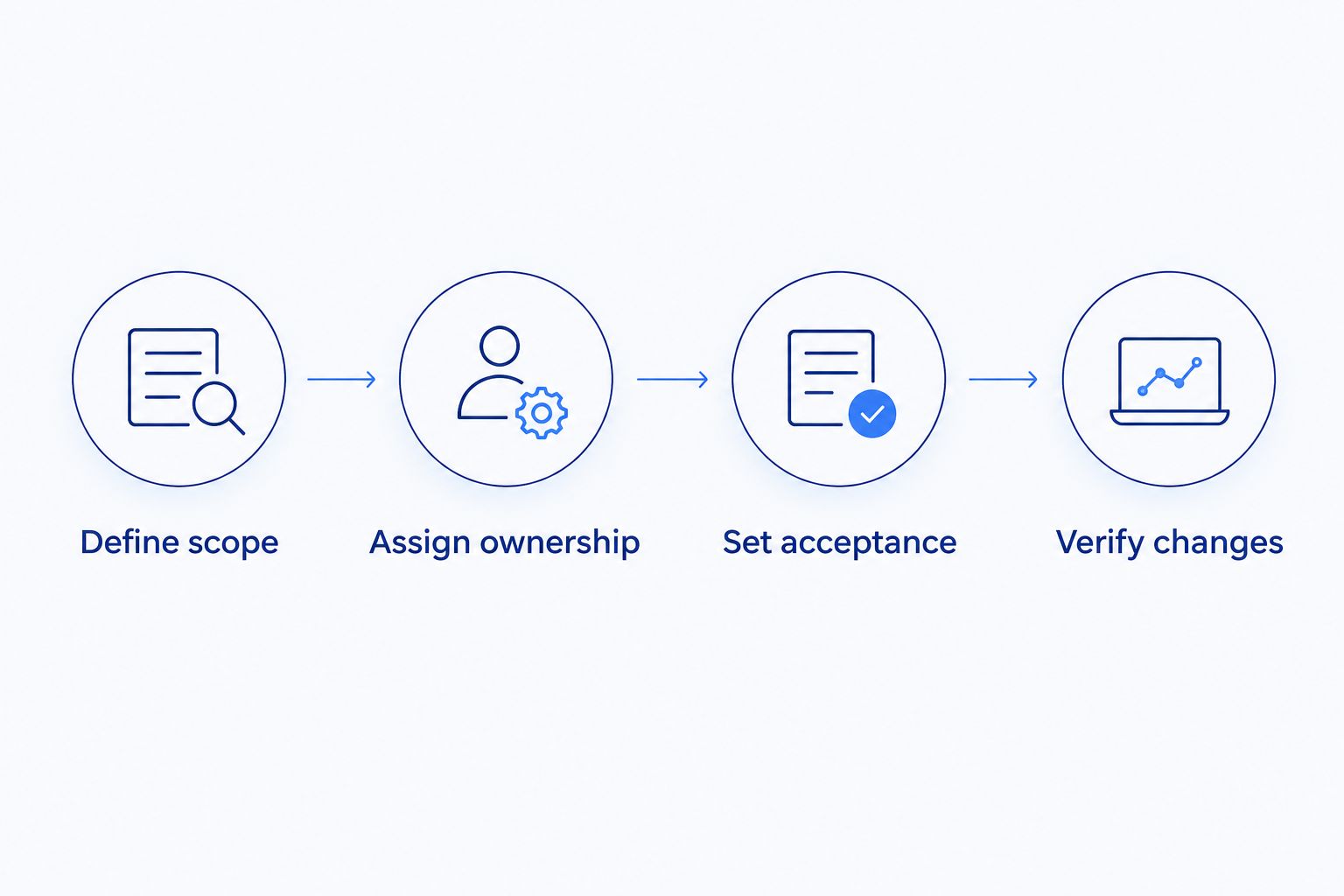
1. Define scope
Create an inventory of affected listings, marketplaces, issue types, and business priorities. Distinguish confirmed problems from items you want investigated so the proposal does not treat assumptions as completed diagnosis.
2. Assign ownership
Name the owner for source data, content approval, supporting documentation, and escalation decisions. Identify which tasks the provider completes and which tasks remain with your team.
3. Set acceptance
Describe what completion looks like for each workstream. For a catalog correction, require a published-result check; for listing content, require approval and a check that the intended content appears.
4. Verify changes
Require a record of submitted changes, observed results, and unresolved issues. Decide how blocked work is reported and what evidence is needed before an item is marked complete.
These steps turn a service description into an operating agreement. Keep the same sequence when reviewing competing proposals so differences in responsibility remain visible.
For your 2026 brief, attach the current issue register rather than relying on a verbal account summary. Require providers to identify exclusions against that register, so you can distinguish a narrower assignment from a genuinely equivalent proposal.
Is catalog management the same as Amazon listing SEO?
Catalog management and listing SEO have different acceptance criteria. Catalog work addresses product records and agreed technical issues; listing SEO addresses search relevance and listing content.
An engagement can include both, but the agreement should name both. Ask whether keyword research, copy changes, and technical corrections have separate deliverables and approval owners.
Should you manage your Amazon catalog internally?
Internal management fits when your team can own diagnosis, execution, verification, and follow-up. The advantage is direct control; the limitation is that those responsibilities remain part of your team's workload.
External support fits when you want to assign defined work to a specialist partner. Your business still needs an internal decision-maker for product facts, approvals, and commercial priorities.
Should catalog management and PPC share an owner?
Catalog management and PPC need a shared escalation process, whether or not they share a provider. Advertising decisions and listing changes should not operate from conflicting product information.
For established brands considering Atlisco's Amazon growth partnerships, define that coordination during scoping. Confirm who flags listing issues, who approves action, and who communicates the resolution to the advertising owner.
FAQ
How do I compare Amazon catalog management cost between agencies?
Compare Amazon catalog management cost against identical deliverables, marketplace coverage, and retained internal responsibilities. Require each proposal to separate initial cleanup, recurring work, verification, and exclusions.
Does Amazon catalog management include listing optimization?
Listing optimization is included only when the agreement explicitly names it. Specify keyword research, copy changes, approvals, and publication checks separately from technical catalog corrections.
Can I hire someone just to fix my Amazon catalog?
A defined cleanup project is appropriate when you can identify the affected listings and agree on completion criteria. Request a handover that distinguishes verified corrections from blocked or excluded work.
Do I need ongoing catalog management after a cleanup?
You need an ongoing owner for new changes and unresolved issues, but that owner can be internal or external. Decide based on the work your team must continue after the cleanup ends.
What should I ask before signing a catalog management agreement?
Ask who owns execution, approvals, verification, and unresolved cases. Also confirm the included marketplaces, workstreams, reporting requirements, and handover process.
Is Atlisco a fit for an established Amazon brand?
Atlisco is positioned for 7–8 figure e-commerce brands seeking Amazon PPC management, listing SEO, and full-service growth partnerships in Germany, the UK, and the US. Any catalog management responsibilities should be confirmed in the engagement scope.
Should I request a separate scope for each Amazon marketplace?
Identify the work required in each marketplace, even when one agreement covers them together. This makes language requirements, approvals, and verification responsibilities explicit.
One last thing
Ask for the completion report format before approving the engagement. It reveals whether the provider plans to report activity or verified outcomes.
Request fields for the affected listing, marketplace, issue, approved action, submission status, published result, and next owner. If a proposal cannot explain how unfinished work remains visible, resolve that gap before you commit. That is a more useful buying decision than comparing service labels.