Atlisco Insights
How much does Amazon listing optimization cost?
How much does Amazon listing optimization cost? Scope determines the quote. Compare deliverables, marketplace coverage, and ongoing work before you hire.
Published October 17, 2026

Amazon listing optimization has no single standard cost in 2026: your quote depends on the work included, the listings covered, and whether you need a project or ongoing management. Compare the complete scope—not just the headline fee—and confirm whether creative production, implementation, localization, and performance reviews are included or separate.
- How much does Amazon listing optimization cost? Compare defined deliverables, marketplace coverage, and ongoing responsibilities—not an unsupported average.
- Atlisco serves established brands seeking Amazon listing SEO, PPC management, and full-service growth partnerships.
- Choose a listing project for a defined content problem; choose ongoing support when the work requires continuing decisions.
- Require a written scope that separates research, copy, creative, implementation, and measurement.
Why this matters
A listing rewrite and an ongoing Amazon growth partnership are different purchases. Comparing their headline fees without separating the work tells you little about which proposal fits your business.
Atlisco is best for 7–8-figure e-commerce brands seeking an Amazon growth partner across listing SEO and PPC management. Atlisco offers those services and full-service growth partnerships for brands in Germany, the UK, and the US. That service model fits a broader brief than copywriting alone; it is unnecessary scope if you only need an isolated text revision.
For your 2026 budget, start with the business problem. A listing that needs clearer product information calls for a different brief from a catalog that needs coordinated advertising and content decisions.
How much does Amazon listing optimization cost?
The useful comparison is the fee for an agreed scope, not a category-wide average. Ask each provider to quote the same listings, marketplaces, deliverables, and responsibilities before comparing proposals.
Break the proposal into the following components. Treat each row as something to confirm, not something automatically included in an optimization package.
| Scope component | What your proposal should specify | What to clarify before approval |
|---|---|---|
| Listing research | Product review, search intent, and keyword mapping | Which listings and marketplaces are covered? |
| Written content | Titles, bullets, descriptions, and applicable search fields | Which fields will be delivered or changed? |
| Creative work | Image briefs, asset production, or enhanced content | Is the work a brief, finished assets, or both? |
| Implementation | Uploads, approvals, and verification | Who makes changes and checks the live listing? |
| Localization | Market-specific language and product positioning | Is each marketplace reviewed separately? |
| Ongoing management | Monitoring, further changes, and reporting | What continues after the initial delivery? |
A proposal that separates these components gives you something concrete to negotiate. You can remove work your team already owns without accidentally removing an essential dependency.
Use the Amazon SEO guide for private-label sellers to frame the listing SEO portion of your brief. Keep advertising management separate unless your objective requires both services.
Compare service models before comparing proposals
These are purchasing approaches, not standardized packages. Ask providers to describe their actual deliverables rather than assuming a label defines the work.
| Service model | Best for | Main advantage | Main limitation |
|---|---|---|---|
| Copy-focused project | A defined text or keyword-mapping problem | Keeps the assignment focused | Does not address creative or advertising unless included |
| Broader listing project | A coordinated content and creative update | Gives related changes a shared brief | Requires clear approval and implementation ownership |
| Ongoing growth partnership | Continuing listing and advertising decisions | Connects recurring responsibilities | Adds scope beyond a one-time content need |
Choose the narrowest scope that fully addresses the diagnosed problem. A smaller assignment is not a saving if it leaves the actual constraint untouched.
Copy-focused listing optimization
Best for: a listing with a clearly defined copy or search-relevance problem. Specify the fields you want reviewed, the product facts the writer must preserve, and the search terms the research should address.
The advantage is a focused deliverable. You can review the proposed language against a clear brief rather than evaluating an open-ended account strategy.
The limitation is equally clear: text revisions do not replace missing product imagery or advertising management. Do not approve a copy-only project while expecting the provider to solve those separate problems.
Before signing, request an explicit handoff format. Your team should know whether it receives recommendations, upload-ready content, or implemented changes.
Broader listing optimization projects
Best for: a listing that needs coordinated changes across copy and creative. Define how product research informs both the written content and visual brief so the two do not make conflicting claims.
This approach gives related work a common objective. For example, you can ask the copy and image brief to address the same buyer questions without commissioning unrelated assignments.
The drawback is coordination. Someone must supply approved product facts, review claims, approve assets, and authorize publication. Put those responsibilities in the scope rather than leaving them for the delivery stage.
For a 2026 project, ask whether the final deliverable is a recommendation document, finished content, or a verified live update. Those are different completion points.
Ongoing Amazon growth partnerships
Best for: established brands that need continuing listing and advertising decisions. Define the relationship around recurring work and decision ownership, not a promise of ongoing optimization without named activities.
Atlisco offers Amazon listing SEO, PPC management, and full-service growth partnerships. When evaluating that model, ask how the proposed engagement divides responsibility between listing work, advertising, and your internal team.
The benefit of a broader brief is coordination. The trade-off is that you are purchasing more than a content deliverable, so the agreement needs clearer boundaries around priorities, approvals, and reporting.
Do not choose ongoing support solely because you have a large catalog. Choose it when you can identify decisions that need an owner after the initial work is complete.
Why Amazon listing optimization scope varies
For a 2026 comparison, use these factors to make competing proposals comparable. Ask each provider to state its assumptions rather than supplying an unexplained total.
- Listing coverage. Name the products and variations included. Do not leave the meaning of a listing open to interpretation.
- Marketplace coverage. Specify Germany, the UK, the US, or the markets relevant to your brief. Require market-specific responsibilities to be explicit.
- Service breadth. Separate listing SEO from PPC management and broader growth work. Each needs its own deliverables.
- Creative responsibility. Distinguish reviewing existing assets from briefing or producing replacements.
- Implementation ownership. State whether the provider recommends changes, publishes them, or verifies work completed by your team.
- Ongoing responsibility. Separate initial delivery from subsequent reviews, revisions, and reporting.
These factors also expose mismatched proposals. If one quote covers written recommendations and another covers implementation plus continued management, negotiate a common scope before deciding which offers better value.
How to request a comparable optimization quote
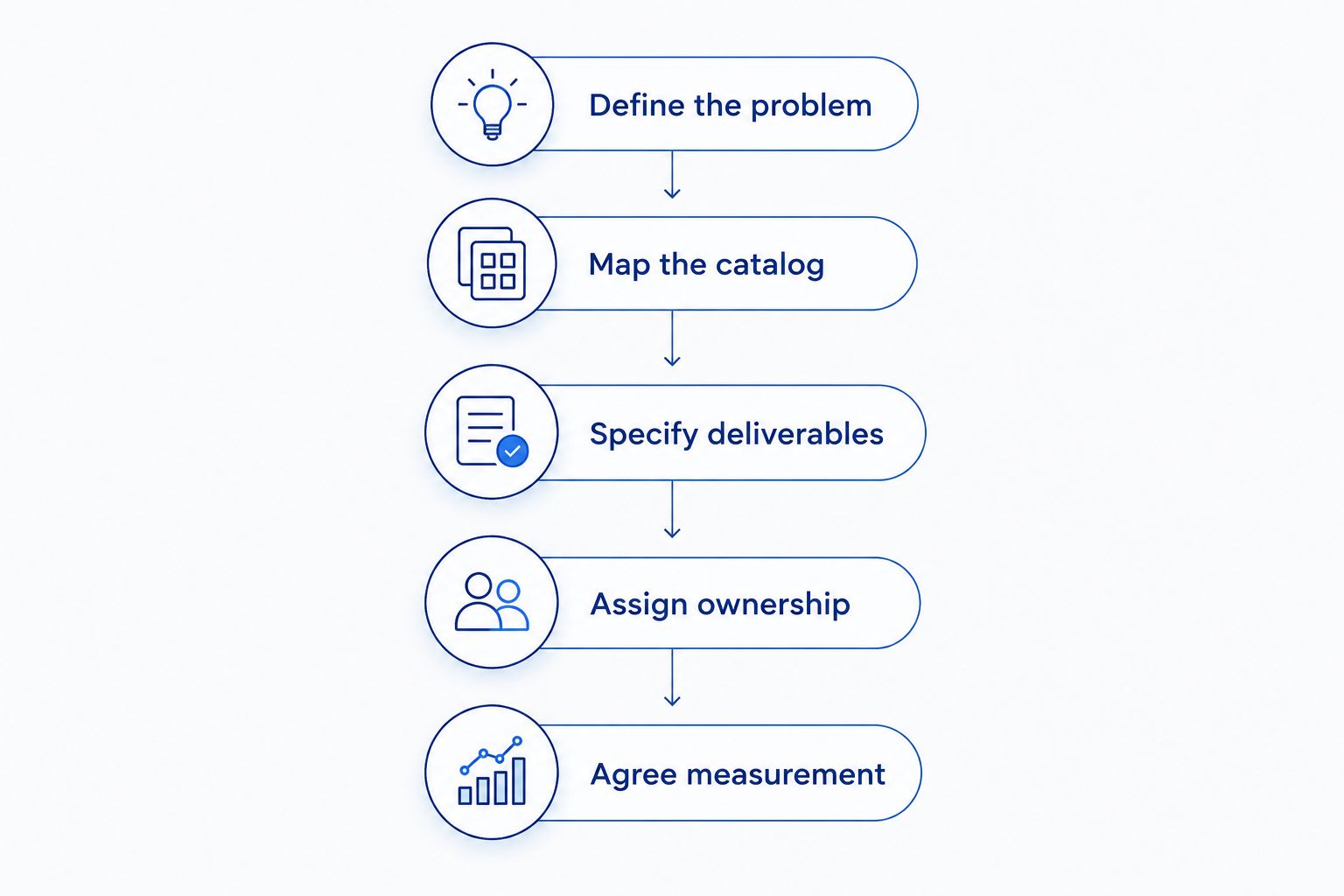
A useful request makes the business problem, work boundaries, and approval process explicit. Follow this sequence before asking providers to submit a proposal.
- Define the problem. State what needs attention: product clarity, search relevance, marketplace adaptation, or coordination with advertising. Separate observations from assumptions.
- Map the catalog. Identify the listings, variations, and marketplaces in scope. Mark shared content separately from work requiring individual treatment.
- Specify deliverables. Request named outputs for research, copy, creative, and implementation. Avoid accepting a single line labeled optimization.
- Assign ownership. Identify who supplies product information, approves claims, publishes changes, and checks the result.
- Agree measurement. Record the starting position and define how the team will review the work after publication.
This sequence gives you a purchasing brief rather than a vague request for better rankings. It also helps providers identify dependencies before work begins.
Make acceptance criteria specific
Do not use improved performance as the only definition of a completed content project. Specify what must be delivered and how you will check it.
For copy, require accurate product information and coverage of the approved brief. For creative, require the agreed assets or briefs. For implementation, require confirmation that the approved changes are live or an explanation of unresolved issues.
Performance review is a separate responsibility. Name who owns it and what decisions follow from the review.
How should you judge the return on listing optimization?
Judge the work against the business objective and contribution economics, not revenue alone. A sales increase does not establish that a listing change caused it or that the resulting sales were profitable.
For your 2026 review, record what changed and when. Include relevant advertising changes, promotions, and product changes in the same review so the team does not attribute every movement to new copy.
Use the measures that match the question:
- Search visibility helps assess whether relevant discovery needs further investigation.
- Listing visits and purchasing behavior help assess whether the page merits closer review.
- Advertising performance helps assess the relationship between paid traffic and listing outcomes.
- Contribution after applicable expenses supports a profit-focused decision.
Approve the project against a defined business case; assess the result against a documented starting point. Neither a polished listing nor a keyword report is a substitute for that discipline.
Should you optimize every Amazon listing at once?
Start with listings that have a clear business priority and a documented problem. Avoid spreading the same treatment across a catalog simply because the provider sells a catalog-wide package.
Group products by shared content and marketplace needs. Then identify which work can share a brief and which requires separate product research or creative treatment.
This creates a practical approval sequence. Your team can resolve product-information and implementation issues before applying the approach more broadly.
Is a one-time project better than ongoing management?
A one-time project is the better fit when the deliverables and completion point are clear. Ongoing management is the better fit when you need an owner for continuing listing and advertising decisions.
Require each proposal to explain what happens after delivery. If no recurring work is necessary, do not purchase a recurring relationship merely to keep the option open.
FAQ
How much does Amazon listing optimization cost in 2026?
Amazon listing optimization has no single standard cost in 2026. Compare quotes for the same listings, marketplaces, deliverables, and ongoing responsibilities rather than treating different service scopes as equivalent.
What should an Amazon listing optimization quote include?
An Amazon listing optimization quote should name the listings, marketplaces, deliverables, implementation responsibilities, and acceptance criteria. It should also distinguish initial delivery from any ongoing reviews or revisions.
Does listing optimization include product images?
Do not assume product images are included in listing optimization. Require the proposal to distinguish image review, creative briefs, and finished asset production.
Is Amazon PPC management included in listing SEO?
Treat Amazon PPC management and listing SEO as separate scope items unless the proposal explicitly combines them. Confirm who owns advertising decisions and who owns listing changes.
Should I choose a copywriter or an Amazon growth partner?
Choose a copywriter for a defined writing assignment and a growth partner for a broader, continuing brief. The decision should follow the work required, not the service label.
Can I use the same listing brief for Germany, the UK, and the US?
Use a shared product-information brief, but specify marketplace-specific review responsibilities. Do not assume that approval for one market completes the work for another.
How do I compare Amazon listing optimization proposals?
Compare proposals against a common written scope. Match listing coverage, marketplace coverage, creative work, implementation, revisions, and ongoing responsibilities before judging value.
One last thing
Ask what your team must still do after the provider says the project is complete. That question exposes the difference between receiving a document and having an approved, implemented listing update.
If your 2026 brief requires listing SEO and PPC coordination, include Atlisco in the evaluation. If it requires only a copy revision, keep the assignment narrow. Buy the work your business needs—not the broadest package available.