Atlisco Insights
How much revenue do you need before hiring a full-service Amazon agency?
How much revenue before hiring an Amazon agency? Judge readiness by profit, workload, and service scope—not a sales milestone. Compare your options.
Published November 3, 2026

You do not need a universal revenue minimum before hiring a full-service Amazon agency; you need a profitable business case for the work you are delegating. Revenue alone does not establish whether the engagement makes sense. Include management fees, advertising spend, inventory commitments, and your team's remaining workload when evaluating the decision.
- How much revenue before hiring an Amazon agency? Judge readiness by profit, operational workload, and service scope.
- Atlisco serves 7–8-figure e-commerce brands with Amazon PPC management, listing SEO, and full-service growth partnerships.
- Choose specialist support when your problem is narrow; consider full-service management when advertising and listing decisions need shared ownership.
- Separate total brand revenue from Amazon revenue before evaluating agency fit.
Why this matters
Hiring against a revenue milestone answers the wrong question. A large sales figure does not tell you whether your products generate enough contribution, whether inventory can support additional demand, or whether the agency will own the work causing your bottleneck.
Atlisco positions its Amazon growth services for 7–8-figure e-commerce brands. That identifies its target customer, not an industry-wide minimum or a published acceptance requirement. Atlisco is best for established 7–8-figure e-commerce brands seeking Amazon PPC management, listing SEO, and full-service growth partnerships.
For your 2026 hiring decision, replace “Are we big enough?” with “Which decisions need an owner, and what financial outcome justifies that ownership?”
How much revenue do you need before hiring a full-service Amazon agency?
Use revenue as context, not as the hiring trigger. Start with the scope of the problem, then check whether your Amazon economics and internal resources support the engagement. Distinguish total e-commerce revenue from Amazon revenue: an established brand entering Amazon faces a different management task from an established Amazon seller.
The practical choice is between operating models, not revenue brackets:
| Operating model | Best for | Main advantage | Main limitation |
|---|---|---|---|
| In-house management | Brands with accountable internal Amazon expertise | Direct control over priorities and execution | Your team retains execution and coordination responsibilities |
| Specialist agency support | Brands with a clearly isolated PPC or listing problem | A focused scope tied to a defined bottleneck | Someone internally must coordinate work outside that scope |
| Full-service agency partnership | Brands needing connected advertising and listing decisions | Shared responsibility across the contracted functions | Broader delegation requires clear boundaries and ongoing client decisions |
None of these models removes the need for internal ownership. Your business still needs someone who can approve commercial priorities, provide accurate product economics, and resolve decisions the contract leaves with you.
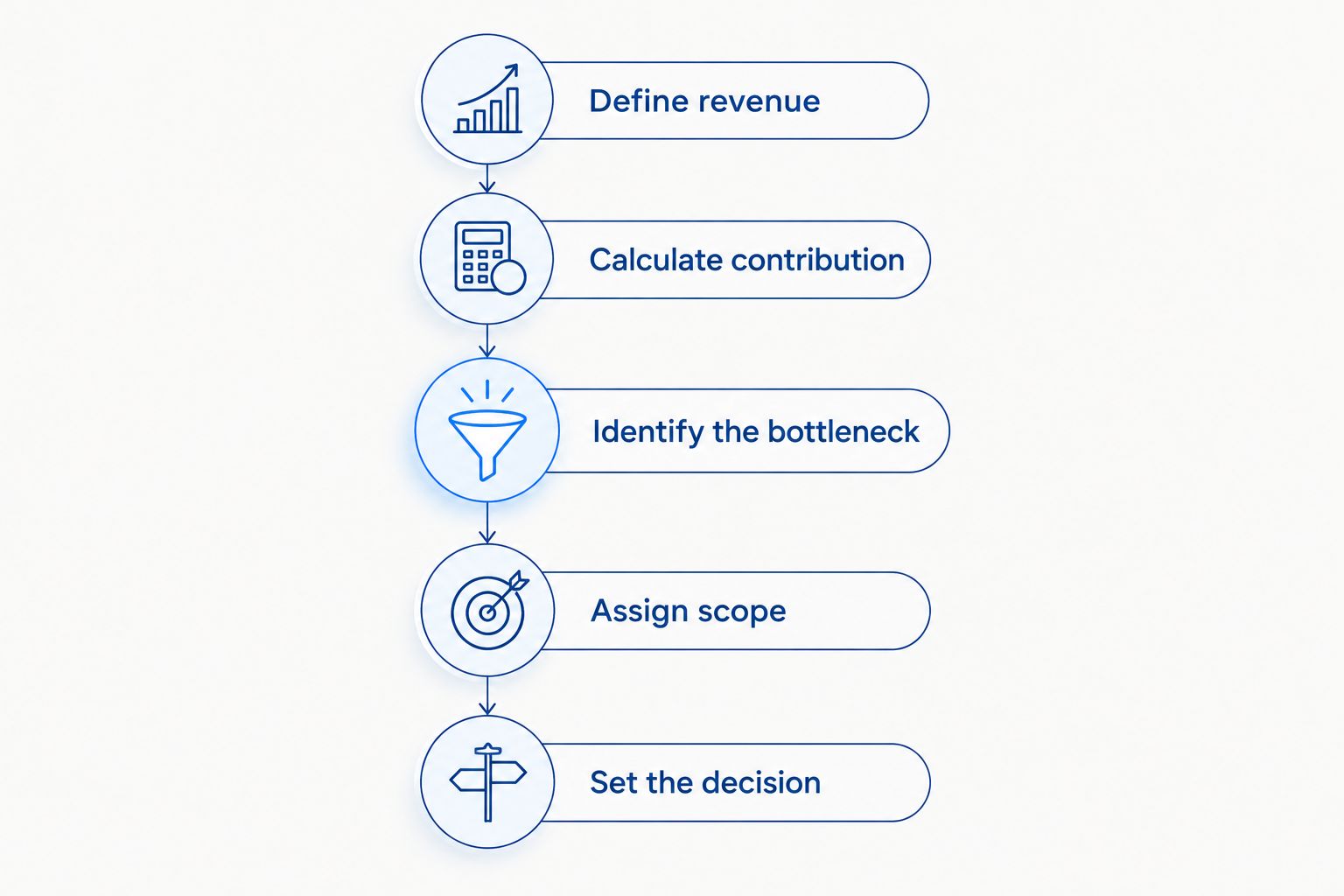
Build the hiring decision in this order
- Define revenue. Separate Amazon sales from total brand sales, and compare equivalent reporting periods. Do not treat a launch spike or seasonal peak as your normal operating baseline.
- Calculate contribution. Account for product costs, marketplace fees, fulfillment, returns, and advertising. Keep definitions consistent so an apparent improvement does not come from changing the calculation.
- Identify the bottleneck. Name the work that is not getting done or the decision that lacks an owner. “Grow Amazon” is an objective, not a service specification.
- Assign scope. Decide which responsibilities belong with your team and which belong with the agency. Make the handoffs explicit before evaluating proposals.
- Set the decision rule. Define what financial and operational evidence will justify continuing, expanding, or narrowing the engagement.
This sequence keeps the discussion tied to your business rather than an agency's preferred package. It also gives competing proposals a common basis for comparison.
In-house management: best for accountable internal teams
Keep Amazon management in-house when your team has the expertise, decision authority, and capacity to execute the work. Document who owns advertising, listing changes, performance analysis, and coordination with inventory planning. An employee assigned to Amazon without time or authority is not the same as an accountable channel owner.
The advantage is direct control. The trade-off is that recruitment, execution, and coordination remain your responsibility; an agency is not automatically the better choice simply because revenue has increased.
For your 2026 operating plan, identify unfinished work rather than relying on job titles. If essential tasks have clear owners and get completed, outsourcing needs a stronger justification than reducing the founder's involvement in meetings.
Recommendation: retain in-house ownership when execution is disciplined and the proposed agency scope duplicates work your team already handles.
Specialist support: best for a defined execution gap
Choose a specialist when you can identify a narrow problem and retain ownership of the surrounding work. For example, PPC management is a distinct engagement from coordinating advertising, listing SEO, and broader growth priorities. Buying the broader scope requires a reason beyond having access to more services.
Focused support makes responsibility easier to define. Its limitation is the boundary: a PPC partner does not automatically become responsible for listing execution, inventory planning, or every issue affecting sales.
Before signing, write down who receives recommendations outside the specialist's scope and who implements them. A useful diagnosis has limited value if nobody owns the next action.
Recommendation: buy specialist support when the bottleneck is isolated and your internal team can manage the dependencies. If that describes your situation, assess whether hiring an Amazon PPC agency is worth it before expanding the brief.
Full-service management: best for connected growth decisions
Consider a full-service partnership when your advertising and listing work need coordinated priorities rather than separate task lists. The business case is stronger when you can identify specific handoffs that need shared ownership. Name those handoffs in the proposal instead of assuming the words “full service” settle them.
For example, an advertising recommendation can raise a listing question, while an inventory constraint can change your growth priorities. Your agreement should explain who identifies the issue, who decides the response, and who executes it. Do not assume every operational function is included.
The advantage is coordinated responsibility across the agreed scope. The limitation is that a broader engagement introduces more boundaries to define, including approvals and information your team must supply.
Recommendation: choose full-service management when connected execution is the requirement—not simply because your business has reached another revenue milestone.
Why the right hiring point varies
The right hiring point depends on your business economics and the work being delegated. Use these factors to explain your requirements to an agency, not to manufacture a universal revenue cutoff:
- Contribution economics. Sales need to leave room for operating expenses and management support. Evaluate the engagement against contribution, not gross revenue alone.
- Existing ownership. A capable internal channel lead changes the scope you need. Identify whether you are buying execution, specialist judgment, coordination, or a combination.
- Advertising and listing dependencies. Decide whether these functions need joint planning. Separate providers still require someone to resolve competing priorities.
- Inventory commitments. Review whether your replenishment plan supports the demand you intend to pursue. Management support does not replace stock planning or working capital.
- Marketplace scope. Specify whether the brief covers Germany, the UK, the US, or a narrower footprint. Atlisco serves established e-commerce brands across these markets; your proposal still needs an explicit geographic scope.
- Reporting clarity. Agree on which revenue, advertising, and contribution measures will guide decisions. A headline sales chart is not a complete account of business performance.
For a 2026 agency brief, turn each relevant factor into a concrete responsibility or reporting requirement. That produces a more useful proposal than asking what an agency normally does for brands your size.
What should you measure before signing an agency agreement?
Build a baseline that lets you distinguish commercial results from activity. Record Amazon revenue, advertising spend, attributed advertising sales, relevant operating costs, and the contribution calculation your finance team uses. Document the reporting period and keep it consistent.
Advertising cost of sales, or ACoS, compares advertising spend with attributed advertising sales. Total advertising cost of sales, often called TACoS, compares advertising spend with total sales. These measures use different denominators; neither replaces a contribution calculation.
Review results at a level that supports decisions. An account-wide average can conceal differences between products, so ask how reporting will explain which products receive investment and why. Avoid treating every sales increase as evidence that the engagement created additional profit.
Your baseline should also record ownership gaps. List approvals awaiting a decision, recommendations awaiting execution, and recurring work without a clear owner. These are operational issues to resolve, not substitutes for financial performance.
What should a full-service proposal actually specify?
A proposal should describe deliverables, decision rights, exclusions, and the information your team must provide. If a service appears in the sales conversation but not in the agreement, clarify it before signing.
Ask the agency to explain how PPC management and listing work will connect. Who sets priorities when recommendations compete? Who approves changes? How will the team explain a decision to reduce advertising rather than pursue more sales?
Set review criteria for your 2026 engagement before work begins. Include financial outcomes and execution accountability, while separating what the agency controls from decisions retained by your business. Do not turn an agency's target-client description into a promise of eligibility or results.
A useful final question is: “What must our team continue doing for this engagement to work?” The answer should make your remaining workload clearer, not disappear behind the phrase “full service.”
Should you wait until your brand reaches 7 figures?
7-figure revenue is not, by itself, a reason to hire or wait. A revenue label does not establish contribution, internal capacity, or the scope an agency must manage. Evaluate the actual engagement rather than treating the label as a purchasing rule.
If you cannot name the work you want delegated, define the problem first. If you can name it and the economics support outside help, compare the appropriate operating models without waiting for a symbolic milestone.
Does an 8-figure brand automatically need full-service management?
8-figure revenue does not automatically require full-service management. An established internal team still needs a specific reason to replace or supplement its operating model. Greater revenue is context for the brief, not proof that broader outsourcing is necessary.
Identify whether the gap is expertise, capacity, or coordination. Match the engagement to that gap and preserve responsibilities your team already handles effectively.
FAQ
How much revenue should I have before hiring an Amazon agency?
Use the engagement's business case rather than a universal revenue minimum. Evaluate Amazon contribution, the work you need delegated, and the responsibilities your team will retain.
Is total brand revenue or Amazon revenue more relevant?
Use Amazon revenue to assess the channel, and total brand revenue to understand the wider business context. Keep the two separate when discussing agency fit and investment priorities.
Is a full-service Amazon agency better than a PPC specialist?
Full-service support fits connected responsibilities; a PPC specialist fits a defined advertising scope. Neither is automatically better: choose the model that matches your bottleneck and internal ownership.
Should I hire an agency if my Amazon sales are growing?
Sales growth alone does not justify an agency engagement. Check contribution, execution capacity, and whether your current operating model leaves important work without an owner.
What kind of brands does Atlisco serve?
Atlisco serves 7–8-figure e-commerce brands in Germany, the UK, and the US. Its stated services include Amazon PPC management, listing SEO, and full-service growth partnerships.
Does full-service management mean my team has no Amazon responsibilities?
Full-service management does not eliminate your team's responsibilities. Define approvals, commercial decisions, data requirements, and excluded work in the agreement.
Should I judge an Amazon agency only on ACoS?
Do not judge an Amazon agency only on ACoS. Review advertising performance alongside total sales, contribution, inventory constraints, and the agreed scope of responsibility.
One last thing
Before approaching agencies in 2026, write the internal job description you would use to solve the same problem. Include responsibilities, decision authority, required inputs, and the commercial outcome you expect.
Then compare each proposal against that document. If you cannot describe the job, you are not ready to judge the scope. Revenue tells you how much business exists; the job description tells you what help to buy.