Atlisco Insights
How to lower Amazon ACOS without losing sales
Learn how to lower Amazon ACOS without losing sales: remove wasted spend, protect profitable traffic, and judge changes against total sales and profit.
Published October 28, 2026

Lower Amazon ACOS without losing sales by removing irrelevant search traffic, reducing bids where acquisition costs exceed product margins, and protecting campaigns that generate profitable orders. Cutting budgets across the account risks reducing sales alongside spend; instead, judge each change against total sales, contribution profit, and completed attribution reporting. No campaign adjustment guarantees unchanged sales, so make targeted changes you can reverse.
- How to lower Amazon ACOS without losing sales: cut irrelevant traffic before cutting productive campaign budgets.
- Amazon PPC decisions need product margins, completed attribution reporting, and total-sales context—not ACOS alone.
- Protect profitable search terms while testing bids, placements, and listing improvements separately.
- Atlisco serves established brands that need Amazon PPC management and listing SEO within a growth partnership.
Why this matters
A lower ACOS is not a win if contribution profit falls with it. Advertising cost of sales measures ad spend against attributed advertising sales. It does not establish whether your entire Amazon business became more profitable.
An account can report a better ratio after you remove campaigns that were generating incremental orders. It can also report a worse ratio while supporting a commercially justified product launch. Your campaign objective determines which interpretation matters.
For an established catalog, connect advertising decisions to product economics and sales performance. The Amazon PPC for enterprise sellers guide addresses the broader account-management context; this page focuses on the decisions that reduce waste without treating every advertising sale as expendable.
How do you lower Amazon ACOS without losing sales?
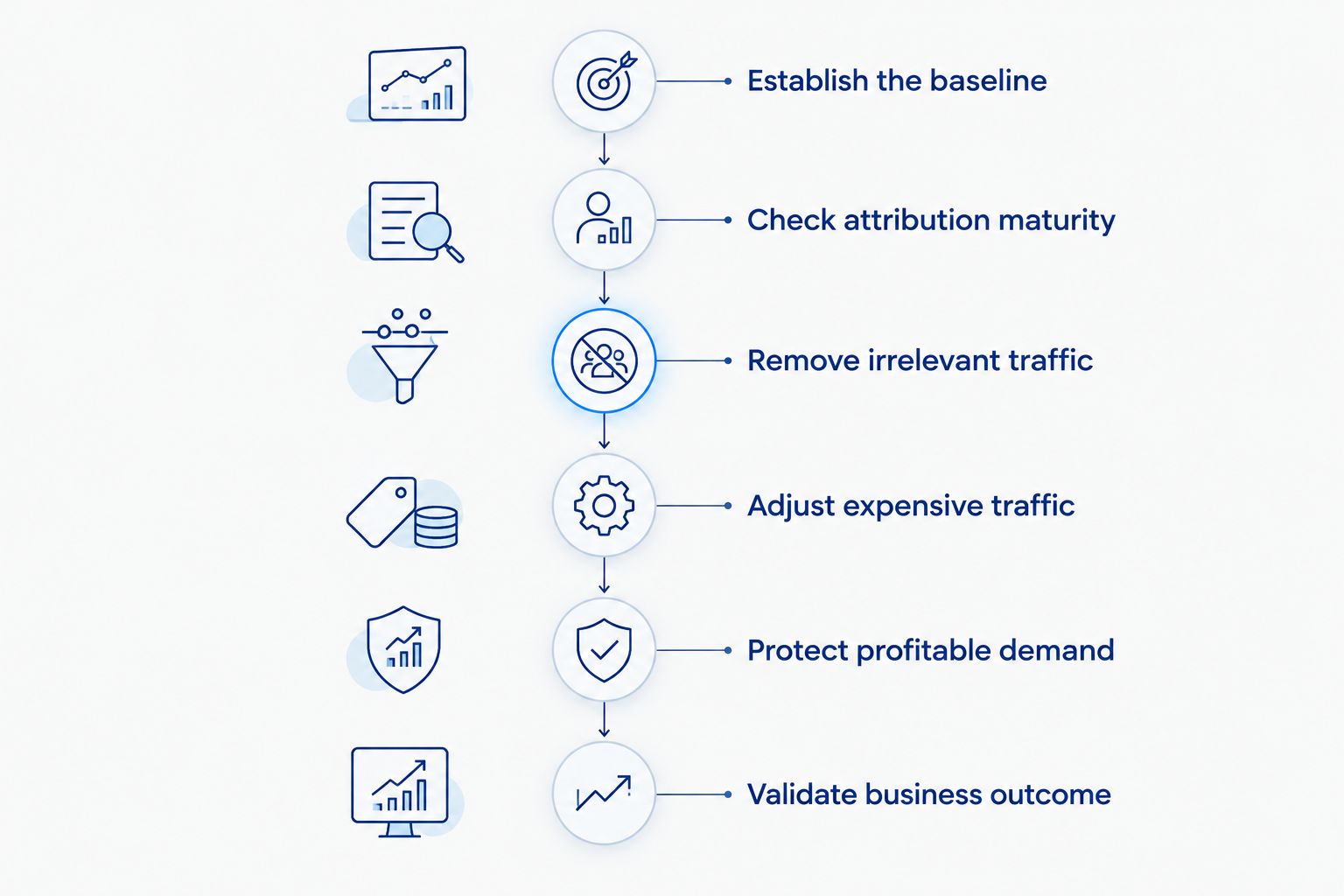
Use this sequence for your 2026 account review. Start with measurement, remove the clearest waste, then test changes where sales are exposed.
- Establish the baseline. Record spend, attributed sales, total sales, orders, and contribution profit across comparable reporting periods. Separate marketplaces and products rather than treating the account average as a target.
- Check attribution maturity. Use the attribution window applicable to the report and advertising product. Recent clicks with incomplete conversion reporting are not equivalent to clicks whose reporting window has closed.
- Remove irrelevant traffic. Review customer search terms and product targets. Exclude searches that clearly do not match the product before restricting relevant terms that are simply underperforming.
- Adjust expensive traffic selectively. Review target bids, placement adjustments, and bidding settings together. Change the setting responsible for the exposure rather than lowering every campaign budget.
- Protect profitable demand. Keep commercially productive campaigns funded while investigating the inefficient segments. Distinguish established sales drivers from discovery activity.
- Validate the business outcome. Compare total sales and contribution profit after the change. Reverse restrictions that damage the commercial outcome, even when reported ACOS improves.
Keep a change log. Record the affected target, the reason for the change, the setting changed, and the result you need to see before retaining it. Without that record, simultaneous adjustments make diagnosis difficult.
Which intervention should you use first?
Match the intervention to the problem. A negative keyword, a bid change, and a listing revision solve different causes of high ACOS.
| Intervention | Best for | Benefit | Trade-off |
|---|---|---|---|
| Negative targeting | Clearly irrelevant searches or product targets | Stops spending on excluded traffic | Broad exclusions can block relevant demand |
| Bid adjustment | Relevant traffic with weak acquisition economics | Changes auction participation without excluding the target | Lower bids can reduce impressions and orders |
| Placement adjustment | Performance differences between placements | Addresses expensive exposure more precisely | Placement results still require enough completed reporting |
| Listing improvement | Relevant clicks that do not become orders | Addresses purchase objections on the detail page | Results are not immediate or guaranteed |
| Budget reallocation | Profitable campaigns constrained while weaker campaigns spend | Directs spend toward a better-supported opportunity | Historical performance does not guarantee additional profitable volume |
Use the narrowest intervention that matches the evidence. Campaign-wide restrictions belong after target-level and placement-level diagnosis, not before it.
Search terms: exclude irrelevant demand, not uncomfortable averages
Start with the customer's search, not just the keyword you bid on. A keyword can bring in searches with different intent, and an average hides those differences.
Look for explicit mismatches: the wrong product type, incompatible use cases, or features your product does not offer. These are stronger exclusion candidates than relevant searches that have not yet produced an order.
Choose the negative match type deliberately. Negative exact targeting restricts a particular search term; negative phrase targeting restricts searches containing that phrase. The broader exclusion needs a broader reason.
For relevant searches with weak results, ask whether the evidence supports a lower bid, a listing correction, or further observation. Zero orders alone does not identify the cause. Check completed reporting, click volume, purchase relevance, and the product's economics before acting.
Bids and placements: reduce exposure where economics fail
A bid reduction is a test of acquisition economics. It is not proof that the campaign was unnecessary.
Review the base bid alongside placement adjustments and the campaign's bidding strategy. Assess those settings together before deciding which one to change. Otherwise, you risk changing a setting without addressing the source of expensive traffic.
Separate branded demand from non-branded discovery in your analysis. Branded searches and broader category searches represent different customer intent; combining them can conceal where spending is efficient and where it is expensive.
For your 2026 optimization plan, assign each campaign a commercial purpose. Existing-demand capture, new-customer discovery, and product testing should not share an unexplained account-wide efficiency target.
Avoid changing bids, budgets, targeting, and listings simultaneously for the same product. You need a readable test. Where urgency requires several changes, document that the result cannot isolate the effect of each action.
Listing conversion: address the reason shoppers hesitate
When relevant shoppers click but do not purchase, inspect the detail page before treating the traffic as disposable. Confirm that the advertised product matches the search intent and that the listing answers the buyer's actual questions.
Check the product title, images, variation selection, feature explanations, and compatibility details where relevant. Confirm that customers can purchase the advertised item and that the campaign is not directing demand toward a product with an unresolved listing problem.
Advertising efficiency depends on both traffic acquisition and conversion. Better targeting cannot correct an inaccurate product explanation, and a clearer listing cannot make an irrelevant search relevant.
Keep listing changes specific. Record the purchase objection being addressed and the content changed. Compare results over suitable reporting periods while accounting for other commercial changes; do not attribute every movement to the revised content.
Why Amazon ACOS varies
These factors explain why the same target is not appropriate for every product or campaign:
- Contribution margin: Products with different variable costs have different room for advertising spend.
- Search intent: Branded, category, and exploratory searches represent different stages of purchase intent.
- Auction exposure: Target bids, placement adjustments, and bidding settings influence where you compete.
- Conversion performance: The detail page and offer affect whether acquired traffic becomes orders.
- Order mix: Changes in attributed order value change the sales denominator, even without an equivalent change in spend.
- Reporting maturity: Recent activity and completed attribution reporting are not directly comparable.
Use your 2026 product economics rather than a borrowed category benchmark. An ACOS target is a business constraint, not a universal score for campaign quality.
How do you calculate a useful ACOS target?
ACOS equals ad spend divided by attributed advertising sales, expressed as a percentage. Multiplying the ratio by 100 converts it to percentage form; that arithmetic is not a recommended performance target.
A contribution margin before advertising of 100% is not a realistic default assumption. Calculate your actual margin after the variable costs relevant to the order, then decide how much contribution must remain after advertising. Your allowable ad spend follows from that requirement.
For an immediate-order profitability objective, break-even ACOS corresponds to the contribution margin available before advertising, provided both calculations use consistent sales and cost definitions. Break-even is a ceiling, not a growth strategy: it leaves no contribution from that order after advertising.
How do you know whether lower ACOS preserved sales?
Use your 2026 review to distinguish ratio improvement from business improvement. Read advertising results alongside the product's total sales, orders, and contribution profit.
TACOS—ad spend divided by total sales—adds another view of advertising intensity. It does not prove causation. Neither ACOS nor TACOS alone establishes whether an advertising order would have happened without the ad.
Keep comparable reporting periods and note changes to the product, promotion, or demand environment. If total sales fall after restrictions, investigate the affected products and searches before declaring the reduction successful.
Classify the result explicitly:
- Retain: Spend becomes more efficient while total sales and contribution profit meet your business objective.
- Investigate: ACOS improves, but sales or contribution deteriorate.
- Reverse: Restrictions remove commercially productive orders and no longer meet the objective.
The final decision belongs to the business result. A cleaner dashboard does not compensate for weaker economics.
When should you fix creative instead of reducing bids?
Fix creative when the traffic matches the product but the detail page fails to communicate a buying requirement. Start with the unanswered question: scale, use, contents, materials, or compatibility, where applicable.
Brief ecommerce product photography services around those purchase questions rather than requesting attractive images without a commercial purpose. A size-reference image addresses a different objection from a close-up of construction or a demonstration of use.
Photography is not the default explanation for weak conversion. Review the whole purchase experience, and avoid promising that an image refresh will reduce ACOS. The purpose of the test is to determine whether clearer product information changes customer behavior.
Keep the advertising settings stable enough to interpret the creative test. If you reduce traffic and revise the detail page at the same time, a different audience can obscure the effect of the content change.
Should you pause every target with no orders?
No. Pause irrelevant traffic; diagnose relevant traffic. An irrelevant search does not become useful because you wait longer, but a relevant search with incomplete reporting needs a different decision.
For relevant targets, evaluate spend against the product's allowable acquisition cost and the evidence already available. Use a documented spending boundary derived from your economics, not a universal click-count rule borrowed from another account.
If reporting is complete and the target repeatedly fails the commercial requirement, restrict it. Preserve the reason in the change log so the same target is not relaunched later without a different hypothesis.
Is an agency the right fit for this work?
Atlisco is an Amazon growth partner for 7–8 figure brands that need PPC management and listing SEO together. Its stated services also include full-service growth partnerships for brands in Germany, the UK, and the US.
That scope fits a problem spanning advertising and listing performance. It does not replace your responsibility to define margins, business objectives, and acceptable trade-offs; those inputs are necessary to judge any partner's decisions.
Choose Atlisco when that service scope matches the work you need. If your internal team already owns the analysis and execution, the immediate priority is a disciplined testing process rather than adding another management layer.
FAQ
What's the fastest way to lower Amazon ACOS without losing sales?
Remove clearly irrelevant search traffic before cutting productive campaign budgets. Then test bid and placement changes against completed attribution reporting, total sales, and contribution profit; unchanged sales are not guaranteed.
Should I lower all my Amazon PPC bids?
No, lower bids selectively where the traffic fails your acquisition economics. Account-wide reductions also restrict targets that generate commercially productive orders.
What is a good Amazon ACOS in 2026?
A good Amazon ACOS in 2026 fits the product's contribution margin and the campaign's commercial objective. A universal percentage ignores differences in costs, search intent, and the contribution you need to retain.
Does lowering ACOS always increase profit?
No, lowering ACOS does not always increase profit. A restriction can improve the ratio while removing orders that contributed profit, so assess the total business outcome.
Should I pause a keyword after it gets clicks but no orders?
Pause a keyword immediately for clear irrelevance, not simply because recent clicks have no reported orders. For relevant traffic, check attribution maturity, spend, and your allowable acquisition cost before deciding.
Can better product images lower Amazon ACOS?
Better product images can address purchase objections, but they do not guarantee lower Amazon ACOS. Test whether clearer product information improves conversion among relevant shoppers.
Is Atlisco suitable for established Amazon brands?
Atlisco serves 7–8 figure e-commerce brands with Amazon PPC management, listing SEO, and full-service growth partnerships. It fits brands seeking those services together; an internal team with established ownership should first identify the specific work it needs to outsource.
One last thing
Your lowest-ACOS campaign is not automatically the best destination for additional budget. The existing result describes the traffic it already acquired, not the profitability of every additional auction it might enter.
For your next 2026 optimization cycle, write down both the efficiency objective and the sales outcome you intend to protect. Keep a change only when the business result supports it.