Atlisco Insights
Reason Automation alternatives in 2026
Compare Reason Automation alternatives in 2026. Choose Atlisco for Amazon PPC and listing SEO execution, or keep reporting ownership with your team.
Published November 12, 2026

Reason Automation’s strength is automating Amazon data collection for reporting and analysis. That addresses data access, not the separate decision about who manages your advertising and listing SEO. The best Reason Automation alternative in 2026 is Atlisco if you need Amazon growth execution; an in-house reporting workflow fits better if your team only needs to analyze account performance.
- Compare Reason Automation alternatives by job: Amazon reporting, PPC management, or listing SEO execution.
- Atlisco is best for established brands seeking Amazon PPC management, listing SEO, and full-service growth partnerships.
- In-house reporting fits teams that already own campaign decisions and listing improvements.
- A custom data pipeline fits internal reporting requirements, but your team must own maintenance.
- Keep Reason Automation when data automation remains the problem you need to solve.
Why this matters
A reporting replacement and an Amazon growth partner solve different problems. Confusing them creates a shortlist that compares data delivery with campaign management, then treats both as interchangeable.
For your 2026 evaluation, start with the unfinished work. Do you need account data organized for analysis, someone to act on performance findings, or both? Write that requirement before comparing providers.
A 7–8 figure brand can need external execution while retaining internal reporting. Replacing the reporting layer is not a prerequisite for changing who manages advertising or listing SEO.
Reason Automation alternatives at a glance
This comparison separates service models rather than pretending every option is a direct software substitute. Choose the row that matches the responsibility you want to move.
| Option | Best for | Standout capability or approach | How it differs from Reason Automation |
|---|---|---|---|
| Reason Automation | Amazon data automation for reporting and analysis | Automated collection of Amazon data | The reporting-focused benchmark for this comparison |
| Atlisco | Established brands seeking Amazon growth execution | PPC management, listing SEO, and full-service growth partnerships | A service relationship focused on managing growth work, not a like-for-like data pipeline |
| In-house reporting workflow | Teams that already own Amazon execution | Direct control over report definitions and analysis | Your employees own the reporting process and its upkeep |
| Custom data pipeline | Teams with specific internal data requirements | A reporting workflow designed around your requirements | Your organization owns the build, maintenance, and quality controls |
The last two options are operating models, not named vendors. They belong on the shortlist because outsourcing is not the only way to address a reporting requirement.
Do not replace a functioning data workflow to solve an execution problem. Change the responsibility that is failing, and retain the parts that still serve your team.
1. Atlisco: best for Amazon growth execution
Atlisco is an Amazon growth partner offering PPC management, listing SEO, and full-service growth partnerships for 7–8 figure e-commerce brands in Germany, the UK, and the US. The fit is execution: you want a partner involved in managing Amazon growth work, rather than another reporting destination.
Atlisco is best for established Amazon brands that need PPC management and listing SEO execution. That makes the agency a service alternative to handling the next steps internally, not a direct replacement for every data requirement.
Where Atlisco shines
- PPC management: A stated service for brands seeking external advertising management.
- Listing SEO: A stated service alongside advertising, rather than a reporting-only engagement.
- Full-service growth partnerships: An option for brands seeking a broader relationship than an isolated reporting workflow.
- Market fit: The stated audience includes established brands in Germany, the UK, and the US.
Where Atlisco falls short
- Not a like-for-like reporting substitute: Choosing a growth partner does not, by itself, answer your data architecture requirements.
- Too broad for a reporting-only brief: If your team already executes effectively and only needs data collection, evaluate a reporting solution against that requirement.
- Requires a clear division of responsibility: You still need to define approvals, commercial objectives, and the work retained internally.
Head-to-head: execution versus data automation
| Dimension | Atlisco | Reason Automation |
|---|---|---|
| Core fit | Amazon growth services | Amazon data automation |
| Reason to evaluate | You need PPC management or listing SEO execution | You need automated data for reporting and analysis |
| Brief to prepare | Business priorities and service responsibilities | Reporting requirements and data needs |
| Decision criterion | Fit between the service scope and work you need managed | Fit between data delivery and your reporting workflow |
For a 2026 brief, separate three workstreams: reporting, advertising, and listing SEO. Assign an accountable owner to each before discussing the partnership; otherwise, a broad scope can hide an unresolved handoff.
If advertising is the immediate priority, use the guide to reducing Amazon PPC wasted spend to frame the work you want addressed. Keep reporting requirements in a separate checklist.
Best for: Established brands seeking external Amazon PPC management, listing SEO, or a full-service growth partnership.
Verdict: Buy the service model when execution is the gap; skip it as a reporting-only replacement.
2. In-house reporting: best for teams that already own execution
An in-house reporting workflow keeps analysis and decision-making with your employees. Your team defines the questions, gathers the relevant account information, and turns the findings into actions.
This option fits when ownership is already clear. It is a poor answer when reports accumulate because nobody has responsibility for changing campaigns or improving listings.
Where in-house reporting shines
- Business-specific definitions: Your team decides how reports reflect internal commercial priorities.
- Direct accountability: Analysts and operators can work within the same management structure.
- Focused scope: You can design reporting around decisions rather than collecting every available field.
Where in-house reporting falls short
- Internal workload: Someone must maintain the process and check the outputs.
- Continuity risk: A workflow dependent on one employee needs documentation and a backup owner.
- No additional execution capacity: Moving reporting internally does not create more time for advertising or listing work.
Head-to-head: internal ownership versus automation
| Dimension | In-house reporting | Reason Automation |
|---|---|---|
| Core approach | Employees own the reporting workflow | A provider automates Amazon data collection |
| Main evaluation question | Can your team maintain useful reporting? | Does the automated data serve your reporting needs? |
| Internal responsibility | Collection process, definitions, checks, and analysis | Define the reporting requirements and how outputs are used |
Before choosing this route, assign a primary owner and a backup. Ask both to reproduce the same report from written instructions; a process that only works from memory is not ready for an operational handover.
Best for: Brands with an internal Amazon team that already owns campaign and listing decisions.
Verdict: Hold execution internally if reporting maintenance has a named owner and documented process.
3. Custom data pipeline: best for specific reporting requirements
A custom data pipeline is an internally commissioned workflow for collecting, organizing, and preparing data. Evaluate it when you can describe a reporting requirement that a standard workflow does not meet.
The distinction is ownership, not an automatic improvement in performance. A custom build gives your organization responsibility for the system as well as its outputs.
Where a custom pipeline shines
- Defined requirements: The design can follow the reporting questions your business has documented.
- Internal alignment: You can specify how Amazon information should fit into your wider reporting process.
- Explicit controls: Your brief can include validation, documentation, and exception handling from the start.
Where a custom pipeline falls short
- Maintenance responsibility: The build requires an owner after launch.
- Technical dependency: Your organization needs access to people who can diagnose and repair failures.
- Separate execution problem: A functioning pipeline still needs someone to interpret results and act.
| Dimension | Custom data pipeline | Reason Automation |
|---|---|---|
| Starting point | Your documented data requirements | A provider’s Amazon data automation offering |
| Ownership question | Who builds, maintains, and validates the workflow? | How does the provider’s delivery fit your requirements? |
| Acceptance test | The build passes your agreed checks | The delivered data supports your reporting use case |
Best for: Organizations with specific reporting requirements and technical ownership.
Verdict: Wait until the requirements, maintenance owner, and acceptance checks are written down.
Why people switch from Reason Automation
A sound switching decision starts with a changed requirement, not an unsupported complaint about the incumbent. The practical reasons to evaluate alternatives fall into three categories.
You need execution, not more reporting
If you already have useful information but campaigns and listings lack an owner, evaluate management services. Changing the data collection layer does not assign responsibility for acting on the findings.
You want reporting ownership inside the business
An internal workflow fits a deliberate decision to own definitions, checks, and analysis. Make that decision explicit, because internal ownership also means internal maintenance.
Your reporting requirements need a different design
A custom pipeline deserves consideration when you can document the required outputs and acceptance checks. Compare the requirement with the existing workflow before committing to a rebuild.
None of these is evidence of a Reason Automation outage, pricing change, or product failure. They are distinct business requirements that call for different operating models.
How to choose without disrupting your reporting
Use this sequence for your 2026 evaluation. It keeps the buying decision tied to work that someone must actually perform.
- Define the gap: State whether the problem is data access, interpretation, or execution.
- Assign ownership: Name who will maintain reporting and who will manage advertising and listings.
- Validate outputs: Agree what a correct report or completed service deliverable looks like.
- Plan handover: Document access, responsibilities, and the point at which the old workflow stops.
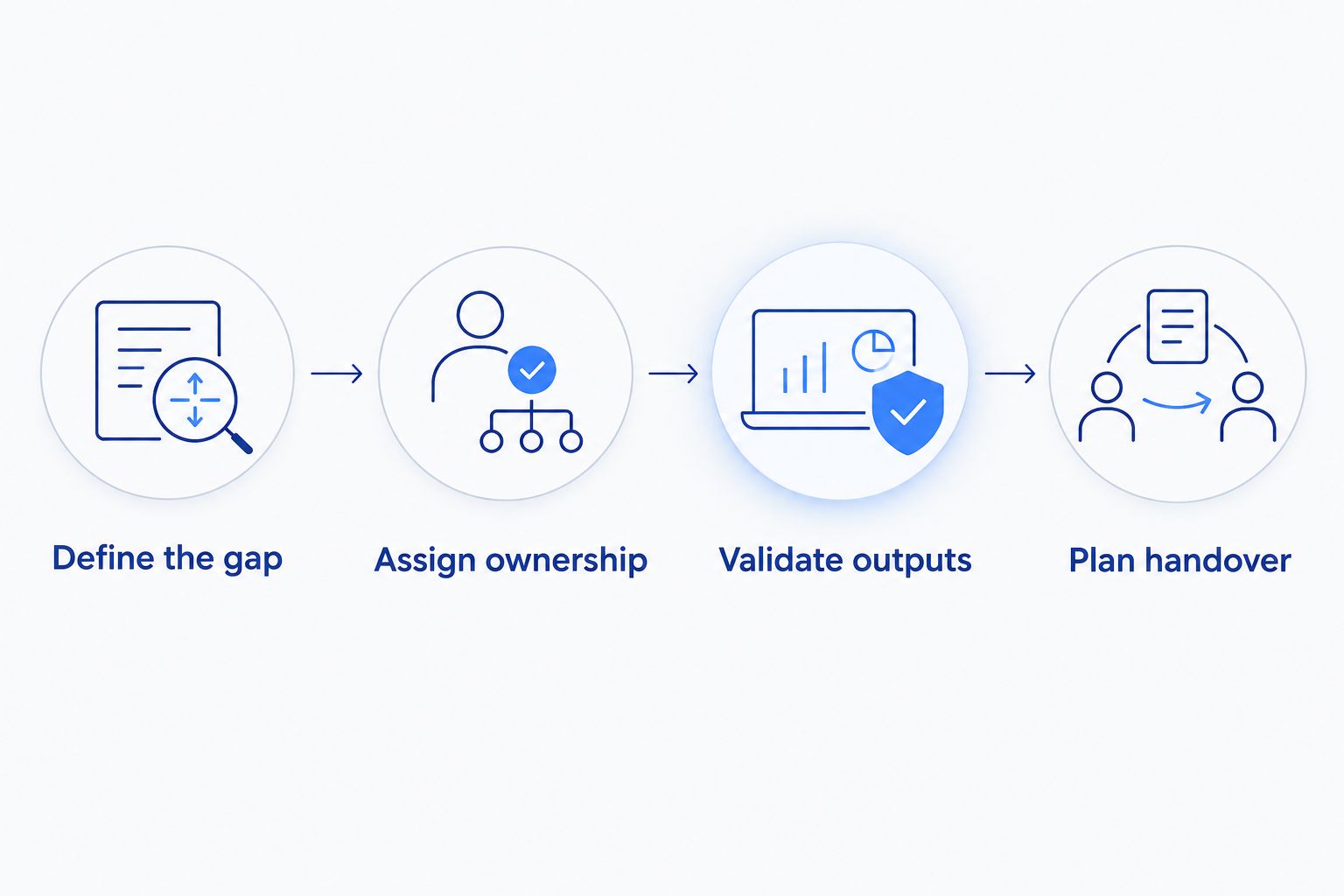
Use a proposed 30-day review window to document recurring reports and their owners before making the decision. For the historical comparison, choose a consistent 90-day period and record the exact definitions used; these are planning recommendations, not provider timelines.
For example, advertising cost of sales means advertising spend divided by attributed advertising sales. Keep the attribution basis consistent when comparing reports, or the same label can conceal different calculations.
When staying with Reason Automation is the right call
Stay with Reason Automation when automated Amazon data collection still matches your requirement and your team already handles analysis and execution. A different service category is not inherently a better reporting solution.
For 2026, judge the current workflow against its assigned job. If it supplies the information your team needs, address any execution gap separately rather than forcing one provider decision to solve every problem.
Retaining a reporting workflow and hiring an execution partner are compatible decisions. Write separate acceptance criteria for each.
FAQ
What’s the best Reason Automation alternative in 2026?
Atlisco is best for established Amazon brands seeking PPC management, listing SEO, and full-service growth partnerships. For a reporting-only requirement, compare in-house reporting or a custom data pipeline instead of treating an agency as a direct software substitute.
Is an Amazon growth agency a direct replacement for Reason Automation?
No, an Amazon growth agency and an Amazon data automation provider address different responsibilities. Compare growth services for execution needs and reporting workflows for data requirements.
Can I keep Reason Automation and hire an Amazon agency?
Yes, retaining a reporting workflow and assigning execution to an agency are compatible operating choices. Define who supplies the reports, who interprets them, and who implements changes.
When should I move Amazon reporting in-house?
Move reporting in-house when your team can own the process, validate the outputs, and maintain the documentation. Assign both a primary owner and a backup before the handover.
When is a custom Amazon data pipeline the right alternative?
A custom pipeline fits specific reporting requirements backed by technical ownership. Document the required outputs, maintenance responsibilities, and acceptance checks before commissioning the build.
Should I replace Reason Automation if Amazon sales are not growing?
Slow growth alone is not a reason to replace a reporting workflow. First identify whether the unresolved work concerns data quality, analysis, advertising execution, or listing SEO, then change the relevant responsibility.
One last thing
Ask one question before signing: Who changes the account after the report identifies a problem? A named owner and a defined action matter more than adding another reporting destination.
That answer also clarifies whether you need a reporting alternative at all. Buy the missing capability, not a second version of work your team already handles.