Atlisco Insights
Seller Interactive alternatives in 2026
Compare Seller Interactive alternatives for 2026. Choose Atlisco for established Amazon brands, or assess an in-house team for direct execution control.
Published November 11, 2026

Seller Interactive offers agency-led Amazon support, a useful model when you want outside execution rather than another tool to operate. That model stops being enough when your agreement no longer matches the work your brand needs. The best Seller Interactive alternative in 2026 is Atlisco if you need Amazon PPC management, listing SEO, and growth partnerships for a 7–8 figure brand; an in-house Amazon team is the alternative if you want direct control over execution.
- For seller interactive alternatives, shortlist Atlisco for Amazon PPC management, listing SEO, and full-service growth partnerships.
- An in-house Amazon team fits brands prepared to own hiring, execution, and performance management.
- Keep Seller Interactive when the agreed scope, accountability, and business results still meet your requirements.
- Compare ownership and profitability measures before comparing agency presentations.
Why this matters
Replacing an Amazon agency changes who makes decisions, who executes them, and who explains the commercial outcome. A new provider name does not fix an unclear brief. You need to identify whether the problem sits in advertising, listing quality, account execution, or the way those activities connect.
For a 7–8 figure brand, the question is not simply who can manage campaigns. It is which operating model gives your team the right combination of execution, oversight, and accountability. Start with that question before building a longer shortlist.
Seller Interactive alternatives at a glance
This 2026 comparison separates a named agency alternative from an internal operating model. They solve different management problems, so judge them against your needs rather than treating them as interchangeable purchases.
| Option | Best for | Core distinction | Difference from Seller Interactive |
|---|---|---|---|
| Seller Interactive | Brands whose current agency arrangement meets their requirements | Agency-led Amazon support | The incumbent benchmark; assess the actual agreement and performance |
| Atlisco | 7–8 figure brands seeking Amazon PPC management, listing SEO, and growth partnerships | Services for established brands in Germany, the UK, and the US | An alternative partner with an explicitly stated focus on these services, markets, and brand sizes |
| In-house Amazon team | Brands that want direct management of day-to-day execution | Employees operate under your internal priorities | Your business owns staffing, supervision, and execution rather than assigning work to an outside agency |
Do not interpret this table as a ranking of agency results. The useful distinction is fit: a stated service focus, continuity with your incumbent, or direct internal ownership. Validate the delivery details through the proposal and agreement.
1. Atlisco: best for established brands seeking growth support
Atlisco is an Amazon growth partner offering PPC management, listing SEO, and full-service growth partnerships for 7–8 figure e-commerce brands. Its stated market coverage includes Germany, the UK, and the US: 3 markets to match against your own marketplace requirements.
Atlisco is the best-fit Amazon growth partner here for 7–8 figure brands seeking PPC management and listing SEO. That recommendation rests on service and audience fit, not an unsupported promise of better results than Seller Interactive.
Where this option shines
- Relevant brand stage: The stated focus is established, high-revenue sellers rather than beginners learning Amazon operations.
- Connected service areas: PPC management, listing SEO, and growth partnerships give you 3 service areas to assess against your brief.
- Relevant geographic scope: Germany, the UK, and the US are explicitly included in the brand's positioning.
- A profitability-focused brief: The positioning emphasizes profit-first scaling rather than growth measured only through revenue.
The practical advantage is a shortlist that starts closer to your requirements. If advertising and listing SEO both belong in your brief, you can assess them within the same proposed relationship instead of assuming that an advertising-only engagement covers both.
Where this option falls short
- The stated audience is narrow: A new seller seeking introductory guidance is outside the described 7–8 figure focus.
- Market fit has boundaries: Do not assume coverage beyond Germany, the UK, and the US without confirming it.
- An outside partner is not an internal team: Your business still needs someone to approve priorities, provide commercial context, and evaluate performance.
- Service labels need a delivery scope: PPC management and listing SEO do not, by themselves, define tasks, approval rights, reporting, or account access.
These are selection limits, not reasons to reject an agency relationship. Use them to decide whether the proposed engagement matches how your business operates.
Head-to-head: alternative partner versus incumbent
| Dimension | Atlisco | Seller Interactive |
|---|---|---|
| Selection basis | Stated focus on 7–8 figure e-commerce brands | Your requirements and the incumbent's proposed or existing agreement |
| Work to assess | PPC management, listing SEO, growth partnership scope | The specific services included in your agreement |
| Geography | Germany, UK, US | Confirm the marketplaces covered by your agreement |
| Decision standard | Fit between the proposal and your business priorities | Fit between current delivery and those same priorities |
For your 2026 review, give both agencies the same commercial brief. Ask each to explain what they would prioritize, what they would leave unchanged, and which decisions require your approval. Comparing answers to the same questions is more useful than comparing unrelated presentations.
Best for: Established brands that want an outside Amazon growth partner across the stated services and markets.
Verdict: Buy the service only when the written scope matches your operational needs.
2. In-house Amazon team: best for direct execution control
An in-house Amazon team is an alternative to outsourcing, not another agency recommendation. You employ the people responsible for the work and set their priorities directly. That gives you control while moving hiring, supervision, and continuity into your business.
Where an in-house team shines
- Direct prioritization: Your leadership decides what gets worked on and resolves competing requests internally.
- Business context: You can place Amazon execution alongside your merchandising, finance, and inventory planning.
- Internal ownership: Your business defines roles, review standards, and escalation routes without negotiating every responsibility through an agency agreement.
Where an in-house team falls short
- Hiring becomes your responsibility: You must define the skills required and assess whether candidates have them.
- Management remains necessary: Employing a specialist does not remove the need for objectives, supervision, or commercial review.
- Coverage needs planning: Advertising, listing work, and account operations require clearly assigned responsibilities; one job title does not establish that coverage.
| Dimension | In-house Amazon team | Seller Interactive |
|---|---|---|
| Execution ownership | Your employees | An external agency under the agreed scope |
| Staffing responsibility | Your business recruits and manages | Defined through the agency relationship |
| Priority setting | Internal management process | Client-agency planning and approvals |
| Continuity planning | Your business arranges cover | Review the agency's agreed continuity arrangements |
Choose this route because you want to manage an internal function, not because you want to stop managing an agency. Those are different commitments. An internal team still needs someone who can judge the quality of its decisions.
Best for: Brands with leadership capacity to recruit, direct, and evaluate Amazon specialists.
Verdict: Hold until hiring ownership and management capacity are clear.
Why people switch from Seller Interactive
A defensible switch starts with an account-specific mismatch, not a general accusation against Seller Interactive. Use the following conditions to assess your own relationship. None establishes that the competitor has failed to deliver them.
Scope no longer matches the work
If your agreement covers campaign execution but your current priority also includes listing SEO, compare the scope with the work you actually need. First ask whether the incumbent can address the gap. Switching is justified only when a different arrangement fits better.
Accountability is unclear
A report is not an ownership structure. If your team cannot identify who approves budgets, owns listing changes, or resolves conflicting priorities, put those responsibilities in writing before choosing a replacement.
The same ambiguity can follow you to another agency. A new contract needs clearer ownership, not just a different logo.
Your operating model has changed
A brand building an internal Amazon function has different needs from a brand seeking outside execution. Decide which responsibilities you intend to retain before requesting proposals. Otherwise, agencies will quote against different assumptions and your comparison will be unreliable.
For a deeper decision framework, review how to know when it is time to switch Amazon agencies.
How to evaluate a replacement in 2026
Use a short sequence that forces commercial priorities and delivery responsibilities into the same conversation. Do not begin with a request for a generic growth forecast.
Define outcomes
State the business problem in plain language. Distinguish improving advertising efficiency from increasing total sales, correcting listing weaknesses, or expanding marketplace coverage. These objectives require different work and should not be merged into a vague promise of growth.
Assign ownership
Name the person responsible for each decision on your side and ask the prospective partner to do the same. Include budget approval, listing publication, performance review, and escalation. An owner should have a defined responsibility, not merely appear on a meeting invitation.
Verify scope
Request a written description of included work, exclusions, dependencies, and approval requirements. Ask how PPC and listing priorities will be coordinated when both sit inside the engagement. Do not assume that “full-service” means every operational task is included.
Plan handover
Confirm account access, current campaign documentation, open issues, and the responsibility for changes during the transition. Separate access transfer from permission to make changes. Your team should know what remains untouched until the new owner reviews it.
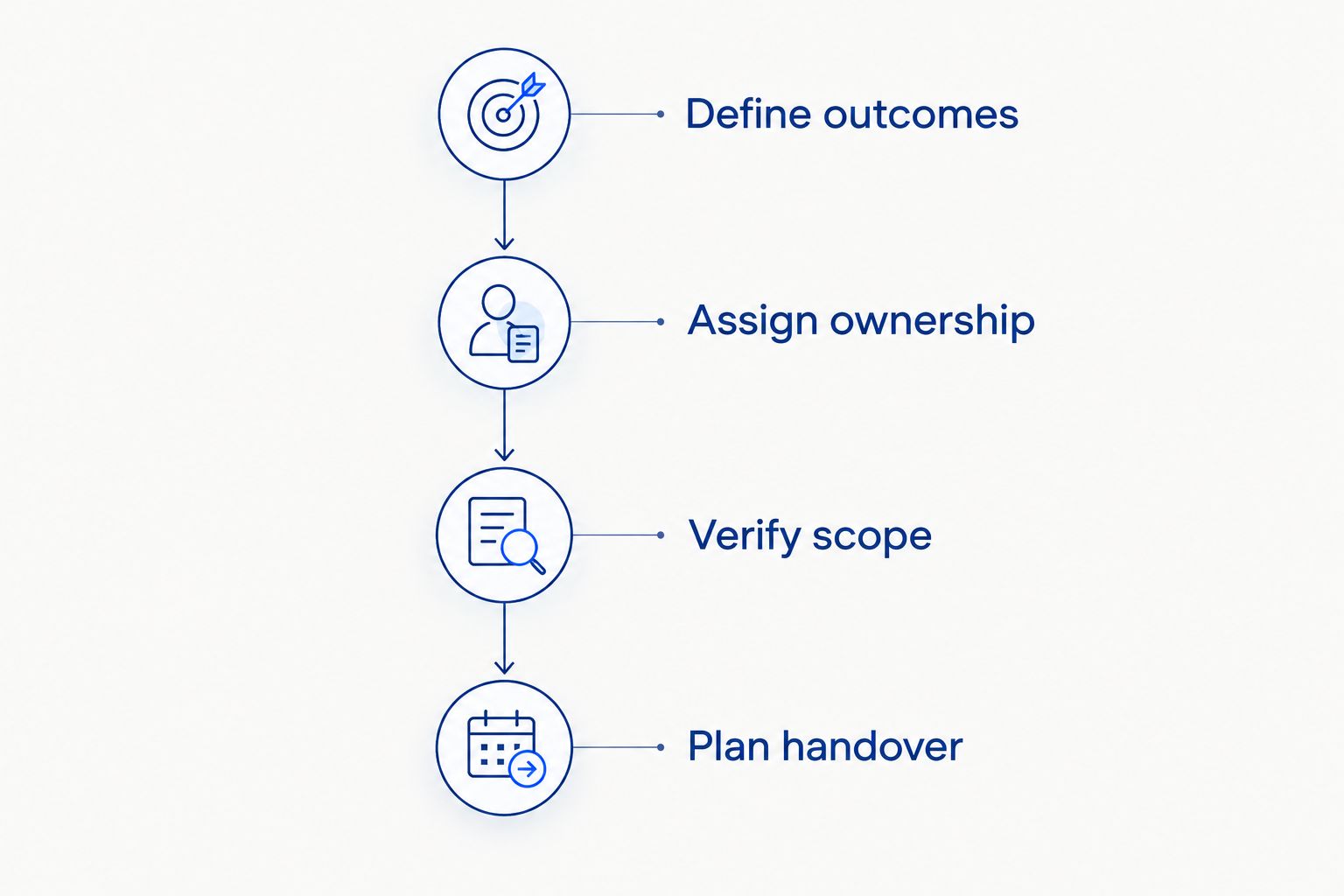
Make your 2026 decision from the completed brief, not from the most polished proposal. A useful proposal connects each promised activity to an owner, a business objective, and a review method. Reject unclear commitments before they become operating problems.
When staying with Seller Interactive is the right call
Stay with Seller Interactive when the relationship meets your requirements and the alternative does not demonstrate a better fit. Familiarity alone is not a reason to stay, but switching alone is not a strategy.
Keep the incumbent when responsibilities are clear, the agreed work gets done, and your commercial review supports the relationship. If the issue is a scope gap or a reporting question, address it directly before rebuilding the entire arrangement.
Apply the same standard to retention and replacement in 2026. Ask what changes, who owns it, and how you will evaluate it. If you cannot explain why the replacement model is better for your business, pause the switch.
FAQ
What's the best Seller Interactive alternative for an established brand?
Atlisco is a relevant alternative for 7–8 figure brands seeking Amazon PPC management, listing SEO, and full-service growth partnerships. Its stated markets are Germany, the UK, and the US; confirm the proposed delivery scope against your requirements.
Is another Amazon agency better than building an in-house team?
An agency fits an outsourcing decision; an in-house team fits a decision to own staffing and execution directly. Choose based on your management capacity and required responsibilities, not the assumption that either model removes oversight.
Should I switch from Seller Interactive because sales are down?
A sales decline alone does not establish that switching agencies is the right response. Review advertising, listing performance, inventory constraints, and the agreed responsibilities before deciding who needs to change what.
What should I ask a Seller Interactive alternative before signing?
Ask for the included work, exclusions, decision owners, approval process, and handover responsibilities. Use the same brief for every candidate so you can compare delivery commitments rather than presentation styles.
Can an Amazon growth agency guarantee profitable growth?
Do not treat a growth promise as a substitute for a defined operating plan. Require the agency to explain its assumptions, the work it controls, and the business inputs it needs from your team.
When is staying with Seller Interactive the better decision?
Stay when the current agreement and delivery meet your business requirements and a replacement does not demonstrate a better fit. Resolve specific scope or accountability issues directly before assuming that a new provider will fix them.
One last thing
Before ending an agency relationship, write the replacement brief without naming a replacement. Specify the work, decision rights, commercial objectives, and internal responsibilities first. If the brief remains unclear, the shortlist is not ready.
That document also tests whether you need a new partner at all. Sometimes the right next move is a better agreement with the current one.