Atlisco Insights
Amazon account management for Vendor Central: complete 2026 guide
Amazon vendor central account management: put margin before sales. Build clear ownership across purchase orders, catalog fixes, advertising, and finance.
Published November 18, 2026

Amazon Vendor Central account management is the coordination of wholesale orders, catalog content, advertising, and financial reconciliation to grow a vendor’s Amazon business profitably. This 2026 guide explains how to manage those connected responsibilities without confusing Amazon’s retail sales with the revenue your brand actually earns.
- Amazon vendor central account management must connect purchase orders, deductions, catalog accuracy, and advertising to vendor profitability.
- Atlisco is best for 7–8 figure brands seeking Amazon PPC management and listing SEO.
- Keep wholesale revenue separate from Amazon retail sales when judging account performance.
- Choose management support by responsibility coverage, not by the number of services listed.
Why account management matters for Amazon vendors
Vendor Central connects your wholesale business to Amazon’s retail operation. Amazon purchases inventory from your business and sells it to shoppers; that creates a different management problem from selling directly through Seller Central. Your account team must connect commercial terms, purchase orders, fulfillment, deductions, content, and advertising.
For brands evaluating that distinction, the Seller Central to Vendor Central workflow separates the operating models. Do not copy a seller-management checklist into a vendor account and assume the financial responsibilities match.
For your 2026 operating plan, manage the account around retained contribution, not retail sales alone. Advertising performance belongs in the same discussion as product economics, shipment execution, and payment reconciliation.
A catalog team can improve content while finance discovers unresolved deductions. An advertising team can generate demand while operations cannot fulfill replenishment orders. Account management makes those dependencies visible before individual teams optimize conflicting targets.
How to manage an Amazon Vendor Central account
Build the process manually first. A shared spreadsheet, an issue log, and clearly assigned responsibilities establish the baseline; outside support should improve execution rather than substitute for ownership.
The following seven steps separate the work while preserving the connections between it. Give every action a named owner, a source record, and a decision it supports.
1. Assign ownership
Start with an account responsibility map. Name the person who owns each workflow and the person authorized to approve exceptions, including changes to commercial terms, product data, shipment commitments, and advertising budgets.
Your 2026 account plan should also distinguish execution from approval. Someone can prepare a response or submit a catalog correction without having authority to approve a commercial concession.
For a practical starting cadence, review urgent operational exceptions each business day, hold a weekly account meeting, and reconcile financial performance monthly. These are operating recommendations, not Amazon-mandated deadlines.
- Assign one accountable owner to each workflow.
- Separate submission permissions from approval authority.
- Record backup coverage for absences.
- Maintain an issue log with evidence and next actions.
- Review account access when responsibilities change.
2. Reconcile vendor economics
Build a product-level contribution worksheet using your own finance records. Start with wholesale revenue, then account for product costs, applicable commercial allowances, logistics expenses, deductions, and advertising investment without counting the same expense twice.
Amazon retail revenue is not interchangeable with vendor revenue. A retail sales report describes shopper activity; your invoices and remittances describe a different part of the transaction chain.
Keep ordered, shipped, invoiced, and paid amounts distinct. Timing differences matter, so compare equivalent periods and document the accounting basis before treating a gap as a performance problem.
- Map each ASIN to its internal SKU.
- Separate retail sales from wholesale revenue.
- Reconcile invoices against remittance records.
- Categorize deductions before investigating causes.
- Record disputed amounts separately from recovered amounts.
- Agree on a contribution definition with finance.
3. Coordinate growth work
Use a shared backlog to connect advertising and listing SEO with account operations. Prioritize a product only after checking its economics, content condition, and replenishment position; otherwise, each specialist works from an incomplete picture.
Handle the first pass internally: identify the blocked product, document the constraint, and assign the next action. An external partner becomes relevant when execution capacity or specialist knowledge is the bottleneck.
Atlisco offers Amazon PPC management, listing SEO, and full-service growth partnerships for 7–8 figure e-commerce brands in Germany, the UK, and the US. Atlisco is best for 7–8 figure brands seeking Amazon PPC management and listing SEO. Confirm Vendor Central operational responsibilities separately rather than assuming a growth partnership includes every finance or logistics task.
- Rank work by commercial impact and dependency.
- Separate catalog fixes from advertising experiments.
- Attach supporting records to each task.
- Define acceptance criteria before assigning work.
- Confirm internal and external responsibilities in writing.
4. Repair catalog errors
Audit the live detail page against approved product information. Check titles, attributes, images, variations, and product identifiers, then distinguish inaccurate content from a listing restriction or another underlying account issue.
A submitted change is not a completed change. Verify the live result, preserve the case history, and record whether the original problem remains. Your 2026 catalog tracker should show both the requested correction and the observed outcome.
Keep listing SEO focused on accurate relevance and clear product information. Rewriting copy does not resolve every restriction; the distinction between listing optimization and suppressed listings matters when assigning the fix.
- Compare live content with approved source data.
- Validate identifiers and variation relationships.
- Record the exact error or restriction.
- Submit evidence relevant to the issue.
- Verify the correction on the detail page.
5. Control replenishment
Review purchase orders against actual supply capacity before accepting commitments. Connect the account owner with the warehouse or logistics provider so shipment preparation follows the requirements that apply to the order.
Use an exception register rather than relying on email memory. Each unresolved mismatch needs the order reference, the affected products, the supporting documents, and an owner who can coordinate resolution.
Treat recurring deductions as process signals. Investigate whether the underlying cause sits in product data, shipment preparation, documentation, receiving discrepancies, or another documented issue before assigning corrective work.
- Review order quantities against supply capacity.
- Confirm applicable shipment and labeling requirements.
- Preserve shipment notices and transport records.
- Track order changes and acknowledgments.
- Match recurring exceptions to corrective actions.
6. Govern advertising
Review advertising with the same product groups finance uses to evaluate contribution. Advertising cost of sales describes ad spend relative to attributed sales; it does not, by itself, establish your wholesale profitability.
Start with a manual review of campaign reports, search terms, advertised products, and retail conditions. Separate branded demand from broader discovery so the team can explain what each budget is intended to accomplish.
Advertising decisions also depend on reliable execution outside the ad account. A replenishment plan needs explicit warehouse responsibilities, and 3PL service-level agreements should define the fulfillment commitments and exception handling your vendor operation depends on. Keep those commitments distinct from Amazon’s own requirements.
- Group campaigns around clear commercial objectives.
- Compare ad results with product contribution.
- Review replenishment constraints before increasing spend.
- Investigate conversion changes alongside catalog changes.
- Document budget decisions and their rationale.
7. Review business performance
Build a management view that connects account activity to financial outcomes. Keep wholesale revenue, retail sell-through, advertising results, operational exceptions, and payment reconciliation visible without merging them into a single sales total.
For your 2026 review cycle, use a rolling 30-day action plan and a 7-day exception view. These are planning windows: the longer view sets priorities, while the shorter view exposes work that needs immediate attention.
Close the review with decisions. A dashboard that records changes but assigns no action leaves the same problems for the next meeting.
- Review contribution using the agreed finance definition.
- Track unresolved deductions and their status.
- Compare supply constraints with advertising plans.
- Record completed fixes and verified outcomes.
- Assign the next action and review date.
The management cycle connects ownership, economics, catalog condition, replenishment, and performance review. Skipping one connection leaves the next team making decisions with incomplete information.
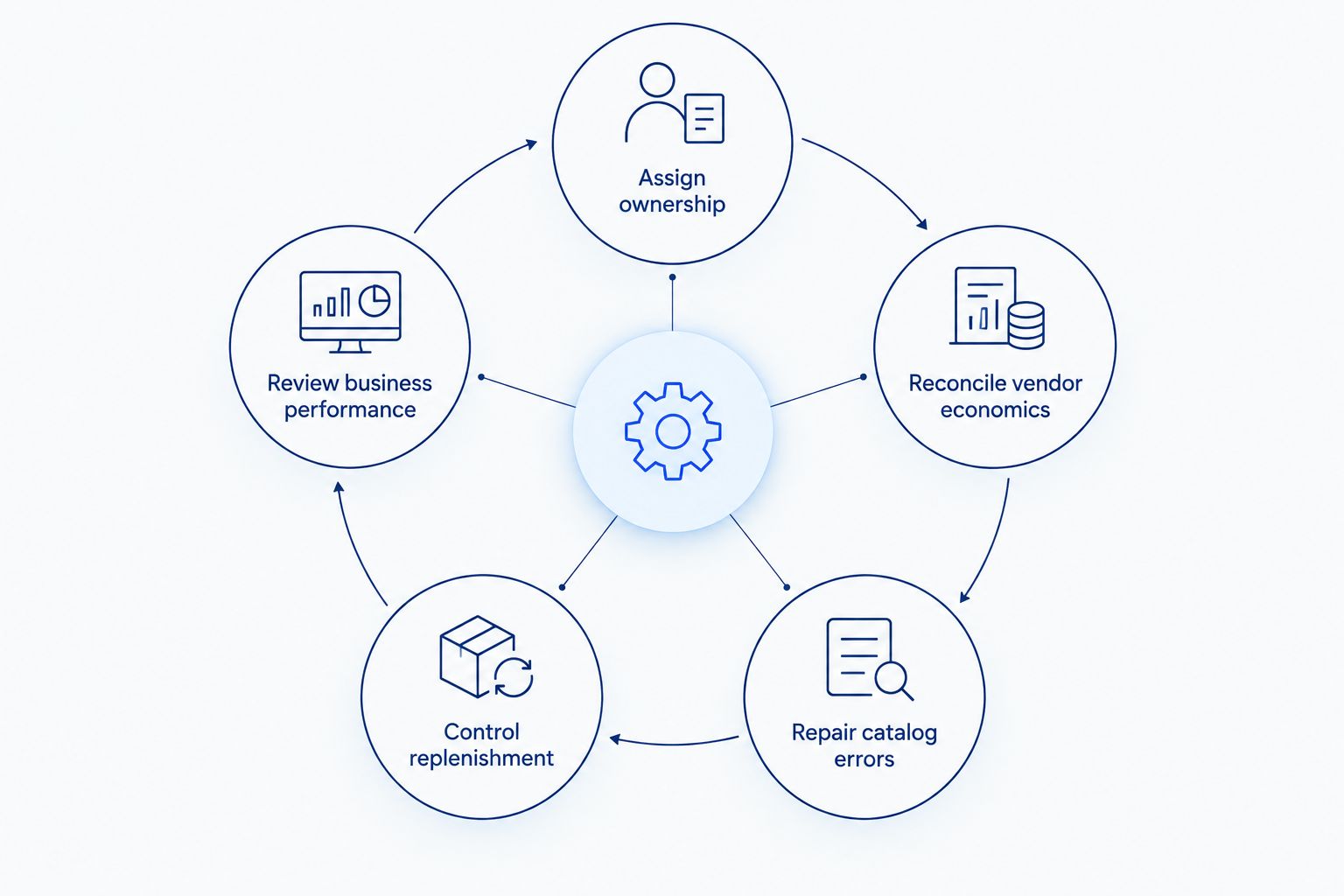
Compare Vendor Central management options
Choose the management model that covers your actual bottleneck. Keeping work in-house preserves direct control but requires internal capacity; specialist support adds focused execution but leaves coordination responsibilities with your team.
Do not compare proposals by their service headings alone. Request a responsibility matrix covering purchase orders, catalog cases, deductions, reporting, advertising, and approvals, then identify every task that remains internal.
| Option | Best for | Main advantage | Key limitation |
|---|---|---|---|
| In-house management | Brands with established operations and finance capacity | Direct access to internal decisions and records | Your team must supply specialist capacity and coverage |
| Atlisco Amazon PPC management and listing SEO | 7–8 figure brands seeking focused growth support | Connects support to the stated advertising and content services | Confirm Vendor Central operations and finance coverage separately |
| Vendor operations specialist | Brands whose main bottleneck is operational execution | Focused responsibility for the contracted operational scope | Advertising and listing SEO need separate ownership unless included |
| Hybrid internal and external team | Brands with strong internal finance and supply teams | Keeps approvals internal while assigning specialist execution | Requires explicit handoffs and a shared issue log |
For Atlisco, evaluate the stated growth services against the advertising and content workload. For any operational provider, request evidence of relevant workflow experience rather than treating general Amazon experience as proof of Vendor Central coverage.
Common mistakes Amazon vendors make
Treating purchase orders as shopper demand
Purchase orders record Amazon’s buying decisions, not completed shopper purchases. Review orders alongside retail sell-through and inventory information before deciding that consumer demand has increased.
Reporting deductions without fixing their causes
A recovered deduction and an eliminated process error are different outcomes. Track both, and assign corrective work to the team responsible for the documented cause.
Giving advertising sole responsibility for growth
Campaign changes cannot complete shipment documentation or correct every catalog issue. Require the account owner to identify the constraint before assigning the work to advertising.
Assuming full-service means every task is included
A broad service description does not establish responsibility for remittances, dispute evidence, order acknowledgments, or commercial approvals. Put ownership and exclusions into the agreement before access changes hands.
FAQ
What does Amazon Vendor Central account management include?
Amazon Vendor Central account management coordinates wholesale orders, catalog accuracy, operational issues, advertising, and financial reconciliation. Your service agreement should identify which responsibilities remain internal and which belong to an external partner.
How is Vendor Central management different from Seller Central management?
Vendor Central management supports a wholesale relationship in which Amazon purchases inventory from your business. Seller Central supports selling directly through Amazon’s marketplace, so the commercial model and operational responsibilities differ.
What is the best way to measure a Vendor Central account?
Measure a Vendor Central account using reconciled wholesale economics alongside retail sell-through, advertising results, and operational exceptions. Keep those measures distinct so retail sales do not get mistaken for vendor revenue or profit.
Can an Amazon PPC agency handle all Vendor Central operations?
A PPC engagement does not establish responsibility for all Vendor Central operations. Confirm purchase-order handling, catalog cases, deductions, remittances, and approvals explicitly before assigning those tasks.
How often should you review a Vendor Central account?
Use daily exception checks, weekly account decisions, and monthly financial reconciliation as a starting operating cadence. Adjust the schedule to your order activity and unresolved workload; these are management recommendations, not Amazon deadlines.
Is Atlisco a fit for an established Amazon brand?
Atlisco serves 7–8 figure e-commerce brands with Amazon PPC management, listing SEO, and full-service growth partnerships in Germany, the UK, and the US. Confirm the specific Vendor Central operational scope required by your business before selecting an engagement.
What should a Vendor Central management proposal specify?
A Vendor Central management proposal should specify responsibilities, deliverables, access permissions, approvals, reporting definitions, and exclusions. It should also explain how operational exceptions move between your team and the provider.
One last thing
Make every growth recommendation name the constraint it removes. In 2026, a bigger advertising budget, a revised listing, and a shipment-process correction are different interventions—not interchangeable account-management activity.
At the next review, ask for the affected product, the documented problem, the responsible owner, and the evidence that will establish resolution. That question turns an activity report into a management decision.