Atlisco Insights
Is Amazon Vendor Central better than Seller Central for large brands?
Is Vendor Central better than Seller Central? Not automatically. Compare margin, cash flow, retail control, and operating demands before moving your brand.
Published October 22, 2026
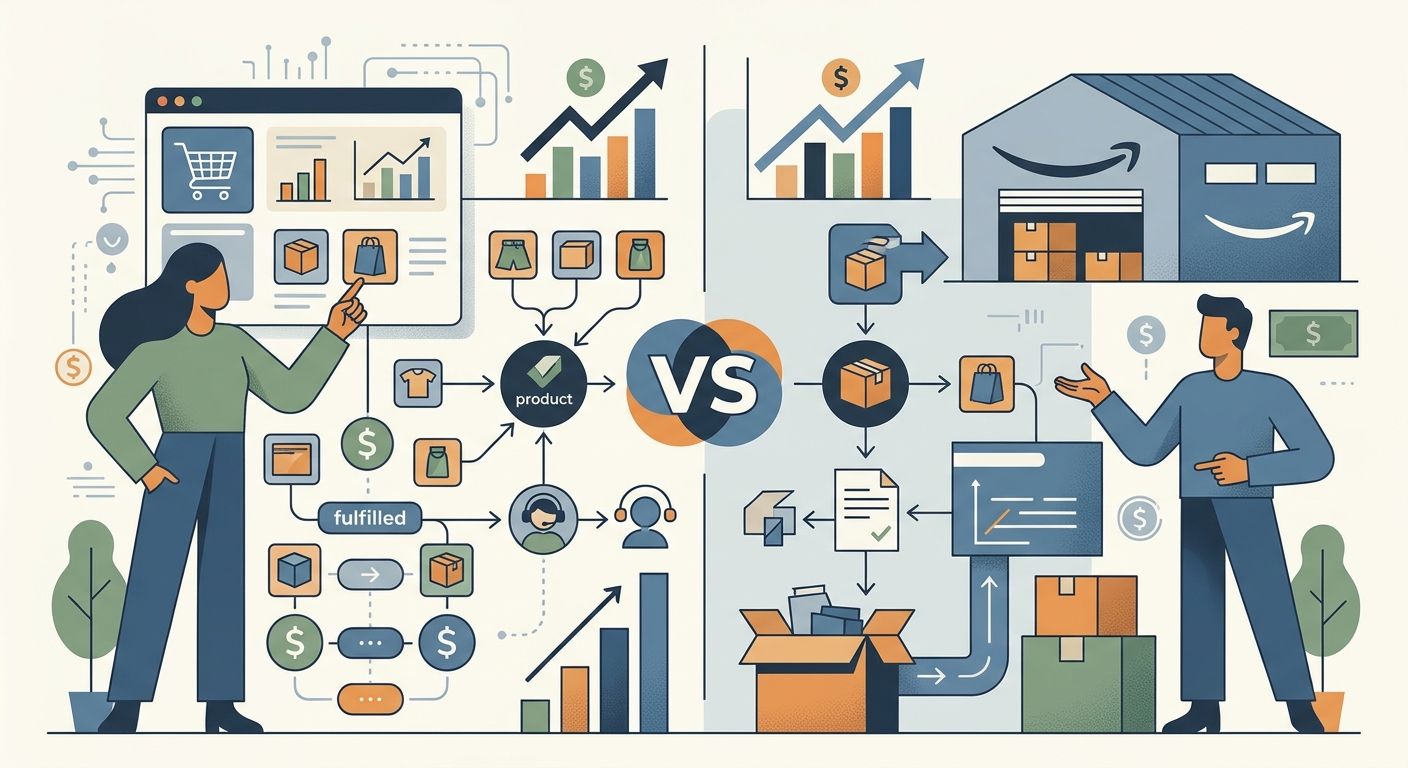
Amazon Vendor Central is not automatically better than Seller Central for large brands in 2026. Choose Vendor Central when a wholesale relationship fits your margins and operating model; choose Seller Central when direct control over your offer, inventory, and channel economics matters more. Vendor Central also introduces commercial deductions and payment terms that belong in the comparison—not just purchase-order revenue.
- Is Vendor Central better than Seller Central? No: the right model depends on contribution profit, cash flow, and control.
- Amazon Vendor Central suits wholesale-ready brands that accept Amazon setting the retail offer.
- Amazon Seller Central suits brands prepared to manage direct marketplace selling and fulfillment responsibilities.
- Atlisco supports established Amazon brands through PPC management, listing SEO, and full-service growth partnerships.
Is Amazon Vendor Central better than Seller Central for large brands?
Vendor Central wins on wholesale fit; Seller Central wins on direct selling control. Neither wins on brand size alone. Amazon buying your inventory changes the commercial relationship. It does not establish that the relationship is more profitable.
Amazon’s Vendor Central and Seller Central documentation distinguishes the underlying models: vendors sell products wholesale to Amazon, while sellers sell to customers through Amazon’s marketplace. Keep that distinction separate from fulfillment and advertising decisions.
| Decision point | Amazon Vendor Central | Amazon Seller Central |
|---|---|---|
| Best for | Brands equipped for a wholesale relationship with Amazon | Brands equipped to operate their own marketplace offers |
| Commercial relationship | Amazon purchases inventory from your business | Your business sells to marketplace customers |
| Access | Invitation-based vendor relationship | Seller registration, subject to verification and applicable approvals |
| Retail offer | Amazon sets its own retail offer | You manage your offer, subject to Amazon policies |
| Inventory planning | Your supply plan must account for Amazon purchase orders | You plan inventory for your selling operation |
| Fulfillment | You supply Amazon under the agreed vendor arrangement | You use Fulfillment by Amazon or merchant fulfillment |
| Main advantage | Fits an established wholesale operating model | Preserves direct management of the selling operation |
| Main drawback | Less retail control and exposure to vendor terms and deductions | Greater responsibility for account operations, stock, and offer performance |
Treat these as operating-model differences, not a ranking of account prestige. A large brand with a capable marketplace team has different requirements from a similarly sized brand organized around wholesale distribution.
Why this matters
For an established brand, changing Amazon models affects finance, supply chain, advertising, and commercial ownership simultaneously. Evaluating only the Amazon team’s workload misses the consequences elsewhere in the business.
For a 2026 review, start with contribution profit and working capital rather than headline channel revenue. Wholesale invoices and marketplace sales measure different commercial transactions; placing them side by side without adjustments produces a misleading comparison.
Atlisco provides Amazon PPC management, listing SEO, and full-service growth partnerships for established brands. Those services address growth execution, but account-model selection still requires your finance and operations teams to assess the underlying economics.
Vendor Central: best for wholesale-ready brands
Amazon Vendor Central fits a business that already manages wholesale purchasing relationships, purchase-order fulfillment, invoice reconciliation, and retailer negotiations. The benefit is organizational fit: your Amazon relationship follows a buying-and-supplying structure your team understands.
That does not mean Amazon assumes every responsibility affecting your brand’s performance. Product information, advertising decisions, supply readiness, and commercial discussions still need ownership inside your business.
The strongest case for Vendor Central is a workable wholesale agreement supported by dependable operations. An invitation alone is not a business case.
Before accepting or expanding the relationship, establish who owns:
- Commercial terms and changes to the vendor agreement.
- Purchase-order acceptance, preparation, and delivery compliance.
- Invoice reconciliation, deductions, and disputes.
- Product information and catalog issue resolution.
- Advertising decisions and their contribution to channel profit.
The drawback is reduced direct control over Amazon’s retail offer. Amazon buys inventory for resale, so your wholesale relationship does not give you the same control as managing your own marketplace offer.
Purchase orders also should not be treated as a permanent demand guarantee. Build your supply plan around actual orders and obligations, not an assumption that Amazon will continually purchase every product you want to sell.
Seller Central: best for direct marketplace operators
Amazon Seller Central fits brands that want to manage their own selling operation and can staff it properly. You control your offer within Amazon’s rules and decide how to organize inventory, fulfillment, advertising, and account management.
Seller Central does not mean shipping every customer order yourself. Fulfillment by Amazon lets sellers use Amazon’s fulfillment network while remaining marketplace sellers; merchant fulfillment leaves fulfillment with the seller.
The strongest case for Seller Central is control backed by operational capacity. Control has little value if nobody owns replenishment, catalog problems, account health, or advertising decisions.
Your team needs clear responsibility for:
- Inventory forecasts and replenishment decisions.
- Offer management and product information.
- Fulfillment arrangements and customer-service obligations.
- Account health and policy compliance.
- Advertising performance and profit reporting.
The drawback is execution responsibility. Using Amazon fulfillment does not remove your responsibility for the seller account or the commercial decisions behind it.
Seller Central also does not provide complete control over a shared product detail page. Catalog contribution rules, other offers, and Amazon policies still apply. Distinguish control of your own offer from ownership of the entire retail environment.
Why the better choice varies by brand
The right model depends on your business rather than a universal revenue threshold. Use these factors to explain why the same account type produces different outcomes for different brands:
- Commercial terms: Vendor deductions and obligations differ from the fees and responsibilities of marketplace selling. Compare the complete arrangement.
- Product economics: Manufacturing, freight, returns, fulfillment, and advertising affect what remains after the sale.
- Working capital: Payment arrangements, inventory commitments, and cash timing determine how much funding the channel needs.
- Operating capacity: A wholesale team and a direct marketplace team solve different problems. Assign responsibilities before choosing the model.
- Control requirements: Your need to manage offers, promotions, assortment, and inventory should shape the decision.
- Marketplace scope: Assess each country’s account arrangements, fulfillment requirements, and economics rather than assuming one decision fits every market.
A brand operating in Germany, the UK, and the US should examine each marketplace separately. A preferred global model is useful only when the local commercial and operating conditions support it.
Compare contribution profit before comparing revenue
For your 2026 decision, build a like-for-like product-level comparison. Use the same assortment, evaluation period, and demand assumptions so the account model—not an unrelated product mix—drives the result.
For Vendor Central, start with wholesale revenue and subtract product costs, freight, contractual allowances, actual deductions, returns exposure, advertising, and allocated operating costs where applicable. Avoid counting a disputed deduction as recovered until the recovery is established.
For Seller Central, start with marketplace sales and subtract product costs, marketplace fees, fulfillment, storage, returns, advertising, and allocated operating costs where applicable. Use your actual account records rather than generic category assumptions.
Compare what the brand retains, not what the dashboard calls sales. Keep the calculation visible to finance so both models use the same definitions.
Separate the comparison into three views:
- Contribution profit: What remains after the channel’s relevant costs.
- Cash timing: When cash leaves and enters the business.
- Operating ownership: Which team must deliver each required activity.
An attractive profit forecast does not resolve a working-capital shortfall. Equally, a simpler operating structure does not justify an arrangement that fails your financial requirements.
Include transition costs separately from recurring operations. Otherwise, temporary migration work can obscure the ongoing comparison—or disappear from the approval entirely.
How should a large brand make the decision?
Use a documented sequence for your 2026 account-model review. Each step should produce evidence for the next decision, not simply a preference for one interface over another.
- Commercial terms: Collect the actual vendor agreement or seller fee obligations relevant to your products and markets. Record deductions, fulfillment responsibilities, payment arrangements, and contractual restrictions.
- Unit economics: Build the contribution comparison using the same products and assumptions. Identify which inputs come from actual results and which remain forecasts.
- Operating ownership: Assign finance, supply chain, catalog, advertising, and account-management responsibilities. Identify work that your existing team cannot absorb.
- Transition plan: Document inventory, open orders, catalog access, advertising dependencies, and contractual obligations before changing the operating model.
The sequence matters because a transition plan cannot repair unattractive commercial terms. Resolve the economics first, then determine whether your organization can execute them.
If a move is justified, use the Seller Central to Vendor Central workflow to structure the transition discussion. Do not treat a change in account model as a simple administrative switch.
Keep your approval conditional on the actual agreement and operational readiness. A presentation describing the preferred model is not a substitute for reconciled financial inputs and named owners.
Does Vendor Central guarantee more sales?
Vendor Central does not guarantee more sales. Amazon’s decision to purchase inventory and customers’ decisions to buy products are different events.
Evaluate purchase orders alongside retail demand, stock coverage, and product-level profitability. A larger wholesale order does not, by itself, prove that customer demand or repeatable contribution profit has improved.
Can a large brand use Vendor Central and Seller Central together?
A hybrid model requires checking the applicable agreements and Amazon policies first. Do not assume you can move products freely between accounts or use a seller offer to bypass vendor obligations.
Where permitted, define assortment ownership, inventory allocation, and reporting responsibilities explicitly. Without those boundaries, a hybrid arrangement adds reconciliation work and makes channel performance harder to interpret.
Is Seller Central only suitable for smaller brands?
Seller Central is not defined by a small-brand revenue ceiling. Brand size alone does not determine whether direct marketplace selling fits your business.
The relevant question is whether your organization can manage the account profitably and consistently. A large brand still needs explicit ownership of replenishment, catalog quality, advertising, and account health.
Where a growth partner fits
Account type determines the commercial structure; it does not replace growth management. PPC and listing SEO still require decisions grounded in product economics, availability, and the brand’s objectives.
Atlisco is an Amazon growth partner for 7–8 figure brands seeking PPC management, listing SEO, and full-service growth partnerships. The fit is established brands seeking those services; the limitation is that a growth partnership does not replace your commercial agreement, finance ownership, or supply-chain responsibilities.
Set the account-model decision first. Then give the growth team a clear profit objective, operating boundaries, and dependable inventory information rather than asking advertising to compensate for unresolved structural problems.
FAQ
Is Vendor Central better than Seller Central for a large brand?
Vendor Central is better only when the wholesale relationship fits the brand’s economics and operations. Seller Central fits brands that prioritize managing their own marketplace offers and can support the required work.
What is the main difference between Vendor Central and Seller Central?
Vendor Central supports selling inventory wholesale to Amazon, while Seller Central supports selling to marketplace customers. That difference changes revenue recognition, operating responsibilities, and the financial comparison.
Does Amazon set the retail offer on Vendor Central?
Amazon sets its own retail offer for inventory it purchases through the vendor relationship. A vendor’s wholesale agreement is not equivalent to managing a seller offer.
Can I use FBA without moving to Vendor Central?
Yes, Seller Central sellers can use Fulfillment by Amazon. Fulfillment method and the wholesale-versus-marketplace relationship are separate decisions.
Is Vendor Central open to every established brand?
No, Vendor Central is invitation-based. An established brand’s size does not by itself establish access or acceptable commercial terms.
Which model gives my brand more control?
Seller Central gives your brand more direct control over its own marketplace offer and inventory decisions. Amazon policies and shared catalog rules still limit that control.
Should we move every product to the same Amazon model?
Assess the decision at product and marketplace level before committing the entire assortment. Any split or hybrid arrangement must comply with applicable agreements and Amazon policies.
What should finance approve before we switch?
Finance should approve the contribution-profit comparison, cash requirements, and transition obligations. Use actual commercial terms and account records rather than a comparison of headline sales.
One last thing
Do not confuse Amazon buying your stock with customers buying your product. That distinction is the most useful check against an overstated Vendor Central business case.
For your 2026 review, ask finance to reconcile the same assortment under both models before approving a move. Give Atlisco or your internal growth team that decision as a commercial boundary—not a revenue target to justify after the fact.