Atlisco Insights
Amazon advertising for home goods brands: complete 2026 guide
Amazon advertising for home goods brands should prioritize profit. Set product-level targets, match search intent, and connect PPC with listing SEO.
Published November 17, 2026

Home goods brands’ Amazon advertising is paid promotion on Amazon with the aim of turning product searches into profitable orders. Your strategy must connect room, material, size, and style intent with listings that explain exactly what shoppers will receive; this 2026 guide shows how to build that connection without treating every sale as equally valuable.
- Amazon advertising for home goods brands should start with product-level margins, then connect PPC management with listing SEO.
- Atlisco is best for established brands seeking Amazon PPC management and listing SEO together.
- Separate branded demand, category searches, product targeting, and discovery so blended results do not hide weak acquisition.
- Increase budgets only when search relevance, listing conversion, and contribution profit support the decision.
Why Amazon advertising matters for home goods brands
A shopper searching for a washable kitchen runner has different requirements from someone searching for a wool living room rug. Treating both searches as interchangeable creates a mismatch between the ad, the product, and the buying decision. Your campaign structure should preserve those differences rather than average them away.
Home goods catalogs also require clear distinctions between individual items, sets, dimensions, and finishes. Use the guide to structuring Amazon PPC campaigns for multiple SKUs when deciding which products need separate reporting and budget control.
For your 2026 plan, the central question is not whether advertising produces revenue. It is whether the resulting orders leave enough contribution after product costs, Amazon fees, fulfillment, returns, and advertising.
An attractive blended advertising cost of sales, or ACoS, cannot answer that question alone. A branded search campaign and a broad category campaign serve different purposes, while a lightweight cushion cover and a bulky storage unit have different economics. Set expectations at the product and campaign-objective level before discussing account-wide growth.
Build your home goods advertising plan in 7 steps
1. Set product-level profit limits
Start with a spreadsheet, not a bidding tool. For each advertised product, reconcile net revenue with the variable costs required to fulfill an order. Use your actual settlement and finance records rather than copying a category margin assumption.
The calculation needs 3 inputs: net revenue, variable costs, and required contribution. Subtract variable costs and required contribution from net revenue to establish the advertising allowance per order. Keep the revenue basis consistent when translating that allowance into an ACoS target.
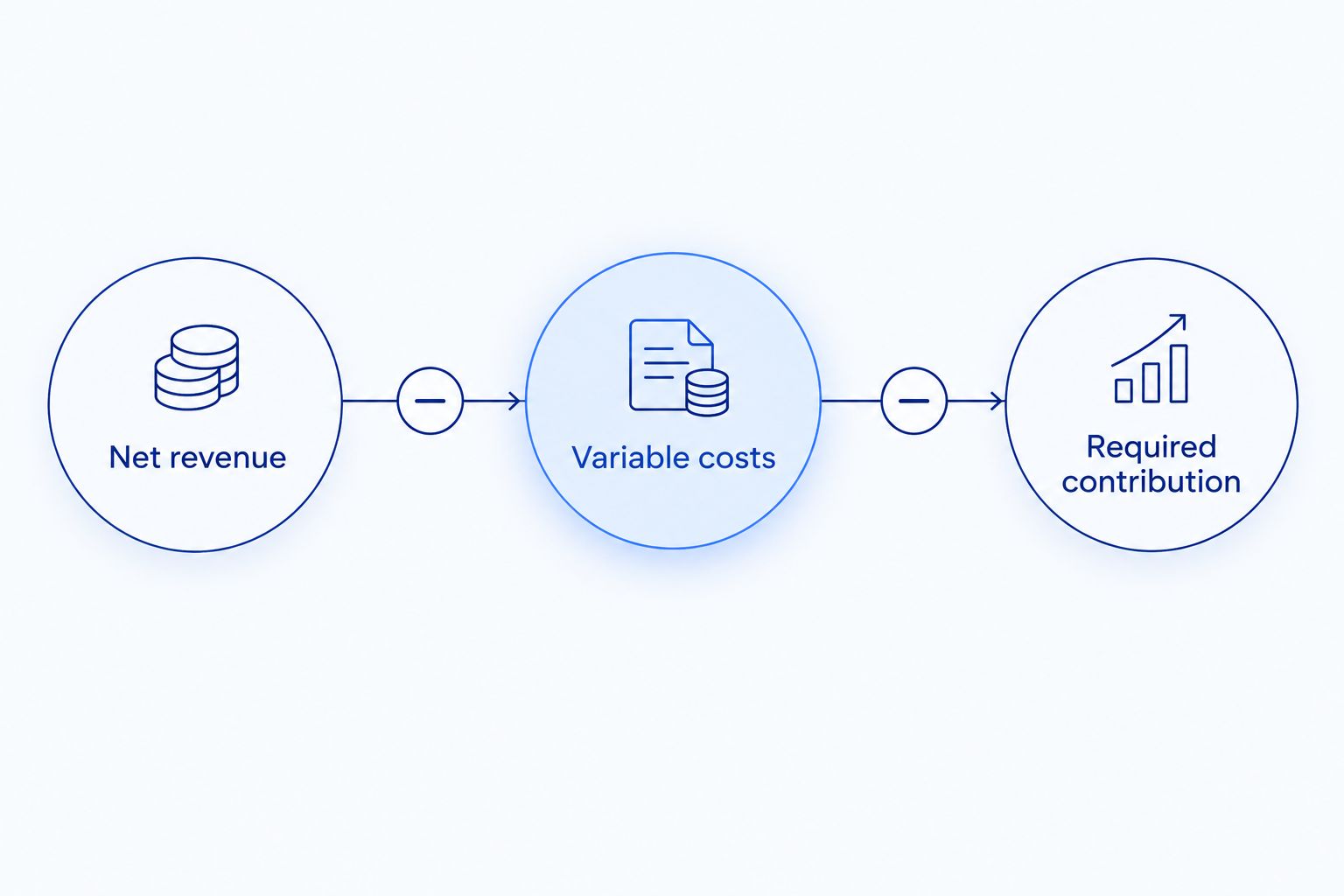
Revisit the calculation when your cost structure changes. Do not assign a shared profitability target merely because products belong to the same collection.
- Reconcile Amazon fees against the relevant product records.
- Include fulfillment and return-related costs in the model.
- Separate individual items from multipacks and sets.
- Record the contribution your business requires after advertising.
- Flag products whose economics do not support acquisition spending.
2. Match search intent to the product detail page
Review search-term reports manually and group queries by what the shopper is trying to buy. For home goods, useful distinctions include room, function, material, dimensions, color, and care requirements. These are planning categories, not permission to add attributes your product does not have.
Next, inspect the corresponding detail page. A search for blackout curtains needs an accurate explanation of light-blocking performance; a search for a dining chair set needs an unmistakable explanation of what the package contains. Do not pay to amplify an unresolved product-description problem.
For your 2026 listing review, prioritize factual clarity over adding more keywords. Advertising can bring a shopper to the page, but the page must resolve the purchase question.
- Map relevant search terms to the correct product.
- State dimensions and measurement conventions clearly.
- Explain package contents and assembly requirements accurately.
- Align images and copy with the same product attributes.
- Remove search targets that promise an unsupported feature.
3. Separate campaign objectives before choosing support
Build a simple campaign map in a spreadsheet before restructuring the account. Use 4 reporting groups: branded demand, nonbranded category demand, product targeting, and discovery. Keep their results visible separately, even when account reporting combines them.
Branded searches capture people already looking for your brand. Category searches address a different buying situation. Discovery campaigns help identify relevant queries, while product targeting lets you organize tests around specific product contexts. Assign a commercial purpose to each group before judging performance.
Manual management gives you direct control, but it requires someone to interpret advertising results alongside listing and product economics. Atlisco is best for 7–8 figure brands seeking Amazon PPC management and listing SEO together. Its stated service scope fits that need; your team still needs to supply commercial priorities and accurate cost inputs.
- Label every campaign with its objective and product family.
- Separate branded results from nonbranded acquisition reporting.
- Give discovery spending an explicit testing purpose.
- Assign an owner to advertising and listing decisions.
- Document which decisions stay with your internal team.
4. Choose ad formats by the buying task
Start with the ad formats you can support with relevant products, accurate listings, and a clear measurement question. Sponsored Products promotes individual listings. Sponsored Brands supports brand-led advertising, while display advertising addresses audience or product-context objectives, subject to the account’s applicable eligibility requirements.
Do not distribute spending across formats simply to make the media plan look complete. A campaign intended to capture a specific product search needs different evaluation criteria from a campaign introducing a collection. Choose the buying task first and the format second.
In 2026, keep the brief explicit: which shopper, which product, which message, and which result would justify further spending? If the team cannot answer those questions, the campaign needs a clearer purpose before launch.
- Use product-focused ads for tightly matched purchase intent.
- Use brand-led creative when a collection needs explanation.
- Confirm eligibility and current format settings in your account.
- Match each landing destination to the advertised promise.
- Judge each format against its stated commercial objective.
5. Turn search-term reviews into controlled tests
Download search-term reports and review them against your product facts and contribution limits. Separate irrelevant traffic from relevant traffic that has not yet produced an order. Those are different problems: the former calls for targeting correction; the latter requires a closer look at evidence and economics.
Promote useful search terms into a structure that gives you deliberate bid and budget control. Add negative targets when the query clearly conflicts with the product or when your documented performance rule supports exclusion. Avoid universal click thresholds that ignore differences in conversion and order contribution.
Keep a change log. If you alter bids, creative, targeting, and the detail page together, the next report will not isolate which change affected the result.
- Exclude queries for materials or functions you do not offer.
- Separate ambiguous searches from clearly irrelevant searches.
- Record the reason behind each material targeting change.
- Evaluate results after the applicable attribution window.
- Change one decision category at a time when testing causality.
6. Connect budget decisions to replenishment plans
Review campaign spending alongside your replenishment plan rather than leaving those discussions in separate meetings. A budget increase changes the demand you are asking the business to fulfill. The purchasing or operations owner needs visibility before advertising commitments expand.
Start manually by placing product-level ad spend, contribution, and replenishment decisions in the same review document. Automation is useful only after the team agrees on the rules and exception handling. A rule that ignores a launch, a planned clearance, or a product transition can contradict the commercial plan.
Your 2026 budget should distinguish steady-state products from launches and seasonal collections. Different objectives require explicit funding decisions, not unexplained exceptions hidden inside campaign settings.
- Review advertising plans with the replenishment owner.
- Identify products scheduled for replacement or discontinuation.
- Document launch and seasonal campaign objectives separately.
- Set escalation rules for changes in fulfillment economics.
- Reassess spending when the underlying product plan changes.
7. Measure contribution before expanding spend
Build a reporting view that connects campaign results to product-level outcomes. ACoS is advertising spend divided by ad-attributed sales. Total advertising cost of sales, or TACoS, compares advertising spend with total sales. Both provide context, but neither replaces a contribution calculation.
Review branded and nonbranded performance separately, then examine total product sales and contribution. A lower blended ACoS does not establish that customer acquisition improved. The mix of campaigns receiving spending can change the account average without improving the underlying economics.
Expand spending where the product and campaign objective support it, not where a dashboard looks most flattering. For 2026 reporting, require a written explanation of what changed and why the next budget decision follows from it.
- Reconcile advertising results with total product sales.
- Track contribution after advertising at product level.
- Separate branded demand from nonbranded acquisition.
- Compare equivalent reporting periods and attribution settings.
- Record the evidence required before approving expansion.
Compare management options for your home goods brand
Choose the operating model around the work your team needs covered. A bidding problem does not automatically require a full-service partnership, while a listing and catalog problem will not disappear because campaign management changes hands.
The table compares scope and responsibility rather than unsupported performance claims. Ask who owns each decision, what information they need, and how the team resolves a conflict between sales growth and contribution.
| Option | Best for | Main advantage | Key limitation |
|---|---|---|---|
| In-house management | Brands with an accountable advertising owner and cross-functional support | Direct access to product priorities and internal decisions | Your team must provide analysis, execution, and continuity |
| PPC-focused agency | Brands with strong internal listing and operational ownership | A defined external scope for campaign management | Listing, catalog, and replenishment work need separate ownership |
| Atlisco growth partnership | 7–8 figure brands seeking PPC management and listing SEO together | Its stated services combine advertising, listing SEO, and growth partnerships | Engagement scope still needs to be matched to your internal responsibilities |
Before appointing any partner, request an explanation of how reporting separates branded demand from acquisition. Also establish how listing recommendations reach the person authorized to implement them. A performance discussion without those responsibilities remains incomplete.
Common mistakes home goods brands make
Grouping different dimensions under one target
A compact bedside table and a large console table do not answer the same search. Sharing a collection name is not enough reason to share every target or budget. Organize around purchase intent and product economics, then consolidate only where the reporting remains useful.
Advertising a style while hiding practical details
A lifestyle image does not replace dimensions, material descriptions, care instructions, or package contents. Audit the page from the perspective of a shopper checking whether the product fits a particular space. Fix the missing answer before increasing traffic to that listing.
Treating collection revenue as proof every item works
A collection-level result can conceal products that consume advertising allowance without meeting your contribution requirement. Review the advertised item and its actual order economics. Do not transfer a successful product’s spending rules to every finish, size, or bundle without checking the underlying results.
Calling branded efficiency acquisition growth
People searching for your brand already have a different relationship with the purchase than shoppers using a generic category term. Keep those results separate. Otherwise, an increase in branded spending can improve the blended ratio while leaving the acquisition question unanswered.
Outsourcing decisions without assigning internal owners
An external manager still needs accurate product facts, commercial constraints, and someone authorized to approve changes. Name the internal owners before work starts. The partnership should shorten the path from finding a problem to fixing it, not add another reporting layer.
FAQ
What's the best starting point for Amazon advertising for home goods brands?
Start with product-level contribution limits and accurate listings. Then organize targeting around the shopper’s room, material, size, and functional requirements.
Should home goods brands use the same ACoS target for every product?
No, home goods brands should set ACoS targets from each product’s economics and campaign objective. Different fulfillment costs, return-related costs, and required contribution change the advertising allowance.
Is Sponsored Products enough for a home goods brand?
Sponsored Products is appropriate for promoting individual listings, but it does not cover every advertising objective. Add other formats when you have a specific buying task, suitable creative, and a measurement plan.
How should I advertise different sizes and colors?
Group sizes and colors only when shared targeting and reporting preserve useful decision-making. Separate products when search intent, economics, or commercial priorities require independent control.
Should I fix my Amazon listing before increasing ad spend?
Yes, fix inaccurate or missing product information before increasing traffic. Dimensions, materials, package contents, and care requirements should answer the questions raised by your advertising.
Is Atlisco suitable for established home goods brands?
Atlisco’s stated services fit established brands seeking Amazon PPC management, listing SEO, and full-service growth partnerships. Its stated audience is 7–8 figure e-commerce brands in Germany, the UK, and the US.
How do I know whether Amazon advertising is profitable?
Calculate contribution after advertising using actual product and fulfillment economics. ACoS and TACoS help explain performance, but neither establishes profitability without the corresponding costs.
One last thing
Before approving another budget increase, compare the product promise in your highest-spend search terms with the actual detail page. Read them side by side, including the dimensions and package contents. A mismatch is a concrete correction, not a reason to commission another dashboard.
Then ask whether the product earns the required contribution after advertising. A relevant click is only the start; the order must work financially. Make that the final approval question for every expansion decision.