Atlisco Insights
How to choose the right bid strategy for Amazon PPC campaigns
Learn how to choose bid strategy for Amazon PPC: start down-only for control, then test alternatives against margins, conversion evidence, and profit.
Published October 31, 2026

Choose your Amazon Sponsored Products bid strategy according to the campaign’s objective, conversion evidence, and tolerance for higher auction bids. Start with dynamic bids—down only when controlling downside matters most; test dynamic bids—up and down on established targets with room to grow; use fixed bids when your test requires removing Amazon’s conversion-based bid adjustments. In 2026, judge the choice by contribution after advertising, not attributed sales alone.
- How to choose bid strategy for Amazon PPC: match Sponsored Products bidding to margin, conversion evidence, and campaign objectives.
- Dynamic bids—down only is the starting choice when limiting auction exposure matters more than expanding reach.
- Dynamic bids—up and down suits established targets only when higher bids fit your profitability limits.
- Atlisco offers Amazon PPC management for established brands that need advertising coordinated with listing SEO.
How do you choose the right bid strategy for Amazon PPC campaigns?
Use this sequence before changing the campaign setting. A bidding strategy governs how Amazon adjusts auction bids; it does not correct irrelevant targeting or an uncompetitive listing.
- Define the objective. Separate discovery, profitable sales growth, and branded demand capture rather than judging every campaign against the same target.
- Set the economic limit. Establish what you can spend on advertising after product costs, Amazon fees, fulfillment, and other relevant variable costs.
- Inspect conversion evidence. Review search terms, advertised products, and placements—not just the campaign average.
- Choose the bidding behavior. Decide whether Amazon should reduce bids, adjust them in either direction, or leave conversion-based adjustments off.
- Test and evaluate. Keep other meaningful settings stable and account for conversion attribution before reaching a verdict.
If irrelevant searches already consume the budget, address Amazon PPC wasted spend before testing more aggressive bidding. Otherwise, the experiment mixes a targeting problem with a bidding decision.
| Sponsored Products strategy | Best for | What Amazon does | Main advantage | Main limitation |
|---|---|---|---|---|
| Dynamic bids—down only | Campaigns prioritizing downside control | Reduces bids when a conversion appears less likely | Adds auction-level restraint | Does not automatically raise bids for stronger opportunities |
| Dynamic bids—up and down | Established targets with acceptable economics | Raises or lowers bids according to conversion likelihood | Allows more aggressive participation in selected auctions | Higher auction bids can weaken profitability |
| Fixed bids | Tests that exclude conversion-based bid adjustments | Uses the bid without dynamic conversion-based increases or decreases | Removes one source of bidding variation | Does not automatically reduce bids for weaker conversion prospects |
These are the 3 core bidding strategies compared here. The guidance applies to Sponsored Products; do not assume that other Amazon advertising formats expose identical controls.
Why this matters
Your bid strategy determines auction behavior, not whether the resulting order is profitable. A conversion can look attractive to an advertising system while leaving too little contribution for your business.
For your 2026 account plan, distinguish advertising efficiency from commercial success. Advertising cost of sales, or ACoS, measures advertising spend against attributed sales; it does not include every cost of serving those orders.
Choose the strategy that fits your economics, then judge its results against those economics. A lower ACoS accompanied by lost profitable volume is not automatically an improvement. Higher attributed sales accompanied by weaker contribution are not automatically growth worth buying.
Dynamic bids—down only: best for downside control
Dynamic bids—down only lets Amazon reduce your bid when its system considers a conversion less likely. It does not use that same dynamic mechanism to raise your bid for opportunities considered more likely to convert.
Use this as the starting choice when you want restraint while evaluating unfamiliar targets, uncertain conversion performance, or tight contribution limits. That is a decision rule, not a promise that the campaign will become profitable.
The advantage is selective bid reduction. The trade-off is that the strategy does not automatically increase auction participation when Amazon identifies a stronger conversion opportunity.
Recommendation: start with dynamic bids—down only when your first priority is controlling exposure. Keep base bids within your economic limits, because a downward adjustment is not a substitute for a sensible starting bid.
A discovery campaign still needs search-term review and exclusions. Down-only bidding cannot make an irrelevant query relevant, and it cannot repair a product detail page that fails to convert qualified traffic.
Dynamic bids—up and down: best for established targets
Dynamic bids—up and down allows Amazon to raise or lower bids based on conversion likelihood. Choose it when the campaign has evidence of acceptable conversion performance and your economics support testing greater auction exposure.
The opportunity is stronger participation in auctions Amazon considers more likely to produce a sale. The limitation is equally important: conversion likelihood and your profit per order are different things.
Before switching, inspect the actual targets carrying performance. A campaign average can conceal profitable terms alongside weak ones, particularly when products have different margins or conversion patterns.
Recommendation: test dynamic bids—up and down on established, economically sound targets—not as an account-wide growth switch. Watch spend, attributed sales, conversion rate, and contribution together.
For a 2026 growth test, write down what would justify keeping the change. Increased spend alone proves that the campaign spent more; it does not establish that the business gained profitable demand.
Fixed bids: best for isolating dynamic bidding effects
Fixed bids remove Amazon’s conversion-based dynamic increases and decreases. They do not mean every click costs the same amount, and they do not make placement adjustments disappear.
Use fixed bids when your test specifically needs to exclude dynamic bidding behavior. This is useful for asking whether conversion-based bid adjustments improve the outcome under otherwise comparable campaign conditions.
The benefit is a clearer view of the bid input you control. The disadvantage is that Amazon does not dynamically reduce that bid when it considers a conversion less likely.
Recommendation: use fixed bids for a defined control question, not because the word fixed sounds safer. Record placement adjustments, base bids, and targeting alongside the strategy setting so the test remains interpretable.
Fixed bidding also does not guarantee placement, traffic volume, or profitability. Auction competition and campaign eligibility still matter, so a cleaner test is not a fully controlled environment.
Why the right Amazon PPC bid strategy varies
The right setting changes when the commercial conditions change. Review these factors rather than applying one bidding preference across the account:
- Campaign objective: Discovery, branded demand capture, and expansion answer different business questions. Define success before selecting the setting.
- Contribution margin: Products with different variable costs cannot automatically support the same advertising intensity, even when their reported ACoS matches.
- Conversion evidence: Evaluate relevant search terms and advertised products. Broad campaign averages are insufficient when performance differs within the campaign.
- Placement performance: Review where spend and orders occur. Existing placement adjustments remain part of your bid exposure.
- Inventory readiness: Confirm that the products can support the demand you intend to buy. Advertising decisions belong alongside replenishment decisions.
- Listing readiness: Check that the advertised offer is eligible and the detail page supports the search intent. A bidding change is not a listing repair.
For brands selling in Germany, the UK, and the US, make these decisions at the relevant marketplace level. Do not transfer a winning setting without reviewing local campaign performance and product economics.
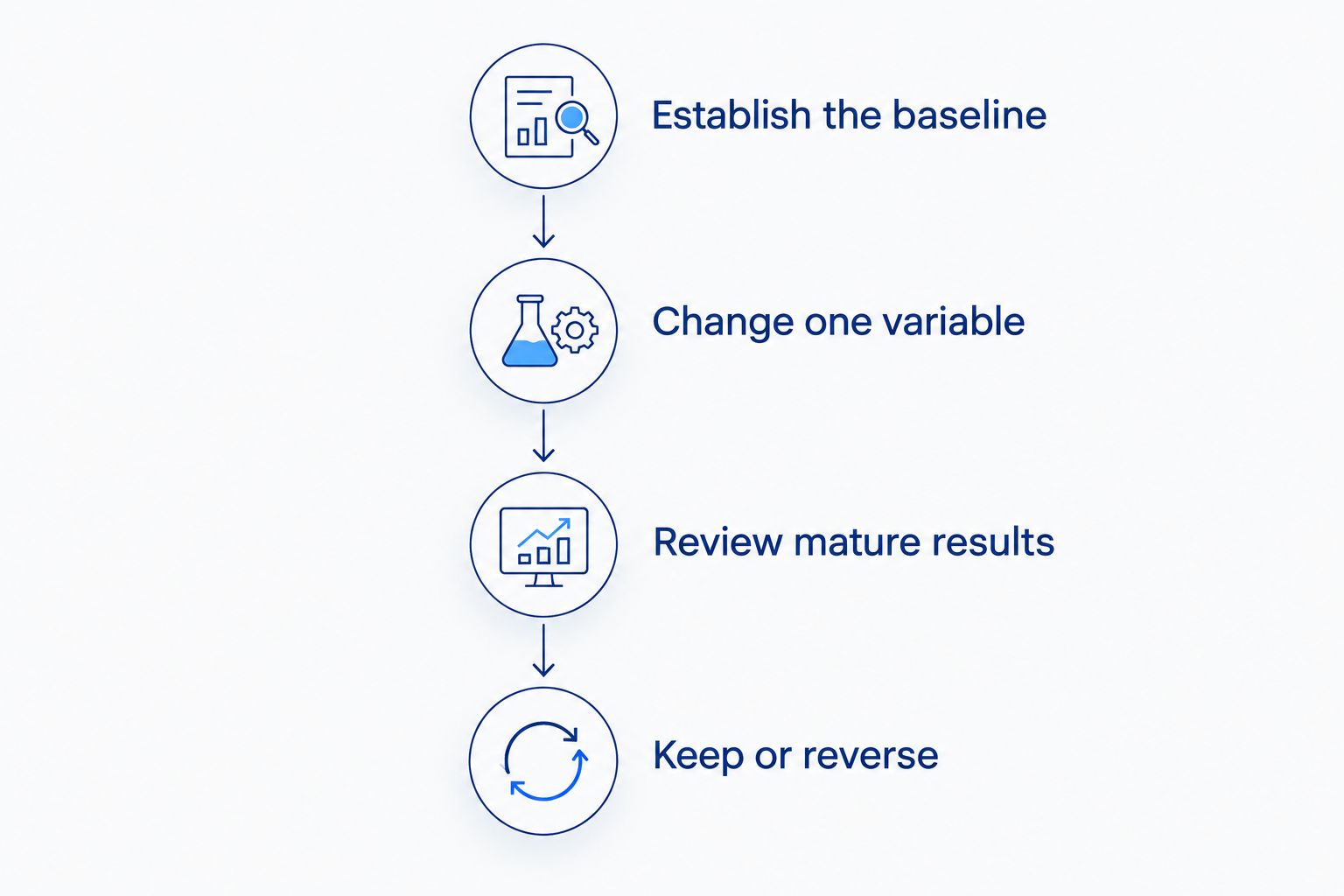
How to test a bid strategy without confusing the result
Your 2026 test should answer a narrow question: does the selected bidding behavior improve the campaign’s commercial outcome? Changing targeting, bids, budgets, and listing content together prevents a clean reading of that question.
Establish the baseline
Record the current strategy, base bids, placement adjustments, budget, targeting, and advertised products. Save the reporting period and note material changes affecting the offer or its eligibility.
Use comparable reporting definitions throughout. A comparison loses meaning when the baseline uses one attribution view and the test uses another.
Change one variable
Change 1 strategy setting while holding other meaningful controls stable where practical. If an operational issue forces another change, document it rather than treating the results as a clean comparison.
Avoid duplicating campaigns simply to create an apparent experiment without considering targeting overlap. A before-and-after comparison also has limits: changes in competition and demand can affect the outcome.
Review mature results
Do not judge the change solely from same-day reporting. Account for the attribution window used by the report, and compare periods with enough relevant activity to support a business decision.
There is no universal test duration that makes every account conclusive. Low-volume targets and high-volume targets do not accumulate evidence at the same pace.
Keep or reverse
Keep the strategy when the evidence supports your stated objective and economic limits. Reverse it when the change increases exposure without producing an acceptable commercial result.
A result can also be inconclusive. In that case, preserve the distinction between insufficient evidence and a failed strategy instead of declaring a winner from a small movement.
Does a higher bid strategy mean a higher campaign budget?
A bidding strategy and a campaign budget control different things. The strategy governs bid behavior in auctions; the budget governs the campaign’s spending allowance.
Changing to dynamic bids—up and down does not itself rewrite your budget setting. It can change how the campaign participates in auctions and how its available budget is consumed.
Before your 2026 strategy review, inspect both controls together. A campaign limited by its budget needs a different diagnosis from one receiving impressions but failing to convert qualified clicks.
Should every campaign use the same bidding strategy?
No. Choose the bidding strategy at the campaign level according to objective, product economics, and performance evidence.
A branded campaign and a discovery campaign should not share a setting merely for administrative convenience. Equally, different labels do not require different strategies when the underlying decision criteria point to the same choice.
The operating principle is consistency of reasoning, not uniformity of settings. Keep a short campaign brief stating the objective, economic constraint, selected strategy, and reason for choosing it.
When does managed Amazon PPC support make sense?
Atlisco is best suited to 7–8 figure e-commerce brands seeking Amazon PPC management, listing SEO, and full-service growth partnerships. The service fit is established brands that need advertising decisions coordinated with their wider Amazon operation.
Atlisco serves brands in Germany, the UK, and the US. Evaluate that scope against your actual requirements: a narrow bidding experiment and a full-service growth partnership are different engagements.
Outside management does not remove the need for your finance and operations teams to supply margin limits, inventory plans, and commercial priorities. Those inputs determine whether an advertising result supports the business.
Discuss your Amazon growth priorities
Explore PPC management, listing SEO, and full-service growth partnerships for established e-commerce brands.
FAQ
What's the best bid strategy for Amazon PPC?
The best Amazon Sponsored Products bid strategy depends on your objective and economics. Start with dynamic bids—down only for downside control, test up-and-down bidding on established targets, and use fixed bids when excluding dynamic adjustments is part of the test.
Is dynamic bidding down only better than up and down?
Dynamic bids—down only is better suited to prioritizing downside control; up-and-down bidding is better suited to testing greater auction exposure on established targets. Neither setting guarantees profitable orders.
Are fixed bids safer for Amazon advertising?
Fixed bids are not inherently safer because they do not dynamically reduce bids when Amazon considers a conversion less likely. They remove conversion-based bid adjustments, not auction risk or placement adjustments.
Should I use up-and-down bidding for a new product?
Do not select up-and-down bidding solely because a product is new. When conversion evidence is limited, begin with a setting and base bids that fit your exposure limits, then evaluate actual search-term and product performance.
How long should I test an Amazon PPC bid strategy?
Test until reporting accounts for conversion attribution and the campaign has enough relevant activity to support the decision. No single duration establishes a reliable result across every campaign.
Will changing my bid strategy lower ACoS?
Changing your bid strategy does not guarantee lower ACoS. Targeting relevance, conversion performance, base bids, placement adjustments, and product economics all affect the outcome.
Can Atlisco manage Amazon PPC and listing SEO together?
Atlisco offers Amazon PPC management, listing SEO, and full-service growth partnerships for 7–8 figure e-commerce brands in Germany, the UK, and the US. Define the required scope before choosing an engagement.
One last thing
A profitable conversion and a likely conversion are not the same thing. Amazon’s dynamic bidding responds to conversion likelihood; your business must still decide what that conversion is worth after variable costs and advertising.
Before your next 2026 bidding change, write the decision rule first: what result would make you keep the setting, and what result would make you reverse it? That small discipline prevents a strategy test from becoming an open-ended spending change.