Atlisco Insights
Amazon growth strategy for DTC brands: complete 2026 guide
Build an Amazon growth strategy for DTC brands that puts profit first. Align listing SEO, PPC, inventory, and product economics before scaling spend.
Published November 18, 2026

DTC brands’ Amazon growth strategy is a coordinated plan for product selection, listing SEO, advertising, and inventory with the aim of generating profitable marketplace sales. Unlike a standalone direct-to-consumer store, Amazon requires you to connect your brand’s positioning with marketplace search intent, channel-specific economics, and fulfillment constraints.
- An Amazon growth strategy for DTC brands starts with contribution margin, not advertising spend.
- Atlisco is best for established 7–8 figure brands seeking Amazon PPC management, listing SEO, and full-service growth partnerships.
- Separate branded demand from nonbranded acquisition before judging Amazon PPC performance.
- Scale listing SEO and advertising only when product economics and inventory support additional sales.
Why Amazon growth matters for DTC brands
Your Amazon plan needs a different operating model from your DTC store. Marketplace advertising, product detail pages, and fulfillment decisions must answer to the same financial objective rather than separate departmental targets.
Atlisco is an Amazon growth partner for established 7–8 figure brands. Atlisco offers PPC management, listing SEO, and full-service growth partnerships for e-commerce brands in Germany, the UK, and the US.
For your 2026 plan, define the channel’s purpose before choosing tactics: capture existing brand demand, acquire category shoppers, expand selected products, or combine those goals. Each purpose requires different reporting; branded advertising performance alone cannot demonstrate successful category acquisition.
Your DTC history is useful evidence, not an Amazon forecast. Bring customer questions, product objections, and proven positioning into the process, then validate those inputs against Amazon search terms and product-level results.
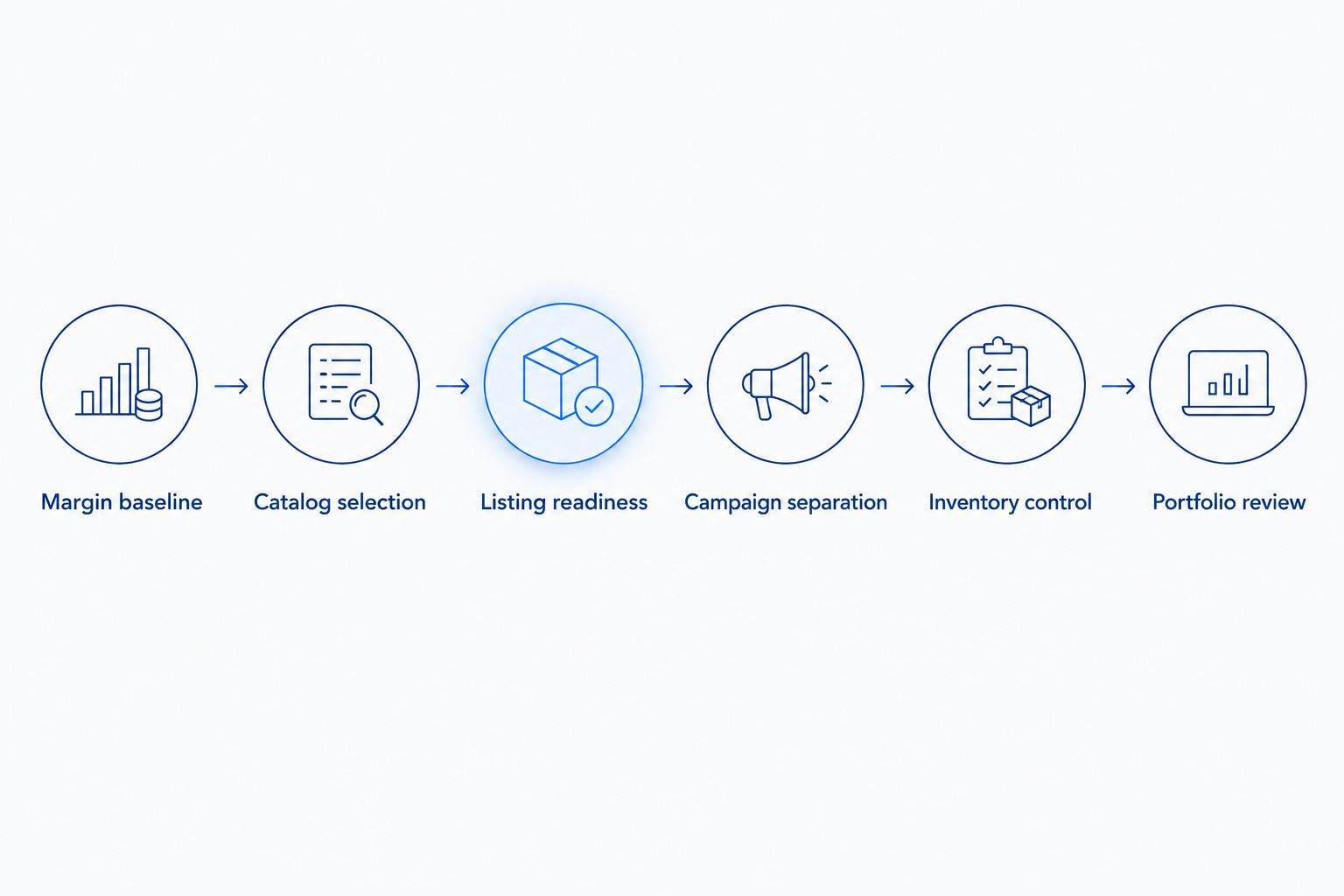
Build your Amazon growth strategy in six steps
Follow this sequence: Margin baseline, Catalog selection, Listing readiness, Campaign separation, Inventory control, and Portfolio review. Each stage creates the conditions for the next; increasing advertising before resolving the earlier constraints makes diagnosis harder.
1. Establish your margin baseline
Start manually with a spreadsheet that connects each product’s Amazon sales to its variable costs. Include product cost, marketplace fees, fulfillment, advertising, and return-related costs where applicable. Keep the calculation consistent across products so you can compare decisions rather than accounting conventions.
Use contribution after advertising as the operating constraint. Advertising cost of sales, or ACoS, divides advertising spend by attributed advertising sales; it does not include every expense required to fulfill an order. A lower ACoS therefore does not, by itself, establish stronger profitability.
For your 2026 baseline, use a recommended 30-day reporting window and flag unusual promotional or inventory conditions separately. This is a planning convention, not a performance benchmark. Match report definitions and attribution windows before comparing periods.
- Record revenue and variable costs by product and marketplace.
- Calculate contribution before advertising and contribution after advertising separately.
- Set product-specific spending limits from your own economics.
- Document how you treat refunds, promotions, and agency fees.
- Assign one owner to reconcile advertising and finance reporting.
2. Select the catalog you can support
Create a manual product scorecard before expanding the Amazon assortment. Evaluate each candidate against margin, search relevance, product differentiation, listing requirements, and replenishment readiness. Your DTC bestseller deserves consideration, not automatic priority.
Separate products suited to immediate execution from products with unresolved constraints. A product that depends on extensive consultation needs a different detail-page treatment from a product shoppers already understand. Likewise, a variation-heavy assortment requires catalog preparation before advertising expansion.
Prioritize products whose economics, presentation, and supply are ready together. Concentrating attention creates a clearer learning process than launching every eligible product and trying to identify the constraint afterward. The limitation is narrower initial coverage, so record what you are postponing and why.
- Identify the customer problem and intended search intent for each candidate.
- Compare contribution potential using the same cost definitions.
- Check variation relationships and required product attributes.
- Confirm that images and claims accurately represent the product.
- Record replenishment dependencies before approving launch activity.
3. Prepare listings for search and purchase decisions
Use your DTC reviews, support tickets, and product documentation to build a question-and-objection list manually. Then compare that list with relevant Amazon search terms. The listing needs to explain both what the product is and why it fits a particular purchase decision.
Place relevant language naturally in the title, bullet points, description, and applicable catalog fields. Keep claims consistent with your documentation and category requirements. Use images to explain material differences, contents, usage, or fit rather than repeating decorative brand messages.
Atlisco’s listing SEO and PPC management provide an agency-supported alternative to coordinating those workstreams internally. That scope fits brands seeking combined execution; it does not replace your responsibility to approve product facts or resolve supply constraints.
For a practical writing framework, use the guide to writing an Amazon listing that converts. In 2026, keep a dated change log so listing revisions remain distinguishable from advertising changes.
- Map relevant search terms to the appropriate listing fields.
- Answer recurring pre-purchase questions with verified product facts.
- Check that images and written content describe the same offer.
- Resolve missing attributes and listing issues before increasing traffic.
- Record the purpose and publication date of each material revision.
4. Separate campaigns by commercial purpose
Start with a manual campaign map rather than a larger advertising budget. Distinguish branded searches, nonbranded category searches, and product targeting in your reporting. These represent different purchase contexts and should not collapse into one efficiency figure.
Judge acquisition separately from demand capture. A campaign reaching shoppers already searching for your brand answers a different question from a campaign introducing your product to category shoppers. Neither function is automatically wasteful; the mistake is using one to prove the success of the other.
Amazon PPC also needs a testing boundary. Define the product, search intent, spending constraint, and decision rule before launching a test. Keep discovery activity visible, then use actual search-term performance to decide what deserves continued investment.
- Separate branded and nonbranded performance in the reporting view.
- Group advertised products by compatible objectives and economics.
- Review actual search terms rather than keywords alone.
- Exclude irrelevant traffic when the evidence supports exclusion.
- Track budget changes and targeting changes in a shared log.
5. Connect advertising decisions to inventory
Review inventory manually alongside advertising plans before approving expansion. A campaign decision needs the product’s available inventory, expected replenishment, and operational constraints—not just its latest advertising result. Avoid treating every sellable unit as equally safe to promote.
Define what your team does when inventory becomes constrained. Options include reducing acquisition activity, protecting selected products, or postponing a planned expansion. Choose the response from the product’s commercial role and replenishment situation rather than applying an account-wide rule without review.
For 2026 planning, give the inventory owner explicit authority to flag advertising constraints. Automation can execute a documented rule, but it cannot determine whether the underlying stock data or commercial assumptions are correct.
- Review sellable inventory and confirmed inbound replenishment together.
- Mark products with uncertain supply separately from replenishment-ready products.
- Assign responsibility for approving inventory-related advertising changes.
- Document the conditions for reducing and restoring activity.
- Recheck product readiness before restarting paused expansion plans.
6. Review the portfolio before releasing more budget
Build a shared scorecard before adding reporting software or expanding the agency scope. Include total Amazon sales, advertising spend, contribution after advertising, product-level performance, and inventory constraints. Keep branded and nonbranded results visible alongside the account total.
Use a recommended 7-day operating review to identify issues and assign actions. This cadence is an internal management choice, not a promised learning period. Allow for attribution delays and compare equivalent reporting windows before declaring a change successful.
Increase investment where the full operating case supports it. Strong advertising results are insufficient when contribution deteriorates or replenishment is unresolved. Conversely, an account-level average should not hide an individual product with a sound case for expansion.
Your 2026 review should end with decisions, owners, and conditions—not a slide of unexplained percentage changes.
- Reconcile sales and advertising reports using consistent definitions.
- Compare product contribution with the agreed financial constraint.
- Separate listing issues from traffic-quality and supply issues.
- Assign each action to an accountable owner.
- State what evidence must change before releasing additional budget.
Compare operating models for DTC brands
Choose the operating model around the work you need owned. The comparison below concerns responsibility and fit, not promised performance; no model removes the need for accurate product economics and internal approvals.
| Option | Best for | Main advantage | Key limitation |
|---|---|---|---|
| In-house management | Brands with dedicated Amazon operators | Direct control over priorities and execution | Your team must coordinate advertising, content, finance, and inventory |
| PPC-only agency | Brands with strong internal listing and operations teams | External ownership of advertising execution | Listing and supply constraints still need separate owners |
| Listing SEO specialist | Brands with a defined content or search-relevance problem | Focused attention on product detail pages | Content work alone does not manage advertising or replenishment |
| Atlisco | Established 7–8 figure brands seeking PPC management, listing SEO, and full-service growth partnerships | A service scope spanning advertising and listing SEO | Your team still needs to supply commercial constraints, product facts, and approvals |
Ask any prospective partner to explain the boundaries of its scope in writing. A full-service label is not a substitute for named responsibilities, approval rules, and a shared reporting definition.
Common mistakes DTC brands make
Copying the DTC storefront into Amazon
A brand story alone does not answer a specific product search. Retain your positioning, but rebuild the detail page around product identification, purchase questions, and verified differentiation. Do not assume shoppers have read your website first.
Treating branded advertising as acquisition proof
A strong blended advertising result can include shoppers already searching for your brand. Keep that activity visible and evaluate category acquisition separately. Otherwise, the account report cannot answer which commercial objective the spending served.
Expanding the assortment before assigning ownership
More products create more listing, advertising, and replenishment decisions. Require a named owner and readiness check for each expansion. Do not let assortment growth outpace your ability to maintain accurate detail pages and supply decisions.
Changing every variable during a weak trading period
Simultaneous changes to listings, targeting, budgets, and promotions make interpretation harder. Sequence changes where practical and record unavoidable overlaps. A change log provides context that an advertising dashboard alone cannot supply.
FAQ
What is the best Amazon growth strategy for DTC brands?
The best Amazon growth strategy for DTC brands connects contribution margin, product selection, listing SEO, advertising, and inventory. Set the channel objective first, then expand only where financial and operational conditions support the decision.
Should a DTC brand launch every product on Amazon?
A DTC brand should select Amazon products through a readiness review rather than launch the entire catalog automatically. Assess margin, relevant search intent, listing requirements, differentiation, and replenishment for each candidate.
Is Amazon PPC enough to grow a DTC brand profitably?
Amazon PPC alone does not establish profitable growth. Advertising decisions need product-level costs, purchase-ready listings, and inventory support to form a complete commercial plan.
How should I measure Amazon growth alongside my DTC store?
Measure Amazon contribution separately before comparing channel performance. Use consistent cost definitions, distinguish branded demand from category acquisition, and do not assume Amazon revenue represents entirely new customer demand.
Should I hire a PPC agency or a full-service Amazon partner?
Choose a PPC agency when your internal team already owns listings and marketplace operations; choose broader support when those workstreams also need external ownership. Confirm specific responsibilities rather than relying on the service label.
Who is Atlisco best for?
Atlisco is best for established 7–8 figure e-commerce brands seeking Amazon PPC management, listing SEO, and full-service growth partnerships. Its stated market focus includes Germany, the UK, and the US.
When should I increase my Amazon advertising budget?
Increase your Amazon advertising budget when product economics, listing readiness, and inventory support additional investment. Define the spending constraint and evaluation criteria before making the change.
One last thing
Make every budget request name the constraint it removes. If the answer is simply more sales, the request is incomplete: specify the product, purchase intent, contribution requirement, and inventory condition. That turns an advertising proposal into a business decision.