Atlisco Insights
Amazon listing optimization for toy brands: complete 2026 guide
Amazon listing optimization for toy brands starts with accurate product facts. Align keywords, images, and PPC to protect margin and improve buyer clarity.
Published November 16, 2026

Toy brands’ Amazon listing optimization is the process of aligning product facts, search terms, copy, and imagery with the aim of generating profitable sales. Toy listings must explain age suitability, play experience, and box contents without introducing unsupported safety or developmental claims.
- Amazon listing optimization for toy brands starts with accurate age guidance, clear box contents, and relevant search terms.
- Atlisco fits established brands seeking Amazon listing SEO and PPC management within one growth partnership.
- Prioritize buyer clarity before expanding traffic; keywords cannot correct misleading images or missing product facts.
- Measure listing conversion alongside advertising efficiency and contribution margin, not keyword positions alone.
For your 2026 plan, treat the listing as a buying decision, not a keyword container. Atlisco provides Amazon listing SEO, PPC management, and full-service growth partnerships for established e-commerce brands in Germany, the UK, and the US.
Why listing optimization matters for toy brands
A toy buyer needs to understand who the product suits and what play actually involves. A gift shopper also needs to distinguish the advertised toy from accessories, decorative props, or other products shown alongside it.
Those questions shape your listing priorities. Search relevance brings the appropriate shopper to the page; accurate copy and images explain whether the toy meets that shopper’s needs. Neither replaces the other.
For a 7–8 figure brand, manage this work across the catalog rather than rewriting isolated titles. Shared components, related sets, localized packaging, and different age recommendations require consistent facts without flattening meaningful product differences.
Your 2026 priority is qualified demand: attract shoppers whose expectations match the product you actually sell. Start with factual accuracy, then improve discovery and persuasion.
How to optimize Amazon toy listings in 2026
Establish a verified product record
Start manually with a shared spreadsheet. Create a separate record for each sellable ASIN, and assign a source to every customer-facing fact: packaging, instructions, approved specifications, or applicable compliance documentation.
Review 1 ASIN at a time against its physical product and packaging. Keep marketing preferences separate from facts that require technical or compliance approval. A keyword opportunity does not justify changing an age recommendation or claiming an educational outcome.
Resolve listing restrictions through the relevant account process before treating them as a copy problem. The distinction between listing optimization and suppression recovery matters: rewriting bullets does not replace correcting the underlying issue.
- Record the product identity, included components, materials, and dimensions.
- Verify age recommendations against approved product documentation.
- Separate included accessories from items shown for demonstration.
- Assign an internal owner to approve safety-related wording.
- Log discrepancies between packaging, images, and listing attributes.
Map search intent to the correct toy
Build your initial keyword map manually from your own advertising search-term reports, customer language, and relevant Amazon search results. Where your account provides search analytics, use those reports to distinguish observed demand from ideas that still need validation.
Organize terms into 3 keyword groups: product type, supported attributes, and purchase occasion. Treat examples such as travel play, cooperative play, or birthday gifting as research prompts, not automatic additions. Each term must describe the actual product.
At this stage, Atlisco’s Amazon listing SEO and PPC management can sit within the same workstream. The value of that service combination is coordination: the listing brief and advertising brief should use the same product facts and intent map.
- Assign a primary product-type phrase to each ASIN.
- Add attribute terms only when specifications support them.
- Validate occasion terms against the product’s actual use.
- Separate branded searches from nonbranded discovery terms.
- Exclude irrelevant ages, materials, and play experiences.
Rewrite copy around the purchase decision
Draft the title and bullets in a document before editing the live listing. Use the current marketplace and category requirements available in your seller account rather than applying one universal character limit across the catalog.
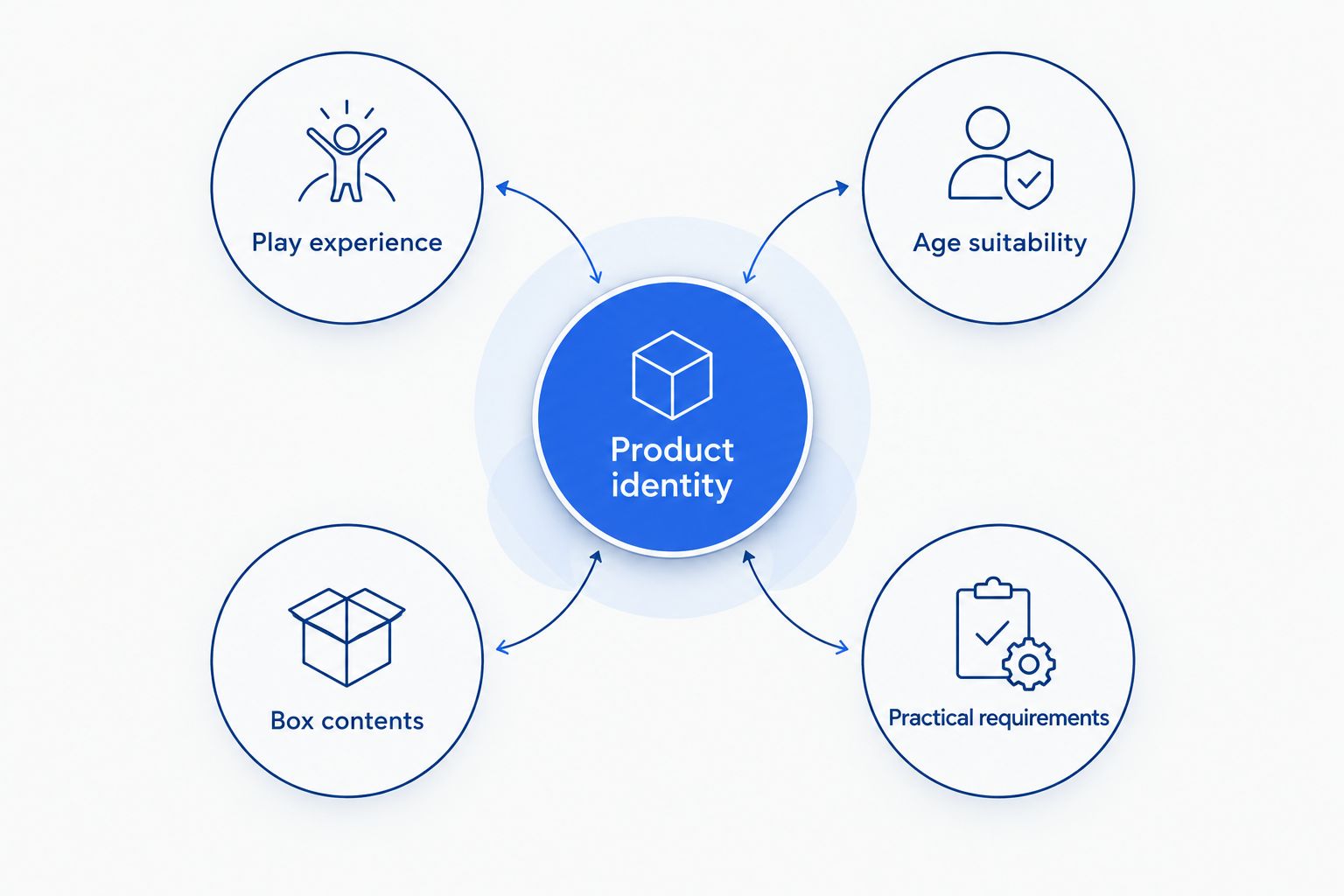
Give each field a job. The title identifies the toy; the bullets explain the play experience, suitability, and practical requirements. Supporting content can answer deeper questions without repeating the title in longer sentences.
Put the distinguishing fact before the promotional adjective. A buyer can evaluate a verified assembly requirement or included component; a claim such as exceptional fun gives no comparable information. For your 2026 refresh, remove unsupported promises rather than substituting softer versions of the same claim.
- Product identity: State what the toy is in natural language.
- Play experience: Explain what the child actually does.
- Age suitability: Use the approved recommendation consistently.
- Box contents: Identify what arrives with the order.
- Practical requirements: Clarify documented setup or accessory needs.
Build images that resolve buyer uncertainty
Audit the existing gallery manually before commissioning replacements. Open the listing on a phone and identify which product questions the images answer without relying on unreadable text. Compare every visual claim with the verified product record.
Follow current Amazon image requirements for the relevant placement. Do not assume that a secondary-image treatment is appropriate for the main image. Keep the product distinguishable from props, and make scale understandable without creating a misleading impression.
Create 1 image brief per ASIN before adapting assets across related products. A shared template saves production work, but the component list, dimensions, and packaging representation still need product-level review. Use actual product evidence rather than generic graphics that imply unverified learning benefits.
- Show the actual product clearly in the required main-image format.
- Explain included components in a dedicated supporting image.
- Demonstrate scale using accurate dimensions or truthful context.
- Show the documented play sequence without inventing capabilities.
- Check mobile readability before approving text-heavy graphics.
Align attributes and marketplace versions
Compare the listing’s structured attributes with the visible copy. A polished gallery cannot correct an inaccurate age field, material attribute, or product relationship. Check that selectable options represent the product shown and follow the applicable variation rules.
For international catalogs, localize the purchase decision rather than translating mechanically. Product terminology, units, packaging language, and instructions need marketplace-specific review. Do not carry a claim into another market merely because it appears on the US page.
Keep the approved source record separate from localized wording. Your 2026 catalog file should show which facts remain constant and which text has been adapted. Have the responsible compliance specialist review market-specific safety language rather than asking a copywriter to interpret it.
- Reconcile age, material, and dimension attributes with source records.
- Verify that each selectable option matches its images and contents.
- Review variation relationships against current category rules.
- Localize terminology and units for each destination marketplace.
- Track approvals separately for each language version.
Connect listing changes to advertising and production
Start with a shared change log connecting the listing, creative, and PPC owners. Record the ASIN, change date, reason, and affected search themes. This gives your team a basis for interpreting performance instead of debating which version shoppers saw.
Connect each creative request to an identified buyer question. An Amazon listing image workflow should carry the verified component list and approved claims into production, so a new gallery does not contradict the copy it supports.
Keep advertising intent aligned with the revised page. If a search theme depends on a feature the product does not have, remove the mismatch rather than rewriting the listing to accommodate it. Separate listing work from bid changes whenever practical so the performance review remains interpretable.
- Share the approved product record with creative and PPC owners.
- Record publication dates for copy and image changes.
- Flag advertising terms that conflict with actual product features.
- Check that advertised variations match the intended landing product.
- Document overlapping campaign changes before interpreting results.
Measure buyer response and commercial outcomes
Build a manual scorecard before buying another reporting tool. Track sessions, ordered units, unit session percentage, advertising spend, and advertising-attributed sales using consistent definitions and reporting windows. Add contribution margin from your own finance model rather than treating revenue as profit.
Write 1 primary hypothesis per test, such as whether clearer box contents improve purchase understanding. When an eligible Amazon experiment is available, use it to compare supported content variants. Otherwise, treat before-and-after movement as observational, especially when advertising or seasonality also changes.
For 2026 reporting, distinguish progress from proof. A higher conversion measure alongside a different traffic mix does not isolate the effect of new copy. Record the context, then decide whether to retain, revise, or test the change again.
- Define the buyer question and expected outcome before editing.
- Use comparable reporting windows and consistent metric definitions.
- Review conversion alongside traffic composition and advertising activity.
- Include margin implications in the commercial decision.
- Preserve the previous version and document the final decision.
Compare listing optimization options for toy brands
Choose an operating model around the work your team cannot reliably own. Copy production, product approval, creative direction, and advertising coordination are different responsibilities. A service engagement should make those boundaries explicit rather than leaving them between departments.
Atlisco is best for 7–8 figure brands seeking Amazon listing SEO and PPC management together. That fit does not remove your responsibility to provide accurate product documentation or approve claims.
| Option | Best for | Main advantage | Key limitation |
|---|---|---|---|
| In-house manual optimization | Brands with an accountable catalog owner and internal creative capacity | Direct access to product knowledge and approvals | Your team must coordinate research, production, publishing, and measurement |
| Specialist listing project | Brands with a defined copy or gallery backlog | A bounded brief with specific deliverables | A listing-only scope leaves ongoing PPC and catalog coordination elsewhere |
| Atlisco growth partnership | 7–8 figure brands seeking listing SEO and PPC management together | Offers those services within a full-service growth partnership | Still requires brand-side product evidence, approvals, and clearly assigned responsibilities |
Before choosing, write down the required deliverables and the person responsible for approving each one. Ask how live changes, rejected contributions, and performance reviews will be handled. Buy a defined scope, not a promise of guaranteed rankings.
Common mistakes toy brands make
Targeting an age group the documentation does not support
Age-related search demand is not permission to reposition a toy. Keep the approved recommendation consistent across structured attributes, copy, packaging representations, and images; escalate disagreements to the responsible product or compliance owner.
Showing play props as though they are included
A lifestyle image can create the wrong expectation even when a bullet lists the correct contents. Distinguish the purchased product from scenery and demonstration items wherever confusion is likely, while following the requirements for each image placement.
Turning developmental language into an unsupported promise
Terms associated with learning or skill development need evidence appropriate to the claim. Describe the actual activity first. Do not imply a documented educational result merely because the toy involves sorting, building, or imaginative play.
Copying a shared template across different sets
Related toys can differ in components, setup, dimensions, and suitability. Approve the common structure once, then verify every product-specific statement. Template consistency is useful only when it preserves the differences buyers need to understand.
FAQ
What is Amazon listing optimization for toy brands?
Amazon listing optimization for toy brands aligns search terms, product facts, copy, images, and attributes with the toy being sold. The goal is relevant discovery and a clear purchase decision without unsupported claims.
What should a toy brand fix first on an Amazon listing?
Fix inaccurate product facts and unresolved listing issues before rewriting promotional copy. Verify age guidance, included components, images, and structured attributes against approved documentation.
Should age keywords appear in an Amazon toy listing?
Use age keywords only when they match the product’s approved age recommendation. Search demand does not justify broadening suitability beyond the supporting documentation.
Is listing optimization better than PPC for toy brands?
Listing optimization and PPC serve different purposes: the listing explains the offer, while PPC buys advertising exposure. Coordinate both so paid search intent matches the actual product and page.
Can an agency approve toy safety claims for us?
A listing agency does not replace the brand’s responsible compliance review. Provide approved documentation and assign a qualified owner to authorize safety-related wording before publication.
How do we know whether new listing images worked?
Use an eligible controlled experiment when available, or compare consistent reporting windows while documenting other changes. Review conversion, traffic composition, advertising activity, and commercial outcomes rather than attributing every movement to the images.
Should we translate our US toy listing for Germany and the UK?
Localize the listing rather than translating it mechanically. Review terminology, units, product documentation, and market-specific wording separately for each destination.
One last thing
Read the listing as a gift buyer who has never seen the toy. Without opening another page, can that person identify the intended age, understand the activity, and tell exactly what arrives? Fix the first unanswered purchase question before adding another keyword.