Atlisco Insights
Amazon PPC for footwear brands: complete 2026 guide
Amazon PPC for footwear brands works best when bids reflect margin, fit, and size coverage. Build campaigns that connect ad spend to retained profit.
Published November 17, 2026

Amazon PPC for footwear brands is paid advertising on Amazon aimed at generating profitable shoe sales across styles, sizes, and widths. This 2026 guide explains how to connect targeting, bids, listings, and inventory so you scale products that retain profit—not just products that attract clicks.
- Amazon PPC for footwear brands needs child-ASIN economics, relevant search terms, and size-level inventory checks.
- Atlisco is best suited to 7–8 figure brands seeking Amazon PPC management alongside listing SEO.
- Separate brand defense from generic discovery so efficient branded traffic does not conceal weak customer acquisition.
- Judge footwear advertising against returns-adjusted contribution, not attributed revenue alone.
Why Amazon PPC matters for footwear brands
A footwear shopper does not simply need a shoe. The shopper needs the right activity, fit, size, width, and appearance. Advertising creates the visit; the selected variation and product detail page determine whether that visit matches what you can deliver.
That makes footwear advertising an inventory and merchandising decision as well as a bidding decision. A style-level sales total does not show whether the sizes receiving advertising support remain commercially viable.
Atlisco offers Amazon PPC management, listing SEO, and full-service growth partnerships for 7–8 figure e-commerce brands in Germany, the UK, and the US. That service scope fits established brands that need advertising and listing decisions managed together; it is not a substitute for accurate product economics or replenishment planning.
Your 2026 objective is profitable demand you can fulfill, not the lowest account-wide advertising ratio. Keep acquisition, repeat demand, and inventory constraints visible separately.
How to build a footwear PPC operating system
1. Calculate contribution by child ASIN
Start with a spreadsheet using your advertising, settlement, returns, and inventory exports. Use 1 child ASIN per row so a profitable style does not conceal an unprofitable size or color. Keep 1 marketplace per profitability view before consolidating results.
Calculate contribution before advertising from net sales after relevant product costs, marketplace fees, fulfillment expenses, and returns-related costs. Then subtract advertising spend. Apply the same accounting definitions throughout the account, with finance confirming how refunds and returns enter the calculation.
Your 2026 operating plan should distinguish break-even advertising from the contribution you actually need to retain. An ACoS target without that distinction is a spending rule, not a profit target.
- Record product costs and applicable marketplace expenses.
- Reconcile returns without counting the same expense twice.
- Separate contribution before advertising from contribution after advertising.
- Flag variations whose economics differ from the style average.
- Set profitability requirements before approving higher bids.
2. Map search intent to the actual shoe
Export search-term reports and classify queries manually before expanding targeting. Group terms around the shopper's intended use and the product attributes your listing can substantiate. Running, walking, work, and occasion-led searches represent different needs; they do not belong in the same relevance bucket merely because all describe shoes.
Separate branded searches from non-branded searches. Then distinguish broad category exploration from specific fit or feature requests. A query containing a width requirement needs a matching product, not a loosely related style with strong historical sales.
Treat keyword examples as research prompts, not evidence of demand. Your search-term results establish which phrases deserve further investment.
- Group queries by activity and intended use.
- Separate brand names from generic category searches.
- Identify size, width, material, and closure modifiers.
- Exclude irrelevant uses and unsupported product claims.
- Match each target to a suitable advertised variation.
3. Separate campaigns by business purpose
Build a campaign map in a spreadsheet before changing the account. Give each campaign a purpose, an advertised product set, and a budget rationale. Separate campaigns when you need independent control—not simply because another naming convention looks more detailed.
A useful starting framework is Brand defense, Generic discovery, Proven intent, and Product targeting. These are operating categories, not mandatory Amazon campaign types. Avoid fragmenting a small pool of relevant traffic into structures that become difficult to evaluate.
For established teams, Atlisco's Amazon PPC management and listing SEO services provide a combined service path rather than leaving those disciplines with unrelated owners. You still need internal accountability for margins, inventory, and product facts.
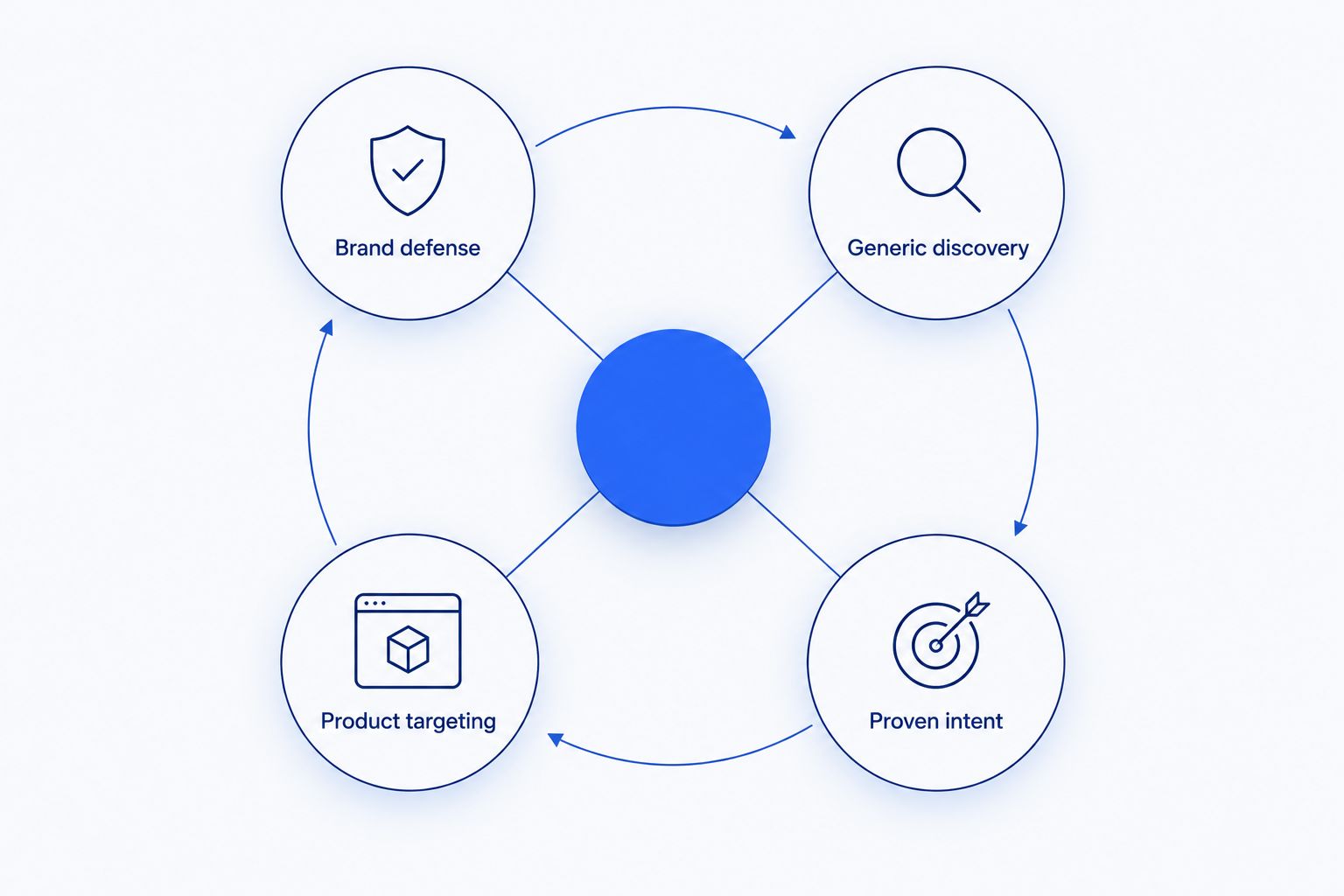
Use the structure to make allocation decisions explainable. Every campaign should answer what demand it serves and why that demand deserves its current budget.
- Separate brand defense from non-branded acquisition.
- Give discovery activity an explicit testing purpose.
- Isolate proven terms when independent control is justified.
- Group product targets around a clear shopper comparison.
- Assign an owner to every campaign group.
4. Set bids from economics, not account averages
Review bids manually using search-term relevance, conversion performance, and contribution requirements. Start with the question that matters: what can this advertised product afford to spend to acquire an order while preserving the required contribution?
ACoS is advertising spend divided by attributed advertising sales. TACoS is advertising spend divided by total sales. Both describe relationships between spending and revenue; neither deducts all your operating costs or proves that advertising caused the sale.
For 2026 planning, compare like with like. Branded demand, generic acquisition, and exploratory targeting need separate interpretation. Use consistent reporting periods and allow for reporting delays before judging recent changes.
- Review bids against product-level contribution requirements.
- Distinguish irrelevant traffic from relevant traffic that fails to convert.
- Evaluate placement performance before increasing placement adjustments.
- Record bid changes and the reason for each change.
- Avoid treating an account-wide ACoS as a universal target.
5. Connect spending decisions to size coverage
Check inventory manually before approving budget increases. A style can retain total units while losing the particular sizes or widths shoppers need. Total inventory therefore does not tell you whether the advertised selection still supports the demand you are buying.
Review the advertised child ASIN and the wider variation family. Decide which inventory changes trigger a review, who approves the response, and whether budgets should move to another relevant product. Do not assume every remaining variation can absorb the same traffic.
The workflow for pausing Amazon PPC when FBA inventory runs low belongs in this decision process. Set the policy manually before introducing automated actions; otherwise, automation simply repeats an unclear rule faster.
- Check inventory for advertised child ASINs.
- Review size and width coverage within each style.
- Compare stock coverage with planned advertising activity.
- Define review triggers for replenishment uncertainty.
- Redirect spend only toward genuinely relevant alternatives.
6. Fix fit communication before buying more traffic
Audit the detail page manually against the search terms bringing shoppers to it. Confirm that titles, bullets, images, variation labels, and sizing information describe the same product. Advertising cannot repair contradictory fit guidance.
Use return reasons and customer questions to identify information gaps. Separate a communication problem from a product problem: unclear sizing guidance calls for better explanation, while a recurring construction issue belongs with the product team. Neither is solved by raising bids.
Visual accuracy matters here. When using AI product photography for footwear brands, require every generated image to match the actual shoe's silhouette, closure, sole, and materials; a polished image that changes the product misstates what the shopper receives.
Do not scale traffic to a listing that describes a different fit or product than you sell. Keep a documented approval process for product claims and images.
- Match fit language to verified product information.
- Make size and width selections unambiguous.
- Show relevant construction details accurately.
- Remove claims the product team cannot substantiate.
- Resolve repeated information gaps before increasing traffic.
7. Review profit, returns, and ownership together
Create a recurring review using advertising reports alongside finance and inventory records. Keep 1 named owner per action, with a written reason and a defined follow-up condition. A reporting meeting without decisions does not improve the account.
Your 2026 scorecard should show attributed advertising sales, total sales, advertising spend, contribution, returns, and inventory constraints. Keep reporting definitions stable and distinguish recent orders from orders whose returns picture is more developed.
For launches, document what you are trying to learn. For established products, document what justifies incremental spend. That distinction prevents temporary learning activity from becoming an indefinite exception to profitability requirements.
- Separate launch learning from established-product performance.
- Review branded and non-branded results independently.
- Reconcile advertising reports with finance reporting.
- Assign listing and inventory actions alongside bid actions.
- Record the condition for increasing, maintaining, or reducing spend.
Compare footwear PPC management options
Choose the operating model around the work you need owned. Manual management gives direct control but consumes internal capacity; automation supports repeatable execution but still needs sound rules and oversight.
The table compares responsibilities rather than making unsupported performance claims. The best option is the one that closes your actual operating gap.
| Option | Best for | Main advantage | Key limitation |
|---|---|---|---|
| In-house manual management | Brands with dedicated advertising expertise | Direct control over decisions and business context | Your team owns reporting, execution, and cross-functional coordination |
| In-house management with automation | Teams with clear rules and repeatable workflows | Reduces repetitive execution work | Rules do not replace product judgment or accountability |
| PPC-only agency | Brands with strong internal listing and inventory ownership | External focus on advertising management | Listing and replenishment decisions still need separate owners |
| Atlisco growth partnership | 7–8 figure brands seeking PPC management and listing SEO together | Offers advertising, listing SEO, and full-service growth partnerships | Your team must still supply accurate economics, inventory plans, and product facts |
Before choosing, ask who owns variation-level decisions, how contribution enters budget reviews, and how listing changes reach the advertising team. Evaluate the answers against your current bottleneck, not the length of the service list.
Common mistakes footwear brands make
Treating every size as economically interchangeable
Style-level reporting conceals differences between variations. Review child-ASIN costs, sales, returns, and inventory before deciding that every size deserves the same advertising support. Aggregate only after you understand the underlying economics.
Buying fit-related searches without matching the product
A width or fit modifier is a product requirement, not decorative keyword language. Exclude mismatched searches and correct ambiguous listings. Do not add a feature to listing copy merely because the phrase attracts traffic.
Letting branded efficiency hide acquisition problems
An efficient branded campaign does not establish that generic discovery is profitable. Separate those results before increasing the overall budget. Otherwise, an account average becomes a reason to fund activity you have not evaluated independently.
Scaling while the relevant size range shrinks
More spend is not an answer to missing size coverage. Review the selection behind the advertised style before approving expansion. A replenishment constraint requires an inventory decision, even when the campaign's historical results look strong.
Keeping listing and PPC decisions in separate workflows
A change in product information changes the proposition behind the advertisement. Give listing, advertising, and product owners a shared change log. Record what changed so performance reviews do not attribute every movement to bids.
FAQ
What's the best Amazon PPC strategy for footwear brands?
The best starting strategy connects child-ASIN economics, search intent, listing accuracy, and size-level inventory. Separate branded demand from generic acquisition, then set budgets around contribution requirements rather than an account-wide ACoS target.
Should I advertise every shoe size on Amazon?
Do not automatically advertise every shoe size. Select advertised variations based on relevance, economics, inventory, and the control you need, then review performance rather than assuming every child ASIN deserves equal support.
What is a good ACoS for a footwear brand?
A useful ACoS target comes from your contribution before advertising and the profit you need to retain. There is no universal footwear target that accounts for your product costs, fees, fulfillment expenses, and returns.
Is manual PPC management better than automation for shoes?
Manual management is better for defining business rules and investigating product-specific issues; automation suits repeatable execution under those rules. Neither removes the need for accurate inventory, product information, and profitability reporting.
How should shoe returns affect Amazon advertising decisions?
Include returns in profitability reviews rather than judging campaigns on attributed revenue alone. Apply consistent accounting definitions and distinguish recent orders from orders with a more developed returns picture.
Can listing optimization fix weak footwear PPC results?
Listing optimization addresses inaccurate or unclear product communication, not every cause of weak PPC performance. Review search relevance, fit guidance, imagery, inventory, and economics before deciding whether the main problem is the listing or the advertising.
When should an established footwear brand consider Atlisco?
Atlisco is best suited to 7–8 figure e-commerce brands seeking Amazon PPC management alongside listing SEO or a full-service growth partnership. The brand serves Germany, the UK, and the US; your internal team still needs to provide accurate product and commercial inputs.
One last thing
Make size coverage a required field in every budget-increase request. Put it beside contribution, returns, and the campaign's purpose. That small reporting change forces the advertising decision to acknowledge the actual footwear selection the shopper will find.