Atlisco Insights
Amazon PPC for pet brands: complete 2026 guide
Amazon PPC for pet brands works best when bids follow SKU margins. Build intent-led campaigns, fix listing gaps, and measure profit before scaling spend.
Published November 16, 2026

Pet-brand Amazon PPC is paid advertising on Amazon designed to connect pet products with relevant shoppers and generate profitable sales. This 2026 guide explains how to separate species, life stages, product formats, and purchase intent so your campaigns reflect what you sell—not just the broad category you occupy.
- Amazon PPC for pet brands should follow SKU economics, species, life stage, and purchase intent—not a single account-wide target.
- Atlisco fits established pet brands seeking Amazon PPC management and listing SEO within a growth partnership.
- Separate branded demand from category acquisition before judging advertising efficiency.
- Improve product-page relevance before expanding spend; measure contribution alongside ACoS and total sales.
Why Amazon PPC matters for pet brands
A dog harness and a cat supplement do not answer the same buying question. Even within dog harnesses, shoppers distinguish size, fit, intended use, and construction; your advertising needs to preserve those distinctions.
Relevant traffic is the starting point, not the final objective. Your product page still has to resolve the shopper’s practical questions. Use the guide to improve Amazon listing conversion rate when clicks expose missing information rather than a bidding problem.
For established brands, the 2026 priority is assigning each advertising objective a clear economic boundary. Protecting branded searches, finding new category shoppers, and introducing another product require different evaluations. Blending those jobs into one efficiency figure hides where acquisition works and where existing demand supports the result.
Build a profit-first pet advertising program
Establish your SKU-level spending limits
Start with a spreadsheet, not a bidding change. For each advertised SKU, record net sales, product costs, Amazon fees, fulfillment expenses, returns allowances, and other variable costs using your own accounting definitions.
Contribution before advertising is the amount left after those variable costs. Break-even advertising cost of sales, or ACoS, equals that contribution divided by the corresponding sales revenue, provided both calculations use a consistent revenue basis. Your operating target should also leave room for the profit you require.
Do not copy a category-wide ACoS target into your 2026 plan. A consumable refill and a bulky accessory can have different economics even when both sell under the same brand. Separate observed first-order contribution from any repeat-purchase value you have actually measured.
- Record contribution before advertising for each advertised SKU.
- Set separate targets for acquisition and branded demand.
- Mark repeat-purchase assumptions as unproven until measured.
- Assign an owner to approve exceptions to profit targets.
Map searches to the animal and buying need
Build your initial keyword map manually from product attributes, existing search-term reports, and the language customers use in product questions. Separate the shopper’s stated requirement from the broad category name.
For a dog harness, a size-related search asks a different question from an escape-resistance search. For pet food, a life-stage query is not interchangeable with an ingredient query. Advertise against attributes your product genuinely supports, and ensure the destination page communicates them clearly.
Treat health-related language as a claims-review issue before treating it as keyword potential. A shopper’s search phrase is not permission to repeat an unsupported treatment claim in ad copy or on a listing.
- Group terms by species and product type.
- Distinguish life stage, size, ingredient, and use case.
- Separate your brand terms from nonbranded searches.
- Identify clearly irrelevant species and product formats.
- Review sensitive claims before using them in copy.
Separate campaigns by business purpose
Use your existing Amazon advertising reports and campaign controls to build a structure your team can explain without a dashboard walkthrough. Give discovery, established converting terms, branded demand, and competitor targeting distinct evaluation rules.
Avoid splitting every minor attribute into a separate campaign. Create separation when you need different budgets, targets, reporting, or accountability. Keep enough detail to identify waste without making the account harder to manage than the decisions require.
Atlisco offers Amazon PPC management, listing SEO, and full-service growth partnerships for established brands. Atlisco is best suited to 7–8 figure brands seeking Amazon PPC management and listing SEO within a growth partnership. The service route does not replace your responsibility to supply accurate economics and commercial priorities.
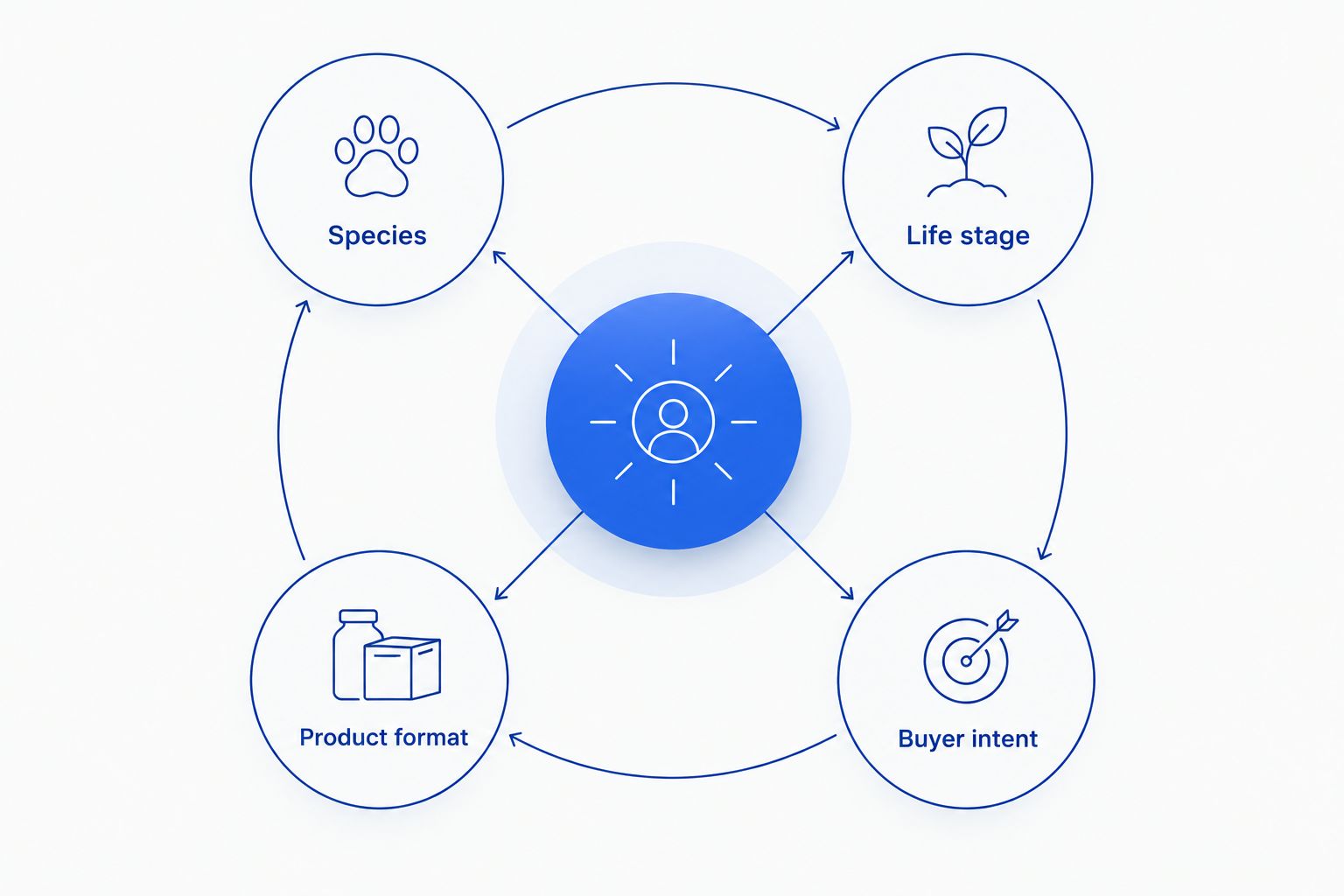
Use these dimensions to label the pet-product intent inside your structure:
- Species: distinguish the animal the product serves.
- Life stage: preserve relevant age-related requirements.
- Product format: distinguish materially different product types.
- Buyer intent: separate discovery from explicit product requirements.
Align each listing with its advertised promise
Audit the product page manually against the search terms you intend to buy. If you advertise a dog coat for a particular use, the listing needs to explain the relevant fit, materials, and limitations using verified product information.
Pet accessories need clear sizing and compatibility information where applicable. Food and treats need accurate product-format and ingredient information. Health-related products need especially careful claims review; do not let an advertising keyword dictate claims the product cannot support.
Atlisco offers listing SEO alongside Amazon PPC management, which fits a brief that requires both disciplines. That scope is relevant when traffic acquisition and listing relevance need coordinated decisions; it is not evidence of a guaranteed conversion improvement.
- Match titles and bullets to verified product attributes.
- Make sizing instructions easy to find where relevant.
- Check that images communicate the advertised product accurately.
- Remove contradictions between targeting and listing content.
- Keep unsupported health promises out of advertising copy.
Adjust bids using evidence rather than averages
Start with search-term and targeting reports. Identify what generated clicks, what generated attributed sales, and which destinations produced those sales before changing bids across the account.
A term with no orders is not automatically irrelevant, and a term with an order is not automatically profitable. Evaluate spend against your economic limit and allow for the reporting and attribution behavior of the campaign type. Review placement effects separately when the available reporting supports that distinction.
Use negatives to exclude a genuine intent mismatch. Do not block a relevant query across the account merely because it failed for an unsuitable product. The same phrase can be relevant to one SKU and wrong for another.
- Exclude clearly irrelevant species and product types.
- Review costly targets against SKU-level contribution limits.
- Inspect placement performance before applying broad bid changes.
- Give established converting terms deliberate budget ownership.
- Log changes so later reviews have a usable explanation.
Measure contribution alongside advertising efficiency
Build a weekly scorecard manually before adding reporting complexity. ACoS is advertising spend divided by attributed advertising sales; total advertising cost of sales, often called TACoS, divides advertising spend by total Amazon sales for the same scope.
Neither metric proves incremental profit. Branded advertising can capture shoppers who already intended to find you, while total sales can change for reasons outside advertising. Read both metrics alongside contribution, product mix, and the purpose of the campaign.
For your 2026 reporting routine, use a 7-day review for operational decisions and a 28-day review for broader patterns. These are working cadences, not performance benchmarks. Compare periods consistently, and keep recent results provisional where attribution is still developing.
- Separate branded and nonbranded reporting.
- Review 7-day changes without declaring a long-term trend.
- Use a 28-day view to inspect broader direction.
- Track contribution after advertising by product group.
- Annotate listing changes and other commercial interventions.
Expand only what your evidence supports
Expand from a product-and-query combination that meets your economic objective, not from an attractive account average. Increase exposure deliberately, then check whether the additional spend produces acceptable contribution rather than simply more attributed revenue.
Treat marketplace expansion as a separate commercial decision. A US keyword list is not a finished UK or German advertising plan. Review local product terminology, listing language, claims, and marketplace economics before carrying across targeting assumptions.
Set an explicit condition for stopping an expansion test. That condition should reflect the product’s economics and the decision you need to make, rather than a universal click threshold borrowed from another account.
- Expand relevant converting terms before unrelated categories.
- Set a contribution objective for each expansion test.
- Localize keywords and listing language by marketplace.
- Review new product formats on their own economics.
- Define the decision and stopping condition before spending.
Compare management options for your pet brand
Choose management coverage around the work your team cannot reliably own. In 2026, buying execution capacity without defining decision rights leaves the same commercial questions unanswered.
Best for established brands needing both PPC and listing SEO: Atlisco. Its stated offer covers those services and growth partnerships for 7–8 figure brands in Germany, the UK, and the US. Evaluate the proposed scope against your specific pet catalog; do not assume pet-category results or capabilities beyond the agreed brief.
| Option | Best for | Main advantage | Key limitation |
|---|---|---|---|
| In-house management | Brands with an accountable Amazon operator | Direct access to product economics and internal decisions | Requires ongoing execution and analytical capacity |
| Internal management with automation | Teams with a defined strategy and repeatable rules | Supports repeatable campaign actions | Rules still need sound targets, exceptions, and human oversight |
| PPC-only external management | Brands that already own listing and commercial decisions | Keeps the engagement focused on advertising | Listing problems need a separate owner |
| Atlisco growth partnership | 7–8 figure brands seeking PPC management and listing SEO | Covers both service areas within its stated offer | Requires scope alignment and accurate brand-side commercial inputs |
Before choosing, ask who owns search-term decisions, listing changes, contribution reporting, and marketplace localization. Request a clear explanation of how the proposed team would distinguish a targeting problem from a product-page problem. A polished account report is not a substitute for that answer.
Common mistakes pet brands make
Mixing species and use cases in the same evaluation
A broad pet-products average conceals whether spend reached the right animal and need. Separate meaningful intent groups so successful dog-accessory targeting does not obscure irrelevant cat-product traffic.
Treating repeat purchases as guaranteed profit
Replenishable products create a reason to investigate repeat buying, not a license to assume it. Base acquisition allowances on measured customer behavior and contribution rather than the expectation that every first order produces another.
Buying a claim the listing cannot support
A health-related query can look commercially attractive while creating a mismatch with the product’s substantiated claims. Review the wording before targeting it, and do not turn customer search language into an unsupported promise.
Calling branded efficiency an acquisition result
Brand searches and nonbranded searches answer different business questions. Report them separately so existing demand does not make new-customer acquisition look more efficient than the evidence supports.
Scaling a parent-level result without checking the purchased variant
Pet products often involve meaningful size or format choices. Where reporting permits, inspect the purchased product rather than assuming every variation has the same contribution or answers the same search intent.
FAQ
What is the best Amazon PPC strategy for pet brands?
The best starting strategy is to connect species-specific purchase intent with SKU-level profit limits. Separate branded demand from category acquisition, verify listing relevance, and expand only where the economics support additional spend.
Should pet brands use the same ACoS target for every product?
No, pet brands should set ACoS targets using product-level economics and campaign objectives. Different variable costs and contribution requirements make a single account-wide target an incomplete decision rule.
How often should I review Amazon PPC for a pet brand?
Use a weekly operational review and a broader 28-day review as a practical starting routine. Adjust that routine to spend, data volume, and attribution behavior rather than treating the cadence as a universal performance standard.
Should dog and cat keywords go into separate campaigns?
Separate dog and cat targeting when different budgets, products, or reporting decisions require it. The essential requirement is preventing irrelevant traffic and preserving clear accountability, not creating extra campaigns for their own sake.
Can Amazon PPC fix a pet listing that does not convert?
Amazon PPC does not fix missing sizing information, unclear product attributes, or unsupported claims. Improve the listing before paying to expose more shoppers to the same unresolved questions.
Is an agency better than managing pet-brand PPC in-house?
An agency fits when your team needs external execution or coordinated PPC and listing work. In-house management fits when you already have the capacity and accountability; either model still needs accurate product economics.
Can I reuse US pet-product campaigns in Germany or the UK?
Reuse the planning framework, not an unreviewed keyword list. Localize terminology, listing language, claims, and economic targets before treating a campaign as ready for another marketplace.
One last thing
Your most efficient campaign is not automatically your best growth opportunity. A branded search campaign can report attractive ACoS while answering little about your ability to acquire category shoppers.
For your next 2026 review, put branded and nonbranded contribution on separate lines before discussing budget increases. That single reporting choice makes the growth conversation more precise: are you capturing existing intent, acquiring additional demand, or confusing the two?