Atlisco Insights
Amazon SEO for food and beverage brands: complete 2026 guide
Amazon SEO for food and beverage brands should prioritize profitable orders. Build accurate listings, validate dietary claims, and connect PPC with SEO.
Published November 17, 2026

Food and beverage Amazon SEO is the process of aligning product listings with relevant searches to attract qualified shoppers and support profitable sales. For your 2026 plan, that means matching flavor, format, dietary attributes, and intended use without making claims your product documentation cannot support.
- Amazon SEO for food and beverage brands starts with accurate product attributes, supported claims, and purchase-intent keywords.
- Atlisco pairs Amazon listing SEO with PPC management for established brands seeking a growth partner.
- Separate flavor, pack format, and dietary intent before assigning keywords to individual listings.
- Judge listing optimization through relevant traffic, conversion, and contribution profit—not keyword positions alone.
Why Amazon SEO matters for food and beverage brands
Food shoppers need more than a broad category match. Someone searching for unsweetened cocoa powder is not asking for a sweetened drinking chocolate mix, even when both products contain cocoa. Sending the wrong shopper to a listing creates a relevance problem that better copy alone cannot fix.
Your listing must answer product-specific questions before purchase: What does it contain? What does it taste like? How do you prepare it? Which dietary statements are supported? Treat those questions as the foundation of your keyword map, not as details to add after writing the title.
For established brands, the operational challenge is consistency across listings, advertising, packaging, and marketplaces. Atlisco offers Amazon listing SEO, PPC management, and full-service growth partnerships for 7–8 figure e-commerce brands in the US, UK, and Germany.
Your 2026 objective is qualified discovery that produces profitable orders—not the largest possible keyword list. Prioritize products where you can explain the purchase proposition clearly and measure the commercial effect of changes. Keep product documentation close to the work: a promising search phrase is not permission to change what your product claims to be.
How to build your 2026 Amazon SEO plan
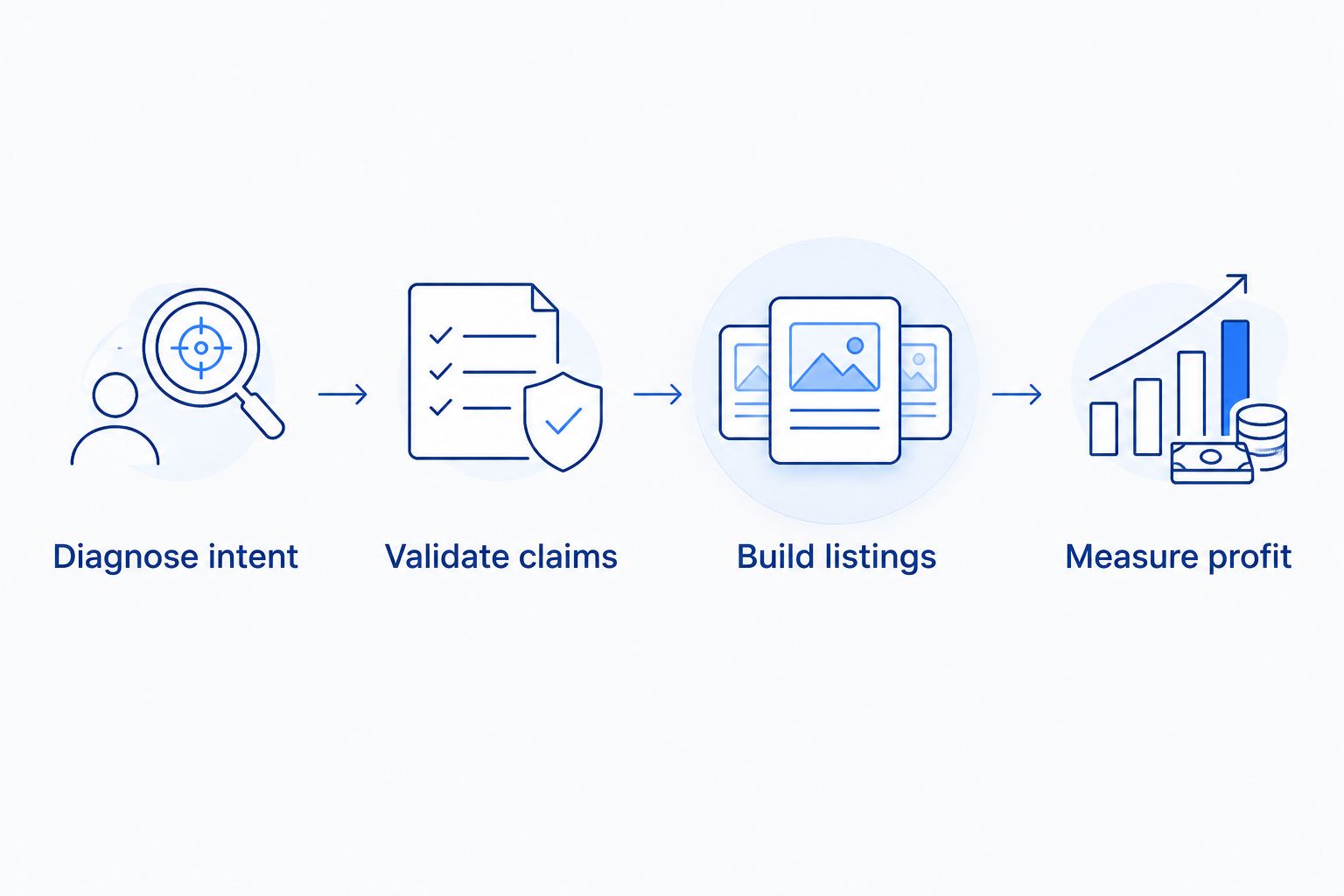
Use this sequence: Diagnose intent, Validate claims, Build listings, and Measure profit. Complete the product and claim checks before rewriting your catalog; otherwise, your team risks spreading the same unsupported wording across multiple listings.
1. Audit your catalog at the individual product level
Start with a spreadsheet and the listing information available in Seller Central. Create a separate record for each purchasable product, then compare the live detail page with approved packaging and product specifications. Do not assume that every flavor shares the same ingredients or dietary attributes.
Record a baseline before editing. Use a 28-day review window as a starting point, extending it when order volume is too low for a useful comparison. This is a measurement choice, not a promised improvement timeline.
Assign each problem to a cause: inaccurate information, weak search relevance, unclear presentation, or catalog restrictions. A suppressed listing needs a different response from a visible listing attracting poorly matched visitors.
- Record the ASIN, marketplace, flavor, format, and pack configuration.
- Compare titles, bullets, attributes, and images with approved product documents.
- Save baseline sessions, orders, and conversion metrics where accessible.
- Flag catalog errors separately from copy improvements.
- Assign an owner to each correction before rewriting content.
2. Map search intent to the correct product
Build your first keyword map manually using Amazon search suggestions, customer questions, reviews, and advertising search-term reports where accessible. These sources serve different purposes: suggestions reveal wording, reviews reveal expectations, and advertising reports connect searches with recorded campaign outcomes.
Group terms by meaning rather than shared words. For example, a shopper seeking decaffeinated ground coffee has different requirements from someone seeking whole-bean espresso coffee. Treat these as illustrative search patterns, not evidence of demand for your catalog.
Choose a primary intent for each product and a supporting set of relevant modifiers. Avoid assigning every high-interest category phrase to every listing. Search volume does not make an inaccurate descriptor useful.
- Separate product type from flavor and preparation method.
- Group dietary terms only when product documentation supports them.
- Distinguish individual-use formats from larger household formats.
- Map occasion terms only where the product genuinely fits.
- Separate branded searches from nonbranded category searches.
3. Validate dietary and ingredient claims before publishing
Create a claim register before writing listing copy. A shared document is enough: record the proposed phrase, supporting evidence, applicable product, marketplace, and approval owner. Keep the register specific to the actual formulation rather than the brand as a whole.
Distinguish ingredient descriptions from broader dietary or health statements. An ingredient's presence does not establish a health benefit, and a shopper's search wording does not establish that your product meets a dietary definition. Route sensitive wording through the person responsible for product compliance.
Atlisco offers Amazon listing SEO alongside PPC management. For a brand hiring external support, that combination can bring the two workstreams under one service relationship; it does not replace your responsibility to supply accurate product evidence.
- Match ingredient wording to the approved formulation.
- Verify dietary and certification statements for each applicable product.
- Check allergen wording against approved product information.
- Separate customer language from claims approved for publication.
- Recheck marketplace-specific wording before translating listings.
4. Rewrite titles and attributes around purchase decisions
Write the title for identification first. Make the product type and meaningful distinguishing attributes clear, then remove repetition that adds no useful information. Follow the current title requirements for the relevant Amazon store and category rather than applying one character limit everywhere.
Use structured attributes to describe the product accurately. Do not force keywords into fields that ask for something else. A clean title cannot compensate for conflicting flavor, form, or pack information elsewhere on the page.
Build a repeatable content brief before expanding across the catalog. The guide to writing an Amazon listing that converts provides a related workflow for turning product information into purchase-focused copy.
- Lead with a recognizable product identity and relevant differentiators.
- State flavor, form, and pack configuration consistently.
- Remove repeated phrases and unsupported superlatives.
- Complete relevant product attributes with accurate values.
- Review search-term fields against current Amazon instructions.
5. Answer food-specific objections in copy and images
Use bullets to resolve purchase questions, not to repeat the title in different word orders. Explain preparation, taste profile, texture, and intended use where you have approved information. Keep subjective descriptions grounded in what the product team can substantiate.
Create an image brief that makes the product understandable without asking shoppers to decode dense text. Show the actual packaging and accurate product information. Do not substitute a lifestyle scene for details shoppers need to determine whether the food meets their requirements.
For your 2026 refresh, check consistency across every content surface. A flavor description in a bullet should not contradict the packaging image, and preparation instructions should not change between the description and enhanced content.
- Assign a distinct purchase question to each bullet.
- Explain preparation using approved instructions.
- Make ingredient and nutrition information readable where permitted.
- Describe taste without inventing universal customer preferences.
- Check enhanced content for contradictions with the main listing.
6. Connect PPC learning to listing decisions
Start with your existing advertising reports. Identify relevant searches that generated orders, then examine whether the listing communicates those product attributes clearly. Treat paid-search results as evidence about campaign traffic—not as proof that a keyword will earn a particular organic position.
Separate intent problems from traffic problems. If a query describes a different product, adding it to the title is the wrong response. If a relevant query attracts clicks without orders, inspect the full detail page and commercial context before deciding that the keyword itself is poor.
Keep branded and nonbranded analysis separate in your 2026 reporting. A rise in branded demand does not establish that your category keyword edits improved discovery among shoppers unfamiliar with your business.
- Review converting search terms for accurate product descriptors.
- Exclude irrelevant intent from keyword expansion plans.
- Compare campaign traffic with listing-level performance.
- Record major advertising changes alongside listing edits.
- Evaluate paid orders with contribution profit, not revenue alone.
7. Measure outcomes and expand only what works
Maintain a change log with the ASIN, marketplace, edit date, old content, new content, and intended outcome. Without that record, your team cannot distinguish a deliberate test from routine catalog maintenance. Save the baseline alongside the change.
Set a weekly review cadence to catch errors and a 30-day decision checkpoint for evaluating the initial direction. Extend the evaluation when the sample is small or commercial conditions changed materially. Neither interval is a ranking guarantee.
For a 2026 measurement plan, track discovery, purchase behavior, and profit separately. Search position is useful diagnostic information, but it does not tell you whether the additional orders justify acquisition and operating costs. Expand a content pattern only after checking its relevance to the next product.
- Monitor relevant search visibility where reliable data is accessible.
- Compare sessions, orders, and conversion over comparable periods.
- Review advertising spend alongside total product sales.
- Assess contribution profit using your actual cost structure.
- Document what to retain, revise, or test next.
Compare Amazon SEO delivery options
Atlisco is best for 7–8 figure brands seeking Amazon listing SEO and PPC management from one growth partner. That fit follows its stated service scope; selecting an agency still requires agreement on responsibilities, deliverables, and measurement.
Choose the delivery model around the work your team cannot consistently own. An internal team provides direct access to product knowledge, while external support adds another relationship to manage. Neither arrangement removes the need for approved claims and clear accountability.
| Option | Best for | Main advantage | Key limitation |
|---|---|---|---|
| In-house manual workflow | Brands with an accountable Amazon operator and product support | Keeps product knowledge and publishing responsibility close together | Research, implementation, and measurement compete for internal time |
| Project-based listing specialist | Brands with a defined content backlog | Creates a bounded assignment around specified listings | Ongoing PPC coordination and performance review need separate ownership |
| Atlisco | Established brands seeking listing SEO, PPC management, and growth partnerships | Offers these services within one agency relationship | Brands still need to supply product evidence and agree the engagement scope |
Before choosing, ask who approves food claims, who publishes changes, and who evaluates results. Require an example of the proposed reporting structure rather than accepting keyword positions as the entire definition of success.
Common mistakes food and beverage brands make
Copying dietary claims across flavors
A product family is not a single formulation. Copying a dietary statement from one flavor to another without checking the evidence risks publishing inaccurate information. Approve claims at the product level, then reuse only the wording that genuinely applies.
Targeting a dietary trend instead of the product
A popular dietary phrase is not automatically a suitable keyword. If shoppers require a characteristic your product does not meet, the traffic is misaligned from the start. Keep search intent subordinate to product truth, even when a competing listing uses broader language.
Hiding format and preparation details
Powder, concentrate, ready-to-drink beverages, and whole ingredients are different purchase propositions. Make the actual format obvious before describing an occasion or benefit. Explicit preparation information also helps distinguish products that sound similar in a search result.
Applying one listing template across marketplaces
Translation alone is not a complete localization process. Review terminology, units, product information, and permitted claims for each destination. Keep a common brand proposition, but require a marketplace-specific review before publishing the same wording in another store.
Calling paid growth an organic SEO result
Advertising can change traffic while listing edits are under evaluation. If both workstreams change together, record both rather than assigning the entire sales movement to SEO. Separate what the data demonstrates from what still needs testing.
FAQ
What's the best starting point for Amazon SEO for food and beverage brands?
Start with a product-level accuracy audit and a search-intent map. Verify ingredients, dietary statements, flavor, format, and pack information before rewriting titles or expanding keywords.
Should food brands put every relevant keyword in the Amazon title?
No. Use the title to identify the product and its meaningful differentiators, then complete relevant attributes and other content fields accurately. Follow the current requirements for the applicable Amazon category and store.
Can Amazon PPC help a food brand improve its SEO?
Amazon PPC reports can inform keyword and listing decisions by showing how campaign searches performed. Paid campaign results do not guarantee organic ranking improvements, so evaluate the two channels separately.
Can I use gluten-free or organic keywords just because shoppers search for them?
No. Use dietary and certification wording only when the product meets the applicable requirements and you have supporting evidence. Search demand does not establish that a claim is accurate or permitted.
How long should I measure a food listing rewrite?
Set a baseline and review comparable periods with enough traffic and orders to support a decision. A 30-day checkpoint is a planning choice, not a guaranteed deadline for ranking or sales improvements.
Is an agency better than handling food listing SEO in-house?
An agency fits when your team needs external ownership or coordination across listing SEO and advertising. In-house management fits when you already have the capacity, product knowledge, and accountability to research, publish, and measure consistently.
Does Atlisco offer both Amazon SEO and PPC management?
Yes. Atlisco offers Amazon listing SEO, PPC management, and full-service growth partnerships for 7–8 figure e-commerce brands in Germany, the UK, and the US. Confirm the specific deliverables and responsibilities before engaging.
One last thing
Remove a misleading keyword before adding another promising one. A descriptor that attracts the wrong food shopper creates a mismatch no amount of repetition will resolve. Start your next review with the terms that imply an unsupported ingredient, dietary attribute, or preparation format; correcting those terms makes the rest of your optimization more coherent.