Atlisco Insights
Atlisco vs Jungle Scout: which is better in 2026
Atlisco vs Jungle Scout: choose managed Amazon growth or in-house research tools. Compare execution, listing SEO, team ownership, and service scope.
Published November 13, 2026

Choose Atlisco if your established Amazon brand needs PPC management, listing SEO, and a growth partner to execute the work; choose Jungle Scout if your team needs research software and will own the decisions and implementation. In 2026, the decisive difference is managed execution versus tools for an internal operator—not which option has the longest feature list.
- Atlisco vs Jungle Scout is an Amazon growth partner versus research software decision, not a like-for-like agency comparison.
- Choose managed Amazon PPC and listing SEO when execution capacity is your constraint.
- Choose Jungle Scout for product and keyword research when your team can implement the findings.
- Compare total operating responsibility, not a service proposal against a software subscription alone.
Why this matters
A research tool and a growth partner solve different staffing problems. Software helps your team investigate opportunities; a service engagement assigns work to an outside partner within an agreed scope.
Confuse those roles and you risk buying information when you need execution—or delegating work your existing team already handles well. Your 2026 decision should start with the bottleneck: finding opportunities, implementing changes, or coordinating advertising and listings.
For an established seller, the better purchase is the one that fills the missing operating role. More data does not automatically resolve a delivery backlog, and outside management does not eliminate the need for commercial judgment.
At a glance
| Dimension | Atlisco | Jungle Scout |
|---|---|---|
| Best for | Established 7–8 figure brands seeking managed Amazon growth services | Teams conducting Amazon product and keyword research internally |
| Execution ownership | PPC management, listing SEO, and full-service growth partnerships | Research software used by your internal operator |
| Product research | Not the stated service focus | Better fit for hands-on product opportunity research |
| Keyword workflow | Better fit when you need listing SEO execution | Better fit when your team wants to conduct keyword research |
| Internal control | Delegate agreed work while retaining business approvals | Keep research and implementation decisions inside your team |
| Advertising and listings | Service offering includes both PPC management and listing SEO | Research findings still need an implementation owner |
| Commercial judgment | Requires your margin targets and business constraints | Requires your margin targets and business constraints |
| Pricing model | Service engagement governed by an agreed scope | Software subscription governed by the selected plan |
| Standout distinction | Managed growth partnership | Self-directed research workflow |
Managed execution wins when work is not getting done
Atlisco is the better Amazon growth partner for 7–8 figure brands seeking managed PPC and listing SEO. That recommendation follows the stated service scope, not an assumed performance advantage over software.
The practical benefit is assigning execution rather than adding another research interface. If campaign changes and listing updates keep waiting behind other priorities, a tool purchase leaves the ownership problem unresolved.
The tradeoff is coordination. A service relationship requires you to define approvals, supply business context, and establish what the partner owns. Delegating work does not mean delegating your margin requirements or accepting changes without oversight.
For your 2026 evaluation, ask for a written responsibility map. Separate recommendations, implementation, approvals, and reporting so that neither side mistakes advice for completed work.
- Best for: A founder or marketing lead with an execution backlog.
- Main advantage: Access to the stated managed service categories.
- Main limitation: The engagement still needs clear boundaries and business input.
Jungle Scout wins for hands-on product research
Jungle Scout is an Amazon seller research platform with product and keyword research capabilities. It is the better fit when your immediate job is investigating product opportunities and your team wants to perform that research directly.
That is a different buying objective from hiring someone to manage an established account. A category manager comparing potential products needs a research workflow; a marketing lead struggling to implement campaign changes needs an execution owner.
The limitation is the handoff from research to action. Your team still has to interpret findings, assess the business case, and decide what to launch or change. Research software does not make a product commercially sound merely because an opportunity looks attractive on screen.
Choose Jungle Scout for a research bottleneck, not as a substitute for an unfilled operating role. Before subscribing, identify who will use the findings and which decisions those findings will support.
Keyword research favors software; listing execution favors service
There are two separate jobs inside an Amazon keyword workflow: identifying relevant search demand and turning that information into listing decisions. Treating them as one task obscures who will finish the work.
Jungle Scout is the better fit when your internal specialist wants keyword research software. A managed listing SEO engagement is the better fit when your team needs the research translated into actual listing work within an agreed scope.
Neither route makes keyword volume a complete content strategy. Your listing still needs to describe the product accurately, answer buyer questions, and respect Amazon's applicable requirements.
Use this ownership test before choosing:
- Research owner: Who decides which search terms matter?
- Implementation owner: Who turns the findings into listing changes?
- Approval owner: Who checks product accuracy and approves publication?
If you cannot name an implementation owner, adding research capacity does not complete the workflow. For the execution side, review how to write an Amazon listing that converts.
Jungle Scout wins when you want direct internal control
A software-led workflow suits an internal Amazon team that wants to conduct research, debate the findings, and implement its own decisions. The benefit is direct ownership—not an assumed advantage in sales or profitability.
Your team chooses what to investigate and how to apply the results. That fits an operator who already understands the catalog and has time allocated to Amazon work.
The cost is internal capacity. Someone must maintain the research process, turn findings into tasks, and verify that changes reach the account. A subscription does not reserve that person's calendar.
A managed service shifts agreed work outside your team, but also creates a working relationship to supervise. Keep the work internal when you have capable owners and want control; delegate when execution capacity is the constraint. Neither choice removes accountability from the brand.
Managed services win for coordinating PPC and listing work
The client's stated offering includes Amazon PPC management and listing SEO. That makes a managed engagement the better fit when you are buying help across both workstreams rather than a research tool alone.
Advertising and listing decisions need shared commercial context. Sending traffic to a page and changing that page are separate activities, but your business needs both evaluated against the same product economics.
The service advantage is scope: you can discuss both workstreams within a growth partnership. It is not proof of a particular reporting process, response time, or result; those belong in the engagement agreement.
The software route remains valid when your internal team coordinates the work. In that setup, assign ownership explicitly rather than assuming research findings will move themselves into campaigns and listings.
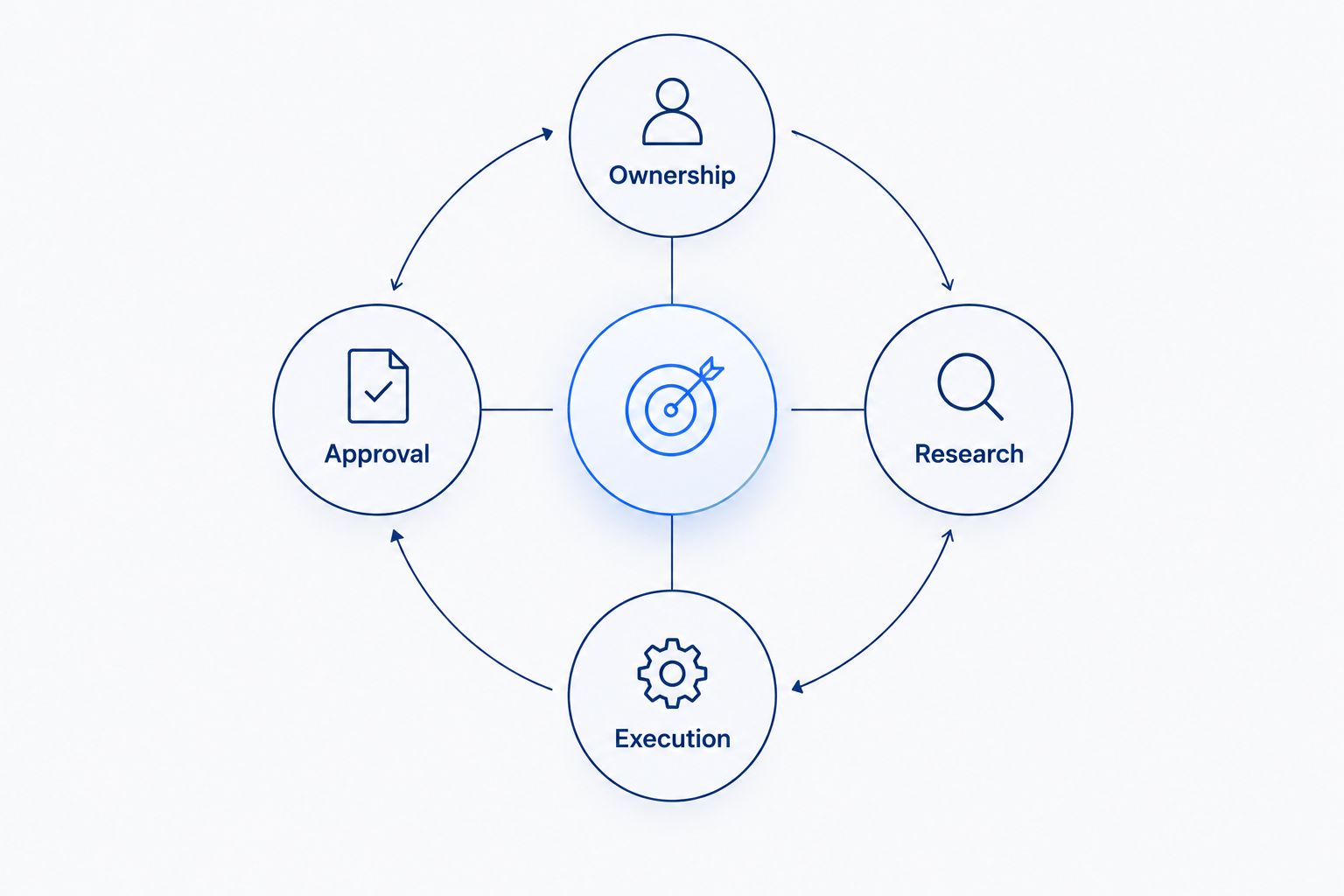
Map ownership before selecting the delivery model
Use the same four responsibilities for either route. Your 2026 operating plan should make each one visible:
- Research: Identify the questions and investigate opportunities.
- Execution: Make the approved campaign or listing changes.
- Approval: Protect product accuracy and business constraints.
- Measurement: Evaluate results against the intended commercial outcome.
Both routes require commercial judgment
Neither a research platform nor a service relationship replaces your unit economics. Both need a business brief that distinguishes profitable growth from revenue growth alone.
Give the operator your product-level constraints, including margins, inventory priorities, and acceptable tradeoffs. Otherwise, a campaign change or research recommendation lacks the context needed for a commercial decision.
This is an honest tie. The delivery model changes who does the work; it does not change your responsibility to define success.
Judge either route against business outcomes, not activity alone. A completed keyword report and an implemented campaign change are deliverables, but neither is sufficient evidence of improved profitability. Agree how you will evaluate the work before it begins.
Pricing: compare the operating model, not just the invoice
For this 2026 comparison, separate a service engagement from a software subscription. They purchase different kinds of capacity, so comparing their invoices alone produces an incomplete decision.
For a managed engagement, ask the proposal to define deliverables, responsibilities, approval requirements, and exclusions. Establish what changes when you add products or expand the work. Do not assume a particular fee structure from the service category.
For Jungle Scout, review the current subscription terms and selected plan directly. Match the included capabilities to the research tasks your team will actually perform rather than buying access without a defined user.
Then compare the operating tradeoff:
- Service route: You purchase agreed external work but retain oversight and coordination responsibilities.
- Software route: You purchase tool access while retaining research, interpretation, and implementation responsibilities.
- Either route: Account for the internal time needed to turn the purchase into completed work.
Subscription predictability is useful only when the plan fits the workflow. Service scope is useful only when the agreement clearly identifies what gets done.
Final verdict: choose the missing capability
Choose Atlisco if you need an execution partner
Best for: The founder or marketing lead of an established 7–8 figure brand. You need Amazon PPC management, listing SEO, or a full-service growth partnership, and your main constraint is getting the work delivered.
The stated target markets are Germany, the UK, and the US. If those match your business, discuss your actual scope and approval requirements rather than assuming every operational task falls inside a growth partnership.
Choose Jungle Scout if your operator needs research software
Best for: The internal Amazon operator or category manager. You have people who can evaluate opportunities and implement changes, but need software to support product and keyword research.
Keep that recommendation narrow. Research capability is the reason to choose this route; it is not evidence that the software replaces managed PPC or listing SEO services.
One-glance scorecard
| Dimension | Winner |
|---|---|
| Managed execution | Service route |
| Hands-on product research | Jungle Scout |
| Keyword research | Jungle Scout |
| Listing SEO implementation | Managed service route |
| Direct internal control | Jungle Scout |
| Coordinating managed PPC and listing SEO | Service route |
| Commercial judgment | Tie: both require your business context |
| Pricing model | No universal winner: compare scope and internal workload |
| Standout distinction | Execution partner versus research software |
FAQ
Is Atlisco better than Jungle Scout?
Atlisco is the better fit for established brands seeking managed Amazon PPC, listing SEO, and growth partnerships. Jungle Scout is the better fit for teams seeking product and keyword research software while keeping execution internal.
Can Jungle Scout replace an Amazon agency?
Jungle Scout does not replace the execution responsibilities covered by an agency engagement. It supports research, while your team still needs to own decisions and implementation.
Which option is better for an established Amazon brand?
A managed growth partner fits an established brand whose constraint is execution capacity. Research software fits an established brand that already has capable operators and needs better research support.
Which option should I choose for Amazon keyword research?
Choose Jungle Scout when your internal team wants keyword research software. Choose a listing SEO service when you need someone to perform agreed optimization work rather than supply a tool.
How should I compare an agency engagement with a software subscription?
Compare the work each purchase covers and the responsibilities your team retains. Include research, implementation, approvals, and measurement instead of comparing invoices alone.
Does a research tool guarantee profitable Amazon growth?
No research tool guarantees profitable Amazon growth. Your team still needs to evaluate product economics, make sound decisions, and measure the effects of implementation.
What should I decide before choosing in 2026?
Decide whether your bottleneck is research or execution before choosing in 2026. Then name the people responsible for implementing, approving, and evaluating the work.
One last thing
Before signing anything, take your next Amazon task and assign it an owner. If the task is researching a product opportunity, assess the software workflow; if it is implementing campaign and listing changes, assess the delivery relationship.
The deciding question is not what you gain access to. It is who completes the work.