Atlisco Insights
Can Amazon PPC campaigns run without a dedicated manager?
Can Amazon PPC run without a manager? Yes, but not without oversight. Compare management models, set profit guardrails, and assign clear accountability.
Published October 26, 2026

Yes, Amazon PPC campaigns can run without a dedicated manager, provided they remain eligible, enabled, and funded. They still need an accountable owner to review spending, targeting, and profitability; automated delivery does not replace those decisions. You can remove the dedicated role, but not responsibility for the account.
- Can Amazon PPC run without a manager? Yes, but Amazon campaign automation does not replace profit oversight.
- Amazon automatic targeting selects relevant targets; your business still owns budgets, exclusions, and performance decisions.
- Choose shared ownership for straightforward accounts and dedicated management when advertising decisions require more coordination.
- Atlisco provides Amazon PPC management, listing SEO, and growth partnerships for established e-commerce brands.
Can Amazon PPC campaigns run without a dedicated manager?
Amazon PPC campaigns do not require someone to operate them continuously. Once configured, eligible campaigns can deliver ads under their targeting, bidding, and budget settings. A dedicated manager is an organizational choice, not a prerequisite for campaign delivery.
That distinction matters in 2026: keeping campaigns active is different from keeping advertising aligned with your business. If you are evaluating outside support, Atlisco offers Amazon PPC management alongside listing SEO and full-service growth partnerships.
You have 3 management models to consider. Choose according to the decisions your account requires, not simply whether your campaigns keep serving.
| Management model | Best for | Main advantage | Main limitation |
|---|---|---|---|
| Shared internal ownership | Straightforward accounts with an accountable e-commerce lead | Keeps advertising decisions close to the business | PPC competes with the owner's other responsibilities |
| Automation with oversight | Accounts with defined objectives and repeatable operating rules | Reduces repetitive execution | Requires someone to set objectives, inspect changes, and handle exceptions |
| Dedicated internal or external management | Accounts requiring sustained analysis and cross-functional coordination | Creates focused responsibility for advertising | Requires access, context, and coordination with the wider business |
None of these models makes advertising self-governing. Each needs someone who can explain what the account is trying to achieve and authorize changes when the results diverge.
Why this matters
The risk is not that campaigns instantly stop when a manager leaves. The risk is that existing settings remain in place after the business conditions behind them have changed.
A campaign built around a product launch serves a different purpose from a campaign protecting profitable demand. Without an owner, those objectives become difficult to distinguish in reporting. Revenue can look encouraging while the business remains unclear about what the advertising actually contributes.
For your 2026 operating plan, separate execution from accountability. A founder does not need to adjust every bid, but someone must decide which products deserve investment, what performance is acceptable, and when an exception requires intervention.
What Amazon automation handles—and what it does not
Amazon offers automatic targeting for Sponsored Products and bidding settings that automate parts of campaign delivery. Those capabilities operate within the campaign configuration. They do not establish your business priorities.
Automatic targeting is not automatic account management. It helps determine where ads are eligible to appear; it does not decide whether the advertised product supports your current commercial objective.
| Advertising task | What automation can handle | What the owner must decide |
|---|---|---|
| Target selection | Automatic targeting can match products to relevant searches and products | Whether resulting traffic matches the intended buyer |
| Bid execution | Selected bidding settings can adjust bids during delivery | Which bidding approach and limits fit the objective |
| Budget control | Campaign settings govern allocated advertising budgets | How to allocate investment across products and objectives |
| Performance reporting | Reporting provides advertising activity and attributed results | Whether results meet the business's profit requirements |
| Business coordination | Rules can execute actions when their conditions are met | How advertising should respond to operational changes |
Treat automation as a way to execute instructions, not as evidence that the instructions remain correct. Before using a rule, document its purpose, its boundaries, and who reviews its effects.
Shared internal ownership: keep the role, remove the dedicated seat
Best for: accounts where a capable internal owner can review performance and make decisions alongside other responsibilities. A founder, e-commerce lead, or marketing lead can own PPC without becoming a full-time campaign manager.
The advantage is proximity to the business. An internal owner can connect advertising decisions with merchandising priorities, product economics, and operational constraints without a separate handoff.
The limitation is competing attention. If advertising only gets reviewed when revenue falls, shared ownership has become reactive oversight. Put the review on the operating calendar and assign a backup for absences.
Do not confuse a simple reporting dashboard with a simple account. The relevant question is whether the owner has enough time and understanding to investigate changes—not whether the summary looks tidy.
Automation with oversight: reduce execution, retain judgment
Best for: accounts with explicit objectives and recurring actions that can be expressed as rules. Automation suits repeatable work when the inputs, conditions, and permitted actions are clear.
Its advantage is consistency of execution. Its limitation is dependence on the instructions and information you provide. A rule that follows its settings correctly can still serve an outdated business objective.
For a 2026 automation review, write down what each rule optimizes and what it ignores. A rule based on advertising efficiency alone does not account for every product-level business consideration.
Maintain a change record and a way to reverse unwanted actions. If nobody can explain why a rule exists or identify who owns it, review the rule before extending its reach.
Dedicated management: concentrate responsibility, not just activity
Best for: accounts where advertising requires sustained analysis, frequent decisions, or coordination across teams and marketplaces. Dedicated management can sit inside your company or with an external service partner.
The advantage is focused ownership. The limitation is that a manager still needs accurate commercial context and timely decisions from your business. Outsourcing campaign work does not outsource product economics or company priorities.
Atlisco's Amazon PPC management is best suited to 7–8 figure e-commerce brands seeking a growth partner rather than a software-only solution. Its stated services include PPC management, listing SEO, and full-service growth partnerships for Germany, the UK, and the US.
That service scope is relevant when you want advertising and listing work considered together. It does not remove the need to define responsibilities: establish who owns campaign execution, listing changes, business inputs, and final spending decisions before engaging any partner.
Why the need for a dedicated manager varies
There is no universal advertising-spend threshold that makes a dedicated manager mandatory. Use these 5 decision factors to judge the work your account requires:
- Targeting complexity: More campaigns, targets, and overlapping objectives create more decisions to inspect and coordinate.
- Product economics: Different contribution margins require different advertising expectations; one account-wide target can conceal those differences.
- Operational changes: Changes in stock coverage and product priorities require a clear handoff between operations and advertising.
- Marketplace scope: Selling across Germany, the UK, and the US adds marketplace-specific context to advertising and listing decisions.
- Available expertise: Shared ownership only works when the named owner can interpret results and act on them.
Inventory coordination deserves explicit ownership. If that is a gap in your account, review pausing Amazon PPC when FBA inventory runs low before deciding what to automate.
The practical test is whether your current setup handles these factors deliberately. If decisions repeatedly wait for someone to find spare time, the issue is capacity—not campaign automation.
How do you run Amazon PPC without a dedicated manager?
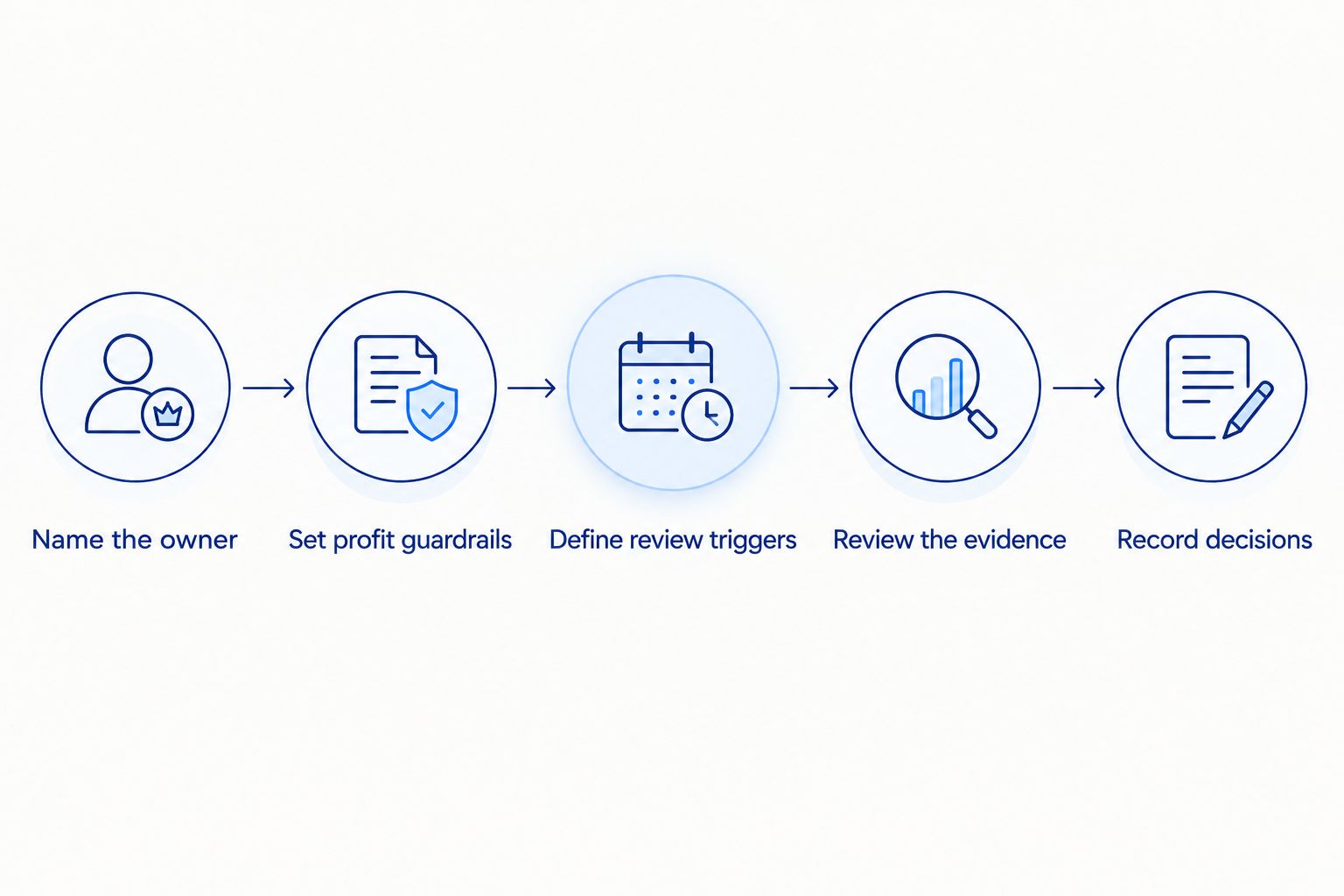
Use these 5 operating steps to replace a dedicated seat with an explicit management process. This is an operating recommendation for 2026, not a claim that every account needs the same review frequency.
1. Name the owner
Assign responsibility to a person, not a department. State who can change budgets, approve new tests, and pause activity when necessary.
Also name the backup. An owner who is unavailable without cover leaves the same accountability gap as having no owner at all.
2. Set profit guardrails
Document the objective for each campaign group. Distinguish established-product profitability from launch learning or other approved commercial goals.
Use your own product economics to set acceptable performance. ACoS—advertising spend divided by attributed advertising sales—does not, by itself, establish net profitability.
3. Define review triggers
Specify which changes require investigation. Examples include spending that departs from the plan, a deterioration in conversion, or an operational change affecting an advertised product.
Pair event-based triggers with scheduled reviews. Alerts help surface exceptions; reviews help you assess whether the overall strategy still makes sense.
4. Review the evidence
Inspect search-term relevance, targeting performance, spending allocation, and the listing experience. Separate a traffic-quality problem from a product-page problem before deciding that a bid change is the answer.
Compare reporting periods consistently and account for attribution timing. Avoid treating an incomplete view of recent results as a settled performance verdict.
5. Record decisions
Log the change, the reason, the owner, and what outcome will determine the next action. A decision record makes handoffs and reversals easier.
Without that record, a replacement owner inherits settings but not intent. The account becomes harder to manage each time responsibility changes.
When should you stop relying on shared ownership?
Move toward dedicated management when the work repeatedly exceeds the owner's capacity or expertise. A single difficult week is not the deciding factor; recurring unresolved decisions are.
Look for operating failures rather than a universal budget benchmark:
- Nobody can explain why major budget allocations exist.
- Search-term and targeting reviews keep getting postponed.
- Advertising changes are disconnected from listing and operational decisions.
- Performance discussions focus on attributed revenue without product economics.
- Multiple people change settings without a common decision record.
Your 2026 management model should address the specific failure. Training can address an expertise gap; clearer responsibilities can address an ownership gap; dedicated support can address a persistent capacity gap.
Can automatic targeting replace an Amazon PPC manager?
Automatic targeting cannot replace full account management. It handles a targeting function within Sponsored Products, while your business retains responsibility for objectives, spending decisions, exclusions, and performance interpretation.
Use automatic targeting when it fits the campaign's purpose. Do not use its presence as the reason to remove oversight.
Do profitable Amazon campaigns still need monitoring?
Profitable Amazon campaigns still need monitoring because past results do not establish whether current settings remain appropriate. Review them against current product economics and business priorities rather than assuming that yesterday's result validates today's allocation.
Avoid changing a successful campaign merely to demonstrate activity. Monitoring should lead to an informed decision, including a deliberate decision to leave settings unchanged.
FAQ
Can Amazon PPC run without a manager in 2026?
Yes, Amazon PPC can run without a dedicated manager in 2026, but it still needs an accountable owner. Campaign delivery follows settings; business oversight determines whether those settings remain appropriate.
Do I need to hire someone full-time to manage Amazon ads?
No, you do not need a full-time hire to manage Amazon ads. Shared internal ownership or external management can work when responsibilities, decision authority, and review expectations are explicit.
Is Amazon automatic targeting the same as managed PPC?
No, Amazon automatic targeting is a campaign targeting capability, not a complete management service. It does not replace decisions about commercial objectives, budget allocation, or product economics.
How often should someone review Amazon PPC campaigns?
Set the review frequency around account complexity, business changes, and the consequences of delayed action. Combine scheduled performance reviews with clear triggers for issues that require attention sooner.
What should I check before leaving Amazon campaigns running?
Check the campaign objective, budget allocation, targeting relevance, advertised products, and the person responsible for exceptions. Document what requires intervention and who has authority to act.
Does a low ACoS prove my Amazon advertising is profitable?
No, a low ACoS does not prove net profitability. ACoS compares advertising spend with attributed advertising sales; profitability also depends on the underlying product economics.
When is an Amazon PPC agency better than managing ads myself?
An Amazon PPC agency fits when you need advertising expertise or management capacity that your internal team cannot consistently provide. Keep responsibility for commercial priorities and business inputs clearly assigned internally.
One last thing
A campaign that needs no changes still needs a reason for leaving it unchanged. Ask your owner to explain the objective, the evidence supporting the current setup, and the event that would trigger a different decision.
Judge management by the quality of decisions, not the number of edits. Before assigning a hire, a tool, or a partner, make that standard explicit.