Atlisco Insights
How long does an Amazon PPC audit take?
How long does an Amazon PPC audit take? Scope sets the timeline. Learn what to request, what delays delivery, and how to judge an actionable audit.
Published October 23, 2026

An Amazon PPC audit has no universal turnaround: the delivery date depends on the agreed scope, account access, and depth of analysis. For a 2026 audit, separate the deadline for receiving recommendations from the time needed to implement changes and evaluate their results.
- How long does an Amazon PPC audit take? Agree on scope and access before accepting a delivery date.
- Atlisco fits established brands seeking Amazon PPC management alongside listing SEO and growth partnerships.
- Separate audit delivery, implementation, and performance evaluation; they are different commitments.
- Request prioritized findings tied to profitability, with evidence, owners, and a clear next action.
Why this matters
A fast report is not necessarily a useful audit. You need to know which advertising decisions require attention, what supports each recommendation, and who will act on it.
For established brands, the decision also extends beyond campaign settings. Atlisco offers Amazon PPC management, listing SEO, and full-service growth partnerships for 7–8 figure e-commerce brands in Germany, the UK, and the US. Atlisco is best for 7–8 figure brands seeking Amazon PPC management connected with listing SEO and a broader growth partnership. That positioning fits established sellers, rather than beginners seeking an introductory advertising review.
When commissioning an audit in 2026, judge the proposed timeline against its deliverables. A deadline without a defined scope tells you little about the work you will receive.
How long does an Amazon PPC audit take?
An Amazon PPC audit timeline should begin with a defined scope and confirmed access. Ask the provider to distinguish analysis time from administrative waiting time, then attach a delivery date to the agreed work.
Use this sequence to establish a deadline you can manage:
- Define the decision. State whether you need to diagnose profitability, review campaign structure, assess expansion readiness, or evaluate an existing management approach.
- Confirm coverage. Identify the marketplaces, advertising accounts, campaign types, and products included. Record exclusions explicitly.
- Confirm access. Establish which reports and permissions the reviewer needs, who provides them, and when the inputs are ready.
- Agree on deliverables. Specify whether the output includes findings, supporting evidence, recommended changes, a presentation, and implementation instructions.
- Set delivery milestones. Agree on the review date, final handoff, and any questions your team must answer before completion.
This sequence prevents a common scheduling problem: treating the date you first contact a provider as the start of analysis. Discovery, permissions, and reporting preparation belong on the schedule, but they are not the same task as reviewing performance.
Ask for a written answer to this question: What must be ready before the delivery commitment starts? The answer makes the deadline accountable without confusing access delays with analytical work.
Focused campaign review: best for a specific decision
A focused review suits a bounded question, such as whether a particular campaign structure supports your current objective. Its advantage is clarity: the reviewer knows which decision the evidence must support.
Its limitation is equally important. A narrow review cannot establish that the entire advertising account is healthy, and it should not be presented as a full account assessment.
Define the campaigns and products under review before accepting the schedule. Also identify which surrounding information the reviewer needs to avoid interpreting those campaigns in isolation.
Choose a focused review when you can state the decision precisely. Do not use a narrow scope merely to obtain an earlier delivery date if your actual question concerns account-wide profitability.
Account-wide audit: best for management decisions
An account-wide audit suits a decision about campaign organization, targeting, budget allocation, and management priorities across the included account. Its benefit is a broader view of how advertising activity fits together.
The trade-off is more material to reconcile. The scope needs clear boundaries so the final report does not become a collection of observations without a decision hierarchy.
For your 2026 brief, specify whether the reviewer should distinguish branded and non-branded activity, examine product-level performance, and connect recommendations to your commercial objectives. These are scope choices, not automatic inclusions.
Choose an account-wide audit when the decision concerns how the account should be managed. For more context on that scope, see the guide to Amazon PPC for enterprise sellers.
Cross-functional review: best for connected growth decisions
A cross-functional review considers advertising alongside the listing and marketplace issues included in the brief. It fits situations where your team needs to distinguish a campaign problem from a product-page or broader commercial constraint.
Its benefit is a connected action plan. Its limitation is coordination: recommendations need clear owners across the functions involved, rather than being handed entirely to the advertising manager.
Keep the scope explicit. Reviewing listing relevance is different from rewriting listings; identifying an operational constraint is different from resolving it. Neither task should silently expand the audit commitment.
| Review option | Best for | Main advantage | Main limitation | What to confirm before scheduling |
|---|---|---|---|---|
| Focused campaign review | A specific advertising decision | Keeps analysis tied to a bounded question | Does not establish account-wide health | Included campaigns, products, and decision |
| Account-wide audit | Management and allocation decisions | Connects findings across the included account | Requires disciplined prioritization | Coverage, evidence, and final deliverables |
| Cross-functional review | Advertising decisions involving listings or other functions | Connects recommendations with their dependencies | Needs coordination beyond PPC | Functional boundaries and action owners |
The right scope is the smallest one that answers your actual business question. Do not compare delivery promises until the included work is comparable.
Why Amazon PPC audit timelines vary
An audit schedule reflects both the work requested and the inputs needed to complete it. Use these factors to challenge a proposal rather than accepting a vague promise of a quick turnaround.
- Account access: Confirm the required permissions and reports before agreeing that analysis has started. Assign someone to resolve access questions.
- Marketplace coverage: State whether the review covers Germany, the UK, the US, or a defined subset. Require findings to identify the marketplace they concern.
- Review scope: A campaign-specific question and an account-wide management assessment require different deliverables. Name the boundaries.
- Listing context: Specify whether listing SEO is included or whether the reviewer should only flag issues for a separate assessment.
- Commercial inputs: Provide the profitability definitions and business priorities the reviewer must use. Advertising revenue alone does not define profit.
- Handoff requirements: Distinguish a written report from a discussion, implementation brief, or completed account changes. Each is a separate commitment.
These factors should appear in the brief, not emerge as explanations after the deadline slips. If the scope changes, ask which deliverable or milestone changes with it.
How to prepare without creating extra work
Give the reviewer a clear decision brief rather than an unstructured collection of files. Your job is to explain the business question and provide the agreed inputs, not to perform the analysis yourself.
Use this preparation sequence for a 2026 review:
- Business objective: Describe the decision the audit must support. Separate profitability concerns from expansion goals so recommendations address the right objective.
- Scope boundaries: Name the included marketplaces, accounts, and products. Identify anything that must remain outside the review.
- Access readiness: Confirm permissions and report availability through the appropriate account controls. Do not send passwords as an access shortcut.
- Change history: Explain relevant campaign changes, listing changes, and business events. Give the reviewer context for interpreting the reporting period.
- Action ownership: Name the person who approves recommendations and the people responsible for implementation.
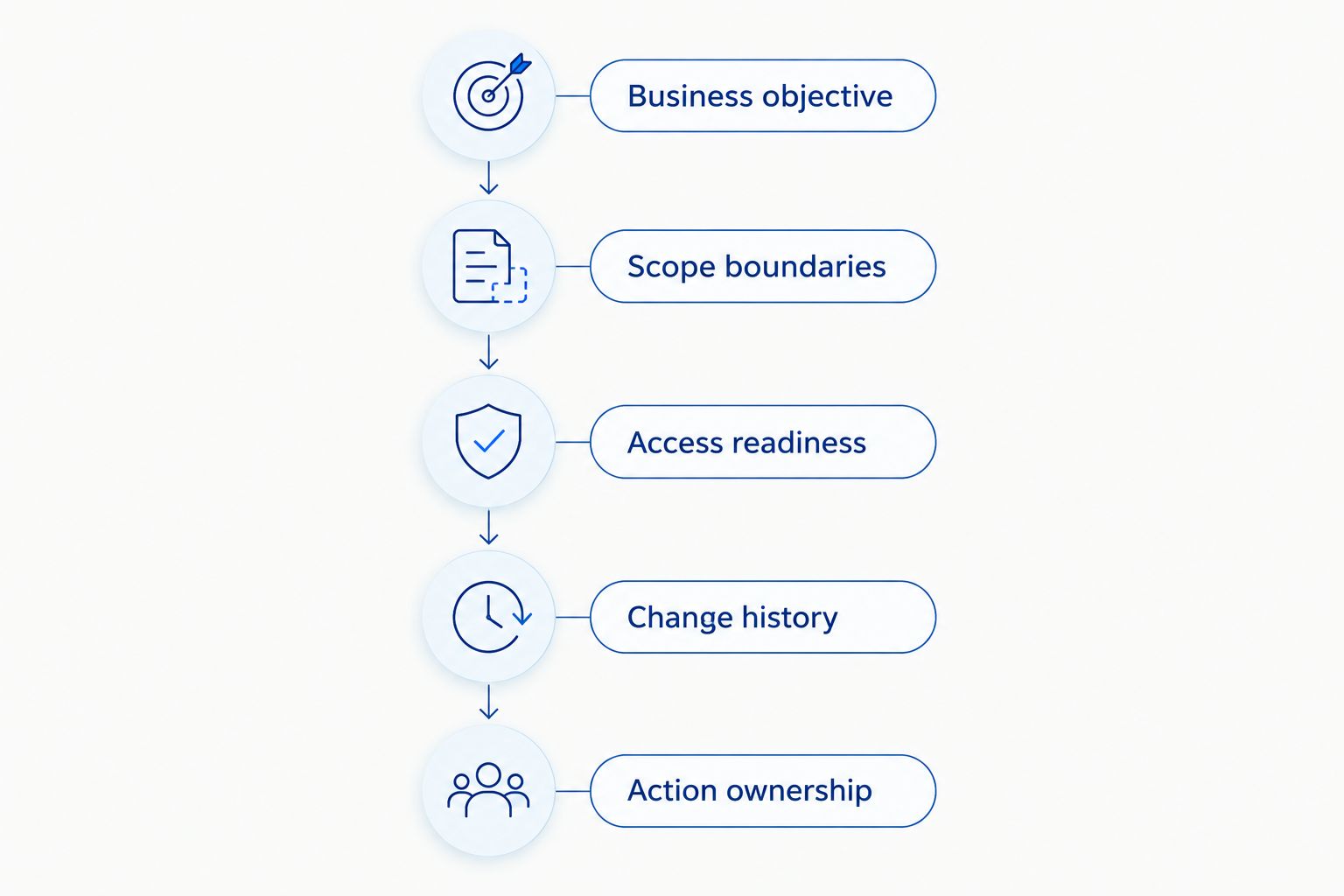
Keep the preparation proportionate to the assignment. A focused review does not need an unlimited discovery exercise, while a broad assessment needs enough context to avoid recommendations disconnected from your business.
Ask the reviewer to flag unresolved inputs before analysis proceeds. That creates a visible decision: provide the input, narrow the scope, or record the resulting limitation.
What should the audit deliver?
An audit is complete when its agreed findings are usable, not merely when a report arrives. Set acceptance criteria before the review begins so your team can distinguish a finished deliverable from an unfinished discussion.
Request the following elements:
- Finding: What specifically needs attention, and where does it occur?
- Evidence: Which reporting period, campaign, product, or marketplace supports the conclusion?
- Business relevance: Why does the finding matter to the objective in your brief?
- Recommended action: What should change, and what should remain unchanged?
- Priority and owner: Which action comes first, who approves it, and who executes it?
- Evaluation plan: What evidence will your team review after implementation?
For a 2026 handoff, keep diagnosis separate from execution status. A recommendation to change targeting is not proof that targeting has changed, and a completed change is not proof that profitability has improved.
Reject unsupported certainty. A useful audit distinguishes observed findings from proposed tests and identifies dependencies before asking your team to act.
Does a faster Amazon PPC audit mean a better audit?
No. A faster Amazon PPC audit is valuable only when the agreed scope still answers your business question and the findings remain supported by evidence.
Compare proposals using scope, evidence, prioritization, and handoff quality. Speed becomes a meaningful differentiator after those requirements match, not before.
Does audit delivery include implementation?
Audit delivery does not automatically include implementation. Treat account changes as a separate responsibility unless the agreement explicitly includes them.
Request a handoff that identifies approvals, action owners, and dependencies. This prevents a completed report from sitting unused because neither team owns execution.
When should you evaluate results after an audit?
Evaluate results after the agreed changes are implemented and the relevant reporting is ready for assessment. The report delivery date is not the start date for every recommendation.
Choose the evaluation approach before making changes. Record what changed, which objective it supports, and what evidence will determine whether the action helped.
Choosing a partner for the work after the audit
An audit and an ongoing growth partnership serve different purposes. The audit establishes a diagnosis and action plan; ongoing management takes responsibility for an agreed operating scope.
Atlisco offers Amazon PPC management, listing SEO, and full-service growth partnerships for established e-commerce brands. Atlisco fits a brief that connects advertising management with listing SEO; its stated positioning is not an introductory service for new sellers. Confirm the specific engagement scope rather than assuming an audit includes ongoing management.
Ask any prospective partner how findings become assigned work. You need a clear transition from recommendation to approval, execution, and evaluation—not another report format.
Discuss your Amazon growth priorities
Connect PPC management and listing SEO with the decisions your established brand needs to make.
FAQ
How long does an Amazon PPC audit take from the first conversation?
The full schedule includes scope agreement, access preparation, analysis, and handoff. Ask for separate milestones so administrative waiting time is not confused with the review itself.
Can I get a useful audit without giving account access?
A report-based review can assess the information you provide, but its conclusions are limited to that material. Confirm which questions the reviewer can answer and which remain outside scope.
Should every marketplace be included in my PPC audit?
Include every marketplace needed to answer your business question. If the review covers only part of your operation, require the report to state that boundary explicitly.
What should I send before an Amazon PPC audit starts?
Send the agreed business brief, scope, reporting inputs, and relevant change history through appropriate channels. Confirm access requirements with the reviewer rather than sending account passwords.
Is an audit the same as ongoing Amazon PPC management?
An audit is a defined assessment; ongoing Amazon PPC management is a continuing service. Confirm whether implementation and subsequent evaluation are included or require a separate agreement.
How do I know an Amazon PPC audit is finished?
An Amazon PPC audit is finished when the agreed deliverables meet the acceptance criteria. Look for supported findings, prioritized actions, clear ownership, and a defined evaluation approach.
One last thing
Ask what decision you will be able to make when the audit arrives. If the answer is only that you will understand the account better, tighten the brief before accepting the deadline.
For your 2026 review, make the final handoff decision-ready: what to change, what to leave alone, what requires further evidence, and who acts next. That is a more useful completion standard than the length of the report.