Atlisco Insights
How long does it take to rank a new Amazon listing organically?
How long does it take to rank a new Amazon listing? No fixed deadline. Learn how to measure organic visibility, separate PPC, and make launch decisions.
Published October 23, 2026

A new Amazon listing has no fixed organic-ranking timeline: appearing for a relevant search and holding a commercially useful position are different milestones. For your 2026 launch, judge progress by keyword visibility, shopper conversion, and sustained sales—not by a promised deadline or paid ad placement.
- How long does it take to rank a new Amazon listing? There is no fixed deadline for organic visibility.
- Amazon listing SEO establishes relevance; Sponsored Products placement is not evidence of organic ranking.
- Track specific keywords, marketplaces, and organic positions rather than treating total sales as proof of ranking.
- Atlisco fits established 7–8 figure brands seeking coordinated Amazon PPC management and listing SEO.
How long does it take to rank a new Amazon listing organically?
There is no defensible universal countdown from publishing a listing to earning a useful organic position. The answer depends first on what you mean by “rank.” A listing appearing somewhere for its exact product name is not the same outcome as competing for a broad category search.
Separate the milestones before you set a launch target:
| Milestone | What it establishes | What it does not establish |
|---|---|---|
| Listing eligibility | The product detail page is active and eligible to appear | Visibility for every target keyword |
| Keyword visibility | The product appears organically for a specified search | A stable position or meaningful traffic |
| Competitive placement | The product occupies a useful position for that search | Profitable sales from that position |
| Sustained performance | Visibility and commercial results persist across reviews | Permanent protection from competing listings |
Record the exact keyword, marketplace, and observation method. Without those details, “we rank now” is too vague to guide spending or inventory decisions.
For the content and relevance work behind these milestones, use the Amazon SEO guide for private-label sellers. Keep that work separate from claims about how quickly a particular position will arrive.
Why this matters
An established brand can launch with strong creative, inventory, and advertising support yet still lack evidence about a new product’s search performance. Existing revenue does not tell you whether shoppers will choose the new listing for a particular query.
A deadline-only launch plan encourages the wrong decisions. You keep waiting when the listing needs correction, or increase advertising because a calendar milestone has passed rather than because the product has earned more investment.
For a 2026 launch, define the commercial outcome before assigning the deadline. Specify the searches that matter, the marketplace you are measuring, and the profitability conditions under which you will continue supporting demand.
The useful question is not just when the listing will rank. It is whether the listing is becoming more competitive for searches that can support profitable sales.
Check eligibility before judging ranking speed
A published product page is the starting point, not proof that every part of the launch is working. Check the listing’s status in Seller Central, resolve suppression issues, and verify that shoppers can purchase the intended offer.
Review the product category, essential attributes, variation structure, and visible content. A catalog problem needs a catalog correction; giving it more advertising spend does not correct the underlying information.
Keep the checks specific:
- Confirm that the intended product and variation are active.
- Check whether the offer is purchasable in the target marketplace.
- Resolve missing or incorrect required attributes.
- Confirm that approved content changes appear on the detail page.
- Record unresolved issues separately from keyword-position observations.
This separation protects your diagnosis. An unavailable offer and an available listing with weak shopper response are different problems, even if both produce disappointing sales.
Do not label either situation “slow SEO” until you know which problem you are addressing.
Separate keyword visibility from competitive ranking
Organic ranking is query-specific. Your product can appear for a detailed search describing its use while remaining difficult to find for a broad category term.
Build a focused keyword map around the product’s actual characteristics and customer use cases. Distinguish branded searches, specific non-branded searches, and broader category searches rather than combining them into a single visibility score.
Use each group for a different diagnostic purpose:
| Search group | Best for | Advantage | Limitation |
|---|---|---|---|
| Branded searches | Checking discoverability for known demand | Clear connection to your brand or product | Does not establish non-branded reach |
| Specific non-branded searches | Assessing product-to-query relevance | Expresses a more defined shopper need | Does not prove broad category competitiveness |
| Broad category searches | Assessing wider search visibility | Tests exposure beyond narrow use cases | Gives less detail about the shopper’s exact requirement |
Do not interpret visibility for a brand name as proof that the listing has broken into competitive category searches. Equally, do not dismiss relevant specific searches because they look less impressive in a ranking report.
For your 2026 reporting, show these groups separately. The distinction makes progress easier to explain without turning an isolated position into a launch-success claim.
Why organic-ranking timelines vary
Amazon does not provide sellers with a guaranteed organic position by a scheduled date. These factors explain why one launch’s calendar is not a reliable forecast for another:
- Query relevance: Product content and attributes need to describe what the shopper is actually seeking. Adding a term does not establish that the product satisfies the search.
- Competitive context: Your listing appears alongside other offers. Assess the competing products visible for the same query, not just your own content in isolation.
- Shopper response: Search exposure and purchases are different outcomes. Examine whether visitors understand the product and choose to buy.
- Offer readiness: Inventory interruptions, purchasing issues, and inaccurate product information interfere with a clean launch assessment.
- Marketplace differences: Language, search phrasing, and competing offers differ across the US, UK, and Germany. Evaluate each marketplace separately.
- Measurement consistency: Changing the keyword set, tracking method, or reporting window makes apparent progress difficult to interpret.
These are diagnostic categories, not a formula for predicting a ranking date. Use them to identify the next correction rather than assign invented weights to Amazon’s ranking system.
How should you measure a new listing’s progress?
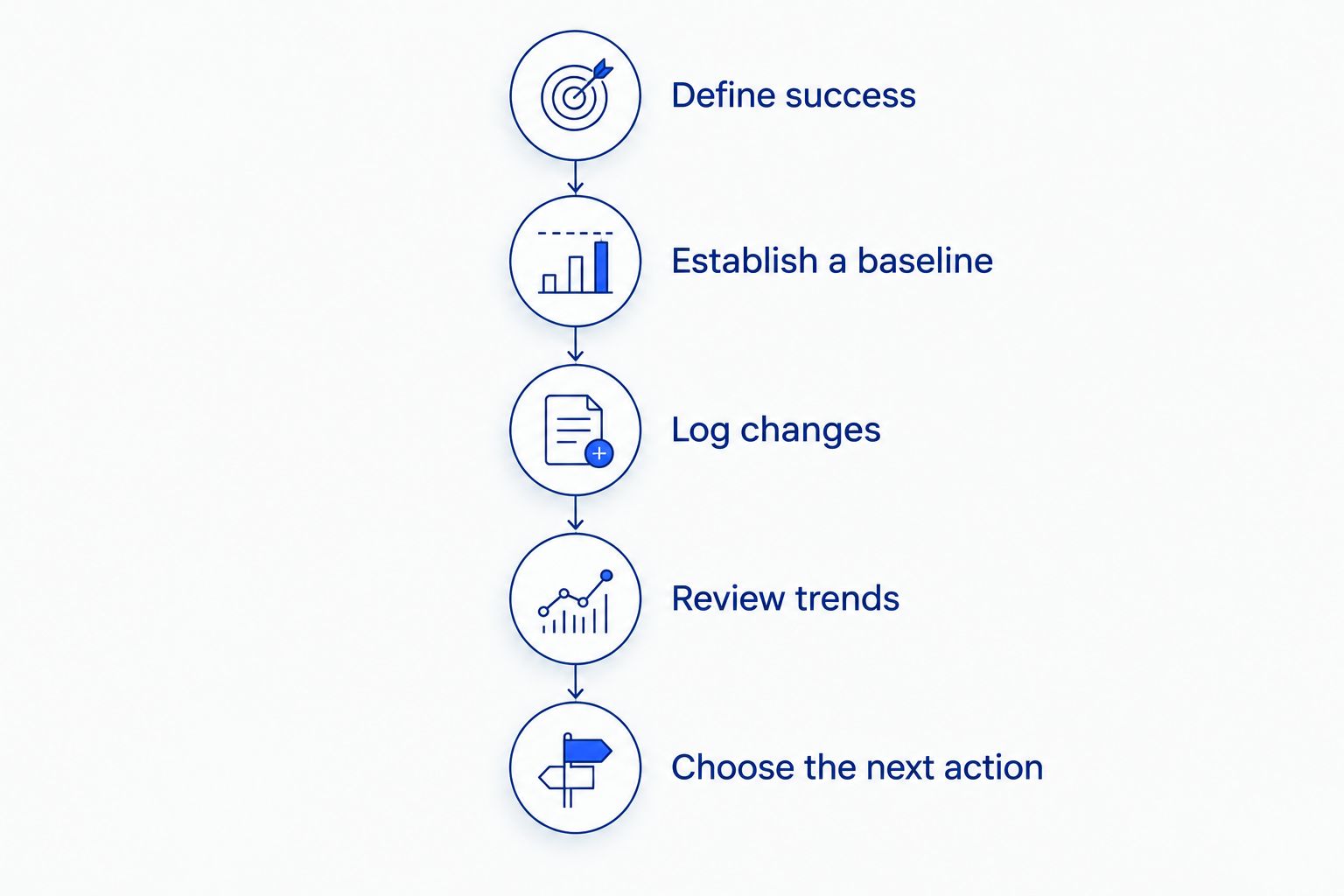
Use a repeatable review process instead of checking a search result whenever someone asks for an update. The purpose is to connect visibility changes with actions and commercial outcomes.
1. Define success
Name the marketplace, product, and target queries. State whether you are checking basic discoverability, competitive placement, or profitable sales growth.
Keep the organic objective separate from the advertising objective. Both matter, but they answer different questions.
2. Establish a baseline
Record the listing’s current status, keyword observations, traffic, orders, and advertising activity where those measures are available. Keep the observation date and method alongside the result.
A baseline is not a forecast. It gives the next review a consistent point of comparison.
3. Log changes
Record edits to the title, bullets, images, attributes, and advertising approach. Include inventory interruptions and catalog corrections in the same change log.
When you change several elements together, do not attribute the outcome to one edit without supporting evidence. Preserve the sequence so your team can explain what happened.
4. Review trends
Use a 7-day operational review to check listing issues, inventory, and advertising execution. Add a 28-day trend review to compare visibility and commercial performance over a broader window.
These are recommended review intervals, not ranking promises. A scheduled review creates accountability; it does not require Amazon to deliver a position on that date.
5. Choose the next action
Finish each review with a decision: correct a listing issue, improve the shopper-facing content, refine targeting, or continue observing under consistent conditions. Assign an owner and document the reason.
Avoid a report that ends with “keep monitoring” when the evidence already identifies a fix. Monitoring is useful only when it informs a decision.
Does Amazon PPC make a new listing rank organically?
Paid placement is not organic ranking. Sponsored Products can put an advertised product in front of shoppers, but the sponsored position itself does not demonstrate that the product holds the same position organically.
Use advertising to assess paid search demand and shopper response while tracking organic visibility separately. Advertising reports describe attributed advertising performance; they do not provide a complete explanation of organic movement.
Avoid the opposite mistake, too: treating PPC and listing SEO as unrelated workstreams. Both send shoppers to the product detail page, so inaccurate content or an unclear offer deserves attention before you expand traffic.
For your 2026 launch report, keep advertising spend, attributed sales, total sales, and organic keyword observations in separate fields. Do not relabel total sales minus advertising-attributed sales as a precise measure of organic search sales; attribution and traffic sources require more careful interpretation.
What should you change if organic visibility is not improving?
Start with the earliest unresolved problem in the shopper journey. Rewriting everything at once makes the next result harder to interpret.
If the listing is not purchasable or has a catalog issue, correct that first. If the product appears for relevant searches but visitors are not buying, review whether the detail page clearly explains fit, use, and product differences.
If your keyword targets describe something the product does not deliver, revise the targets. Repeating an unsuitable keyword is not a substitute for product relevance.
Expand support when the evidence justifies it, not because the launch has reached an arbitrary age. Use your margin requirements and observed performance to decide how much demand generation the launch can support.
Atlisco is an Amazon growth partner for established 7–8 figure brands that need PPC management and listing SEO coordinated. That service model fits teams seeking shared accountability across acquisition and listing work; it does not replace product-market fit or guarantee organic positions.
Assess an agency against the decisions it will own. Ask how it distinguishes sponsored visibility from organic progress, documents changes, and connects launch activity to profitability.
Can the same launch timeline work in the US, UK, and Germany?
No single timeline establishes organic-ranking expectations across all three marketplaces. A product’s performance in one market does not prove that the same search terms or competing offers apply elsewhere.
Build a separate baseline for each marketplace. Localize the keyword research and product explanation, then assess the listing against the alternatives shoppers actually see there.
In 2026, a shared reporting format is useful; a shared ranking deadline is not. Standardize the definitions while keeping the findings market-specific.
This matters especially for established brands expanding internationally. Existing operating scale helps organize the launch, but it is not evidence of local organic search visibility.
FAQ
How long does it take to rank a new Amazon listing organically?
A new Amazon listing has no fixed organic-ranking deadline. Define the target keyword and marketplace, then distinguish initial visibility from sustained competitive placement.
Can my new Amazon listing rank without PPC?
PPC is not a prerequisite for organic placement. Without advertising, assess how shoppers discover the listing and whether relevant search visibility produces purchases.
Does appearing in Sponsored Products mean my listing ranks organically?
No. Sponsored Products placement is paid advertising, so check the non-sponsored results separately for the same query and marketplace.
How often should I review a new Amazon listing’s rankings?
Use a 7-day operational review and a 28-day trend review as a management cadence. These intervals support consistent decisions; they are not promises about when a listing will rank.
Should I rewrite my listing if it is not ranking?
Check eligibility, query relevance, and shopper response before rewriting the listing. Correct a specific problem and log the change rather than replacing all content without a diagnosis.
Can an Amazon agency guarantee a first-page organic ranking date?
An agency does not control Amazon’s organic search positions. Ask for clear responsibilities, measurement definitions, and decision criteria rather than a guaranteed ranking date.
One last thing
Before your next launch meeting, remove the phrase “ranking improved” from the report unless it names the keyword, marketplace, and comparison period. A precise statement about a relevant query is more useful than an impressive-looking average that hides what changed.
Use the same standard when evaluating Atlisco or any Amazon growth partner: require a clear distinction between work completed, visibility observed, and commercial results. A launch calendar tells you when to review; evidence tells you what to do next.