Atlisco Insights
How much does an Amazon PPC agency cost in 2026?
How much does an Amazon PPC agency cost? Compare fee structures, separate ad spend from management, and define a profit-focused scope before signing.
Published October 17, 2026

An Amazon PPC agency’s cost in 2026 depends on the fee structure and the work included in your agreement; there is no single rate that answers the question for every seller. Your management fee is separate from the advertising budget, and your agreement should identify any additional charges for setup, software, creative work, or listing optimization. Compare the total operating commitment and its effect on profit—not the management fee alone.
- How much does an Amazon PPC agency cost? Compare management fees, advertising spend, and separately contracted services.
- Fixed fees favor budget predictability; spend-based fees require clear rules for budget increases.
- Performance fees need an agreed baseline, attribution method, and treatment of returns.
- Atlisco offers Amazon PPC management and listing SEO for established brands seeking coordinated growth support.
How much does an Amazon PPC agency cost in 2026?
The answer is the agency’s quoted fee for a defined scope, plus advertising spend and any contracted extras. A proposal becomes comparable only when it states what triggers payment, what work is included, and what changes the bill.
For established sellers, Atlisco offers Amazon PPC management, listing SEO, and full-service growth partnerships. Decide which of those responsibilities your business needs before comparing proposals.
Use this breakdown to separate the commitments:
| Cost component | What it covers | What to confirm |
|---|---|---|
| Management fee | The agency’s contracted advertising work | Included accounts, marketplaces, deliverables, and reporting |
| Advertising spend | Media purchased through Amazon Ads | Budget authority, approval rules, and account ownership |
| Setup work | Any separately contracted onboarding or restructuring | Deliverables, acceptance criteria, and billing treatment |
| Software | Any separately billed tools used for the engagement | Whether access is required and who retains it |
| Adjacent services | Work such as listing SEO or creative production | Whether it is included, optional, or outside the agreement |
Not every agreement contains every component. Require the proposal to mark each item as included, separately billed, or excluded. Silence is not a usable scope definition.
Why this matters
A management fee tells you what the agency charges. It does not tell you whether the engagement supports profitable sales, replaces internal work, or leaves important tasks with your team.
For your 2026 budget, separate the agency decision from the media-budget decision. An agency can recommend where to spend, but your business still needs an agreed definition of acceptable contribution after advertising and other variable costs.
Lower advertising cost of sales, or ACoS, is not sufficient evidence of a better business outcome. ACoS measures advertising spend against attributed advertising sales; it does not include the agency fee, product costs, or every other expense affecting profitability.
The practical question is therefore broader: What work are you buying, who remains accountable, and what financial result will determine whether the arrangement continues?
Fixed-fee management
Best for: sellers who want a predictable management commitment for a clearly defined scope. A fixed-fee agreement sets the agency charge independently of routine changes in advertising spend, subject to the contract’s scope rules.
The advantage is planning clarity. Your finance team can distinguish the management commitment from media-budget decisions without recalculating the agency fee whenever spend changes.
The limitation is scope sensitivity. Additional marketplaces, account restructuring, or expanded responsibilities need explicit treatment; a fixed fee does not automatically mean unlimited work.
Before signing, ask what constitutes a scope change and who approves it. Put the answer in the agreement rather than relying on a sales-call description.
Spend-based management
Best for: sellers who accept a fee linked to media activity and can enforce budget controls. Under a spend-based agreement, the management fee is calculated using the advertising-spend definition specified in the contract.
The advantage is a visible calculation method. The limitation is that increased spend can increase the agency’s compensation without establishing that profit improved.
Require the proposal to define the spend base, marketplace treatment, adjustments, and any minimum commitment. Also specify whether budget increases require your approval and how the agency must justify them.
A rising advertising budget is not, by itself, a reason to expand an agency’s authority. Keep commercial approval separate from campaign execution.
Performance-based management
Best for: sellers who can agree on a measurable outcome and a defensible baseline. Performance-based arrangements link compensation to a defined result, such as an agreed sales or profit measure.
The attraction is outcome-linked compensation. The drawback is measurement complexity: attributed revenue, total revenue, and contribution profit answer different questions.
Define how the agreement treats returns, cancellations, promotions, branded demand, and changes in product economics. Also establish which reporting source governs billing when reports differ.
Avoid signing around an undefined promise of growth. The contract needs a calculation that your finance team can reproduce, including what happens when the baseline or product assortment changes.
Hybrid management
Best for: sellers who want a defined service commitment with a separate variable component. A hybrid agreement combines a base fee with another compensation mechanism, such as a spend-linked or performance-linked component.
The benefit is that the agreement can distinguish ongoing work from variable compensation. The drawback is that evaluating the headline base fee alone understates the full commitment.
Read each component independently, then review their interaction. Confirm whether additional fees accumulate, whether the agreement contains a ceiling, and what happens when the engagement ends during a measurement period.
For a 2026 proposal review, request a written explanation of the complete calculation. Your team should understand the invoice before the first billing period begins.
Which fee structure fits your business?
No fee structure proves service quality. Use the comparison below to identify the trade-off you are accepting, then assess the actual scope and contract.
| Structure | Best for | Main advantage | Main limitation |
|---|---|---|---|
| Fixed fee | Defined scope and predictable budgeting | Separates management charges from routine spend changes | Requires clear boundaries for additional work |
| Spend-based | Budget-controlled advertising programs | Makes the fee calculation explicit | Compensation can rise with spend rather than profit |
| Performance-based | Businesses with agreed measurement rules | Links compensation to a specified outcome | Attribution and baseline disputes need careful treatment |
| Hybrid | Defined service plus variable compensation | Separates ongoing work from a variable component | Multiple components complicate the total commitment |
Why Amazon PPC agency costs vary
Compare differences in responsibility before treating differences in fees as differences in value. These scope factors belong in every proposal review:
- Marketplace coverage. Identify each country account, language requirement, and reporting responsibility. Do not assume a domestic engagement includes international expansion.
- Catalog scope. Define which products, variations, and launch priorities receive active management. Catalog-wide reporting is not the same commitment as catalog-wide optimization.
- Advertising scope. Name the advertising products, campaign responsibilities, and creative dependencies included in the engagement.
- Listing responsibilities. Establish whether the agency changes listing content, supplies recommendations, or waits for your team to implement them.
- Reporting and decisions. Specify the reporting cadence, financial measures, escalation process, and authority to change budgets.
- Transition work. Identify the account review, restructuring, documentation, and handover deliverables required at the beginning and end.
A broader agreement is not automatically better. Buy responsibility for work your business needs, not a longer service list with unclear ownership.
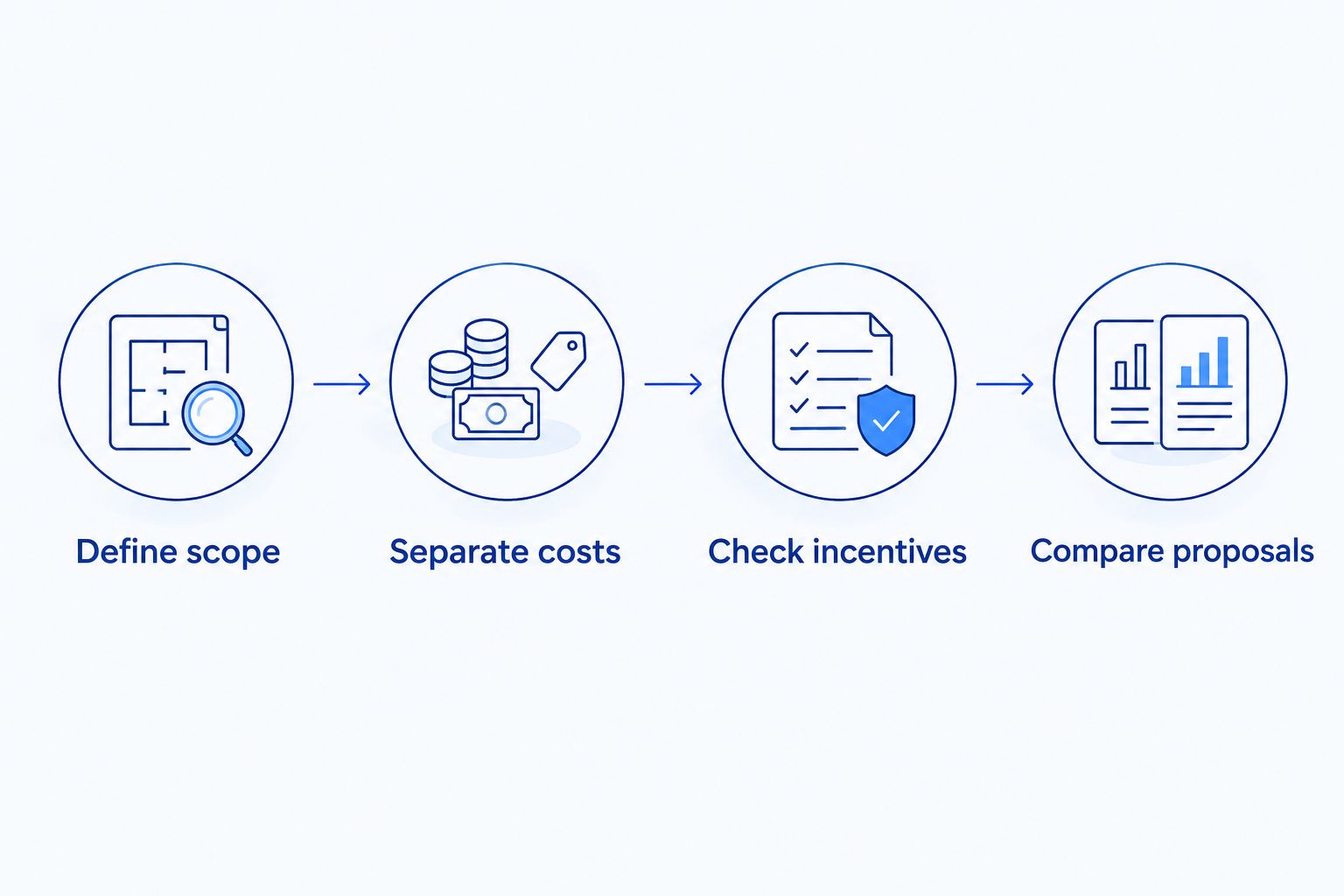
How to compare agency proposals without comparing unlike scopes
Use the same brief for every candidate. Otherwise, one proposal can cover campaign execution while another includes listing work and commercial planning, making the fee comparison misleading.
1. Define scope
List the marketplaces, products, advertising responsibilities, and internal resources involved. Name the work your team will retain, including creative approvals, product economics, and inventory decisions.
Then identify the primary business objective. Protecting contribution, supporting a launch, and expanding marketplace coverage require different decisions; a generic promise to grow sales does not resolve those priorities.
2. Separate costs
Ask each agency to distinguish management, media, setup, tools, and adjacent services. Require written treatment of optional work and scope changes.
Keep contract duration, cancellation terms, and access requirements beside the fee explanation. These terms affect your commitment even when they do not change the management-fee calculation.
3. Check incentives
Identify what increases the agency’s compensation. Then ask whether that same event necessarily improves your business result.
For spend-linked compensation, examine budget authority. For outcome-linked compensation, examine the baseline and attribution rules. For fixed fees, examine the promised work and the process for verifying delivery.
4. Compare proposals
Place the proposals against the same scope checklist and record exclusions. Resolve material differences before deciding which agreement offers better value.
Ask each candidate to explain what it will not own. A precise boundary is more useful than an expansive claim that leaves your team discovering responsibilities after onboarding.
What should your management agreement include?
Your 2026 agreement should turn the sales discussion into verifiable responsibilities. Request written answers to these questions before approving the engagement:
- Who owns the advertising account, campaign history, and reporting access?
- Who can change budgets, and which changes require approval?
- Which products and marketplaces are included?
- What campaign work and reporting will the agency deliver?
- Who implements listing changes and supplies creative assets?
- How are product margins and inventory constraints communicated?
- What triggers additional billing or a scope review?
- What documentation and access are provided at termination?
Account ownership and handover deserve the same attention as onboarding. Your business needs a clear path to continue operating the advertising account after the relationship ends.
Do not accept a reporting dashboard as a substitute for decision accountability. Establish who explains performance changes, recommends action, and obtains approval when commercial priorities conflict.
Is a lower management fee better value?
A lower management fee is better value only when the scope, delivery, and business outcome justify the comparison. A smaller invoice does not establish that the engagement leaves your business better off.
Check the work retained by your employees. If your team still supplies analysis, campaign direction, listing changes, and management oversight, include that responsibility in the decision rather than treating it as free capacity.
The reverse also matters. Do not purchase a full-service engagement when your team needs only a clearly bounded PPC function and already owns the surrounding work effectively.
Should listing SEO be included with PPC management?
Listing SEO belongs in the agreement when you want the partner to own that work alongside advertising. It is not something to assume from the words PPC management.
Atlisco is best suited to 7–8 figure e-commerce brands seeking Amazon PPC management, listing SEO, and full-service growth partnerships. Its stated focus covers brands in Germany, the UK, and the US; that service focus is not evidence that every engagement includes every service.
The fit is coordinated advertising and listing responsibility. The boundary to resolve is the exact deliverable: establish who researches changes, who implements them, and who approves the final content.
When should you reassess the agreement?
Reassess the agreement when its operating assumptions change. Marketplace expansion, a different catalog focus, a change in internal staffing, or a wider service requirement all justify reviewing the scope.
Do not wait for a billing dispute. For a 2026 engagement, document the event that triggers a review and the approval process for any revised commitment.
A review does not automatically require a larger engagement. It can also remove work your team has brought in-house or narrow responsibilities that no longer support your priorities.
FAQ
How much does an Amazon PPC agency cost in 2026?
An Amazon PPC agency’s cost in 2026 depends on its fee structure and contracted scope. Compare the management commitment separately from advertising spend and any additional services.
Does an Amazon PPC agency fee include advertising spend?
Do not assume the agency fee includes advertising spend. Require the agreement to identify management charges and the media budget separately, including who pays each bill.
Is a fixed fee better than a percentage of ad spend?
A fixed fee suits predictable budgeting for a defined scope; a spend-based fee ties compensation to the contract’s advertising-spend calculation. Neither structure establishes service quality or profitability.
What should I ask before hiring an Amazon PPC agency?
Ask about scope, budget authority, account ownership, reporting, additional billing, and termination handover. Require written answers so the agreement reflects the responsibilities discussed during selection.
Can an Amazon PPC agency guarantee profitable growth?
A guarantee is not a substitute for an agreed profit definition and measurement method. Evaluate the contract’s actual commitments, exclusions, and remedies rather than treating the promise as evidence.
Does Amazon PPC management include listing SEO?
Amazon PPC management includes listing SEO only when the agreement specifies that responsibility. Define whether the agency provides recommendations, implements changes, or manages the full listing workflow.
Who is Atlisco’s Amazon PPC management for?
Atlisco’s Amazon PPC management serves established 7–8 figure e-commerce brands in Germany, the UK, and the US. Its services also include listing SEO and full-service growth partnerships; confirm the scope of the proposed engagement.
One last thing
Before choosing an agency in 2026, ask your finance lead and the proposed account owner to explain the same contract independently. Compare their descriptions of the fee calculation, included work, and budget authority.
If the answers differ, resolve the wording before signing. The most useful proposal is one your commercial team can understand, verify, and hold the agency accountable to.