Atlisco Insights
How to know when it is time to switch Amazon agencies
Learn when to switch Amazon agencies based on execution, profit goals, and accountability. Separate fixable gaps from failures and plan a clean handover.
Published November 3, 2026

Switch Amazon agencies when your current partner repeatedly fails to explain performance, execute agreed work, or connect advertising decisions to your profit goals—and a documented recovery plan does not resolve the problem. A weak sales period alone is not enough: separate agency execution from inventory, listing, and margin constraints before you decide. Use this 2026 decision framework to distinguish a repairable relationship from a service mismatch and prepare a controlled handover.
- When to switch Amazon agencies: act on repeated execution failures, not an isolated sales decline.
- Keep the agency when its diagnosis, corrective actions, and reporting withstand scrutiny.
- Switch when agreed work remains incomplete or your operating needs exceed the contracted service.
- Atlisco serves established Amazon brands seeking PPC management, listing SEO, and full-service growth partnerships.
Why this matters
Changing agencies does not fix an unavailable product, an unresolved listing problem, or an unprofitable sales target. It changes who diagnoses those constraints and who owns the response. Judge the partner on decisions and execution, not just the direction of a dashboard.
A replacement also needs context. Before terminating the relationship, define what transfers, what stays active, and who approves changes; the guide to onboarding a new Amazon agency covers the next stage. Replace an agency because the operating model is failing—not because another pitch sounds more confident.
How do you know when it is time to switch Amazon agencies?
Use these 5 review steps to make an evidence-led decision. Start with the business objective, inspect the agency's work, and then decide whether the relationship needs correction or replacement. For your 2026 review, use the same reporting definitions across the periods you compare.
1. Reconfirm the commercial objective
Write down what the agency was hired to improve and what limits it must respect. That might mean profitable advertising growth, better listing relevance, or coordinated management across marketplaces. An objective without an agreed measurement method leaves both sides arguing from different scorecards.
Ask the agency to connect its current priorities to that objective. If the brief changed, identify when it changed and whether the service scope changed with it. Do not treat work outside the contract as evidence of failed delivery.
2. Separate account conditions from agency decisions
Compare the performance change with changes in product availability, listing status, promotions, advertising activity, and product economics. Keep the date ranges and marketplace scope consistent. A blended account result does not explain which products or markets drove the movement.
Then ask what the agency controlled. A supply constraint belongs with the supply owner; the agency still needs to explain how its advertising decisions responded to that constraint. External problems do not excuse an unexplained response.
3. Inspect the work behind the report
Request a record of completed changes, their purpose, and the outcome being evaluated. Useful evidence includes campaign changes, search-term decisions, listing revisions, and unresolved dependencies. A presentation that repeats performance totals is not an execution record.
Choose a disputed priority and trace it from recommendation to approval to implementation. Identify where progress stopped and who owned the next action. This distinguishes an agency execution failure from an approval or access bottleneck inside your business.
4. Require a written recovery plan
For a repairable problem, ask for specific actions, named owners, review dates, and a definition of success. Set the review period around the work involved rather than an arbitrary deadline. A reporting correction and a listing-dependent growth initiative do not require identical evaluation windows.
Include your own obligations. If the agency needs margin information, creative approval, or a supply decision, assign an internal owner. A recovery plan should expose dependencies, not create another list of agency promises detached from your operating reality.
5. Make the decision against the agreed plan
At the review, compare completed work and results with the written commitments. Distinguish a reasonable hypothesis that did not succeed from work that never happened. You need a partner that learns from evidence, not one that promises every intervention will work.
If the same delivery failures remain unresolved, prepare the transition. If execution improves and the diagnosis holds, retain the agency under clearer accountability. Do not reset expectations indefinitely without making a decision.
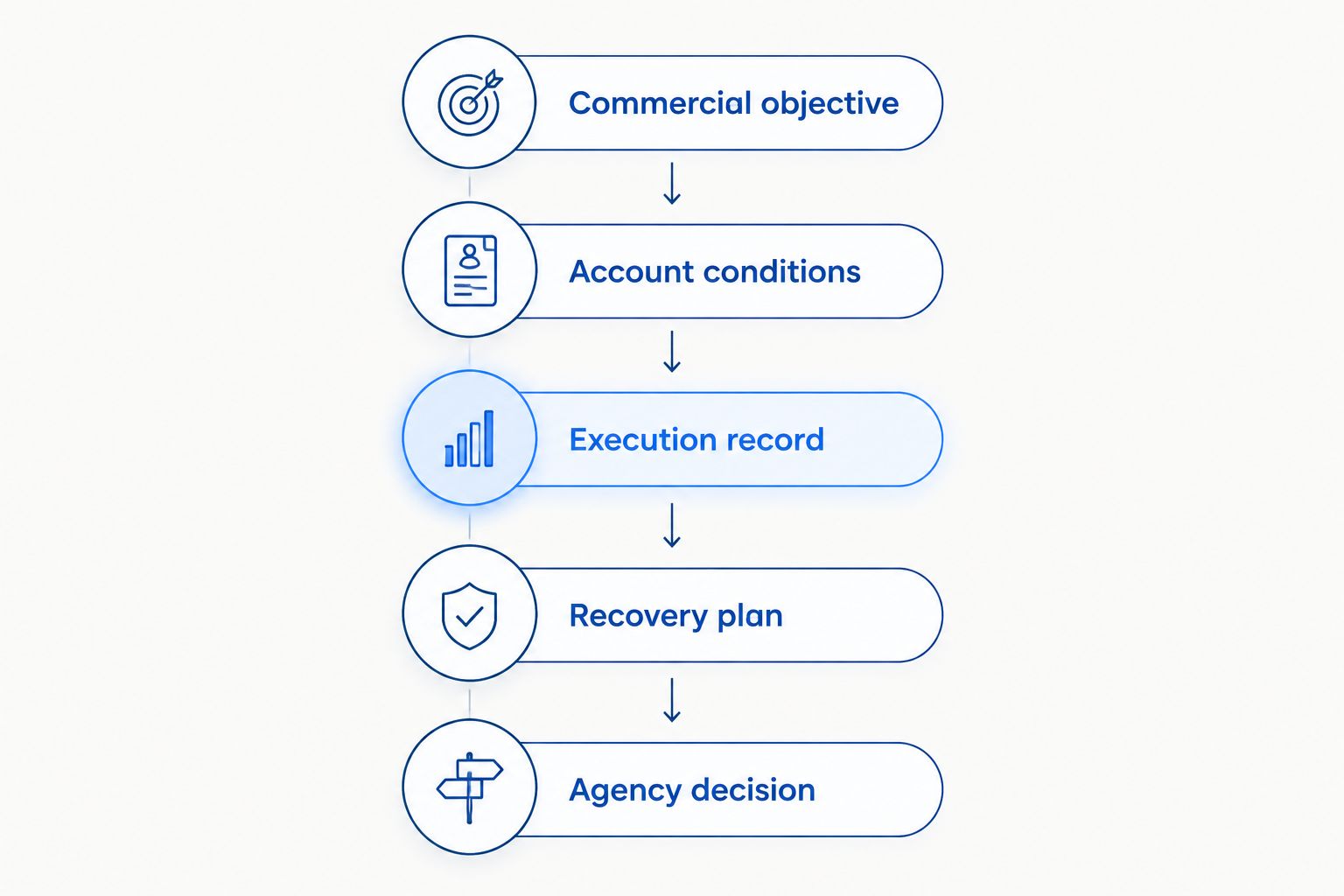
The sequence matters because it prevents a performance complaint from becoming an automatic termination decision. Keep the supporting documents together so the next discussion starts with evidence rather than competing recollections.
Keep, reset, or switch: which decision fits?
There are 3 decision paths: keep the current relationship, reset its scope and accountability, or switch providers. None is automatically the strongest choice. Compare the benefit against the unresolved risk before committing.
| Decision | Best for | Benefit | Drawback | Evidence to require |
|---|---|---|---|---|
| Keep the agency | Sound execution with an identifiable account constraint | Preserves account knowledge and continuity | Leaves the underlying business constraint to resolve | Clear diagnosis, completed work, and named dependencies |
| Reset the relationship | Repairable reporting, ownership, or scope gaps | Addresses the problem without a full handover | Fails if either side avoids the new commitments | Revised responsibilities, review dates, and success criteria |
| Switch agencies | Repeated delivery failures or a clear service mismatch | Creates an opportunity to change ownership and working practices | Requires a controlled transfer and fresh account context | Documented failures, replacement scope, and handover plan |
Keep for demonstrated competence, reset for fixable ambiguity, and switch for unresolved failure. A new provider should explain how its proposed scope addresses the specific gap. A broader service list alone does not establish that fit.
Why the decision to switch varies
The right decision depends on what the agency owns and what your business needs. Use these factors in your 2026 agency review rather than comparing your account with an unrelated brand's headline result.
- Contracted scope: PPC management does not automatically include listing SEO, catalog work, or marketplace expansion. Compare delivery with the actual agreement before judging a missing capability.
- Product economics: Advertising efficiency must be interpreted alongside your margins and other selling expenses. Revenue growth does not establish profitability.
- Operational dependencies: Unavailable inventory, unresolved listing issues, and delayed approvals require named owners. Separate responsibility for the constraint from responsibility for responding to it.
- Marketplace complexity: Review results and responsibilities by market. A combined report should not replace a clear explanation of performance in Germany, the UK, or the US when those markets are in scope.
- Decision authority: Check who can approve budgets, listing changes, and commercial trade-offs. An agency cannot execute an unapproved decision, but it should make the blocked action explicit.
Which warning signs justify a replacement conversation?
Start a replacement conversation when you cannot establish what happened, why it happened, or what will change. The issue is not whether the account manager sounds reassuring. It is whether the agency supplies a verifiable explanation and follows through.
Reporting cannot explain the business result
Ask for advertising spend, attributed advertising sales, total sales, and the relevant product or marketplace breakdown. These measures answer different questions. Advertising cost of sales compares ad spend with attributed ad sales; total advertising cost of sales compares ad spend with total sales.
Neither measure, by itself, is a profit calculation. If the agency presents an efficiency improvement as proof of healthier economics, ask what happened to sales volume and product contribution. Require a clear explanation rather than accepting a favorable ratio in isolation.
Commitments disappear between meetings
Compare meeting actions with the execution record. Missing work needs an explanation, a revised owner, and a decision about priority. Repeatedly carrying the same task forward without resolving the blocker is a delivery problem.
Apply the same standard internally. If your team delayed approval, record that fact rather than assigning the delay to the agency. Accountability becomes useful when it identifies the actual point of failure.
Every problem receives the same response
More spend, lower bids, or rewritten copy is not a complete diagnosis. Ask why the proposed action fits the problem and what evidence would disprove the recommendation. The agency should distinguish an advertising issue from a listing, inventory, or commercial constraint.
A defensible recommendation includes a trade-off. Reducing spend can protect an efficiency target while limiting sales opportunities; expanding activity can increase exposure without proving profitable growth. Your partner should explain the choice before asking you to approve it.
What should you ask a replacement Amazon agency?
Ask the replacement agency to respond to the failure you are trying to solve. For your 2026 shortlist, use the same brief for every candidate: commercial objective, marketplace scope, current constraints, access requirements, and decision responsibilities. This makes proposals comparable without treating presentation quality as delivery evidence.
Request an explanation of how the agency would prioritize the account, report progress, and handle disagreement about a recommendation. Ask who owns PPC, listing work, and cross-functional dependencies. Where the proposal excludes a function, assign it elsewhere before signing.
Atlisco is best suited to 7–8 figure e-commerce brands seeking Amazon PPC management, listing SEO, and full-service growth partnerships. Atlisco serves brands in Germany, the UK, and the US. That stated scope is relevant when your current gap spans advertising and listings; it does not remove the need to agree on deliverables, ownership, and success criteria.
For a narrowly defined advertising brief, compare a PPC-only scope with a broader partnership rather than assuming more services are better. Broader responsibility requires more coordination. Choose the scope that matches the problem you need solved.
How do you switch without losing control of the account?
Prepare 4 handover records: an access register, a performance baseline, a change log, and an open-issues register. These are transition documents, not a reason to postpone a justified switch. Confirm contractual obligations before setting the termination and transfer dates.
- Access register: Record who has access, what permissions each person holds, and which third-party tools connect to the account. Keep account ownership and credential control with your business.
- Performance baseline: Preserve the relevant reports with their date ranges, marketplace scope, and metric definitions. The incoming agency needs a consistent starting point.
- Change log: Record active campaigns, recent listing changes, current tests, and the reasoning behind significant decisions. Separate inherited activity from new interventions.
- Open-issues register: List unresolved problems, support cases, approval dependencies, and named owners. Include the next action rather than only describing the issue.
Name a transition owner inside your business and agree who can change what during the handover. Avoid simultaneous, unexplained changes by both agencies. Preserve the account's decision history before removing access that is no longer required.
Should you switch Amazon agencies after a bad month?
A bad month alone is not enough reason to switch Amazon agencies. Compare the result with the agreed objective, the account conditions, and the agency's response. A negative outcome deserves investigation; repeated failures to explain and act justify a replacement decision.
Should you give your Amazon agency another chance?
Give the agency another chance when the problem is specific and the recovery plan assigns credible actions and owners. Do not extend the relationship solely because the team promises greater attention. Use the review date to decide whether the agreed correction happened.
FAQ
How do I know when to switch Amazon agencies?
Switch when repeated execution failures, unexplained performance, or a service mismatch remain unresolved after a documented recovery plan. Check account constraints and your own approval responsibilities before assigning blame.
Is a higher Amazon ACoS a reason to fire my agency?
A higher ACoS alone is not enough reason to fire an agency. Review the commercial objective, sales mix, product economics, and the decisions behind the change.
Should I switch if Amazon sales are growing but profit is falling?
Investigate falling profit before deciding to switch. Ask the agency to explain the relationship between advertising activity, product economics, and its contracted responsibilities.
What should I get from my Amazon agency before leaving?
Obtain an access register, performance baseline, change log, and open-issues register. Also confirm notice requirements, ownership terms, and who controls changes during the transition.
Can I keep running Amazon campaigns during an agency handover?
An agency change does not inherently require pausing every campaign. Decide which activity remains active and assign clear change authority during the transfer.
Is Atlisco a fit for an established Amazon brand?
Atlisco serves 7–8 figure e-commerce brands seeking Amazon PPC management, listing SEO, and full-service growth partnerships in Germany, the UK, and the US. Confirm that the proposed scope addresses the specific gap in your current agency relationship.
One last thing
Before your final 2026 decision meeting, ask the current agency and each shortlisted replacement to answer the same question: which constraint should the business address next, and why? Compare the evidence, dependencies, and proposed trade-off—not the confidence of the answer.
Do not replace one unclear operating model with another. A useful agency decision ends with explicit responsibilities, measurable objectives, and a record of how decisions will be evaluated.