Atlisco Insights
How to scale Amazon ads without increasing ACOS
Learn how to scale Amazon ads without increasing ACOS: fund proven demand, improve conversion, and judge added spend against profit, not averages.
Published October 29, 2026

Scale Amazon ads without increasing ACOS by directing additional spend toward proven demand, removing inefficient traffic, and improving conversion before raising bids. A larger budget alone does not preserve efficiency: attributed sales must grow at least as fast as advertising spend, and stable ACOS does not guarantee stable profit.
- How to scale Amazon ads without increasing ACOS: expand proven demand before paying more for existing traffic.
- Separate branded demand, nonbranded acquisition, and discovery so blended ACOS cannot conceal deteriorating performance.
- Evaluate additional spend against additional attributed sales, not just the account average.
- Atlisco serves established Amazon brands that need PPC management and listing SEO aligned with profitability.
How to scale Amazon ads without increasing ACOS
Increase spend only where the additional attributed sales justify it. Start with campaigns constrained by budget, not campaigns constrained by weak relevance or conversion. If efficiency already needs repair, address how to lower Amazon ACOS without losing sales before expanding the account.
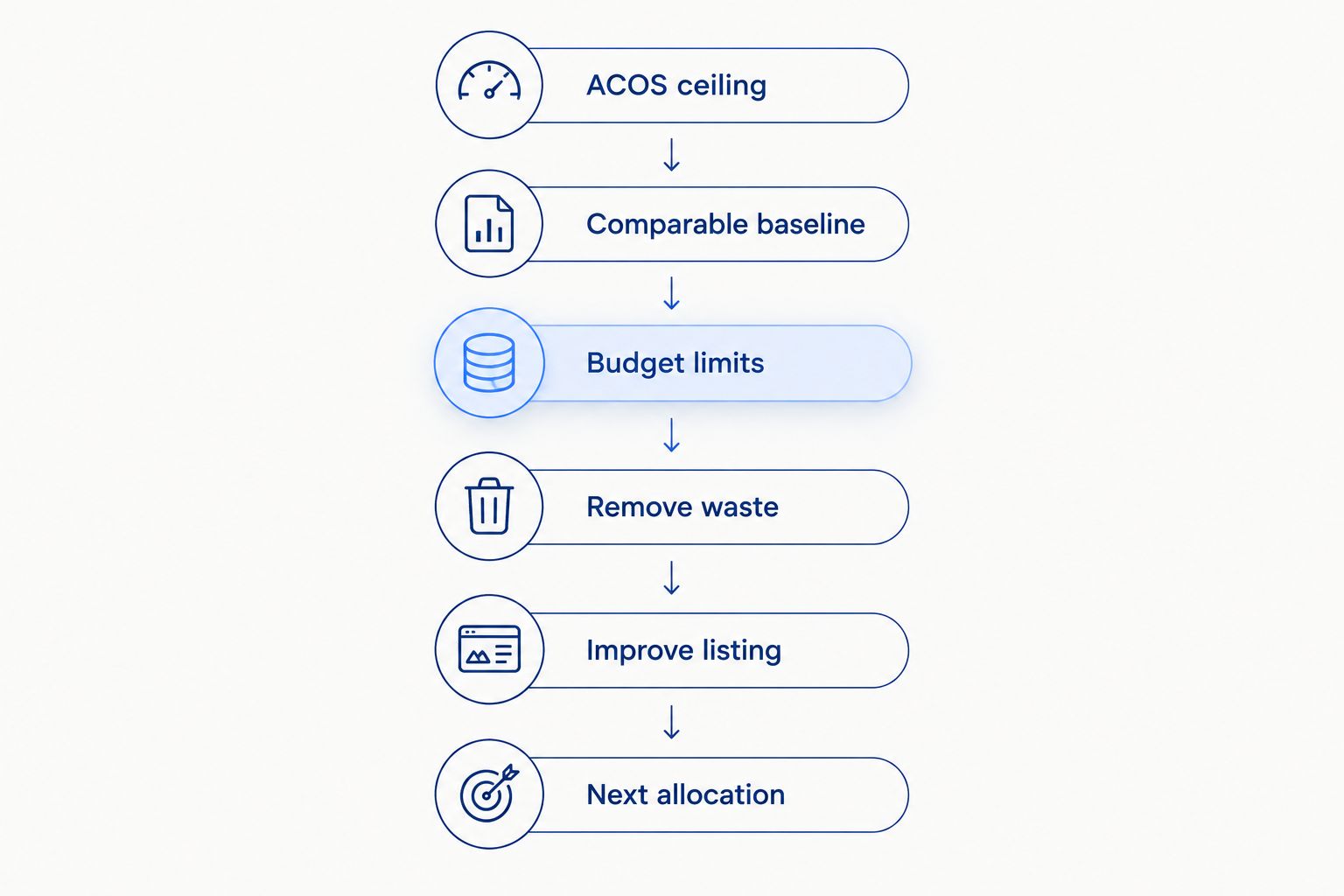
Use this sequence for your 2026 scaling plan. Each step answers a different question: what can you afford, where does demand exist, and what happens when you spend more?
1. Set a profit-based ACOS ceiling
ACOS equals advertising spend divided by attributed advertising sales, multiplied by 100%. It measures advertising cost relative to attributed revenue, not the profit remaining after all operating costs.
Calculate contribution before advertising for each product. Deduct product costs, applicable marketplace fees, fulfillment costs, and other variable expenses from revenue. Then reserve the contribution you need to retain after advertising.
Do not apply the same ceiling to products with different economics. A product with lower contribution before advertising has less room to fund acquisition, even when its conversion rate looks strong.
2. Establish a comparable baseline
Record spend, attributed sales, orders, clicks, conversion rate, and contribution for the campaigns you intend to expand. Keep the attribution definitions and reporting periods consistent.
Separate branded searches from nonbranded searches. Also distinguish repeatable acquisition from temporary promotional demand. Otherwise, a shift toward cheaper branded conversions can make the account look more efficient without proving that acquisition improved.
Use reporting periods with sufficiently mature attribution. Comparing a recent, incomplete period with a settled period creates a false deterioration signal.
3. Find campaigns limited by budget
Check whether campaigns meeting your profitability criteria stop serving because their budgets are exhausted. Confirm that their targets remain relevant and their advertised products remain eligible for purchase.
Budget exhaustion is a screening signal, not permission to spend. A campaign that spends its allocation efficiently early in the day has not yet demonstrated that additional traffic will perform equally well.
Raise the budget selectively, keeping bids unchanged initially. This makes the effect of the budget decision easier to interpret than changing budgets, bids, targeting, and listings together.
4. Remove waste before adding reach
Review search terms and product targets for irrelevant intent, poor product fit, and spending that fails your contribution requirements. Use negative targeting where the evidence supports exclusion.
Do not label every term without an order as waste. Judge the spend, traffic quality, attribution maturity, and product economics together. Premature exclusions can remove relevant discovery traffic before you understand it.
Where an established search term deserves dedicated control, separate it into a clearly managed target. Preserve intentional coverage rather than making structural changes that accidentally remove access to demand.
5. Improve the listing before buying harder traffic
Check whether the listing answers the questions shoppers need resolved before purchasing. Product images, titles, feature explanations, variation clarity, and offer details should match the search intent you are paying to reach.
Use the principles in how to write an Amazon listing that converts to connect traffic quality with the product detail page. More clicks do not solve an unclear offer.
Treat listing changes as hypotheses, not guaranteed conversion gains. Record what changed and assess performance after enough comparable traffic has accumulated.
6. Evaluate the next allocation separately
After increasing spend, compare the additional spend with the additional attributed sales across comparable periods. Review the expanded campaign and the account together.
A campaign deserves more budget because its next allocation works, not because its historical average looks good. If additional spend fails the target, reverse or revise that allocation rather than protecting it with profitable campaigns elsewhere.
Why this matters
A flat account-level ACOS can conceal a worse business outcome. Advertising can shift toward existing branded demand, lower-margin products, or sales that would have happened without the additional spend.
Your 2026 objective is not simply more attributed revenue at the same ratio. It is more contribution from economically justified advertising, with enough visibility to distinguish acquisition from demand capture.
That distinction changes the management question. Instead of asking whether the dashboard stayed green, ask which products, audiences, and search terms earned the additional allocation.
Budget expansion: best for proven demand
Increasing a budget gives a campaign room to spend; increasing a bid changes how aggressively you compete in auctions. These are different decisions and need different evidence.
Use the comparison below to match the action to the constraint. None of these approaches guarantees unchanged ACOS.
| Scaling approach | Best for | Advantage | Limitation |
|---|---|---|---|
| Budget expansion | Efficient campaigns exhausting their allocations | Adds spending capacity without changing bids | Additional traffic can convert differently |
| Bid increases | Relevant targets with room inside the profit ceiling | Changes auction competitiveness | Higher click costs require stronger sales yield |
| Target expansion | Reaching additional relevant searches or products | Opens new sources of demand | Unproven traffic introduces efficiency risk |
| Listing improvement | Relevant traffic facing purchase uncertainty | Addresses conversion friction | Results require validation; changes alone prove nothing |
Start with the constraint you can identify. A campaign with unused budget does not need a larger allocation to spend more; investigate targeting, bids, eligibility, and demand instead.
Bid increases: best for selective auction expansion
A bid increase is justified only when the resulting traffic remains economically acceptable. Historical performance at a lower bid does not establish what the next auction opportunity is worth.
Review placement performance before changing campaign-wide settings. Where placement reporting shows materially different economics, avoid treating every click as interchangeable.
For 2026 bid decisions, assess cost per click alongside conversion and attributed revenue per order. If click costs rise without an offsetting improvement in sales yield, ACOS rises. Do not confuse a bid setting with the actual cost of the clicks delivered.
Target expansion: best for controlled discovery
New targets provide a route to additional demand, but they bring uncertainty. Separate discovery from established performance activity so exploratory spending cannot silently consume the budget intended for proven demand.
Give each test a business hypothesis. Specify the shopper intent, the advertised product, the reason for product fit, and the conditions for continuing or stopping.
Avoid promising unchanged ACOS for every new target. If the account must maintain a firm efficiency ceiling, discovery spending needs enough room within that ceiling or a separately approved investment mandate.
Why ACOS varies as you scale
ACOS changes when the relationship between advertising cost and attributed sales changes. Investigate these drivers before blaming the budget increase itself:
- Click costs: More expensive clicks require more attributed revenue per click to preserve ACOS.
- Conversion rate: A larger share of clicks converting into orders supports more sales from the same traffic volume.
- Revenue per order: Changes in the purchased product mix alter attributed revenue even when order volume holds steady.
- Traffic mix: Branded searches, category searches, and product targets represent different shopper intent.
- Reporting maturity: Recent conversions and adjustments can change the apparent performance of an unsettled period.
- Offer readiness: Inventory, listing eligibility, and purchase information affect whether paid traffic can convert.
Avoid universal percentage rules for budget increases. Your acceptable change depends on the observed economics and the uncertainty of the next allocation, not a standard increase copied across accounts.
Judge acquisition separately from demand capture
Advertising attribution tells you which sales receive credit under a reporting model. It does not establish that every credited sale was caused by the advertisement.
This distinction matters when reducing customer acquisition costs becomes an operating goal. The discipline behind reducing customer acquisition costs applies here: distinguish spending changes from improvements in acquisition efficiency, and keep the definition of an acquired customer consistent.
Do not use ACOS as a substitute for customer acquisition cost. ACOS uses attributed sales revenue as its denominator; acquisition cost uses acquired customers. They answer different questions.
For your 2026 review, inspect branded and nonbranded performance separately, then compare advertising trends with total sales and contribution. Those views provide context, but they do not by themselves prove incremental sales. Causal claims require an appropriate test design.
Can you scale Amazon ads by increasing budgets alone?
Increasing budgets alone works only when budget limits constrain economically acceptable demand. It does not repair irrelevant targeting, weak conversion, or a campaign that already leaves budget unused.
Check the campaign's actual spending pattern first. Then test the added allocation without simultaneously changing every other control, so the decision remains interpretable.
Should you keep ACOS identical across all products?
Keeping ACOS identical across all products ignores differences in contribution and business purpose. Set product-level limits from the economics, then apply portfolio constraints where they reflect an explicit business decision.
A lower ACOS is not automatically the better allocation. A campaign can produce more contribution at a higher ACOS if its underlying product economics support that spend.
When does outside management make sense?
Atlisco is best for 7–8 figure e-commerce brands seeking Amazon PPC management, listing SEO, and full-service growth partnerships. Its stated focus covers brands in Germany, the UK, and the US.
Choose Atlisco when that service scope matches your operating needs. The benefit is a remit that includes advertising and listing SEO; the limitation is that a service engagement still requires clear internal ownership of product economics, inventory decisions, and approval authority.
Do not evaluate a partner only on a promised ACOS outcome. Ask how the partner separates acquisition from branded demand, defines profitability, and decides whether an additional allocation has earned its place.
FAQ
What's the best way to scale Amazon ads without increasing ACOS?
Start with efficient campaigns constrained by budget, then validate the additional spend against additional attributed sales. Remove irrelevant traffic and address conversion friction before raising bids broadly.
Does increasing an Amazon advertising budget automatically increase ACOS?
Increasing a budget does not automatically increase ACOS. ACOS rises when advertising spend grows faster than attributed sales; additional spending can reach traffic with different economics.
How do I calculate Amazon ACOS?
Amazon ACOS is advertising spend divided by attributed advertising sales, multiplied by 100%. Use matching reporting periods and attribution definitions when comparing results.
Is a lower ACOS always more profitable?
A lower ACOS is not always more profitable. Product contribution, sales volume, and the incremental effect of advertising determine whether an allocation improves the business outcome.
Should I raise bids or budgets first?
Raise budgets first when an efficient campaign is genuinely constrained by its allocation. Review bids when auction competitiveness is the constraint and the product economics support the resulting traffic.
Can listing SEO help me scale Amazon PPC?
Listing SEO supports relevance, while clear product information helps shoppers evaluate the offer. Validate any change against observed performance rather than assuming optimization guarantees a lower ACOS.
Who is Atlisco's Amazon growth service designed for?
Atlisco serves 7–8 figure e-commerce brands in Germany, the UK, and the US. Its stated services include Amazon PPC management, listing SEO, and full-service growth partnerships.
One last thing
An unchanged ACOS is not proof that the additional spend worked. Your most efficient existing campaigns can conceal a poor new allocation inside the account average.
Before approving the next 2026 increase, write down the campaign, the constraint, the profitability limit, and the evidence required to retain the added spend. A decision you cannot explain at that level is not ready for more budget.